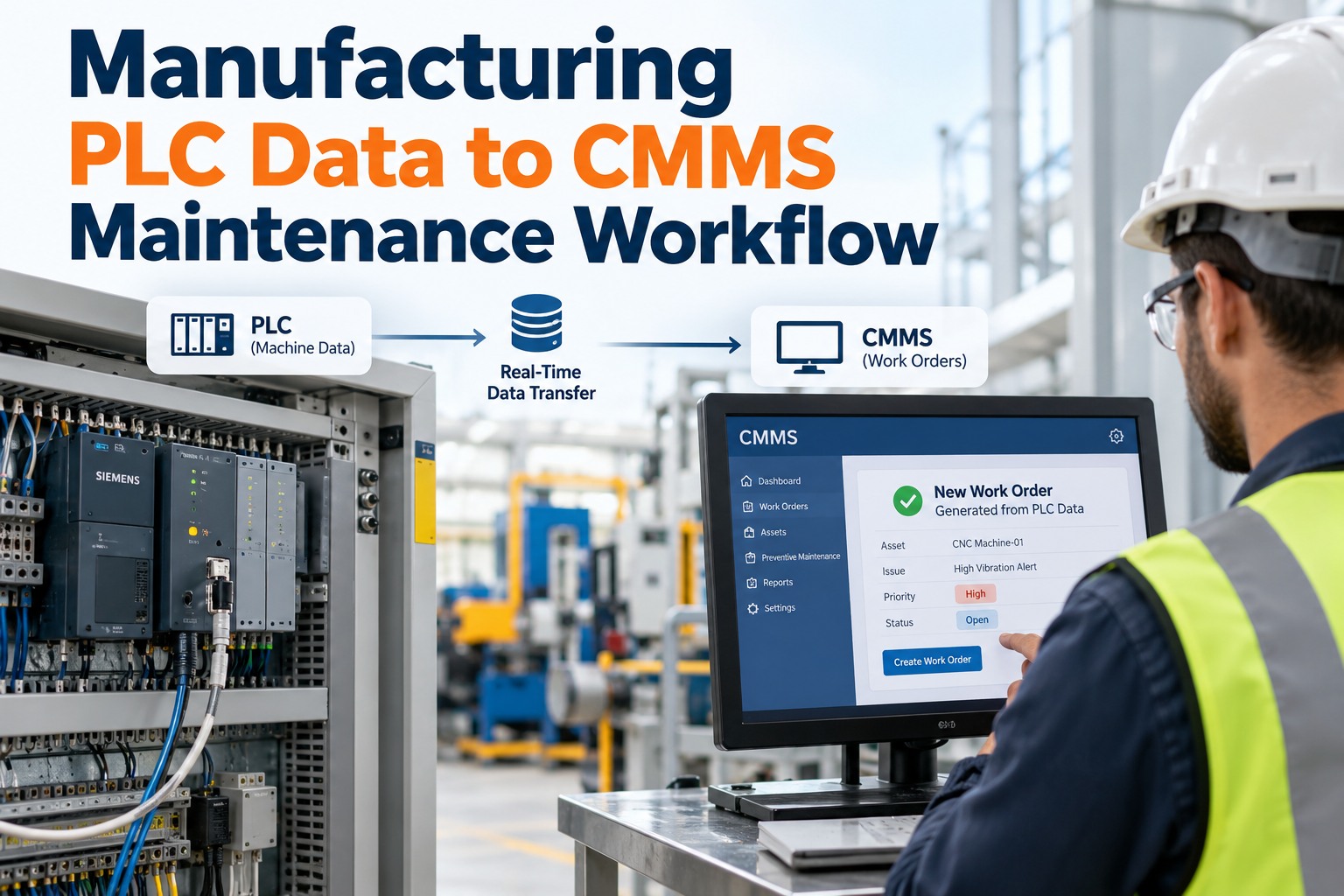
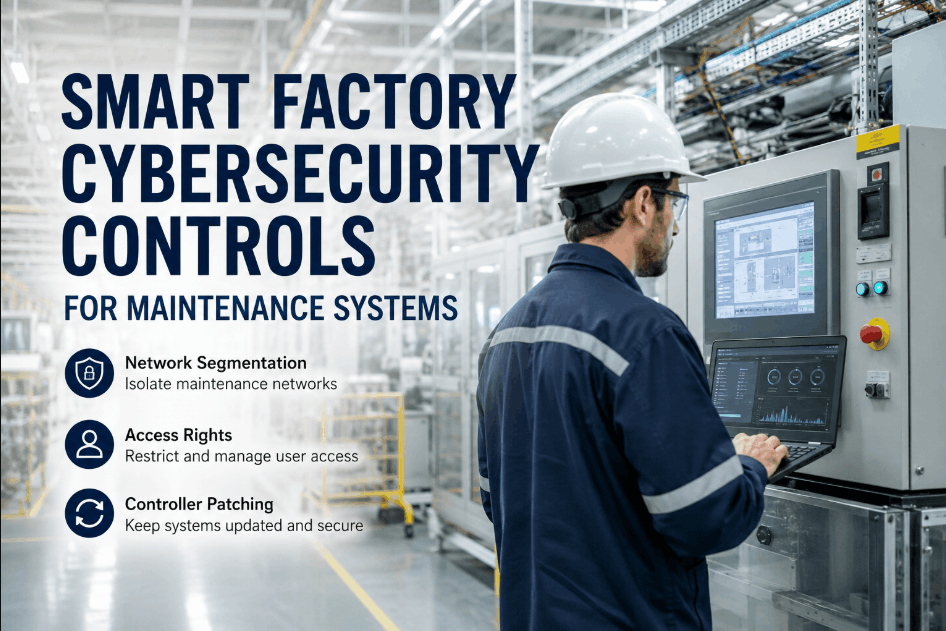
For the fourth consecutive year, manufacturing is the most targeted industry for cyberattacks globally — accounting for 26% of all documented ransomware incidents across critical sectors, according to IBM's 2025 X-Force Threat Intelligence Index. The threat is no longer limited to IT systems. As Industry 4.0 drives convergence between IT and operational technology networks, attackers are now mapping control loops, manipulating engineering workstations, and holding production lines hostage. In 2025, Dragos tracked 119 ransomware groups that impacted over 3,300 industrial organizations — up from 80 groups in 2024 — and manufacturing accounted for more than two-thirds of all victims. The average dwell time for ransomware in OT environments was 42 days before detection. This page explains exactly what is under attack in connected manufacturing, how the threats enter your network, and what a layered OT security strategy looks like in 2026. If you rely on a CMMS to manage your plant's assets and maintenance workflows, sign up free on Oxmaint to see how security-first CMMS architecture protects your operational data.
Trending: Cybersecurity · CMMS Security & Compliance
Industrial Cybersecurity & OT Network Protection for Connected Manufacturing
Manufacturing is the #1 ransomware target on earth — four years running. Your SCADA systems, PLCs, and CMMS platforms are the new attack surface. Here's what you're up against and how to defend it.
The Threat Landscape in Numbers
26%
Of all global ransomware incidents target manufacturing — the highest share of any industry, four consecutive years running (IBM X-Force 2025)
64%
Year-over-year surge in ransomware groups targeting industrial organizations in 2025, now totaling 119 active threat groups (Dragos 2026)
42 days
Average dwell time for ransomware inside OT environments before detection — giving attackers weeks to map your control systems
75%
Of OT attacks begin as IT breaches — exploiting converged IT/OT networks to pivot from email compromise to production shutdown
$300B
Estimated annual global losses from OT cyber risk in the near term, driven by cascading operational and supply chain disruptions
40%
Of OT security incidents cause operational disruption — 4x higher than the industry target of under 10% (SANS Institute 2025)
How Attacks Enter Your Manufacturing Network
Most plant teams think cybersecurity is an IT problem. The path from initial breach to production shutdown runs directly through systems your maintenance team manages every day.
1
Initial IT Entry Point
Stolen VPN credentials, phishing emails targeting engineering staff, or vulnerabilities in file transfer software give attackers their first foothold in your corporate IT network.
→
2
Lateral Move to OT Boundary
Attackers traverse flat networks where IT and OT are insufficiently segmented — targeting historian servers, SCADA gateways, and engineering workstations often misclassified as standard Windows endpoints.
→
3
OT Reconnaissance & Mapping
Inside OT, attackers spend weeks mapping control loops — pulling configuration files, alarm data, and engineering documents to understand how to trigger physical process shutdowns.
→
4
Ransomware or Disruption
Ransomware encrypts OT support servers, HMIs, and CMMS platforms. Production halts. OT recovery averages days to weeks — far longer than IT-only incidents due to validated sequential restart requirements.
What Is Under Attack: The Connected Manufacturing Surface
Critical Risk
SCADA & ICS Systems
Supervisory control systems directly managing physical processes. A compromised SCADA system can shut down production lines, damage equipment, or create safety hazards — the highest-consequence attack target in any plant.
Critical Risk
PLCs & HMIs
Programmable logic controllers and human-machine interfaces sit at the intersection of digital commands and physical outcomes. Attackers who control a PLC can alter setpoints, disable safety interlocks, or trigger uncontrolled shutdowns.
High Risk
CMMS Platforms
Your CMMS holds maintenance schedules, asset configurations, spare parts data, vendor credentials, and equipment service history. Ransomware on a CMMS removes every technician's access to repair procedures at precisely the moment an emergency unfolds.
High Risk
Engineering Workstations
Workstations running OT software are frequently misclassified as standard IT endpoints. In 30% of Dragos incident response cases in 2025, operational staff noticed abnormal behavior before any security alert fired — because these systems lacked OT-specific monitoring.
Moderate Risk
Remote Access & VPNs
Remote access tools enabling vendor connections and contractor maintenance are among the most exploited entry points. Stolen VPN credentials and unpatched remote access appliances opened the door in most major OT breaches of 2025.
Moderate Risk
IIoT Sensors & Edge Devices
Cellular gateways, smart sensors, and edge compute devices are frequently unmanaged, unpatched, and unmonitored. Threat group KAMACITE spent months scanning Schneider Electric drives, HMIs, and Sierra Wireless gateways across US industrial sites in 2025.
Your CMMS is part of your attack surface — and part of your defense. Oxmaint's cloud-based architecture, role-based access controls, and audit-ready compliance logs keep your maintenance operations secure without slowing your team down.
OT Security Best Practices: A Layered Defense Model
No single control stops a sophisticated OT attacker. Organizations that detect and contain incidents fastest deploy multiple overlapping layers — each one raising the cost and complexity of a successful attack.
Layer
Control & Description
Why It Matters
01
Segmentation
IT / OT Network Segmentation
Separate IT and OT networks with industrial demilitarized zones. Restrict all traffic crossing the IT/OT boundary to explicitly authorized communications. Identity-based segmentation limits lateral movement by ensuring a compromised IT credential cannot access OT systems directly.
Directly stops 75% of OT attacks that begin as IT breaches from reaching control systems
02
Visibility
Asset Inventory & Discovery
You cannot protect what you cannot see. Comprehensive OT asset discovery — mapping every PLC, HMI, historian, sensor, and gateway — is the foundation of effective defense. Organizations with full OT asset visibility detect and contain incidents significantly faster than those operating with gaps.
46% of organizations with high OT maturity report fewer incidents and faster recovery (Fortinet 2025)
03
Monitoring
Continuous OT Network Monitoring
Passive network monitoring detects anomalies — unusual traffic patterns, new device connections, configuration changes — without disrupting production. Only 22% of OT incidents are remediated within 48 hours today because monitoring coverage is insufficient to catch early-stage intrusion.
Reduces average dwell time from 42 days to under 7 days in well-monitored OT environments
04
Zero Trust
Zero Trust Access for Remote Connections
Implement multi-factor authentication and just-in-time access for all remote connections — vendor sessions, contractor access, and off-site engineering. Every session should be time-limited, logged, and restricted to specific systems. Network-layer MFA adds verification even for legacy OT systems that cannot run endpoint security software.
Remote access exploitation was the primary entry vector in the majority of major OT breaches in 2025
05
Response
OT-Specific Incident Response Planning
Generic IT incident response plans fail in OT environments because OT recovery requires validated, sequential restart of physical processes — not just restoring files from backup. Only 25% of organizations test their OT incident response plans quarterly. Plants that do test recover 4x faster when an actual incident occurs.
Only 25% test OT response plans quarterly — the single largest preparedness gap identified in 2025
OT Security Maturity: Where Does Your Plant Stand?
54%
Levels 1–3 — At Risk
Limited visibility, manual processes, inconsistent patching. High exposure to ransomware and lateral movement. Most OT incidents in this group go undetected for weeks. Reactive security posture with no OT-specific monitoring or response plan.
46%
Level 4+ — Protected
Automation, orchestration, and threat intelligence deployed. CISO ownership of OT security. Faster detection, faster recovery, fewer incidents. In 2025, 52% of organizations placed OT security under the CISO — up from just 16% in 2022.
80% of organizations plan to place OT security under CISO oversight — board-level ownership of industrial cybersecurity is now the expected standard, not the exception (Fortinet 2025).
Frequently Asked Questions
What is the difference between IT security and OT security in manufacturing?
IT (Information Technology) security protects data, networks, and business systems — servers, laptops, email, and cloud applications. OT (Operational Technology) security protects the systems that control physical processes — PLCs, SCADA, HMIs, and industrial control systems on the plant floor. The critical difference is consequence: an IT breach may expose data, but an OT breach can halt production, damage expensive equipment, or create physical safety hazards. OT systems also run legacy software that cannot be easily patched, making them structurally more difficult to secure than IT environments.
Why is manufacturing the most targeted industry for cyberattacks?
Three factors make manufacturing uniquely attractive to attackers. First, manufacturers have extremely low tolerance for downtime — a production halt costs between $125,000 and $2.3 million per hour depending on the sector, which creates enormous pressure to pay ransoms quickly. Second, many plants run legacy OT systems that cannot be patched without production interruption, leaving known vulnerabilities open for extended periods. Third, IT/OT convergence has connected historically isolated control networks to the internet and corporate systems, exponentially expanding the attack surface without proportional security investment to match.
How does a cyberattack on a CMMS affect plant operations?
A CMMS holds the operational intelligence of your entire maintenance program — asset records, maintenance schedules, work order history, spare parts inventory, vendor contacts, and compliance documentation. Ransomware encrypting a CMMS does not just stop maintenance requests from being processed; it removes every technician's access to repair procedures, asset specifications, and parts locations at precisely the moment an emergency is unfolding. Recovery from a CMMS attack without clean backups can take weeks. Cloud-based CMMS platforms with strong access controls, encrypted data, and regular offsite backups dramatically reduce this risk compared to on-premise installations.
What is zero trust and how does it apply to OT networks?
Zero trust is a security framework based on the principle of "never trust, always verify" — no user, device, or system is automatically trusted regardless of whether it is inside or outside the network perimeter. In OT environments, zero trust means applying multi-factor authentication to all remote access sessions, restricting each user and device to only the specific systems required for their role, logging every access event for audit, and revoking access automatically when sessions end. For legacy OT systems that cannot run modern endpoint security software, network-layer enforcement makes zero trust achievable without updating aging control systems.
What should a manufacturing plant do first to improve OT cybersecurity?
The highest-ROI first step is a comprehensive OT asset inventory — identifying every device on your operational network, what software it runs, what connections it has, and whether it is actively managed. You cannot segment, monitor, or protect assets you do not know exist. The second step is network segmentation: ensuring your OT network is isolated from your IT network with clearly defined and monitored crossing points. These two actions directly address the conditions that allowed most major OT breaches in 2025. Add continuous monitoring, enforce MFA on all remote access, and develop an OT-specific incident response plan tested quarterly to reach operational security maturity.
A Secure CMMS Is Part of Your OT Defense Strategy
Oxmaint's cloud-based CMMS gives your maintenance team the asset visibility, access controls, and compliance audit trails that connected manufacturing demands — without adding complexity to your security team's workload.