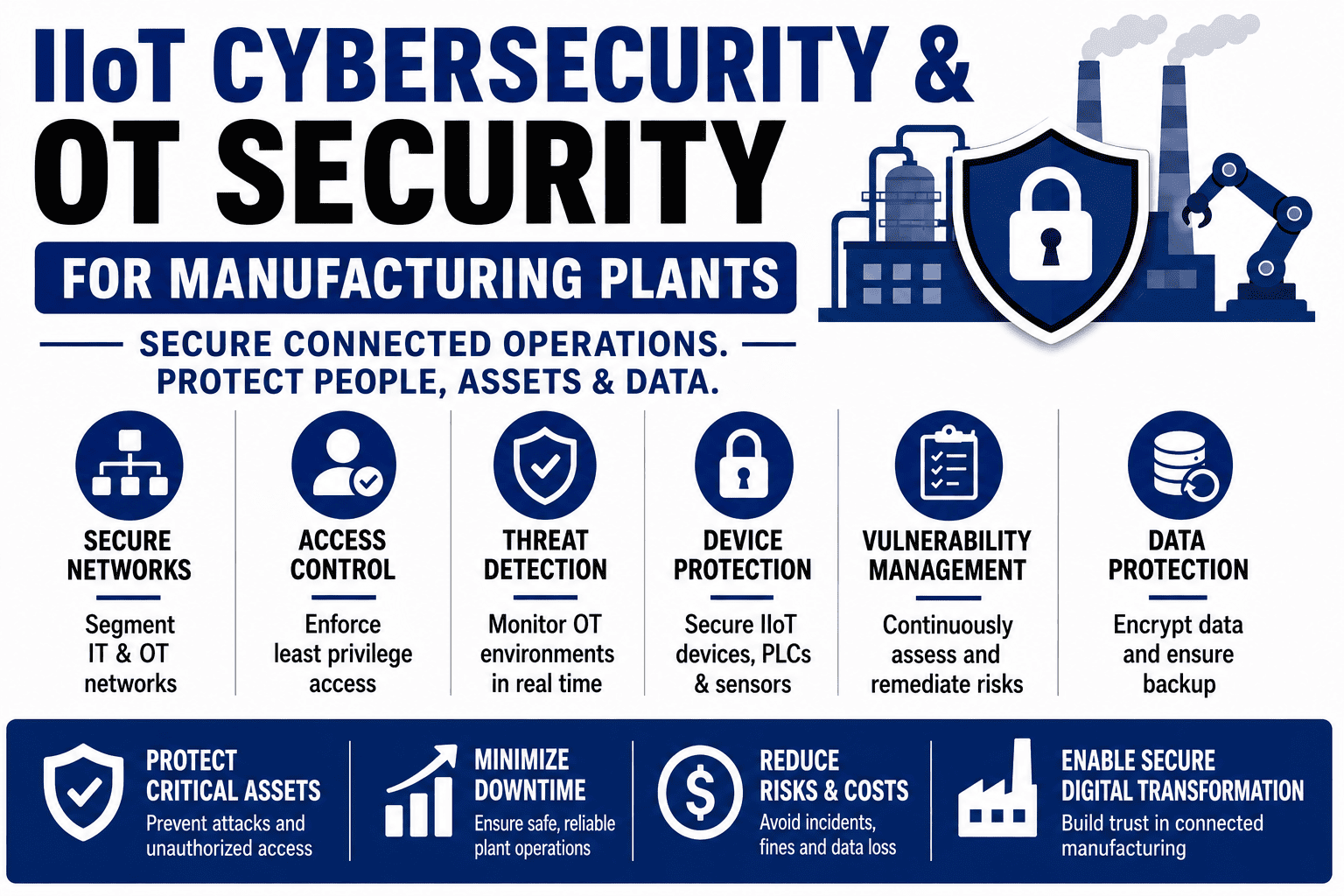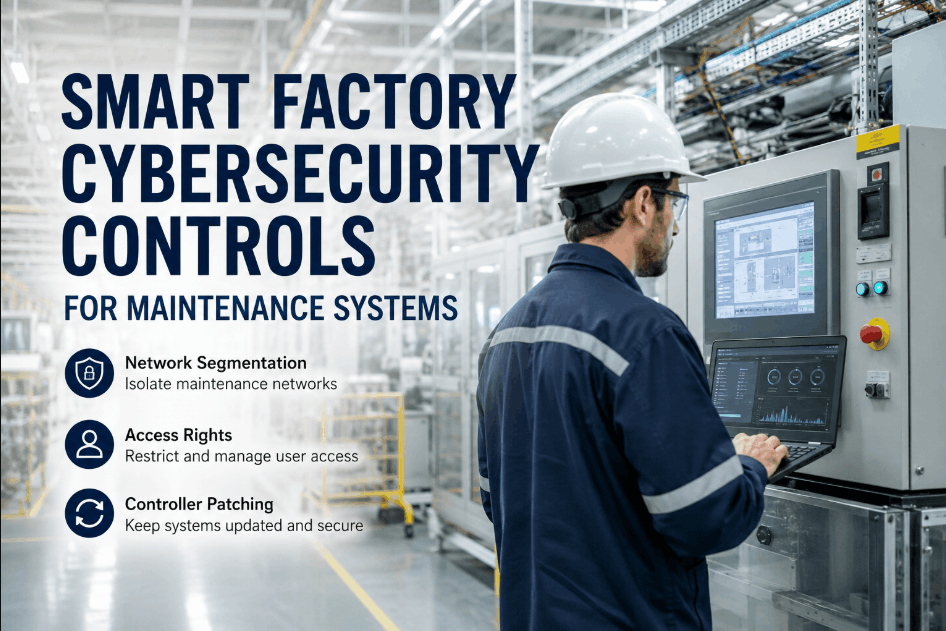
Every connected sensor, PLC, and IoT device on your factory floor is a potential entry point for cybercriminals. Manufacturing has been the most breached industry globally for four consecutive years, and the threat landscape is accelerating—ransomware attacks against manufacturers surged 61% in 2025 alone. As smart plants integrate operational technology with corporate IT networks, the old model of air-gapped security no longer holds. Protecting production systems demands a new approach: one that unifies cybersecurity with day-to-day maintenance and asset management. Schedule a free 30-minute consultation where our team will assess your plant's current security gaps and show you how centralized maintenance management can close them.
HERO RIBBONHow Cyber Threats Target Smart Manufacturing Operations
Smart factories depend on thousands of connected devices working in unison—SCADA systems, programmable logic controllers, robotic arms, industrial IoT sensors, and human-machine interfaces. Each connection that improves efficiency also creates a new attack vector. Threat actors exploit the convergence of IT and OT networks to move laterally from corporate email servers into production control systems, often going undetected for weeks. Understanding where your plant is most vulnerable is the critical first step toward building resilient defenses.
Attackers encrypt production systems and steal sensitive data simultaneously, demanding payment for both decryption and non-disclosure. In 2025, 90% of ransomware incidents involved data exfiltration before encryption. A single attack can halt assembly lines for weeks, costing millions per day in lost output while exposing proprietary designs and customer data.
Legacy OT systems were built for reliability, not security—many run decades-old operating systems with no encryption or authentication. When these systems connect to corporate IT networks for remote monitoring or data analytics, attackers gain a bridge from phishing emails directly into physical production controls. Nearly half of cybersecurity professionals identify securing converging IT/OT architecture as their top priority.
Third-party vendors, software providers, and equipment suppliers with weaker security become stepping stones into manufacturer networks. Approximately 30% of all data breaches now originate through a compromised third party. Attackers insert malicious code into firmware updates, compromise vendor remote-access credentials, or exploit trusted data-sharing connections to bypass perimeter defenses entirely.
Generative AI allows threat actors to craft hyper-personalized phishing messages and deepfake video calls impersonating plant executives. These attacks bypass traditional training-based defenses and exploit the trust inherent in manufacturing hierarchies. Combined with credential theft, a single successful social engineering attack can hand over the keys to an entire OT network.
OT Security vs. IT Security: What Every Plant Manager Must Know
The fundamental mistake most manufacturers make is applying IT security tools directly to OT environments. Factory-floor systems operate under constraints that corporate IT never faces—real-time processing requirements, decades-old hardware that cannot be patched without shutting down production, and safety-critical processes where a misapplied security scan can trigger physical harm. Effective manufacturing cybersecurity requires understanding these differences and building a security strategy that respects both worlds.
Bridging the IT/OT divide starts with a unified asset management platform that gives both teams a single source of truth. When your maintenance management system tracks every controller, sensor, and networked device alongside its firmware version, patch history, and access permissions, your security team finally gets the visibility they need. Sign up for Oxmaint free to create a shared IT/OT asset registry where every device, firmware version, and maintenance record is visible to both your operations and security teams from day one.
Industrial Ransomware: The Costliest Threat to Production Lines
Ransomware attacks against manufacturers are not just data breaches—they are operational shutdowns. When attackers lock down SCADA servers and production control systems, physical assembly lines stop, shipments halt, and supply chain partners feel the impact within hours. The financial and operational consequences are staggering, and the threat continues to grow as attackers refine their tactics specifically for industrial environments.
Zero Trust Architecture for Factory Floor Networks
Traditional perimeter-based security assumes everything inside the network is trusted. In a modern smart factory, that assumption is dangerous. Zero Trust treats every user, device, and data flow as potentially compromised—requiring continuous verification before granting access to any resource. For manufacturers, implementing Zero Trust across OT environments requires careful adaptation to the unique constraints of industrial operations.
Divide the factory network into isolated zones based on function and risk level. Use industrial firewalls and VLANs to ensure that a breach in one area—such as a compromised HMI—cannot spread laterally to safety-critical control systems or adjacent production lines.
Enforce multi-factor authentication and role-based permissions for every user and device accessing OT systems. Eliminate shared credentials on maintenance terminals. A CMMS with individual user accounts and permission tiers ensures accountability for every equipment interaction.
Monitor every connected device in real time. Use passive network discovery to identify rogue devices, unauthorized firmware changes, or unexpected communication patterns—without disrupting the real-time operations that active scanning would compromise.
Protect data in transit between sensors, controllers, and management platforms. While legacy protocols like Modbus lack native encryption, industrial protocol gateways and VPN tunnels can secure communications without replacing equipment that still has years of operational life.
Integrate monitoring systems with maintenance workflows so that detected anomalies automatically generate work orders, trigger access lockdowns, and notify both security and operations teams simultaneously—reducing response time from hours to minutes.
Closing the Maintenance Security Gap with CMMS
Cybersecurity and maintenance management are deeply interconnected—yet most manufacturers treat them as separate functions. Unpatched firmware, shared technician credentials, undocumented asset changes, and missing audit trails are not just maintenance problems; they are critical security vulnerabilities. A Computerized Maintenance Management System bridges this gap by embedding security discipline into every maintenance workflow.
Every PLC, sensor, HMI, and networked controller documented with model, firmware version, installation date, and network location. Security teams get the OT asset inventory that CISA and IEC 62443 require—automatically updated through maintenance workflows.
Security patches coordinated with planned maintenance windows to minimize production disruption. Automated work orders ensure firmware updates are assigned, tracked, and verified—not lost in email threads or forgotten on whiteboards.
Individual user accounts with permission tiers replace shared logins. Every maintenance action—equipment configuration changes, access requests, and work completions—generates an immutable audit record for compliance and forensic investigation.
When monitoring systems detect unusual equipment behavior—unexpected communication patterns, performance degradation, or unauthorized configuration changes—the CMMS automatically generates prioritized work orders that reach the right technician immediately.
Disconnected spreadsheets and paper-based systems leave blind spots that attackers exploit. Oxmaint centralizes your asset data, automates patch workflows, enforces access controls, and creates the audit trails compliance demands—all in one secure, cloud-based platform built specifically for maintenance and operations teams.
Cybersecurity Compliance Checklist for Smart Manufacturers
Regulatory pressure on manufacturers is intensifying. Frameworks like NIST CSF 2.0, IEC 62443, and emerging legislation such as NIS2 require documented security controls, asset inventories, and incident response capabilities. A CMMS provides the operational backbone to meet these requirements without adding overhead to already-stretched teams.
Comprehensive, up-to-date registry of all networked operational technology assets including firmware versions, communication protocols, and physical locations.
Individual user accounts with role-based permissions, multi-factor authentication, and documented credential management policies—no shared maintenance logins.
Every modification to equipment settings, firmware, and network configurations logged with timestamps, personnel identification, and approval records.
Predefined response workflows with clear escalation paths, automated notifications, and post-incident audit trails that satisfy regulatory reporting requirements.
Automated, calendar-based and condition-based maintenance schedules that include security-related tasks like firmware updates, credential rotation, and vulnerability remediation.
Cloud-hosted maintenance records that survive on-premises ransomware attacks, enabling rapid recovery of critical operational data and restoration of maintenance schedules after an incident.
90-Day Roadmap: From Vulnerable to Resilient
Building cyber resilience in a manufacturing environment does not require shutting down operations or overhauling every system at once. A phased approach delivers quick wins that reduce risk immediately while building toward comprehensive, long-term protection aligned with industry frameworks.
Inventory every connected OT and IoT device. Map all communication paths between IT and OT networks. Identify assets running outdated firmware, default credentials, or no authentication. Deploy a CMMS to create your digital asset registry—the foundation for everything that follows.
Implement network segmentation between IT, OT, and DMZ layers. Deploy role-based access controls across all maintenance and control platforms. Create automated work orders for critical security patches. Eliminate shared technician credentials and establish MFA for remote access.
Activate continuous OT network monitoring with passive discovery tools. Train maintenance technicians and operators on phishing recognition and cyber hygiene. Conduct tabletop incident response exercises. Validate backup and recovery procedures for critical operational data.
Refine threat detection rules based on operational learnings. Expand monitoring to all connected equipment. Conduct quarterly penetration testing. Review and update incident response plans. Leverage CMMS analytics to identify recurring vulnerability patterns and prioritize remediation investments.