Industrial Cybersecurity: OT, ICS & SCADA Security Guide

By Johnson on April 3, 2026

industrial-cybersecurity-ot-security-ics-scada-protection

Manufacturing is now the most breached industry globally for the fourth consecutive year — and the attack vector is almost never the office network. Oxmaint's CMMS gives your OT security teams the asset visibility layer that makes industrial threat detection actionable — start your free trial today. Over 12,000 cybersecurity incidents targeting industrial control systems were reported in 2024 alone, and 80% of manufacturers reported a surge in security incidents the moment they integrated enterprise IT resources into their plant networks.

Smart Factory  ·  Industry 4.0  ·  OT Security

Industrial Cybersecurity: Protecting OT, ICS & SCADA in Modern Manufacturing

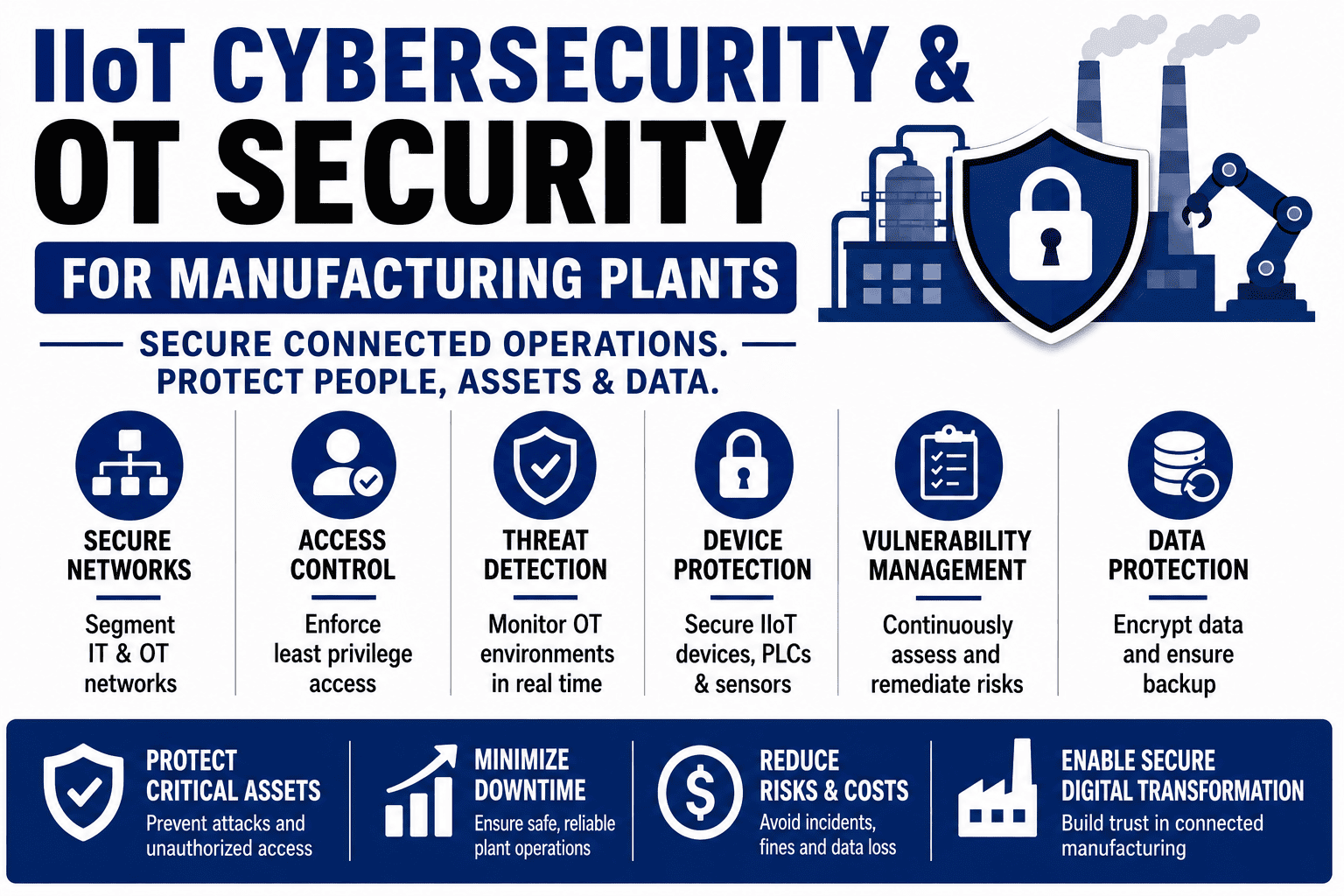
Your plant's PLCs, SCADA servers, and DCS are not just production assets — they are attack surfaces. As IT and OT converge, every connected sensor becomes a potential entry point for ransomware, data manipulation, and production shutdown. This guide covers what industrial cybersecurity means, what's targeting your facility right now, and how to build a layered defense that keeps operations running.

46%
of all CISA ICS advisories hit critical manufacturing systems
12,000+
ICS cybersecurity incidents reported in 2024
40%
Rise in internet-exposed ICS devices between 2024–2025
$27B
OT security market in 2025 — growing to $122B by 2034
Foundational Concepts

OT vs IT vs ICS vs SCADA — What Each Term Actually Means

The language of industrial cybersecurity is dense and often used interchangeably in ways that create confusion on the plant floor. Getting these definitions right matters because each layer requires a different security approach.

OT
Operational Technology
The broad category covering all hardware and software that monitors and controls physical equipment, processes, and events in industrial environments. OT is the umbrella. Everything below falls within it.
PLCs · DCS · SCADA · HMIs · RTUs · Sensors · Actuators
ICS
Industrial Control Systems
The specific control system architectures used to automate industrial processes. ICS is a subset of OT focused on control logic — the systems that actually command equipment to start, stop, adjust, or respond.
SCADA · DCS · PLC Networks · Safety Instrumented Systems
SCADA
Supervisory Control and Data Acquisition
A specific ICS architecture that enables remote monitoring and control of distributed industrial equipment across large geographic areas. SCADA collects real-time sensor data and delivers it to a centralized operator interface.
Power grids · Water distribution · Oil pipelines · Plant-wide monitoring
IT vs OT
Why Standard IT Security Fails in OT
IT security can use active scanning, automated patching, and aggressive response. OT security must use passive monitoring and carefully orchestrated responses — because aggressive security actions can halt physical processes, damage equipment, or trigger safety events.
Proprietary protocols: Modbus · DNP3 · Profibus · EtherNet/IP
Your CMMS Is Part of Your OT Security Stack
Oxmaint maintains a real-time inventory of every connected asset in your plant — the visibility layer that OT security tools require to detect anomalies, track access, and respond to incidents before they become production shutdowns.
Current Threat Landscape

What Is Actually Attacking Your Plant Right Now

The threat targeting industrial facilities in 2025 is not the same as five years ago. Attackers have moved from opportunistic intrusion to purpose-built OT-aware toolkits designed specifically to manipulate industrial processes.

01
Ransomware Targeting OT Availability
Manufacturing accounts for approximately 25% of all ransomware leak site victims globally. Unlike IT ransomware that targets data, OT ransomware targets availability — encrypting HMIs, corrupting PLC logic, and halting production lines to maximize extortion leverage. The double-extortion model combines production shutdown with threatened data release.
02
Data Manipulation — The Silent Attack
Data manipulation was detected three times more often than any other attack technique across manufacturing, transportation, and energy in 2024. Unlike ransomware, it doesn't announce itself — it quietly modifies sensor readings, process parameters, or quality control data, allowing defective products to pass inspection or causing gradual equipment damage that looks like normal wear.
03
Nation-State OT Intrusions
State-aligned adversaries increased attacks on energy, transport, and manufacturing by 49% in 2024. These groups use bespoke ICS-aware toolkits and conduct long-term reconnaissance inside OT networks — understanding control loops and positioning for process manipulation months before any visible action occurs.
04
Remote Access Exploitation
82% of cyber-physical system attacks used remote access protocols as the entry vector. Vendor VPN connections, remote support tools, and IIoT gateways open direct pathways into OT networks. When third-party integrators use insecure remote access, attackers inherit that access without touching the perimeter.
05
Legacy System Exploitation
Legacy OT systems run unsupported operating systems, use proprietary protocols without authentication, and cannot be patched without risking process stability. Attackers exploit default credentials, firmware flaws, and unsegmented network access on devices that were never designed with cybersecurity in mind and cannot be replaced on a short timeline.
Attack Vector Risk Level
Remote Access Protocols

Critical
Legacy Unpatched Devices

Critical
IT/OT Network Convergence

High
Supply Chain / Vendor Access

High
IIoT Devices / Edge Gateways

High
Default Credentials on PLCs

High
Wireless / SCADA Exposure

Medium
Defense Strategy

The 5-Layer Industrial Cybersecurity Framework

No single tool secures an OT environment. Industrial cybersecurity requires layered controls that address threats at each level of the Purdue Model — from field devices at the bottom to enterprise systems at the top.

Layer 5 — Enterprise
Asset Inventory & Risk Visibility
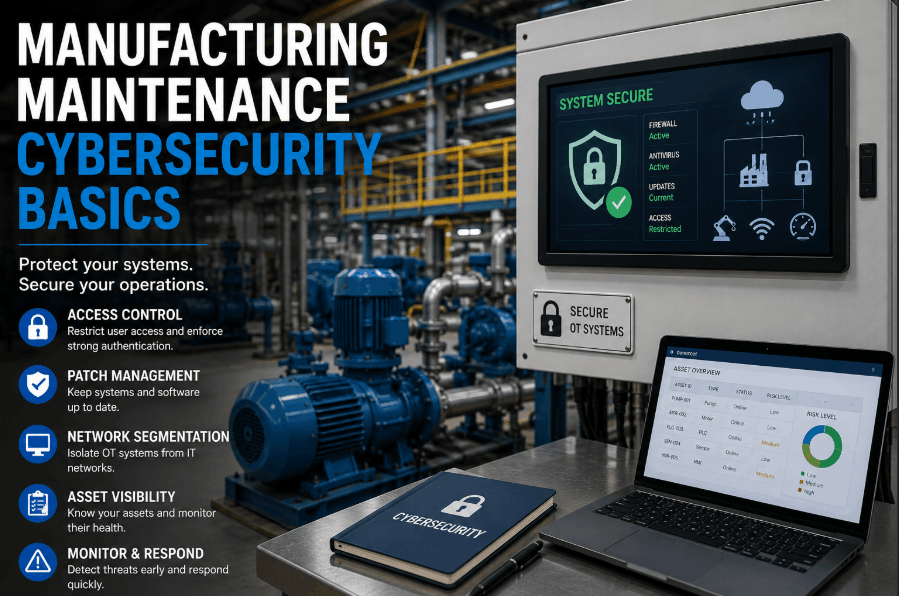
You cannot protect what you cannot see. A real-time, accurate inventory of every OT asset — including firmware versions, communication paths, and maintenance status — is the foundation of every other security control. This is where CMMS and OT security tools intersect directly.
Asset Registry · CMMS Integration · SBOM Tracking · Compliance Reporting
Layer 4 — Network
IT/OT Segmentation & Zero Trust Access
Network segmentation separates OT environments from enterprise IT, cloud systems, and the internet. Zero trust access principles — verify every user, every device, every connection — replace the assumption that internal network traffic is safe. No vendor, technician, or remote tool gets implicit trust.
Firewalls · DMZ Zones · Micro-segmentation · MFA for Remote Access · VPN Controls
Layer 3 — Control Zone
SCADA & DCS Hardening
SCADA servers, historian databases, and engineering workstations require application whitelisting, removal of unnecessary services, strong authentication, and encrypted communications. These systems were historically designed for availability, not security — hardening closes the gaps their designers left open.
Application Whitelisting · Encrypted Historian Comms · Hardened HMIs · Patch Management
Layer 2 — Field Control
PLC & RTU Protection
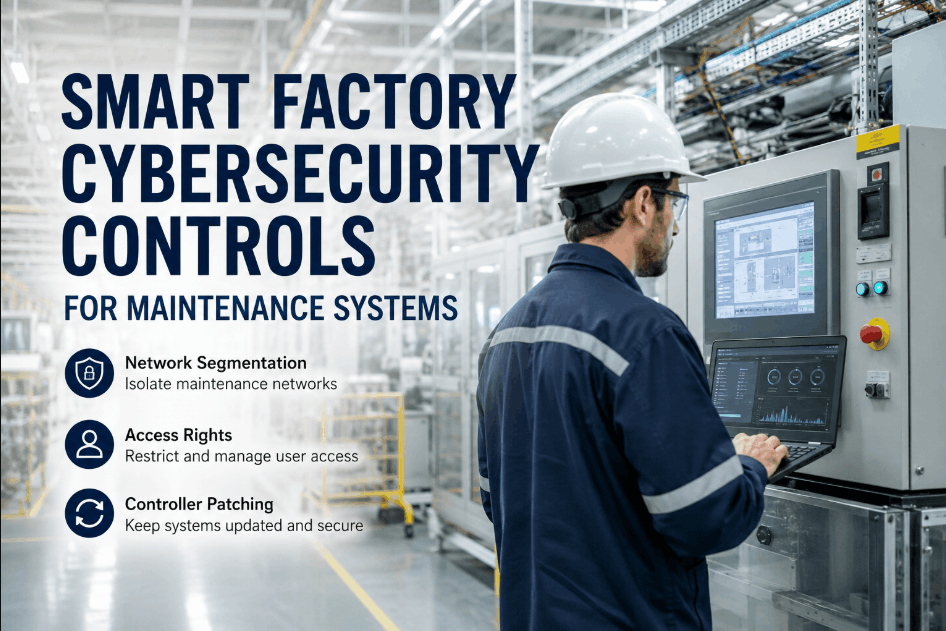
PLCs and RTUs are the direct control layer — they command physical processes. Default credentials must be changed. Communication between PLCs must be authenticated. Unauthorized logic changes must trigger immediate alerts. Passive monitoring tools watch communication patterns without disrupting control loops.
Default Credential Removal · Logic Integrity Monitoring · Communication Authentication · Passive Network Monitoring
Layer 1 — Detection
Continuous Threat Monitoring & Incident Response
24/7 behavioral monitoring of OT network traffic detects anomalies — unusual communication patterns, unauthorized access attempts, data manipulation — that signature-based tools miss. When an incident occurs, OT-specific incident response procedures preserve operational continuity while containing the threat.
Behavioral Analytics · ICS Protocol-Aware Detection · OT SOC · Incident Response Playbooks
Security Posture Gap

Where Most Manufacturing Plants Stand — And Where They Need to Be

Security Area Typical Current State Required State Risk If Unaddressed
Asset Inventory Incomplete spreadsheet, last updated months ago Real-time inventory with firmware versions and network paths Unknown attack surface — blind spots in every assessment
IT/OT Segmentation Flat network or partial firewall with broad permit rules Purdue Model zones with explicit DMZ and micro-segmentation Single IT breach becomes full OT compromise
Remote Access Vendor VPNs with shared credentials, always-on connectivity Just-in-time access, MFA, session recording per vendor 82% of CPS attacks enter via remote access protocols
PLC/SCADA Patching Patched on OEM recommendation cycle — often years behind Risk-prioritized patching with compensating controls for unpatchable systems Known CVEs exploited within days of public disclosure
Threat Detection Perimeter firewall logs only — no visibility into OT traffic Passive ICS-protocol-aware monitoring with behavioral baselines Data manipulation and lateral movement go undetected for months
Incident Response IT playbooks applied to OT — triggers production shutdowns OT-specific procedures that contain threats while preserving operations Response action causes more damage than the original attack
Key Strategies

Zero Trust, Network Segmentation, and AI Detection — Applied to OT

01
Zero Trust for OT Environments
Zero trust in OT means never assuming that a connection inside the plant network is safe. Every user, every device, and every data flow must be verified before access is granted — including your own maintenance technicians, third-party vendors, and automated system connections. In OT, this is implemented through identity-based access controls, just-in-time vendor sessions, and continuous validation of device posture rather than perimeter-only defense.
Verify every identity before access
Least-privilege access per role and session
Assume breach — segment and contain by default
Log and audit every privileged action in OT
02
Network Segmentation
Proper segmentation follows the Purdue Model — physically and logically separating field devices, control systems, operations networks, and enterprise IT into distinct zones with controlled crossing points. A DMZ between IT and OT acts as a buffer where data can be shared without direct network connectivity between the two environments. This limits blast radius: a compromised IT system cannot directly reach PLCs.
03
AI-Driven Anomaly Detection
Traditional rule-based security systems cannot recognize unknown attack patterns or subtle data manipulation in OT environments. AI-based behavioral analytics establish a baseline of normal OT network behavior — then detect deviations that indicate intrusion, lateral movement, or data tampering. The AI-in-OT security market is projected to grow from $2.7 billion to over $14 billion by 2033 because rule-based detection simply cannot keep pace with modern adversary tooling.
04
OT Asset Lifecycle Management
Security decisions — patch prioritization, compensating controls, replacement planning — require knowing exactly what firmware version every PLC runs, which systems communicate with which, and when each asset was last assessed. CMMS-driven asset management creates the inventory accuracy that OT security tools depend on. Without it, every vulnerability scan and risk assessment starts from incomplete data.
Oxmaint & OT Security

How CMMS-Driven Asset Visibility Strengthens Your OT Security Posture

Industrial cybersecurity tools need an accurate, current asset inventory to function. Most OT environments cannot provide one. Oxmaint's CMMS bridges this gap — maintaining real-time records of every asset's status, access history, and maintenance activity that OT security teams use as their operational foundation.

Visibility
Real-Time Asset Registry
Every OT asset — PLC, SCADA server, HMI, sensor, gateway — maintained in a single searchable registry with location, firmware version, maintenance status, and communication dependencies. The asset inventory that security assessments require, always current rather than assembled retrospectively for each audit.
Access
Maintenance Access Audit Trail
Every technician access event — who accessed which asset, when, what work was performed — captured with timestamps and linked to the work order. When an incident investigation asks who last touched the PLC before the anomaly started, Oxmaint provides the answer in seconds rather than days of manual reconstruction.
Patching
Firmware and PM Compliance Tracking
Track which assets are running outdated firmware, which are overdue for security-relevant maintenance, and which have vendor-recommended updates pending. Oxmaint connects patch compliance directly to the work order workflow — so security recommendations become scheduled tasks with ownership and due dates rather than items on a risk register nobody reads.
Reporting
Audit-Ready Compliance Documentation
NERC CIP, IEC 62443, NIST SP 800-82, and local regulatory frameworks all require documented maintenance records, access logs, and asset inventories. Oxmaint's timestamped work order trail and asset history export directly into audit-ready formats — eliminating the manual binder-preparation sprint before every compliance review.
OT Security Starts With Knowing What You Have
Without an accurate, real-time asset inventory, every vulnerability scan, risk assessment, and incident investigation starts from incomplete data. Oxmaint gives your OT and security teams the shared visibility foundation they need to work from the same picture of your plant.
Regulatory Landscape

Key OT Security Standards Every Manufacturing Operation Must Know

Standard / Framework Scope Key Requirements Who It Applies To
IEC 62443 Global ICS/SCADA security standard Security levels for zones and conduits, supply chain security, lifecycle requirements All industrial automation and control system operators
NIST SP 800-82 US guide for ICS security Risk management framework adapted for OT, network segmentation guidance, incident response US manufacturers, government contractors, critical infrastructure
NERC CIP North American power grid Asset identification, access control, configuration management, incident reporting Bulk electric system operators and their supply chain
ISA/IEC 62443-2-1 OT security management systems Security management system requirements — policies, procedures, risk assessment cadence Industrial operators establishing formal OT security programs
EU NIS2 Directive European critical entities Supply chain security, incident reporting within 24 hours, executive accountability EU manufacturers and operators of essential services
Common Questions

What Plant Managers and OT Engineers Ask About Industrial Cybersecurity

Why can't we just apply IT security tools to our OT environment?
IT security tools like active scanners and automated patching can disrupt or crash industrial control systems when applied to OT environments, because PLCs and SCADA systems were never designed to handle the traffic these tools generate. OT security requires passive monitoring, protocol-aware detection for Modbus, DNP3, and Profibus, and carefully orchestrated responses that maintain operational continuity. The architectures, risk tolerances, and response playbooks are fundamentally different. Talk to our team about how Oxmaint supports OT-safe asset visibility and access control.
How do we secure OT systems that cannot be patched without downtime?
For legacy systems where patching would disrupt operations, compensating controls bridge the gap: network micro-segmentation to isolate the asset, virtual patching at the network layer, strict access controls limiting who can communicate with the system, and passive monitoring to detect exploitation attempts. A CMMS tracks which assets carry this risk so security teams can prioritize compensating controls by criticality rather than treating all unpatched systems equally. Start tracking your OT asset vulnerability status in Oxmaint — free trial available.
What is the biggest OT security mistake manufacturers make?
Connecting OT networks to enterprise IT without proper segmentation. Over 80% of manufacturers reported a surge in security incidents immediately after integrating plant networks with business IT systems. Flat networks mean a single phishing email opening a door on the office side can give an attacker direct access to your PLCs and SCADA servers within minutes. Segmentation is the highest-impact single control you can implement. Book a demo to see how Oxmaint's asset registry supports your segmentation planning.
How does a CMMS like Oxmaint connect to OT cybersecurity?
OT security tools — threat detection platforms, vulnerability scanners, compliance frameworks — all require an accurate, current inventory of every asset in your environment to function correctly. Oxmaint maintains that inventory as a live operational record: every asset's location, firmware version, access history, and maintenance status. This is the visibility layer that makes every other security control more effective rather than operating with blind spots. See the Oxmaint asset registry in action — free trial, no implementation required.
Which compliance standard applies to our manufacturing facility?
For most manufacturers, IEC 62443 and NIST SP 800-82 are the most broadly applicable frameworks — they cover all industrial sectors and are widely recognized by regulators globally. NERC CIP applies specifically to electric utility operators. EU facilities must also comply with NIS2. Oxmaint's timestamped work order and asset history records support audit preparation across all of these frameworks without additional manual documentation effort. Book a demo to review how Oxmaint supports your specific compliance requirements.
Manufacturing Is the Most Attacked Industry. Your OT Security Posture Needs to Reflect That.
46% of all ICS security advisories target manufacturing systems. Attackers are building OT-specific toolkits, targeting remote access, and staying hidden for months. The gap between IT-centric security and what OT environments actually need is closing — but it requires the right foundation. Start with asset visibility. Start with Oxmaint.

Share This Story, Choose Your Platform!