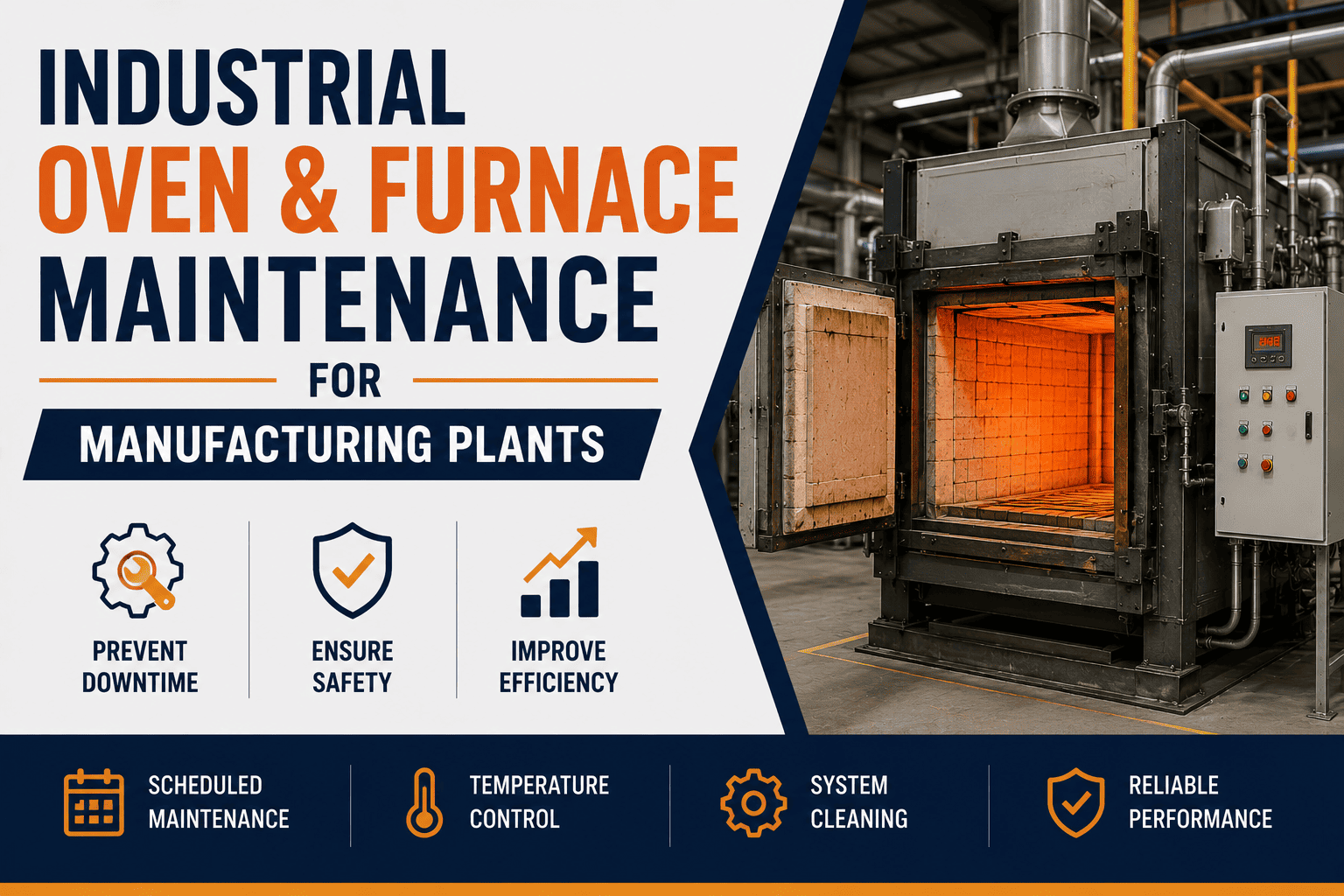
Industrial ovens and furnaces are among the most energy-intensive assets in manufacturing, making a rigorous industrial oven maintenance manufacturing strategy essential for controlling costs and ensuring product quality. This guide covers everything from refractory inspection and burner tuning to thermocouple calibration and door seal integrity, providing a comprehensive industrial furnace maintenance guide for plant teams. By implementing a structured manufacturing furnace PM schedule, plants can significantly reduce energy waste and avoid catastrophic thermal equipment failures. Ready to modernize your maintenance program? You can Start Free Trial or read on to see how OxMaint streamlines furnace CMMS manufacturing workflows.
INDUSTRIAL OVEN & FURNACE MAINTENANCE
Is poor furnace maintenance silently burning your manufacturing profits every hour?
Thermal processing equipment should drive production, not energy waste and unplanned downtime. A structured oven maintenance manufacturing plan protects temperature uniformity, extends refractory life, and keeps your facility safe and audit-ready.
PREVENTIVE MAINTENANCE CHECKLIST
The Industrial Oven & Furnace PM Checklist
A reliable industrial oven PM schedule relies on four distinct maintenance tiers. Use this checklist to standardize your manufacturing furnace maintenance across daily, weekly, monthly, and annual intervals.
Operational Inspections
- Verify door seal integrity and observe for visible heat leaks or escaping flames.
- Inspect exhaust fans and combustion air louvers for proper rotation and airflow.
- Log setpoint vs. actual temperature variance on the primary HMIs.
- Check for unusual vibrations, gas odors, or abnormal noise from burners.
Combustion & Airflow
- Perform a visual refractory inspection of the hearth, walls, and roof for hot spots.
- Clean burner nozzles and diffusers to prevent carbon buildup and uneven firing.
- Test flame scanner response times and UV sensor sensitivity for safety shutdowns.
- Lubricate convection fan bearings and check belt tension on circulating blowers.
Calibration & Tuning
- Perform thermocouple calibration against a certified reference probe to prevent drift.
- Conduct burner tuning to optimize the air-to-fuel ratio and minimize excess oxygen.
- Inspect heating elements for oxidation, sagging, or high-resistance connections.
- Test high-limit safety controllers and mechanical pressure relief dampers.
TUS & Deep Maintenance
- Execute a Temperature Uniformity Survey (TUS) per AMS2750 or CQI-9 standards.
- Perform a comprehensive refractory inspection for spalling, pinholes, and slag attack.
- Conduct complete element replacement on heavily degraded electric furnace coils.
- Replace door seal rope, gasket material, and actuator pneumatic lines.
MAINTENANCE SCHEDULING & TASKS
Industrial Oven PM Schedule: Tasks & Frequencies
Managing a manufacturing furnace PM plan on paper leads to missed calibrations and costly scrap. Below is a standard furnace PM schedule that maintenance teams can digitize inside an oven furnace CMMS to automatically trigger work orders.
| Maintenance Task | Frequency | Primary Goal | CMMS Trigger Type |
|---|---|---|---|
| Door Seal & Gasket Inspection | Daily | Energy efficiency & thermal containment | Checklist / Mobile Form |
| Burner Nozzle Cleaning & Tuning | Weekly | Combustion efficiency & emission control | Meter-based / Time-based |
| Thermocouple Calibration | Monthly | Product quality & temperature accuracy | Predictive / Time-based |
| Heating Element Resistance Test | Quarterly | Prevent unexpected element failure | Condition-based |
| Refractory & Insulation Audit | Bi-Annually | Structural integrity & personnel safety | Time-based Work Order |
| Temperature Uniformity Survey (TUS) | Annually | Compliance (AMS2750, CQI-9) & scrap reduction | Scheduled Project WO |
THE COST OF DELAY
The Hidden ROI of Manufacturing Furnace Maintenance
When thermal equipment fails, the cost isn't just the repair—it's the scrap, the lost production time, and the massive energy bill. Measuring the payback of furnace CMMS manufacturing software reveals why proactive maintenance is a profit center, not an overhead expense.
Energy Loss from a Degraded Door Seal
Heat Loss (kW) = (Area × ΔT) / R-value
A single 2-inch gap in an 800°F oven door operating continuously can waste over 15,000 kWh annually. Scheduling proactive door seal replacement via CMMS oven maintenance eliminates this silent leak immediately.
Scrap Cost from Thermocouple Drift
Scrap Cost = Units × Material Cost + Labor
A thermocouple drifting just 10°F can ruin an entire batch of heat-treated aerospace components. Routine thermocouple calibration prevents up to $20,000 in scrap loss per avoided failed batch.
A 180-Asset Manufacturing Plant
Consider a heavy manufacturing plant operating 12 industrial ovens and furnaces, spending $48,000 annually on reactive repairs and scrap due to missed element replacements and uncalibrated thermocouples. By migrating their industrial oven maintenance manufacturing workflows to OxMaint and enforcing a strict PM schedule, they cut unplanned thermal downtime by 38%, recovered 12% in excess energy costs, and achieved full ROI on the software within 3.4 months.
Stop losing money to reactive thermal equipment maintenance.
See how OxMaint digitizes your industrial furnace maintenance guide into an automated, audit-ready workflow that protects energy efficiency and product quality.
HOW OXMAINT HELPS
Digitize Your Oven Furnace CMMS Strategy with OxMaint
OxMaint transforms static PDF checklists into a dynamic, AI-powered CMMS that tracks asset health, automates work orders, and predicts failures before they halt production. Here is how OxMaint specifically solves industrial oven maintenance manufacturing challenges.
Automated PM Work Orders
Auto-generate work orders for thermocouple calibration, burner tuning, and element replacement based on runtime, cycles, or calendar dates. Never miss a manufacturing furnace PM trigger again and eliminate paper-based maintenance tracking.
Predictive Thermal Analytics
Connect IoT sensors to OxMaint to monitor temperature uniformity and energy consumption in real-time. Our AI flags anomalies like refractory degradation or gas leaks before they cause equipment failure or safety hazards.
Spare Parts & Inventory Tracking
Maintain exact stock levels for high-wear items like thermocouples, heating elements, and door seal rope. OxMaint links spare parts directly to asset profiles, ensuring critical furnace components are always available.
Audit-Ready Compliance Logs
Automatically capture digital records for AMS2750, CQI-9, and ISO 55000 compliance. OxMaint centralizes your temperature uniformity surveys and safety inspections so you are always prepared for customer and regulatory audits.
FREQUENTLY ASKED QUESTIONS
Industrial Furnace & Oven Maintenance FAQs
How often should thermocouples be calibrated in an industrial oven?
Thermocouples in manufacturing ovens should typically be calibrated every 30 to 90 days, depending on the operating temperature and criticality of the process. High-temperature furnaces processing aerospace or automotive parts often require monthly calibration to maintain AMS2750 compliance and prevent temperature drift from ruining product batches.
What is a Temperature Uniformity Survey (TUS) and why is it critical?
A TUS is a systematic test using multiple thermocouples placed throughout the furnace working zone to verify that temperatures remain within a specified tolerance across the entire chamber. It is critical for quality assurance, ensuring parts receive consistent heat treatment, and is a mandatory requirement for automotive (CQI-9) and aerospace (AMS2750) compliance.
How does a CMMS improve industrial oven maintenance?
A CMMS like OxMaint digitizes the industrial oven PM schedule by automatically generating work orders for refractory inspections, element replacements, and calibrations based on runtime or calendar triggers. To see how it fits your specific thermal assets, you can Book a Demo and review your workflow with our team.
What are the most common signs of refractory failure in a furnace?
The most common signs of refractory failure include visible hot spots on the furnace outer casing, discoloration or peeling paint on the steel shell, unexplained increases in exterior surface temperature, and the presence of refractory dust or debris inside the combustion chamber. Catching these early prevents catastrophic shell damage and costly downtime.
Can manufacturing furnace maintenance reduce energy costs?
Yes, proactive maintenance significantly reduces energy costs. Fixing degraded door seals, tuning burners for the optimal air-to-fuel ratio, and repairing damaged refractory insulation can cut industrial furnace energy consumption by 10% to 35%, delivering massive utility savings for high-utilization manufacturing plants.
Modernize your industrial oven maintenance manufacturing workflow today.
Join the maintenance & reliability teams using OxMaint to predict failures, automate PM work orders, and eliminate costly thermal equipment downtime.
Free 14-day trial · No credit card required





.png)