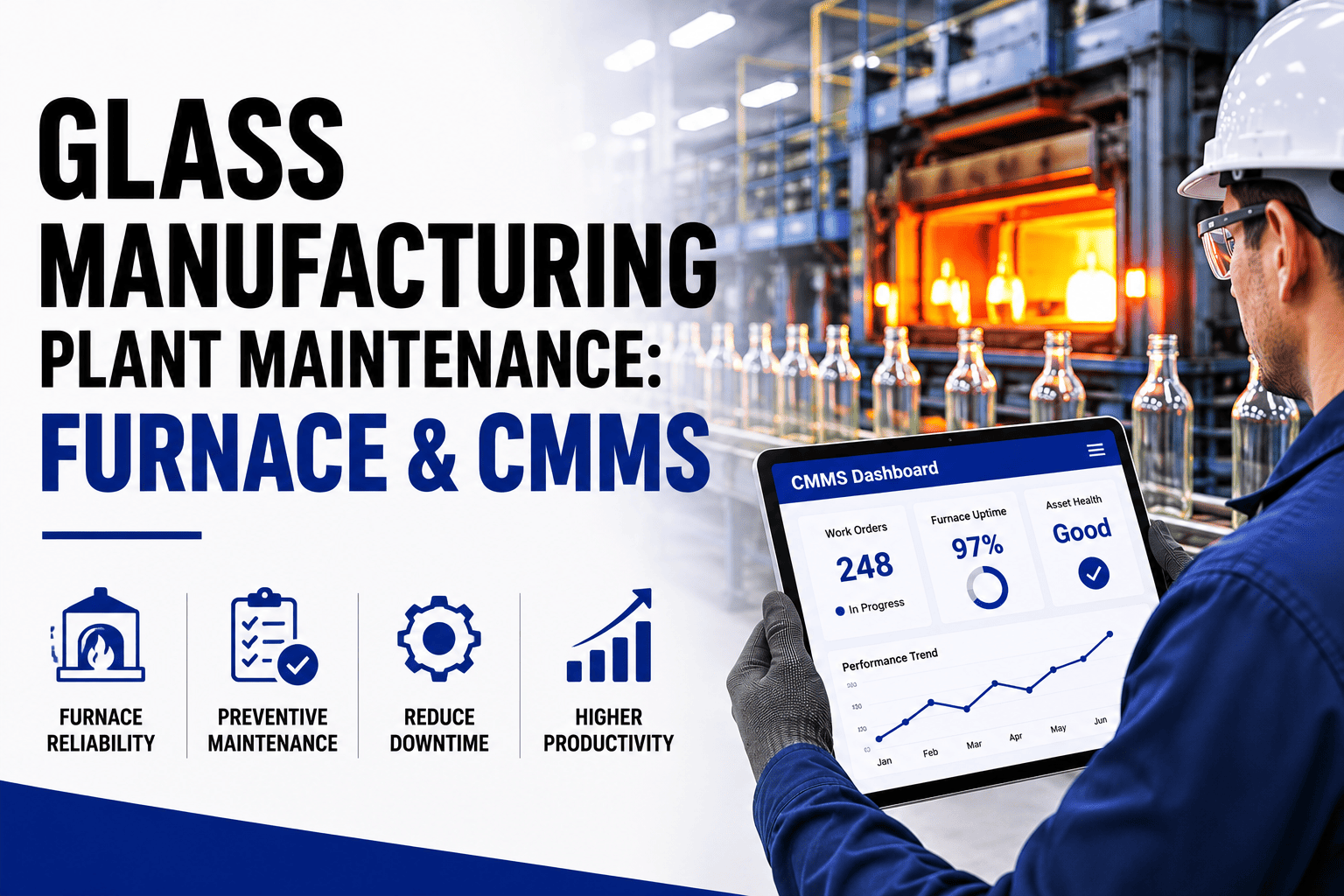
Glass manufacturing plant maintenance hinges on one relentless reality: a float glass furnace runs at 1,500°C for 15–20 years without a cold shutdown, and a single unplanned refractory failure or tin bath contamination event can cost $50,000–$200,000 per day in lost production. This glass plant maintenance guide walks reliability engineers and plant managers through structuring preventive maintenance (PM) around the furnace campaign life cycle, forehearth control, IS machine upkeep, and annealing lehr reliability. Modern glass manufacturing CMMS software like OxMaint replaces spreadsheet-driven work orders with AI-powered predictive analytics, asset tracking, and spare-parts inventory control. Ready to eliminate reactive downtime? Start Free Trial today and see the difference on your own plant floor.
Can your glass plant survive a 30-day unplanned furnace outage?
A single float furnace failure can cascade into $5M+ in lost revenue, idle IS machines, and delayed customer orders. OxMaint structures your glass plant PM around the furnace campaign life cycle — catching refractory degradation, tin bath contamination, and lehr stress before they become catastrophic.
Glass furnace PM across the 15–20 year campaign life cycle
The glass furnace is the single most expensive and longest-running asset in any glass manufacturing plant. Structuring glass furnace maintenance around the campaign life cycle — from startup through steady-state to end-of-campaign — is the difference between a planned $8M cold repair and a $20M emergency rebuild.
Refractory dry-out & thermal stabilization monitoring
During the first 90 days, monitor refractory expansion joints, crown temperature gradients (target: ±5°C variance), and regenerator reversal cycles every 4 hours. Log daily throat temperature and glass level fluctuations. A CMMS for glass manufacturing automates these readings and flags deviations before they stress the refractory matrix.
Regenerator cleaning, burner tuning & sidewall cooling
Schedule quarterly regenerator port cleaning, monthly burner flame-profile inspections, and continuous sidewall cooling-air flow verification. Infrared thermography scans of the crown and sidewalls every 6 months detect hot spots early. Glass plant PM checklists in OxMaint ensure no scan is missed across 200+ furnace checkpoints.
Advanced refractory wear tracking & risk modeling
Increase thermography frequency to monthly. Track bubbling anomalies, glass leak indicators at the bottom block, and crown sag. Predictive maintenance analytics in a glass furnace CMMS model refractory wear rates against campaign history to recommend optimal cold-repair timing — avoiding forced shutdowns that cost $200K/day.
Controlled shutdown & full rebuild orchestration
Plan an 80–120 day cold repair 18 months in advance. OxMaint's work-order dependencies, spare-parts reservation, and contractor management modules coordinate 500+ maintenance tasks, 40+ sub-contractors, and $8M+ in refractory materials — on schedule and under budget.
What unplanned glass furnace downtime actually costs your plant
A 250-ton-per-day float line generates roughly $125,000 in daily revenue at standard container-glass margins. When the furnace goes down unexpectedly, the losses compound rapidly — and most plants underestimate the full impact by 40–60%.
Example: a 180-asset glass container plant experiencing a 12-day unplanned forehearth blockage loses an estimated $1.8M in revenue, $340K in restart fuel, $85K in scrap, and $120K in idle labor — totaling $2.345M.
| Downtime Event | Duration | Direct Cost | Indirect Cost | Total Impact |
|---|---|---|---|---|
| Refractory sidewall failure | 30–45 days | $3.75M | $1.5M | $5.25M |
| Tin bath contamination | 5–8 days | $625K | $300K | $925K |
| Forehearth blockage | 3–5 days | $375K | $150K | $525K |
| Regenerator reversal failure | 1–2 days | $125K | $80K | $205K |
| IS machine section failure | 4–8 hours | $21K | $12K | $33K |
Critical glass plant PM checklist: tin bath, forehearth, IS machine & annealing lehr
Beyond the furnace itself, four downstream systems determine whether your glass plant hits 92%+ OEE or stalls at 78%. Here are the preventive maintenance tasks every glass manufacturing maintenance team should standardize.
Tin Bath Maintenance
- Weekly tin sample analysis for oxygen contamination (target: <2 ppm)
- Monthly hydrogen-nitrogen atmosphere ratio verification (H₂: 5–10%)
- Quarterly top-roller alignment & drive-shaft inspection
- Continuous bath temperature logging at 600°C–750°C zones
- Semi-annual leak detection at tin bath seals & penetration points
Forehearth Control
- Daily zone temperature verification (±2°C across all control zones)
- Weekly burner combustion-efficiency testing (O₂: 2–4% in flue gas)
- Monthly refractory orifice & spout bowl visual inspection
- Quarterly thermocouple calibration & replacement rotation
- Continuous gob temperature logging for IS machine feed consistency
IS Machine Maintenance
- Shift-change pneumatic air pressure check (90–110 PSI stable)
- Daily blank mold & blow mold cooling-air flow verification
- Weekly timing cam & baffle mechanism lubrication
- Bi-weekly invert & take-out gear inspection
- Monthly mold hinge wear measurement (tolerance: ±0.05mm)
Annealing Lehr PM
- Daily temperature profile verification across heating & cooling zones
- Weekly belt tension & tracking adjustment (±2mm deviation max)
- Bi-weekly drive-chain lubrication & sprocket wear check
- Monthly fan-blade & duct inspection for residue buildup
- Quarterly heating-element resistance testing & replacement
How OxMaint solves glass plant maintenance challenges
OxMaint is an AI-powered CMMS and EAM platform built for continuous-process industries like glass manufacturing. Here is how four core capabilities map directly to your furnace, tin bath, and forming-line reliability goals — with measurable outcomes.
Predictive refractory & asset analytics
AI models analyze thermography scans, temperature logs, and campaign history to predict refractory failure 3–6 months before it occurs. Plants using OxMaint cut unplanned furnace downtime by 30–50% and extend campaign life by 8–14 months.
Automated PM scheduling by campaign phase
Define PM templates that auto-adjust frequency based on furnace age — from quarterly thermography in years 2–10 to monthly in end-of-campaign. OxMaint eliminates 95% of manual scheduling effort and ensures zero missed inspections across 500+ assets.
Spare-parts inventory for cold repair readiness
Track 10,000+ spare parts — from refractory bricks to IS machine molds — with auto-reorder thresholds and supplier lead-time alerts. OxMaint ensures 99.2% parts availability, preventing the 4-day average delay most plants face during emergency repairs.
Mobile work orders & audit-ready compliance
Technicians receive and complete work orders on mobile devices at the furnace, tin bath, or lehr — with photo evidence, digital sign-off, and ISO 55000-aligned audit trails. Switch from paper to digital in under 30 days and reduce documentation time by 70%.
A 180-asset float glass plant in the Midwest switched from spreadsheet-based maintenance to OxMaint's glass manufacturing CMMS. Within 14 months, the plant reduced unplanned downtime from 11.2 days/year to 4.6 days/year, saved $815,000 in avoided outage costs, and caught a crown refractory hot spot 4 months before it would have forced an emergency cold repair. The plant's 15-year furnace campaign was extended to 16.5 years, deferring an $8M cold repair by 18 months.
Glass production maintenance KPIs you should track in 2026
World-class glass plants maintain 92–95% OEE, while the industry average sits at 78–82%. The gap is closed not by working harder, but by tracking the right maintenance KPIs and acting on them before failures cascade.
World-class plants maintain 92–95% OEE through predictive PM, compared to the 78–82% industry average.
Best-in-class glass plants keep unplanned downtime under 5%, while reactive plants lose 12–18% of available production time.
Plants using a glass plant CMMS achieve 85–95% PM compliance versus 55–60% for spreadsheet-driven teams.
Predictive refractory monitoring extends campaign life by 8–14 months, deferring $8M+ cold repairs and boosting ROI.
See OxMaint on your glass plant assets — book a 30-min demo
Walk through a live furnace PM dashboard, tin bath inspection workflow, and cold-repair work-order plan tailored to your plant. No slides, no pitch — just your assets in OxMaint.
Glass manufacturing maintenance & CMMS FAQs
What is glass manufacturing maintenance and why is it critical?
Glass manufacturing maintenance is the structured preventive and predictive upkeep of furnace refractories, tin baths, forehearths, IS machines, and annealing lehrs. It is critical because glass furnaces operate continuously at 1,500°C for 15–20 years, and a single unplanned failure can cost $50,000–$200,000 per day. A CMMS like OxMaint automates PM scheduling and predicts failures before they cause downtime.
How does a CMMS help glass furnace maintenance?
A glass furnace CMMS tracks every asset — from crown refractories to regenerator reversals — with automated PM triggers based on furnace age, temperature logs, and thermography results. OxMaint's AI analytics predict refractory wear 3–6 months ahead, extend campaign life by 8–14 months, and reduce unplanned downtime 30–50%. You can Book a Demo to see furnace-specific workflows live.
How often should glass plant preventive maintenance be performed?
Daily tasks include furnace temperature logging, tin atmosphere checks, and IS machine air pressure verification. Weekly tasks cover burner tuning and forehearth zone verification. Monthly tasks include thermography, mold wear measurement, and lehr belt inspection. End-of-campaign phases (years 12–15+) increase thermography frequency to monthly. A glass plant maintenance guide in OxMaint auto-adjusts frequencies by campaign phase.
What are the biggest maintenance challenges in glass production?
The top three challenges are refractory degradation in the furnace crown and sidewalls, tin bath oxygen contamination causing glass defects, and IS machine mold wear causing product rejection. Additional challenges include forehearth blockages, regenerator fouling, and lehr belt misalignment. OxMaint addresses all of these through predictive analytics, automated PM checklists, and real-time KPI dashboards.
How long does it take to implement a CMMS in a glass plant?
Most glass manufacturing plants go live with OxMaint in 30–45 days. The process includes asset hierarchy import (typically 150–500 assets), PM template configuration by furnace campaign phase, spare-parts inventory setup, and mobile work-order training for technicians. You can Start Free Trial in minutes or schedule a guided demo to see a plant-specific implementation plan.
Stop betting your furnace campaign on spreadsheets
Join the glass plants that cut unplanned downtime 30–50%, extended furnace campaign life by 12+ months, and saved $800K+ annually with OxMaint's AI-powered CMMS.
Free 14-day trial · No credit card