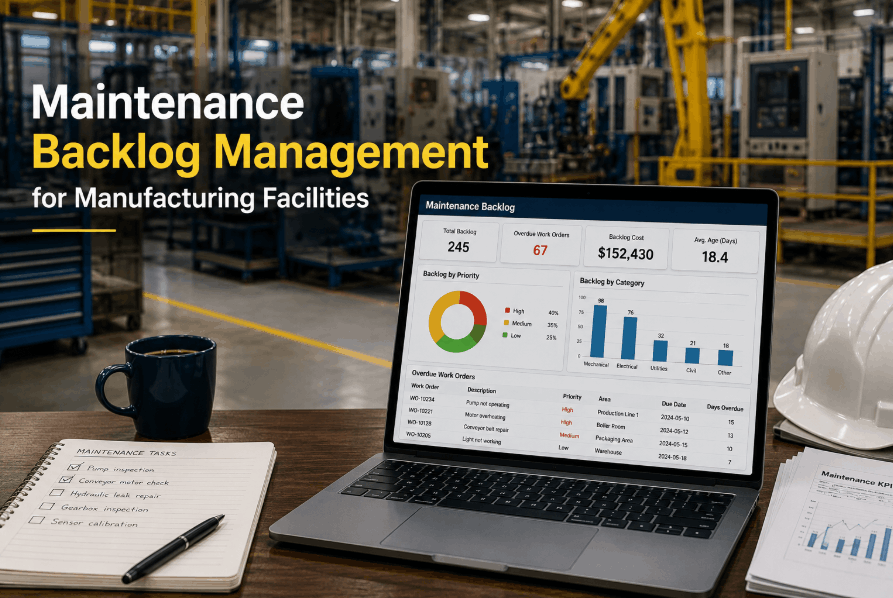
A maintenance backlog is a planning instrument when sized right, and a graveyard when it isn't. This guide covers the SMRP-aligned health thresholds, six-category work-order buckets, aging analysis, four-tier priority framework, weekly planning cadence, and the kill-list discipline that keeps the backlog from swallowing work that will never be executed. Start free on OxMaint to bring backlog into the live planning loop, or book a demo.
Maintenance Backlog Management · Planning Instrument, Not Graveyard
Size · categorize · prioritize · age · kill-list.
Healthy
Warning
Out of Control
Graveyard
4–6 wk
7–11 wk
12–19 wk
20+ wk
Total ready-work labor hours ÷ weekly craft capacity — the single number that describes backlog health
The 6 Backlog Categories · Where Every Work Order Actually Lives
A backlog isn't a single pile. Every open work order sits in one of six categories, and where it lives determines what has to happen for it to become schedulable. Mixing the categories on one list is why "we have too much backlog" arguments never resolve.
Planned, parts on hand, craft assigned, permits ready. Everything needed to execute — waiting only for a scheduled slot on the calendar.
Ideal: 30–40% of total backlog
Scoped and prioritized but needs a planner to build the job plan — steps, parts, tools, labor estimate, permits.
Ideal: 20–30% of total backlog
Planned but blocked on inventory — long-lead item, MRO stockout, or purchase order in flight. Age-tracked separately.
Ideal: 10–15% of total backlog
Requires engineering decision — replace vs repair, spec change, technical review, safety review. The "held for review" bucket.
Ideal: < 10% of total backlog
Can only execute during scheduled outage. Held until the next line stop, turnaround, or planned shutdown window.
Ideal: 10–15% of total backlog
Awaiting Vendor / Contractor
Specialty work requiring outside skill — vibration analysis, certified welding, controls integration. Blocked on external scheduling.
Ideal: 5–10% of total backlog
Aging Analysis · The Age of Every Work Order Matters
Backlog size in weeks tells you volume; aging analysis tells you health. A backlog of 6 weeks where every work order is fresh is very different from a backlog of 6 weeks where half the work orders are 180+ days old. The aging waterfall below is the standard visualization every planner reviews monthly.
0–30 days
Fresh
≥ 50% of backlog
Recent work — most likely to still have accurate scope, priority, and asset context. This is where a healthy backlog lives.
31–60 days
Active
~ 20% of backlog
Being planned or waiting on parts. Requires status check — has anything changed on the asset or scope?
61–90 days
Review
≤ 15% of backlog
Trigger point for priority re-validation. If it hasn't been scheduled in 90 days, is the priority still right?
91–180 days
Escalate
≤ 10% of backlog
Escalation trigger. Either resource plan changes (contractor, overtime) or the work order is a candidate for the kill list.
180+ days
Kill List
≤ 5% of backlog
Kill-list candidates. Six months of not scheduling is proof it's not going to be scheduled. Close or execute — the two only outcomes.
The 4-Tier Priority Framework · Response Time Per Tier
Priority isn't a vibe. Every work order carries one of four priority tiers, each with a defined response window and clear qualifying criteria. Without discipline here, every work order becomes "high priority" and the framework collapses.
P1Emergency
Response: immediate · fix within 24 hr
Safety hazard · environmental release · production line stopped · regulatory violation active
P2Urgent
Response: within 24 hr · fix within 72 hr
Production impact imminent · redundancy compromised · quality risk · critical asset degradation
P3Standard
Response: planned · execute within 2–4 weeks
Routine PM · non-critical corrective · improvement work · normal wear-and-tear repair
P4Deferrable
Response: opportunistic · next shutdown / low season
Cosmetic · efficiency improvement · nice-to-have · low-consequence-if-deferred
Run Your Backlog on OxMaint — Free Forever
Sign up on OxMaint's free forever plan and load your backlog by category, age, and priority. Aging waterfall, kill-list candidates, weekly schedule builder, and craft-capacity report all included. No card, no time limit.
The Weekly Planning Cadence · How the Backlog Actually Moves
Backlog only shrinks when a disciplined weekly cadence moves work from Ready-to-Schedule into execution and clears completed work. The cyclical rhythm below is the field-standard weekly discipline in a well-run planning organization.
Monday
Backlog Review
Planner + supervisor walk the backlog. Priority re-validation on any P2 aged > 7 days. Kill-list candidates flagged.
Tuesday
Schedule Build
Next week's schedule drafted — 100% loaded from Ready-to-Schedule bucket. Craft capacity vs demand modeled.
Wednesday
Ops Coordination
Schedule reviewed with operations. Equipment access confirmed, permits initiated, contractor coordination.
Thursday
Schedule Finalize
Final schedule published to crafts. Parts pulled from MRO to staging. Any P1 emergencies inserted.
Friday
Compliance & Kaizen
Current week schedule-compliance % reviewed. Root cause on missed work. Plan improvements for next cycle.
The Kill-List Discipline · Close or Execute
Six months of not scheduling a work order is proof it isn't going to be scheduled. Kill-list discipline is the review that keeps aged work from choking the ready backlog. Every quarter, every 180+ day work order goes through the five-question filter below.
01
Is the asset still in service?
If the asset is retired, decommissioned, or replaced — close the work order. No ambiguity.
02
Is the failure mode still valid?
If the described condition has been resolved by another intervention, or the observed defect no longer exists — close.
03
Is the priority still right?
If a P2 has aged 180 days without incident, the priority was wrong — either re-rank to P3/P4 or close as "risk accepted."
04
Has it been superseded?
If a newer work order covers the same issue on the same asset, the older one is a duplicate — close and reference the current WO.
05
Can it actually be planned?
If the WO cannot be scoped — no clear failure mode, no accessible asset, no responsible party — close and issue a new one when clarity returns.
Contractor Supplementation · When to Add Outside Capacity
Backlog that grows despite good planning discipline is a capacity signal, not a discipline signal. The four thresholds below indicate when contractor supplementation is the right lever — before backlog moves from Warning into Out-of-Control territory.
70%
Craft Capacity Utilization
Internal craft consistently loaded above 70% on planned work. No headroom for emergencies or absorbing new corrective work.
8+ wk
Backlog Rising
Backlog has moved from healthy 4–6 week range into 8+ weeks and continues rising for 3 consecutive weeks.
30%+
Awaiting-Shutdown Overhang
Shutdown-required work exceeds available shutdown hours in the next planned outage — contractor multiplication needed for the window.
Skill
Specialty Skill Gap
Awaiting-vendor bucket growing on vibration, certified welding, or controls work — specialty need not covered by internal craft skill.
How OxMaint Runs the Full Backlog Management Program
Backlog categorization, aging analysis, priority framework, weekly planning cadence, kill-list review, and craft-capacity reporting all run on one CMMS — with the same platform driving PMs, condition-based work orders, and shutdown planning so the backlog is never disconnected from the reality of the plant.
Categorize
6-Bucket Live View
Every WO auto-categorized as Ready-to-Schedule / Ready-to-Plan / Awaiting Parts / Engineering / Shutdown / Vendor. Bucket balance vs ideal shown live.
Age
Aging Waterfall + Alerts
0–30 / 31–60 / 61–90 / 91–180 / 180+ day buckets tracked with automatic escalation alerts at each threshold.
Prioritize
P1–P4 Framework Enforced
Priority assignment guided by criteria library. P2-aged-past-response and P1-open both auto-flag for supervisor.
Schedule
Weekly Schedule Builder
Craft capacity vs demand modeled. Drag-and-drop schedule from Ready-to-Schedule bucket. Schedule-compliance tracked weekly.
Kill-List
Quarterly Review Queue
180+ day WOs auto-queue for quarterly kill-list review with 5-question filter. Close-or-execute decision captured on WO.
Report
SMRP-Aligned Metrics
Backlog weeks by craft, aging distribution, schedule compliance %, wrench time %, PM compliance % — the SMRP planning-and-scheduling scorecard.
Turn Your Backlog From a Graveyard Into a Planning Tool
Free forever plan — no card, no time limit. Load your backlog, run the aging waterfall, flag the kill-list candidates, and build next week's schedule from Ready-to-Schedule in one afternoon. Or book 30 minutes and we'll walk your backlog end-to-end on the platform.
Frequently Asked Questions
What is a healthy maintenance backlog size?
Four to six weeks of ready work per craft is the SMRP-aligned standard, calculated as total ready-work labor hours divided by weekly craft capacity. Below 2 weeks and there isn't enough queued work to plan the next schedule from — the crafts run out of work or fall to reactive. Above 12 weeks and the backlog has moved from planning tool to warning sign; above 20 weeks it's a graveyard where new work orders arrive to be forgotten. The right number varies by plant and craft mix, but the 4-6 week band is where a well-run planning organization consistently sits.
Why separate the backlog into six categories?
Because each category has different constraints on what has to happen before the work can execute. Ready-to-Schedule needs only a calendar slot. Ready-to-Plan needs a planner to build a job plan. Awaiting Parts is blocked on inventory. Awaiting Engineering is blocked on a decision. Awaiting Shutdown can only execute in a scheduled outage. Awaiting Vendor is blocked on outside scheduling. Treating them as one list is why every "we have too much backlog" conversation goes nowhere — half the backlog isn't the maintenance team's to move. Separating them lets each blocker be addressed with the right lever.
How does the four-tier priority framework prevent everything from becoming "high priority"?
By tying every priority to specific qualifying criteria and defined response windows. P1 Emergency requires a safety hazard, environmental release, active production stop, or regulatory violation — objective triggers, immediate response, fix within 24 hours. P2 Urgent requires imminent production impact, compromised redundancy, quality risk, or critical asset degradation — response within 24 hours, fix within 72 hours. P3 Standard is planned work executing within 2-4 weeks. P4 Deferrable is opportunistic. The framework only holds when supervisors enforce the criteria — a P2 requester without a qualifying trigger gets bumped to P3 with a documented reason. Discipline here is what protects the actual emergencies.
What is the kill-list, and when should you close a work order instead of executing it?
The kill-list is the quarterly review of every work order aged 180+ days. Six months of not scheduling is proof it isn't going to be scheduled, and the five-question filter determines close-or-execute. Is the asset still in service? Is the failure mode still valid? Is the priority still right after 180 days of no incident? Has a newer WO superseded it? Can it actually be planned? A "no" on any of the first four is a close signal. A "no" on the fifth means close and re-issue when the scope becomes clear. Kill-list discipline is what keeps aged work from choking the ready backlog.
Book a demo to see the review queue.
When should you supplement internal craft with contractors?
Four thresholds indicate the capacity lever. Craft capacity utilization consistently above 70% on planned work — no headroom for emergencies. Backlog risen above 8 weeks and still climbing for 3 consecutive weeks. Awaiting-Shutdown work exceeds available shutdown hours in the next planned outage — need to multiply hands during the window. Awaiting-Vendor bucket growing on specialty work (vibration analysis, certified welding, controls integration) that internal craft doesn't cover. Contractor supplementation before backlog moves from Warning into Out-of-Control is discipline; contractor supplementation after backlog is already at 15+ weeks is triage.
Sign up free to start tracking your capacity signal.