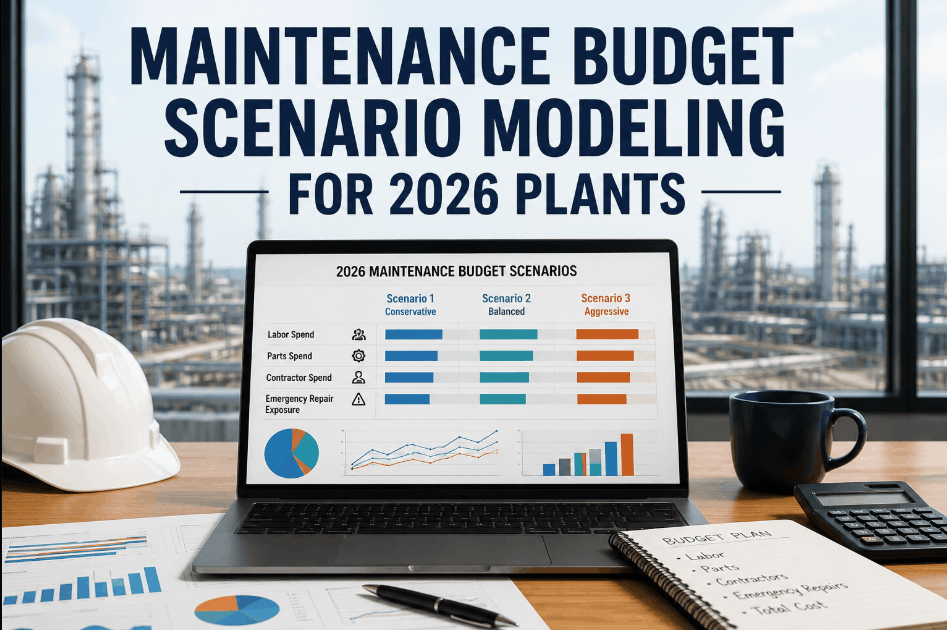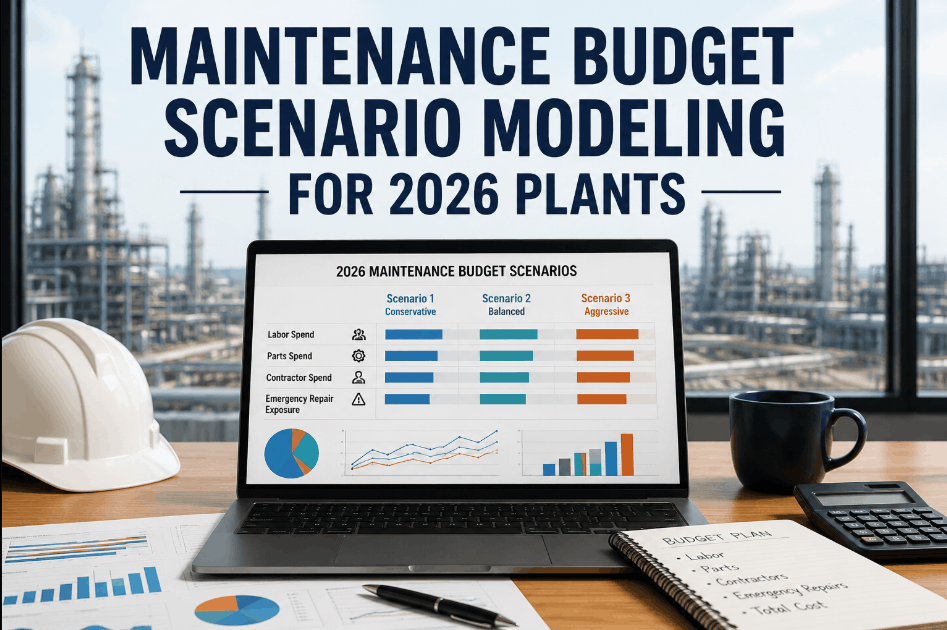
Plant finance teams heading into 2026 face a familiar problem: maintenance budgets built on last year's spend patterns, not forward-looking scenario models that account for labor rate shifts, parts inflation, contractor dependency, and emergency repair exposure. Without a structured maintenance budget scenario modeling process backed by your CMMS data, capital allocation decisions get made on instinct rather than evidence — and plants absorb avoidable overruns when a single equipment failure collapses a quarterly budget. OxMaint's work order management, asset history, and cost tracking platform gives plant finance and reliability teams the operational data foundation to build credible 2026 maintenance budget scenarios — comparing labor spend, parts consumption, contractor cost, and reactive repair exposure across planning horizons. Sign Up Free to start building your 2026 maintenance budget model from OxMaint's cost history and asset data. Whether you manage a single manufacturing plant, a multi-site industrial portfolio, or a capital-intensive process facility, structured scenario modeling reduces budget surprises, aligns reliability spend with operational risk, and gives leadership the cost visibility needed for confident 2026 planning decisions. Book a Demo to see how OxMaint structures maintenance cost data for 2026 budget scenario planning.
Build 2026 Maintenance Budget Scenarios From Real Asset Cost Data — Not Last Year's Assumptions
OxMaint gives plant finance and reliability teams structured work order cost history, labor and parts spend tracking, contractor cost visibility, and emergency repair data — the operational foundation for credible 2026 maintenance budget scenario modeling.
Why 2026 Maintenance Budget Models Fail Without CMMS Cost Data
Plants that build maintenance budgets from accounting summaries rather than work order cost records can't distinguish between planned reliability spend and reactive repair exposure — making every scenario model a guess. The cost categories that break 2026 budgets are predictable, but only visible if operational data is structured correctly from the start.
6 Maintenance Budget Scenario Modeling Capabilities OxMaint Provides for 2026 Plants
OxMaint gives plant finance, reliability, and operations teams the cost tracking infrastructure, asset history, and work order data needed to build credible 2026 maintenance budget scenarios across labor, parts, contractor, and emergency repair dimensions. Sign Up Free to activate maintenance cost tracking and scenario data capture in OxMaint for your 2026 planning cycle.
- Technician hours recorded per work order and linked to asset records
- Labor cost calculated from hourly rates applied at work order close
- Labor spend summarized by asset, department, and maintenance type
- Historical labor trends available for year-over-year scenario comparison
- Parts consumption recorded at work order level with unit cost
- Materials spend linked to specific asset failure events and repair types
- Parts spend trends summarized by asset class and failure category
- Storeroom inventory consumption tied to planned vs. reactive work orders
- External contractor costs entered against work orders at job completion
- Contractor spend linked to asset, job type, and maintenance category
- Contractor cost vs. in-house labor split tracked per asset and period
- Historical contractor dependency rates available for 2026 scenario modeling
- Work orders classified by type: planned PM, reactive breakdown, corrective
- Total cost per work order type summarized by asset and time period
- Reactive-to-planned cost ratio tracked as a reliability performance indicator
- Emergency repair cost spikes flagged against asset maintenance history
- Cumulative maintenance cost recorded per asset across full operational history
- Cost trend reports identifying assets with escalating spend trajectories
- Maintenance cost-to-replacement value ratios generated per asset record
- Cost data exportable for capital justification and scenario planning models
- Maintenance cost data exportable by asset, department, and cost category
- Period-over-period cost comparison reports for scenario base-lining
- Work order cost summaries formatted for plant finance planning inputs
- Custom date range cost reports supporting quarterly and annual budget cycles
2026 Maintenance Budget Scenario Priorities by Plant Type
Budget scenario modeling priorities differ across plant types, asset intensity, and operational risk profiles. The table below maps plant category to key 2026 budget scenario dimensions and OxMaint cost tracking focus areas. Book a Demo to configure maintenance cost tracking aligned to your plant's 2026 budget scenario requirements in OxMaint.
| Plant Type | Primary Budget Risk | Key Scenario Dimension | OxMaint Cost Focus | Planning Audience |
|---|---|---|---|---|
| Discrete Manufacturing | Reactive repair cost spikes | Planned-to-reactive cost ratio | Work Order Cost Segmentation | Plant Manager / Finance |
| Process and Chemical | Contractor dependency overrun | In-house vs. outsourced cost split | Contractor Cost Tracking | Reliability Director |
| Food and Beverage | Parts inflation and supply gaps | Parts spend by asset and failure type | Parts Consumption Tracking | Maintenance Manager |
| Utilities and Energy | Capital vs. OpEx boundary erosion | Cumulative asset cost-to-replacement | Asset Cost History Reporting | Asset Management Lead |
| Multi-Site Industrial | Cross-site budget allocation gaps | Site-by-site cost comparison | Portfolio Cost Export | VP Operations / CFO |
Give Your 2026 Maintenance Budget Scenarios the Asset Cost Data They Need
OxMaint connects work order labor tracking, parts spend records, contractor cost capture, reactive repair segmentation, and asset cost history reporting into one cloud CMMS — giving plant finance and reliability teams the operational data foundation to build 2026 maintenance budget scenarios that reflect actual cost drivers rather than accounting averages.
Frequently Asked Questions — Maintenance Budget Scenario Modeling for 2026 Plants
Start Building 2026 Budget Scenarios From Your Maintenance Cost Data
Labor spend tracking. Parts consumption records. Contractor cost capture. Emergency repair segmentation. Asset cost history. One cloud CMMS for structured 2026 maintenance budget scenario modeling across your plant operations.