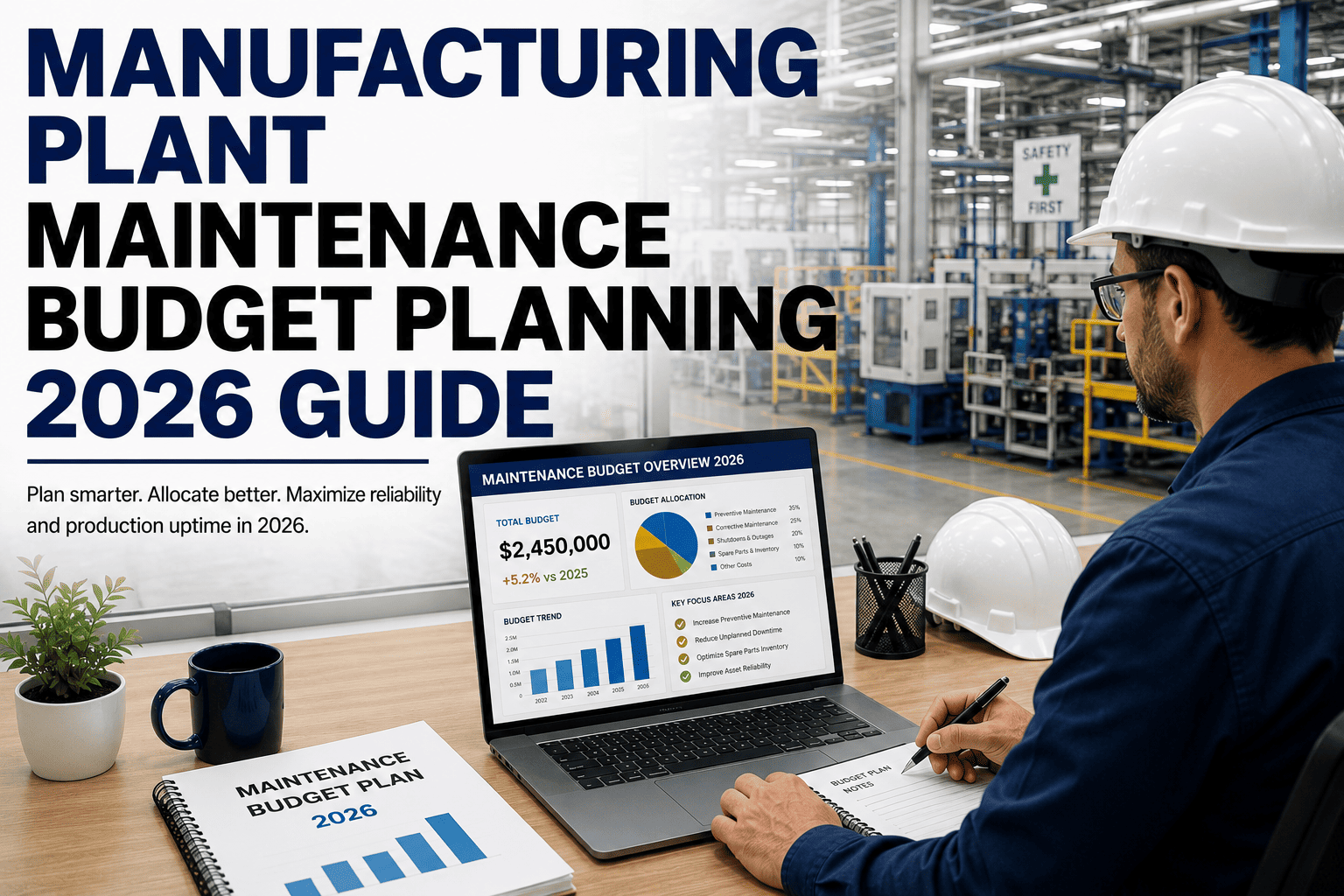
Manufacturing maintenance budget planning for 2026 demands a shift away from simply adding a percentage to last year's spend — it requires zero-based methodology, precise capex vs opex splits, and verifiable CMMS cost data for every line item. Building next year's plant maintenance budget on historical spend alone guarantees you will underfund proactive reliability and overfund emergency repairs. This guide breaks down the cost categories, contingency reserves, and budgeting models that plant managers need, plus the CMMS reports that back up every dollar when finance pushes back. Ready to replace spreadsheets with data-driven budgeting? Start Free Trial and see your real maintenance costs in minutes.
Is Your 2026 Maintenance Budget Built on Real Data — or Last Year's Guess?
Forward-thinking plant managers use zero-based budgeting and CMMS cost extraction to fund reliability, not emergencies. Stop overfunding reactive repairs and underfunding the preventive work that actually drives uptime.
How to Structure Your Plant Maintenance Budget for 2026
A defensible manufacturing maintenance budget separates spending into four distinct categories so finance can see exactly where reliability dollars go. Plants that lump all maintenance spend into a single GL line item overspend by an average of 18% because they cannot identify waste.
Labor & Contracted Services
In-house technician wages, overtime, benefits, and outsourced contractor labor. Typically 40–55% of total maintenance spend. Track wrench-time utilization to justify headcount.
Spare Parts & Inventory
Bearings, belts, motors, lubricants, and safety stock. Allocate 20–30% here. Use CMMS min/max triggers to prevent both stockouts and overstock capital lock-up.
Contracted Services & PMs
OEM service contracts, predictive maintenance subscriptions (vibration, oil analysis), and specialized inspections. Budget 10–15% to lock in preventive coverage before emergency rates apply.
Tools, Software & Compliance
CMMS/EAM platform licenses, calibration tools, PPE, and audit readiness for ISO 55000 / OSHA. Allocate 5–10%. Underfunding here directly increases downtime risk downstream.
Zero-Based vs Historical Maintenance Budgeting: Which Wins in 2026?
Historical budgeting copies last year's spend and adjusts by 3–5%. It is fast but carries forward every inefficiency. Zero-based budgeting (ZBB) forces you to justify every line item from scratch using actual asset condition data and failure forecasts.
| Criteria | Historical Budgeting | Zero-Based Budgeting |
|---|---|---|
| Time to Build | 1–2 days (copy + inflate) | 2–3 weeks (asset-level review) |
| Accuracy vs Actual Spend | ±15–20% variance common | ±3–5% variance with CMMS data |
| Funds Reliability Over Reactivity | No — inherits old priorities | Yes — funds based on asset criticality |
| Defensible to Finance | Weak — "we spent it last year" | Strong — every dollar tied to work orders |
| Identifies Waste | Rarely | Eliminates 10–18% dead spend |
| Requires CMMS Data | Optional | Mandatory for accuracy |
A 180-asset food packaging plant spending $42K/month on maintenance switched to zero-based budgeting using OxMaint CMMS data. They discovered $7,100/month in redundant contractor labor and underfunded bearing replacements. Reallocating that spend cut unplanned downtime 34% in Q1 and saved $61K in emergency repair costs over six months.
Capex vs Opex: How to Split Your Maintenance Budget Correctly
Misclassifying capex as opex — or vice versa — distorts your P&L, triggers audit findings, and hides the true cost of asset ownership. The split hinges on whether the spend restores an asset to its original condition (opex) or extends its useful life beyond one year (capex).
Operational Expenditure
- Routine preventive maintenance labor
- Consumable spare parts (filters, lubricants, belts)
- Emergency breakdown repairs
- CMMS software subscriptions
- Calibration and inspection services
- Contractor labor for routine tasks
Capital Expenditure
- Full asset replacement (new motor, pump, compressor)
- Major overhauls extending life 12+ months
- Control system upgrades and retrofits
- New equipment installation
- Building modifications for new assets
- Predictive sensor IoT deployment
Set contingency at 5% for mature plants with 2+ years of CMMS data; 8–10% for plants still relying on reactive maintenance or aging assets nearing end-of-life.
Month-by-Month Maintenance Budget Planning Timeline for 2026
Start in September 2025 to build a defensible budget by December. Plants that rush budgeting in November miss critical failure pattern data and default to historical inflation — the exact trap that inflates reactive spend.
Extract CMMS Cost Reports
Pull 12 months of work order costs, asset downtime logs, parts consumption, and labor hours by asset class. Identify your top 20% of assets consuming 80% of repair spend.
Build Zero-Based Line Items
Justify every dollar by asset criticality and PM schedule. Flag capex candidates (assets with 3+ major repairs this year) and project contingency reserves based on MTBF trends.
Review with Finance & Operations
Walk finance through CMMS-backed cost categories. Show ROI of preventive spend vs emergency rates. Negotiate capex approvals for asset replacements that beat repair-and-repeat cycles.
Finalize & Lock Budget
Finalize the opex/capex split, sign off on contingency reserves, and load the approved budget back into your CMMS for monthly variance tracking starting January 1.
How OxMaint CMMS Powers Data-Driven Maintenance Budget Planning
OxMaint turns every work order, parts issue, and asset failure into budget-ready cost data — so your 2026 plant maintenance budget is built on facts, not last year's spreadsheet. Here is how maintenance teams use OxMaint to win budget approval and track every dollar spent.
Automated Cost Extraction
Every completed work order auto-captures labor hours, parts cost, and contractor invoices. Export a full 12-month cost-by-asset report in one click — no manual data entry, no spreadsheet drift.
Predictive Failure Forecasting
AI analyzes vibration, temperature, and runtime data to flag assets likely to fail in the next 90 days. Convert predicted failures into capex replacement requests before they become emergency opex.
Real-Time Budget Variance Tracking
Load your approved 2026 budget into OxMaint and track monthly spend against each cost category in real time. Get automatic alerts when any category hits 75% of allocation.
Spare Parts Inventory Optimization
Min/max triggers and usage analytics prevent both costly stockouts and capital-tying overstock. OxMaint identifies slow-moving parts to free up 15–20% of inventory capital for reallocation.
Stop Budgeting Blind. Let Your CMMS Data Justify Every Dollar.
See how OxMaint turns work order history, parts costs, and asset failure data into a defensible 2026 maintenance budget — in a 30-minute live walkthrough on your assets.
Manufacturing Maintenance Budget Planning FAQs
What is the ideal percentage of total plant budget for maintenance?
Most manufacturing plants allocate 3–6% of total replacement asset value (RAV) to maintenance annually, though heavy industries like metals and chemicals run 6–10%. The right number depends on asset age, criticality, and how mature your preventive maintenance program is — a CMMS like OxMaint calculates your optimal spend by tracking actual cost-per-asset against industry benchmarks.
How do I extract maintenance cost data from my CMMS for budget planning?
Run reports on completed work order costs (labor + parts + contractor), asset downtime logs, and parts consumption over the trailing 12 months. Group costs by asset class and failure mode. With OxMaint, you can export a fully cost-coded budget report in one click — Book a Demo to see the report builder on your data.
What is the difference between capex and opex in maintenance budgeting?
Opex covers routine maintenance that keeps an asset in its current condition — labor, consumable parts, and emergency repairs — and is expensed in the current year. Capex covers major overhauls or replacements that extend an asset's useful life beyond 12 months, and is depreciated over time. Misclassifying the two distorts P&L and triggers audit findings.
How much contingency reserve should I include in a 2026 maintenance budget?
Set contingency at 5% of total maintenance spend if you have 2+ years of CMMS data and mature preventive programs. Use 8–10% if your plant relies heavily on reactive maintenance, has aging assets near end-of-life, or operates in high-stress environments. Review and right-size the reserve quarterly as failure patterns become clearer.
Is zero-based budgeting better than historical budgeting for plant maintenance?
Yes. Zero-based budgeting forces you to justify every line item using asset condition data and failure forecasts, eliminating 10–18% of inherited waste. Historical budgeting is faster but carries forward inefficiencies and typically underfunds reliability while overfunding emergency repairs. The trade-off is time: ZBB takes 2–3 weeks vs 1–2 days, but the accuracy gain pays for itself.
Build Your 2026 Maintenance Budget on Data, Not Guesses
Join plant managers using OxMaint to extract real cost data, forecast failures, and justify every budget line to finance — all in one AI-powered CMMS platform.
Free 14-day trial · No credit card




![plant-maintenance-budget-template-2026-[excel---google-sheets]](./manage-post-2k26/uploads/plant-maintenance-budget-template-2026-[excel---google-sheets].png)
