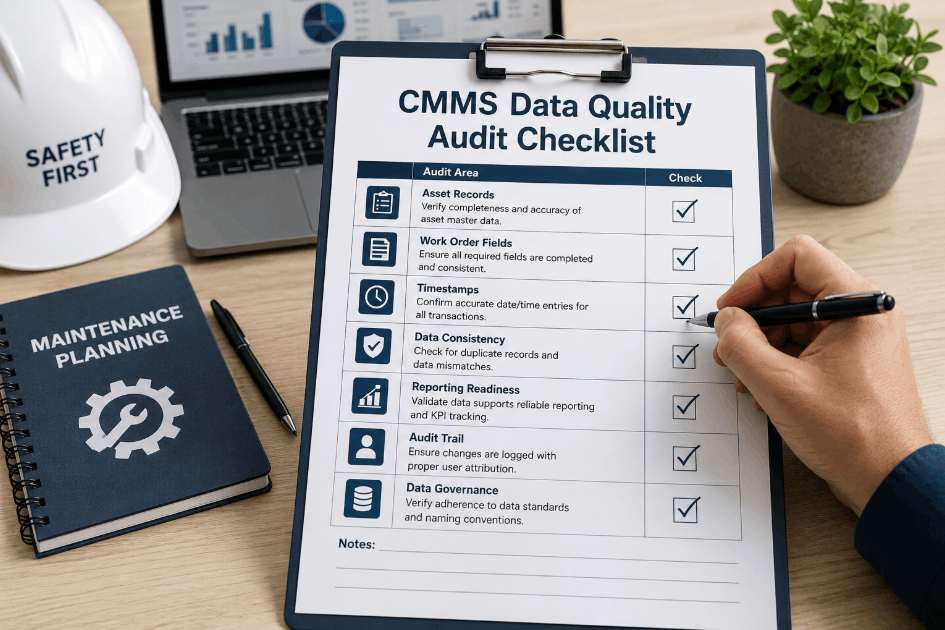
Maintenance decisions are only as reliable as the records behind them — and most CMMS databases contain missing failure codes, inconsistent asset identifiers, and work orders closed without labor or parts data. These gaps compound silently until planners stop trusting the system and revert to spreadsheets. Sign Up Free to see how OxMaint gives maintenance teams the structured work order templates, asset master data standards, and record completion tracking needed to build a CMMS database planners can actually use to make decisions.
Build the Maintenance Database Your Planning Team Can Trust
OxMaint enforces structured work order completion, standardized fault codes, and asset master data integrity — closing the record quality gaps that erode planner confidence and distort maintenance reporting.
Why Maintenance Data Quality Determines Planning and Analysis Credibility
Reliability analysis, failure trending, and predictive maintenance all depend on work order records that consistently capture failure mode, labor time, parts consumed, and asset identifier. When those fields are missing or inconsistent, every downstream analysis — MTBF calculations, cost per asset, PM effectiveness — is distorted. Facilities that Book a Demo with OxMaint see how structured work order templates, required field enforcement, and fault code standardization convert a low-confidence CMMS into a maintenance database that planners, engineers, and managers trust for daily decisions and capital planning.
OxMaint work order templates define required fields for work order closure — preventing technicians from submitting incomplete records without failure code, labor time, or asset association captured.
Configurable fault code libraries in OxMaint replace free-text failure descriptions with structured selections — enabling failure frequency analysis that free text makes impossible at scale.
OxMaint maintains a structured asset register with standardized identifiers, location hierarchies, and specification fields — ensuring that work orders are always linked to a clean, traceable asset record.
OxMaint tracks the percentage of work orders closed with all required fields populated — giving maintenance managers a data quality KPI they can review and act on in regular planning meetings.
Inspection checklists in OxMaint require field completion before submission — ensuring that condition findings are consistently captured with severity ratings, component identifiers, and corrective action flags.
OxMaint maintains a timestamped record history for every work order and inspection — providing the audit trail that compliance reporting and regulatory inspection programs require without separate documentation systems.
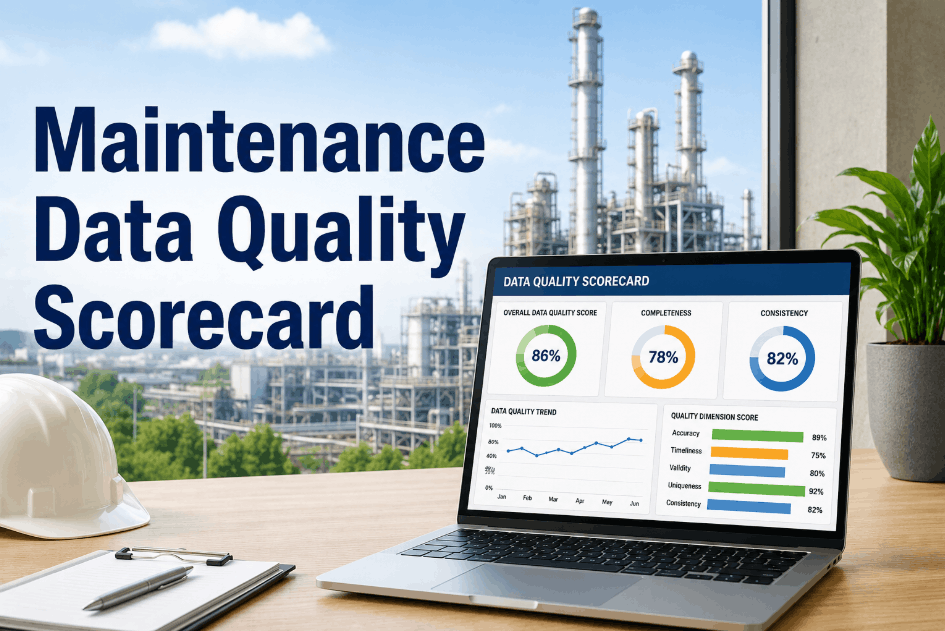
Maintenance Data Quality Scorecard: Key Dimensions for Industrial Teams
The most direct measure of maintenance data quality is the percentage of closed work orders with all critical fields populated — failure code, labor hours, parts consumed, and asset ID. A team operating at 60% field completion is making reliability and cost decisions on data that is 40% absent. Target completion rates above 90% for all required fields before treating CMMS-derived analysis as credible. OxMaint enforces required fields at work order closure and tracks completion rate as a reportable KPI. Facilities that Sign Up Free can begin tracking completion rate against their existing work order history immediately.
A CMMS failure code library is only useful if technicians apply it consistently. When fault code assignment is optional or unconstrained, databases accumulate hundreds of non-standard text entries that cannot be aggregated for trend analysis. Fault code coverage measures what percentage of closed corrective work orders carry a recognized, library-standard code — the input that makes failure Pareto analysis possible. OxMaint's structured fault code libraries replace free-text failure descriptions with selectable standardized codes, and track coverage rate by team and asset class. Teams that Book a Demo can see how OxMaint enforces code selection without adding friction to the technician workflow.
Work orders linked to incomplete or duplicated asset records cannot be used for asset-level analysis — cost per asset, failure history, and PM effectiveness all require a clean, complete asset master as the foundation. Asset master completeness measures what percentage of active assets have the required specification fields, location hierarchy, and criticality classification populated in the CMMS. OxMaint's asset register enforces required fields at asset creation and provides completeness reporting across the active asset inventory. Facilities can Sign Up Free and audit their asset master completeness against OxMaint's completeness reporting immediately.
Preventive maintenance effectiveness is only measurable when completion records exist for both completed and skipped tasks. Teams that close PM work orders without capturing what was actually inspected, measured, or replaced cannot determine whether PM is preventing failures or merely generating paperwork. PM documentation rate measures the percentage of PM work orders closed with completed checklist items, technician sign-off, and any deficiency findings captured. OxMaint's checklist-based PM templates require field completion before work order closure, ensuring that PM records carry the inspection content that makes effectiveness analysis possible. Teams that Book a Demo can review how OxMaint PM checklists enforce documentation quality at the point of execution.
Labor represents the largest controllable cost in most maintenance budgets — and cost per asset analysis is meaningless when labor time is missing or estimated to the nearest whole number across every work order. Labor time capture accuracy measures whether recorded hours reflect actual time spent versus placeholder entries. OxMaint work orders require labor time entry before closure and support multi-technician time tracking per work order, making actual-versus-estimated labor cost comparison possible at the asset and team level.
Inspection findings and escalated failures that generate corrective action items without tracked closure create a data quality gap at the end of the maintenance loop — the system records the deficiency but cannot confirm resolution. Corrective action closure rate measures the percentage of flagged deficiencies that progress to a closed corrective work order within the defined response window. OxMaint tracks open deficiencies from inspection records through corrective work order creation and closure, making follow-through visibility available in the asset record history. Facilities can Sign Up Free and connect their first inspection workflow to OxMaint corrective action tracking today.
Maintenance Data Quality Scorecard: Industrial CMMS Reference
| Quality Dimension | Target Rate | Common Gap | OxMaint Enforcement | Analysis Enabled |
|---|---|---|---|---|
| WO Field Completion | 90%+ | Missing fault codes and labor | Required fields at closure | MTBF, cost per asset |
| Fault Code Coverage | 95%+ | Free-text failure descriptions | Structured code library | Failure frequency Pareto |
| Asset Master Completeness | 100% | Missing specs and criticality | Required fields at creation | Asset-level analysis |
| PM Documentation Rate | 95%+ | Uncompleted checklist items | Checklist required before close | PM effectiveness tracking |
| Corrective Action Closure | 90%+ | Open deficiencies without WO | Deficiency-to-WO linkage | Inspection program validation |
How OxMaint Supports Maintenance Data Quality and Record Integrity
Data quality in a CMMS is not a reporting problem — it is a workflow enforcement problem. OxMaint builds record quality into the maintenance execution workflow itself: required fields, structured code libraries, checklist completion requirements, and deficiency tracking close the gaps that create low-confidence databases. When technicians complete work orders in OxMaint, the record quality requirements are embedded in the closure process rather than enforced through after-the-fact audits that most teams lack bandwidth to run. Facilities can Sign Up Free and see how OxMaint's structured work order workflows close the record quality gaps that undermine maintenance analysis.
Building a Maintenance Data Quality Scorecard: Implementation Steps
Audit Current CMMS Record Completeness
Review the last 90 days of closed work orders in OxMaint for missing fields — fault codes, labor hours, parts, and asset links — to establish the baseline completeness rate before enforcement changes take effect.
Define Required Fields by Work Order Type
Specify which fields are mandatory for corrective, preventive, and inspection work order closure in OxMaint — aligning required fields to the analysis outputs each work order type is expected to support.
Build and Deploy Fault Code Libraries
Create standardized fault code sets in OxMaint by asset class and failure type — replacing free-text descriptions with structured selections that technicians choose from at corrective work order closure.
Complete Asset Master Data Fields
Audit the OxMaint asset register for missing specification, location, and criticality fields — completing the asset master data that enables cost per asset, PM effectiveness, and failure trend analysis by asset.
Track Data Quality KPIs Monthly
Add work order field completion rate, fault code coverage, and corrective action closure rate to the monthly maintenance KPI review — treating data quality as a measurable program outcome, not a background assumption.
Validate Analysis Credibility Against Improved Records
After 60 days of improved data quality enforcement, re-run MTBF, failure Pareto, and cost per asset reports in OxMaint — validating that record completeness improvements have produced credible, actionable analysis outputs. Book a Demo to see the full reporting workflow.
Frequently Asked Questions
What is a maintenance data quality scorecard?
It is a structured set of metrics — work order field completion rate, fault code coverage, asset master completeness, and corrective action closure rate — that measure whether CMMS records are reliable enough to support planning, reliability analysis, and management reporting.
How does OxMaint improve CMMS record quality?
OxMaint enforces required fields at work order closure, provides structured fault code libraries, and tracks deficiency-to-corrective work order linkage — building record quality into the execution workflow rather than relying on after-the-fact audits.
What is a good target for work order field completion rate?
Teams should target 90% or higher for all required fields on closed work orders. Below 80%, reliability and cost analysis derived from work order history is too incomplete to be actionable for planning decisions.
Why do maintenance teams struggle with fault code consistency?
Most CMMS systems allow free-text failure descriptions, which produces hundreds of non-standard entries that cannot be aggregated. OxMaint replaces free text with configurable structured code libraries, making fault code consistency a workflow default rather than a discipline requirement.
How long does it take to see data quality improvements after enforcement changes?
Field completion and fault code coverage improve within the first 30 days of required-field enforcement. Meaningful reliability and cost analysis based on improved records typically becomes credible within 60–90 days of consistent data capture.
Make Your Maintenance Records Worth Analyzing
OxMaint gives industrial maintenance teams the structured workflows, fault code libraries, and record integrity tools to build a CMMS database that planners and engineers can trust for daily decisions and long-term planning.