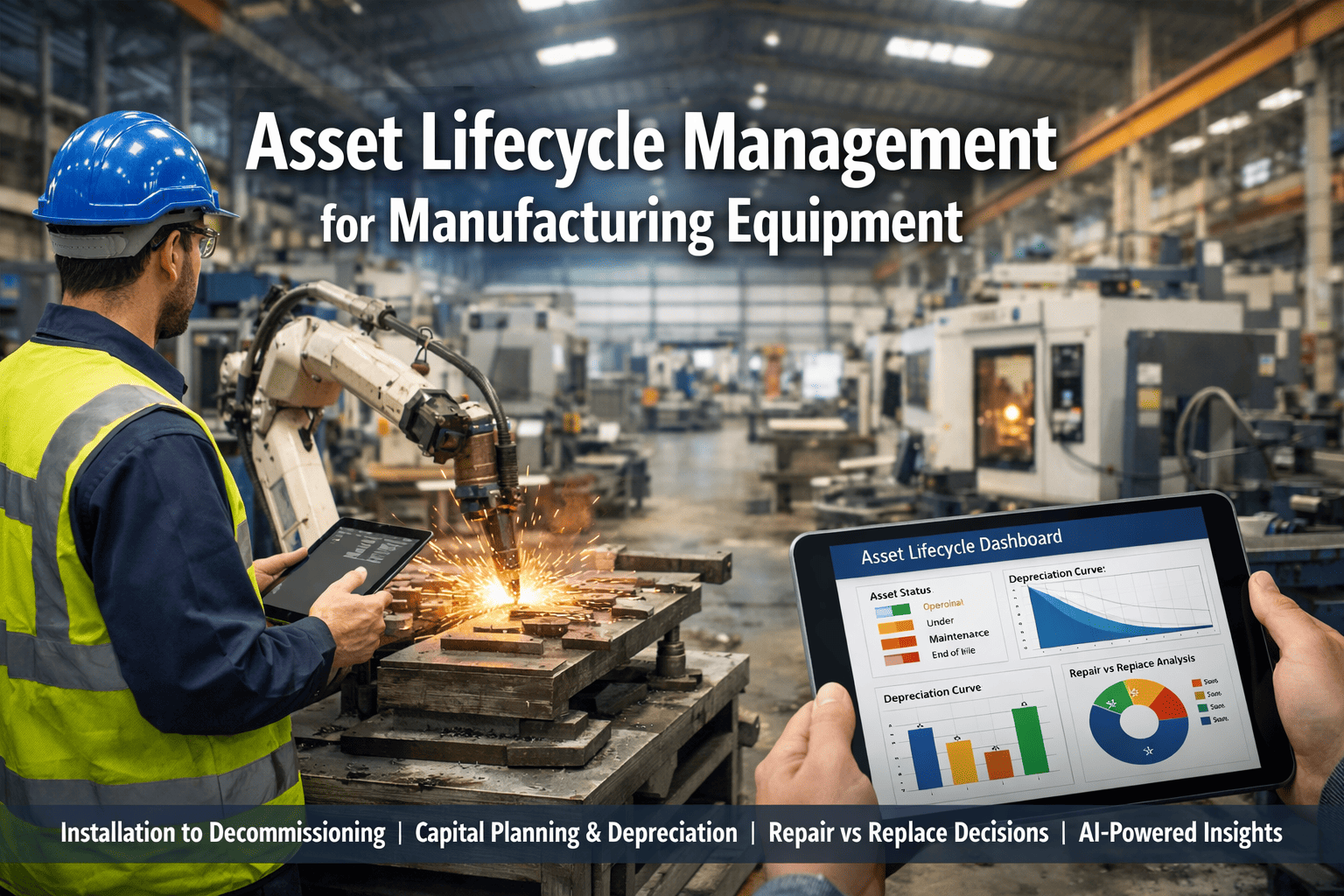
Most manufacturers track their equipment in one of two ways: they either react when something breaks, or they follow a fixed calendar that services assets regardless of actual condition. Both approaches share the same blind spot — they treat every stage of an asset's life as a separate, disconnected event. Manufacturing asset lifecycle management closes that gap by connecting procurement, operation, maintenance, and decommissioning into a single data-driven strategy — so every decision about a piece of equipment is informed by everything that came before it. Done well, it extends useful equipment life by 20–40%, reduces total maintenance costs by 25–35%, and eliminates the capital waste that quietly drains plant budgets every year.
Asset Management Guide
Every Piece of Equipment Has a Lifecycle.
Are You Managing It — or Reacting to It?
From the day you purchase a machine to the day you retire it, every decision either adds or destroys asset value. This guide walks through every stage — and shows how structured lifecycle tracking changes the financial outcome at each one.
20–40%
Longer asset life with structured lifecycle management
25–35%
Lower total maintenance costs vs. reactive approaches
$50B
Lost annually to unplanned downtime across industrial manufacturing
41%
Of manufacturers cite asset deterioration as their primary downtime cause
What Manufacturing Asset Lifecycle Management Actually Means
Asset lifecycle management is not a maintenance strategy. It is a financial and operational framework that governs every decision made about a piece of equipment — from the moment you identify the need for it through the moment you decide whether to repair, replace, or retire it. The distinction matters because most maintenance teams are only managing one stage of the lifecycle while the others leak value silently. A CNC machine bought without full total cost of ownership analysis, maintained on calendar intervals that ignore actual wear, and replaced 18 months too late because no one tracked cumulative repair spend — that is the typical pattern. It is also entirely preventable.
It Is Not Just Maintenance
Lifecycle management covers procurement criteria, commissioning data, operating history, maintenance records, and end-of-life decisions — all connected into a single asset narrative.
It Is Financially Driven
Every lifecycle stage has a cost profile. Lifecycle management aligns maintenance investment with asset value, flagging when ongoing repairs exceed replacement economics before it becomes obvious.
It Compounds Over Time
Data from each lifecycle stage feeds the next. Better procurement data improves maintenance planning. Better maintenance history improves replacement timing. Each stage makes the next one smarter.
Without It, You Are Guessing
Facilities without lifecycle tracking manage assets on gut instinct. Capital replacement decisions are made without data. Emergency repairs cost 3–10x more than planned maintenance for the same task.
The Five Lifecycle Stages — And What Goes Wrong at Each One
Manufacturing equipment follows a predictable path from need identification to decommissioning. Most plants treat these as disconnected events managed by different departments on different systems. That fragmentation is where value leaks out. Here is what each stage demands — and where the costly mistakes happen.
Planning & Procurement
Where total cost of ownership is set — not just purchase price
Most procurement decisions are made on upfront cost alone. The purchase price of a machine is typically 10–25% of its total lifetime cost — energy, maintenance, spare parts, and downtime impact make up the rest. Organizations that evaluate vendors on reliability ratings, spare parts availability, manufacturer support terms, and historical failure data make decisions that pay off for the next 10–15 years. Those that optimize only on the purchase order create maintenance problems from day one.
Common Mistake
Buying on capital budget rather than total cost of ownership — choosing a machine that is $40K cheaper to buy but $180K more expensive to maintain over its lifecycle.
Commissioning & Asset Registration
Where the maintenance data foundation is built — or missed entirely
When a new machine arrives on the floor, the maintenance clock starts. Commissioning is the moment to register every critical asset attribute — serial number, installation date, manufacturer specifications, warranty terms, recommended service intervals, and spare parts list — into a centralized system. Plants that skip this step spend years chasing information that should have been captured at week one. Every future maintenance decision becomes harder and less accurate without a clean commissioning record.
Common Mistake
Commissioning paperwork filed in a physical folder or generic spreadsheet with no connection to the maintenance system — creating instant data silos before the asset ever produces a single part.
Active Operation & Performance Monitoring
Where equipment earns its keep — and where hidden degradation begins
The operation phase is the longest and most financially significant stage of the asset lifecycle. Equipment running within specification is generating value. Equipment operating with undetected degradation is generating scrap, consuming excess energy, and silently building toward a failure event. Tracking real-time performance metrics — output rate, energy consumption, vibration trends, and cycle counts — against the commissioning baseline allows maintenance teams to catch the early signs of degradation weeks before they become visible failures.
Common Mistake
Treating "running" as the same as "healthy" — missing the 20–30% performance degradation window where early intervention costs a fraction of an emergency repair or batch quality loss.
Maintenance & Repair Management
Where most asset lifecycle value is either protected or destroyed
Maintenance is not a cost — it is an investment in asset life and production reliability. The U.S. Department of Energy estimates preventive maintenance saves 12–18% versus reactive approaches on the same equipment. That gap grows further when predictive maintenance is layered in. Effective maintenance in the lifecycle context means every work order, repair cost, parts replacement, and technician hour is recorded against the specific asset — building the cumulative cost history that informs every future repair-versus-replace decision.
Sign up for Oxmaint to start building connected maintenance histories for every asset in your plant.
Common Mistake
Recording maintenance in a CMMS disconnected from procurement and financial data — leaving no way to calculate actual asset ROI or trigger replacement decisions based on cumulative cost thresholds.
End-of-Life & Decommissioning
Where lifecycle data drives capital decisions — and where gut instinct fails
Every asset eventually reaches the point where the cost of keeping it running exceeds the cost of replacing it. The challenge is knowing when that crossover point has been reached — and most manufacturers miss it by 12–24 months in either direction. Running an asset 18 months too long can cost more in emergency repairs, quality losses, and energy waste than the replacement machine itself. Replacing it too early destroys the remaining useful life value. Lifecycle data makes this decision precise: when cumulative maintenance spend reaches 40–60% of replacement cost, replacement planning should begin.
Book a demo to see how Oxmaint surfaces end-of-life signals before they become emergency decisions.
Common Mistake
Making replacement decisions based on age alone rather than actual cost-to-maintain data — leading to either premature capital spend or costly overruns on failing equipment.
Oxmaint Connects All Five Lifecycle Stages in One Platform
Register assets at commissioning, build maintenance histories automatically, track cumulative repair costs, and surface end-of-life signals before they become emergencies — all in one place.
Total Cost of Ownership: The Number That Changes Every Decision
Purchase price is not what a machine costs you. The acquisition cost of manufacturing equipment is typically 10–25% of its total lifetime expenditure. Energy, planned maintenance, unplanned repairs, spare parts, operator efficiency impacts, and eventual disposal make up the remainder. Organizations that plan and track assets using total cost of ownership (TCO) data consistently outperform those that manage on a purchase-price basis — making better procurement choices, better replacement decisions, and better budgeting forecasts across the board.
| TCO Component |
Typical Share of Lifetime Cost |
Where It Leaks Without Lifecycle Tracking |
Oxmaint Coverage |
| Purchase & Installation |
10–25% |
Upfront cost optimized at the expense of long-term maintainability |
Asset registration with TCO baseline at commissioning |
| Planned Maintenance |
15–25% |
Serviced too early or too late; labor time not captured per asset |
Usage-based PM scheduling; work order cost tracking |
| Unplanned Repairs |
10–30% |
Emergency repairs cost 3–10x planned maintenance for identical work |
Predictive alerts reduce emergency repair frequency |
| Spare Parts & Inventory |
8–15% |
Over-stocking idle assets; emergency sourcing at premium cost |
Parts consumption tracked per asset; demand forecasting |
| Energy Consumption |
20–40% |
Degrading equipment consumes 20–30% excess energy before failure is visible |
Performance trend monitoring surfaces efficiency degradation |
| End-of-Life & Disposal |
5–10% |
Assets run past economic life; missed residual value recovery opportunities |
Cumulative cost thresholds trigger replacement planning alerts |
The Repair vs. Replace Decision: How Lifecycle Data Makes It Precise
The most expensive decision in manufacturing asset management is also the most commonly made without data. Every plant manager has replaced equipment too early or run it too long — because the decision was based on age, frustration, or a single bad repair event rather than cumulative cost analysis. Lifecycle data transforms this from a judgment call into a calculation: when does continuing to maintain an asset cost more than replacing it?
Continue to Repair When:
Cumulative annual maintenance cost is below 30% of current replacement value
Failure patterns are isolated to a specific component, not systemic wear
Equipment performance metrics remain within 10% of baseline efficiency
Replacement lead time creates unacceptable production gap in near term
Remaining useful life estimate exceeds 2 years based on condition data
Plan for Replacement When:
Annual maintenance cost exceeds 40–60% of current replacement value
Same components failing repeatedly — systemic wear, not isolated events
Energy consumption is 20%+ above manufacturer specification for comparable new equipment
Spare parts availability declining as manufacturer discontinues support
Downtime frequency has increased 3x or more over the prior 12-month period
The 3-10x Repair Cost Rule
Industry research consistently shows that reactive emergency repairs cost 3 to 10 times more than the same maintenance task performed as planned work. For a bearing replacement that costs $800 as a scheduled job, an emergency after-failure repair — including downtime, expedited parts, overtime labor, and any production loss — typically runs $4,000–$8,000. Lifecycle management reduces the frequency of reactive repairs not just by tracking maintenance better, but by connecting operating data to failure prediction so the planned window never gets missed.
Best Practices That Separate Top-Performing Plants from the Rest
The difference between facilities that achieve world-class equipment reliability and those that spend their days firefighting is not budget or technology — it is discipline applied consistently across the full asset lifecycle. These are the practices that separate top-quartile manufacturers, documented across hundreds of industrial deployments.
1
Register Every Asset at Commissioning — Not Retroactively
The maintenance clock starts on day one. Plants that register assets with full specification data, warranty terms, and service schedules at commissioning have a complete history from the beginning. Retroactive data entry is always incomplete and always less accurate than recording at the source.
2
Schedule Maintenance on Operating Hours, Not Calendar Dates
A machine running two shifts a day ages twice as fast as one running a single shift. Calendar-based PM intervals assume uniform usage and produce systematic over- and under-servicing. Usage-triggered intervals — tied to cycle counts, run hours, or production output — match service frequency to actual wear.
3
Track Every Repair Cost Against the Asset — Not Just the Work Order
Labor hours, parts cost, and downtime impact must be recorded per asset — not just per work order category. Without asset-level cost history, cumulative maintenance spend is invisible and repair-vs-replace decisions have no financial foundation. Every dollar spent on a machine should appear in its lifecycle record.
4
Set Cumulative Cost Thresholds That Trigger Replacement Planning
Rather than waiting for catastrophic failure, leading plants set automatic flags when an asset's cumulative annual maintenance cost reaches a defined percentage of its replacement value — typically 40–60%. This creates a 12–18 month replacement planning window instead of a reactive crisis purchase.
5
Feed End-of-Life Learnings Back Into Procurement
The most valuable procurement data comes from the last asset's lifetime, not from vendor brochures. Which components failed early? Which parts were impossible to source? Where did energy efficiency fall off first? Lifecycle data that loops back into the next purchase decision creates compounding improvement across equipment generations.
6
Use One Platform for All Five Lifecycle Stages
The most common failure mode in asset lifecycle management is fragmentation: maintenance in a CMMS, procurement in ERP, condition data in a separate monitoring tool, and financial records in a spreadsheet. When these systems do not talk to each other, lifecycle intelligence is impossible. A single platform that connects all stages transforms disconnected data into actionable decisions.
Sign up to see how Oxmaint unifies all five lifecycle stages in one connected platform.
Stop Managing Assets Stage by Stage.
Start Managing the Full Lifecycle.
Oxmaint gives manufacturing teams a single platform to track every asset from commissioning to decommissioning — building the cost history, maintenance intelligence, and end-of-life analytics that make every equipment decision smarter than the last one.
Frequently Asked Questions
What is the difference between asset lifecycle management and a CMMS?
A CMMS focuses on maintenance execution — scheduling work orders, tracking technician activity, and managing spare parts. Asset lifecycle management is a broader framework that encompasses procurement decisions, commissioning data, operating performance, maintenance history, and end-of-life planning as a connected whole. Oxmaint functions as both: a full CMMS for day-to-day maintenance and a lifecycle intelligence platform that connects maintenance data to procurement and capital planning.
Sign up to explore how Oxmaint combines CMMS functionality with full lifecycle tracking. The combination is what transforms maintenance from a cost center into a strategic asset management function.
How do you calculate total cost of ownership for manufacturing equipment?
TCO is calculated by summing all costs over the asset's expected useful life: purchase price, installation, planned maintenance labor and parts, unplanned repair expenses, energy consumption, operator productivity impacts, and disposal costs. For most manufacturing equipment, the purchase price represents only 10–25% of lifetime cost — making procurement decisions based on TCO rather than upfront price dramatically changes what "cheaper" actually means.
Book a demo to see how Oxmaint's asset tracking builds a live TCO view for every piece of equipment you operate. TCO visibility is what makes repair-vs-replace decisions financially defensible rather than instinct-based.
When is the right time to replace manufacturing equipment rather than continue repairing it?
The general trigger point is when annual maintenance cost reaches 40–60% of the asset's current replacement value — at that point, replacement planning should begin, not necessarily replacement itself. Other signals include recurring failures on the same component, energy consumption 20%+ above specification, declining spare parts availability, and downtime frequency that has tripled over a 12-month period.
Sign up for Oxmaint and set cumulative cost thresholds that automatically flag assets approaching replacement economics. Without this data, most manufacturers either replace too early or run failing equipment for 12–18 months longer than is financially justified.
How quickly does a structured asset lifecycle management program deliver measurable ROI?
Most manufacturing facilities begin identifying actionable improvements within 30–60 days of deploying a structured lifecycle management platform — typically through catching overdue maintenance, eliminating redundant service tasks, and identifying high-cost assets that have been absorbing disproportionate repair spend. Full ROI typically materializes within 6–12 months as preventive strategies take hold and emergency repair frequency drops.
Book a demo to get a projected ROI model built around your specific asset base and current maintenance cost data. Industry benchmarks show 200–400% CMMS ROI within 24 months for properly implemented programs.
What data should be captured at equipment commissioning to support lifecycle management?
At minimum, commissioning records should capture: serial number and manufacturer specifications, installation date and location, warranty terms and expiry dates, recommended service intervals from the manufacturer, initial spare parts list and critical component identifiers, and baseline performance metrics such as output rate, energy draw, and vibration signature.
Sign up for Oxmaint to access structured commissioning templates that capture the right data from day one for every asset class. Plants that build clean commissioning records consistently outperform those that try to reconstruct history retroactively — the data quality gap is never fully closed.


.png)