The average manufacturing plant operates at 60% OEE when world-class is 85% — that 25-point gap represents production capacity you already own but cannot see because nobody is measuring the right things at the right frequency. Companies using standardized maintenance KPIs outperform peers by 25% in asset uptime and 20% in cost efficiency, yet most maintenance teams still report from spreadsheets updated once a week, by hand, after the decisions have already been made. The fix is not more data — it is the right metrics, calculated automatically from your work orders, visible in real time. Start tracking maintenance KPIs in Oxmaint free and have your first live dashboard running from your first work order — or book a 15-minute demo to see how MTBF, MTTR, OEE, and PM compliance are calculated automatically in Oxmaint.
Manufacturing Maintenance KPIs & Dashboard Guide
Every essential maintenance KPI — MTBF, MTTR, OEE, PM compliance, wrench time, and more — with formulas, world-class benchmarks, and how to track them automatically in your CMMS.
The Two Types of Maintenance KPIs — and Why You Need Both
Maintenance KPIs fall into two categories that serve different purposes. Lagging indicators — MTBF, MTTR, downtime percentage — tell you what already happened. They are essential for understanding performance trends and justifying investment decisions, but they cannot prevent the failure that already occurred. Leading indicators — PM compliance rate, schedule adherence, work order backlog — predict future equipment performance. A plant that tracks only lagging indicators is always reacting. A plant that balances both is managing reliability proactively.
The Five KPIs Every Manufacturing Maintenance Team Must Track First
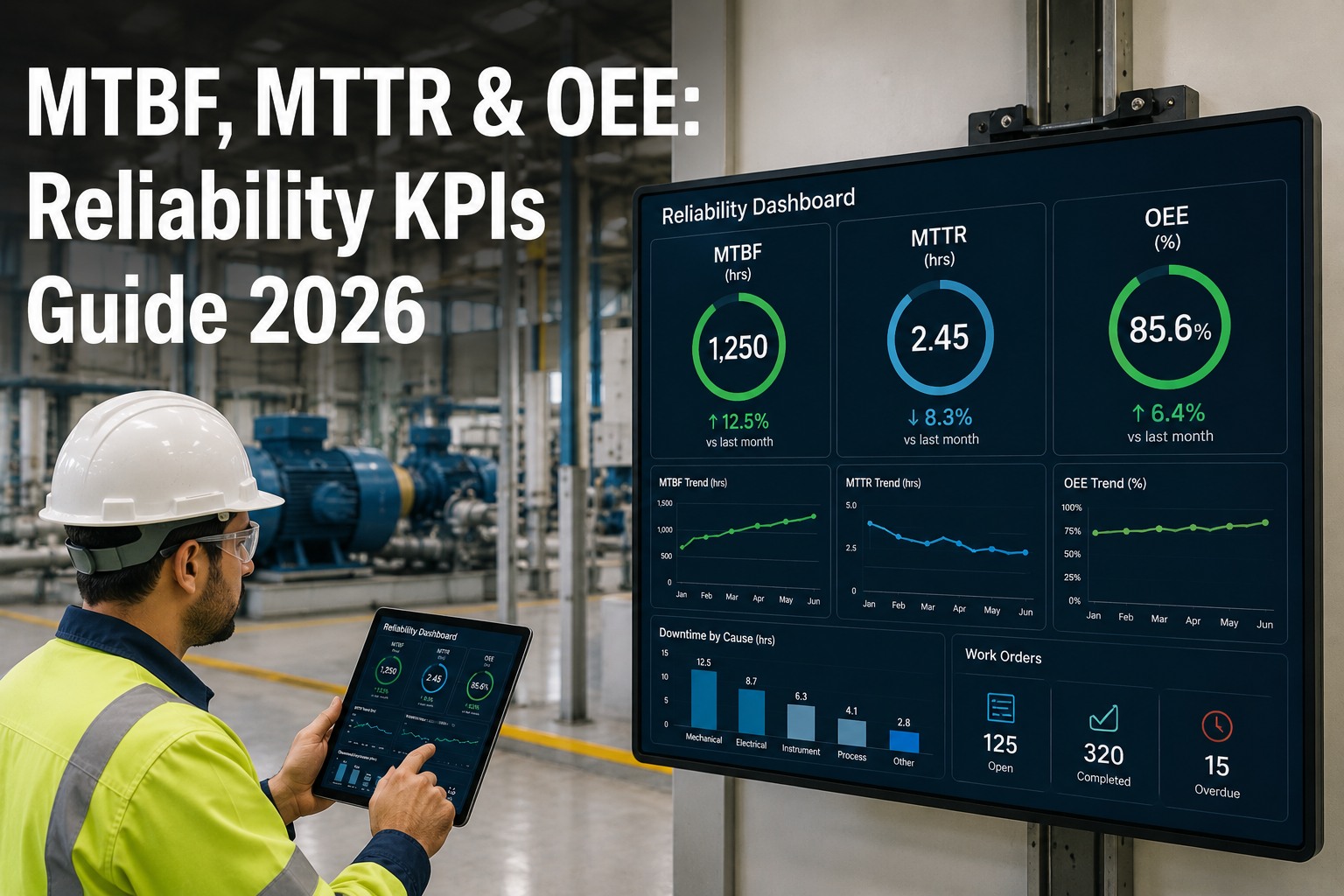
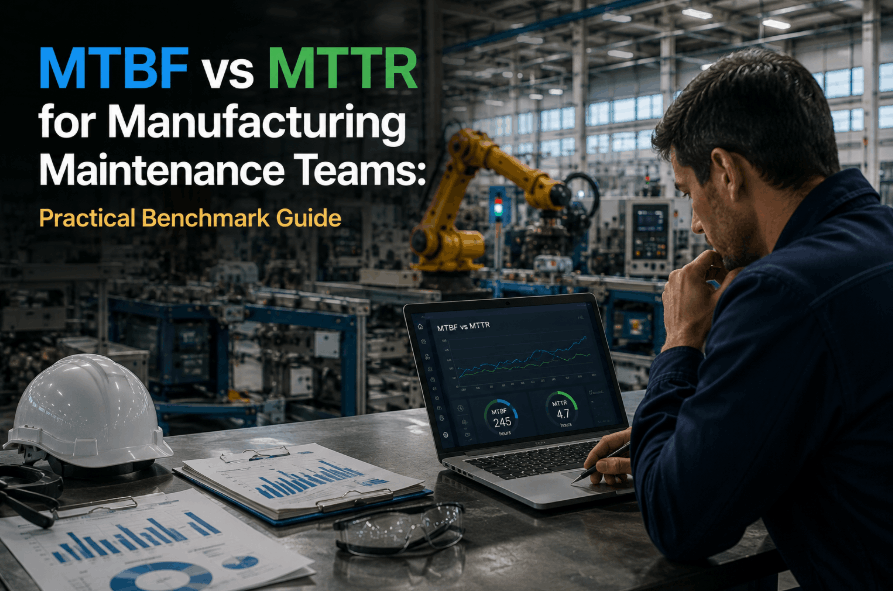
Start with five KPIs that deliver the highest insight-to-effort ratio. MTBF and MTTR cover equipment reliability and recovery speed. OEE gives the complete production picture. PM compliance and planned maintenance percentage show whether your team is operating proactively or reactively. Together, these five metrics answer the questions that matter most to maintenance managers, plant directors, and the finance team that funds maintenance operations.
A declining MTBF is the clearest early signal that your PM program needs adjustment — either more frequent tasks or different inspection methods. Track per asset, not just plant-wide.
High MTTR almost always points to spare parts availability, technician training gaps, or poor diagnostic procedures — not technician effort. Investigate root cause before addressing the metric.
A 5-point OEE gain is equivalent to adding an entire production shift without capital investment. The industry average of 60% leaves 25 points of untapped capacity already inside your plant.
The clearest measure of whether your maintenance culture is proactive or reactive. Every percentage point improvement in PMP reduces total maintenance cost and unplanned downtime risk simultaneously.
PM compliance is the leading indicator most directly correlated with future MTBF. A compliance rate below 85% means assets are running past their safe maintenance interval — MTBF decline follows within 60–90 days.
Every KPI on This Page Is Calculated Automatically in Oxmaint — From Your Work Orders.
When technicians close work orders with timestamps and failure codes, Oxmaint calculates MTBF, MTTR, OEE, PMP, and PM compliance automatically. Live dashboards. No spreadsheets. No manual reporting hours.
Secondary KPIs: Add These Once Your Big Five Are Stable
Once MTBF, MTTR, OEE, PMP, and PM compliance are tracking consistently with clean data, add these secondary KPIs to build a complete performance picture. Each targets a specific operational dimension — cost efficiency, technician productivity, scheduling effectiveness, and asset lifecycle value.
| KPI | Formula | Target | What It Reveals |
|---|---|---|---|
| Schedule Compliance | (On-Time WOs ÷ Total Scheduled WOs) × 100 | 90%+ | Whether your planning is realistic and being executed as planned |
| Wrench Time | Actual repair hours ÷ Total technician hours on shift | 55–65% | Proportion of technician time spent on actual maintenance vs. travel, waiting, admin |
| WO Backlog (weeks) | Total backlog hours ÷ Available weekly maintenance hours | 2–4 weeks | Whether maintenance team has capacity or is overwhelmed. Over 6 weeks signals resource gap. |
| Cost per WO | Total maintenance cost ÷ Number of WOs completed | Track trend down | Cost efficiency of maintenance execution. Rising cost per WO flags growing emergency work. |
| Maintenance Cost % RAV | Annual maintenance cost ÷ Replacement Asset Value | 2–4% (reactive: 6%+) | Best-in-class plants spend 2–2.5% of asset value. Above 4% signals inefficiency or aging assets. |
| Asset Availability | [(Total Time – Downtime) ÷ Total Time] × 100 | 95%+ for critical | Pure uptime metric. Tracks scheduling impact of both planned and unplanned downtime together. |
Scroll horizontally to view full table on smaller screens
OEE Unpacked: Availability × Performance × Quality
OEE is the single most comprehensive metric in manufacturing maintenance because it captures all three dimensions of production loss in one number. But its power is in disaggregation — knowing your OEE is 68% tells you little. Knowing your availability is 95%, your performance is 78%, and your quality is 92% tells you exactly where to investigate first.
Time the machine was available vs. scheduled. Breakdowns and extended changeovers are the primary drivers. A maintenance team directly controls this component through PM compliance and MTTR reduction.
How fast the machine ran vs. its design speed. Small recurring stops and speed reductions — often caused by worn tooling, alignment issues, or inadequate lubrication — silently erode performance without triggering breakdown alarms.
The proportion of output that met quality standards first time. Quality losses linked to maintenance include worn tooling, miscalibrated sensors, and equipment running outside design tolerance due to deferred maintenance.
Even with 91% availability and 96% quality, a performance rate of 83% pulls OEE below 75%. Performance losses are often the most overlooked — and most recoverable — OEE component in manufacturing.
How to Structure Your KPI Review Cadence — Daily, Weekly, Monthly
KPI programs fail not because of the wrong metrics — they fail because there is no consistent review habit that converts data into action. Metrics reviewed once a quarter after everything has gone wrong are not a management tool. They are a retrospective. The most effective maintenance teams run three distinct review cycles that catch problems at different time scales.
Supervisors review live dashboard at shift start to catch overnight anomalies. Purpose: catch outliers before they compound. 5-minute review — no formal meeting required.
Maintenance team reviews the week's KPI movements. Every metric deviation gets an action item with an owner and a due date. Meeting length: 20–30 minutes maximum.
Finance and operations review of strategic KPIs. Focus on cost efficiency and capacity impact. Used to justify headcount, tools, and capital maintenance budgets for the next quarter.
How Oxmaint Turns Work Order Data Into Live Maintenance Dashboards
Oxmaint calculates every KPI on this page automatically from work order data — timestamps, failure codes, technician hours, parts used, PM completion status. When a technician closes a work order on their mobile device, the dashboard updates in real time. No manual data entry. No reporting hours. The data is already in your work orders — Oxmaint surfaces it.
Oxmaint uses work order open and close timestamps with asset failure codes to calculate MTBF and MTTR per asset, per asset class, and plant-wide — updated every time a work order closes. No manual calculation. No lag between event and metric.
PM compliance rate is calculated from the ratio of PMs completed on time to PMs scheduled in the period. Overdue PMs appear on the supervisor dashboard immediately — not on a Monday morning report. Compliance rate trends visible over 3, 6, and 12-month windows.
Technicians see their own work queue and completion status. Supervisors see team compliance and backlog. Plant managers see OEE trend and maintenance cost. Each role gets the right metrics without data overload or custom reporting work.
Every work order is classified as planned (PM, scheduled repair) or reactive (breakdown, emergency). Planned maintenance percentage updates automatically every week. The ratio is visible on the dashboard so managers can see whether the organization is trending toward or away from a proactive maintenance culture.
Plant-wide MTBF of 200 days is useful for management reporting. Asset-level MTBF that shows one conveyor at 45 days while the rest average 280 days is what drives actual maintenance decisions. Oxmaint surfaces per-asset KPI drill-down for every metric in the dashboard.
Maintenance teams that switch from spreadsheet-based reporting to Oxmaint dashboards consistently report eliminating 8 to 12 hours per week of manual data compilation. That time shifts from report-building to actual maintenance work — improving wrench time alongside data quality.
Frequently Asked Questions About Maintenance KPIs
Which maintenance KPIs should we start tracking if we have no current metrics program?
Start with three: MTBF (equipment reliability), MTTR (repair speed), and Planned Maintenance Percentage (proactive vs. reactive balance). These three cover the most important dimensions of maintenance performance and require only that your team records timestamps and failure codes accurately on work orders. Once these are stable and reviewed weekly, add OEE and PM compliance to build the full picture. Start free in Oxmaint and track all three automatically from your first work order.
What is a realistic OEE improvement target for a manufacturing plant in year one?
A 3 to 8 percentage point OEE improvement in the first year is realistic and measurable for most plants implementing a structured maintenance KPI program. The industry average sits around 60% — a 5-point improvement toward 65% represents significant additional production capacity without capital investment. Focus on trend direction, not absolute benchmark comparison. Book a demo to see how Oxmaint tracks OEE trend over time on your asset data.
How do we ensure KPI data is accurate when technicians close work orders on mobile?
Data quality depends on two things: mandatory fields and fast closure. Require failure code, actual start time, and actual end time as mandatory fields before a work order can be closed. Enable mobile work order closure so technicians close WOs at the point of work — not hours later from memory at a shared terminal. Review anomalies weekly (unusually short or long MTTR values) and investigate with the technician who closed the WO. Configure mandatory WO fields in Oxmaint free to enforce data quality from day one.
How many KPIs is too many for a maintenance team dashboard?
More than 8 to 10 actively reviewed KPIs creates metric overload — teams stop engaging with all of them. The most effective dashboards show 5 to 6 core KPIs at the top with drill-down available for secondary metrics on demand. The goal is a dashboard someone looks at and makes a decision from in under 2 minutes. If your current dashboard requires interpretation time, it has too many metrics competing for attention. Book a demo to see how Oxmaint structures role-appropriate dashboard views for technicians, supervisors, and managers.
Stop Calculating KPIs by Hand. Start Managing by Dashboard.
Oxmaint automatically calculates MTBF, MTTR, OEE, PM compliance, and planned maintenance percentage from your work order data — visible in real-time dashboards the moment a technician closes a job. Start free. First KPI dashboard live today.

.png)