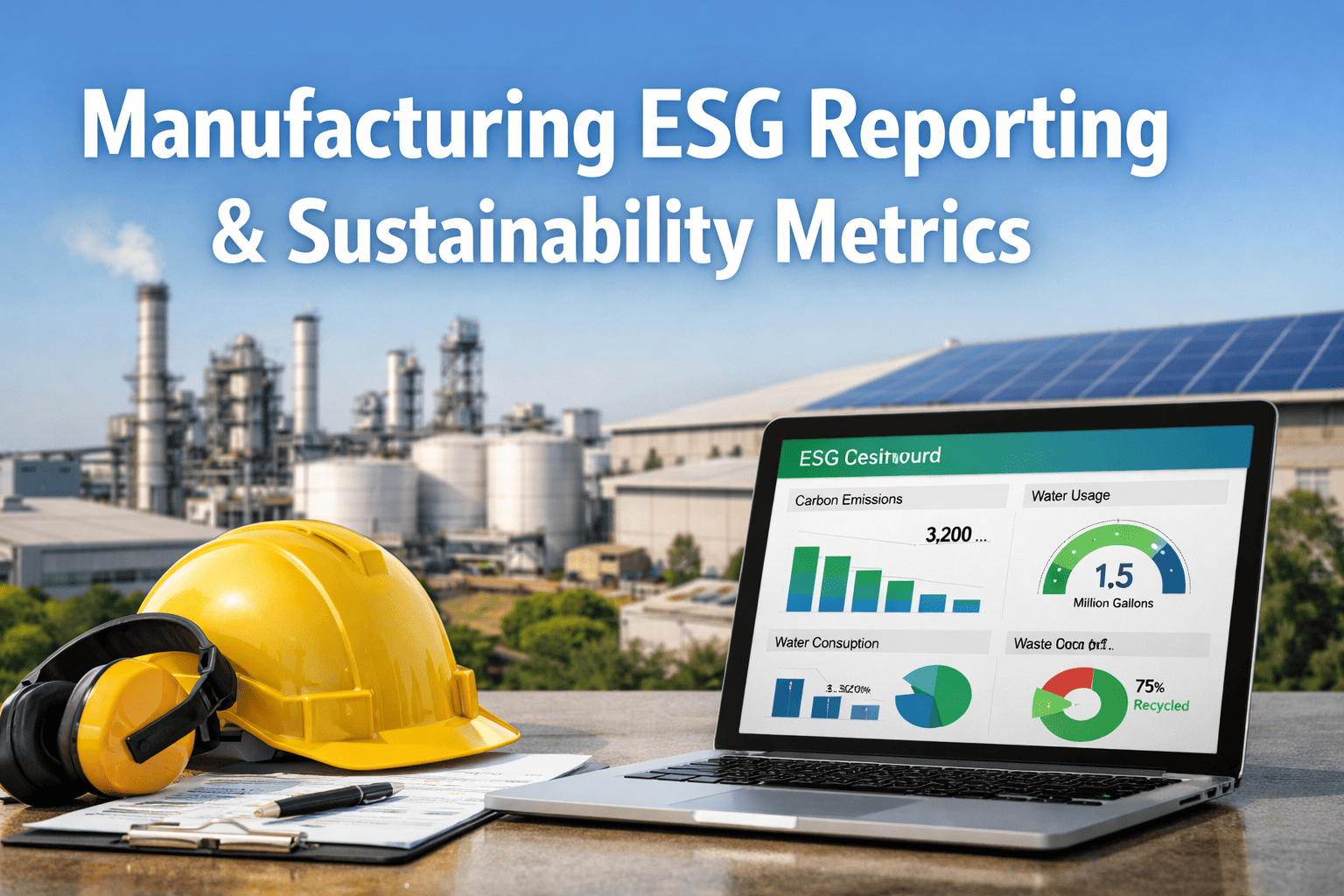
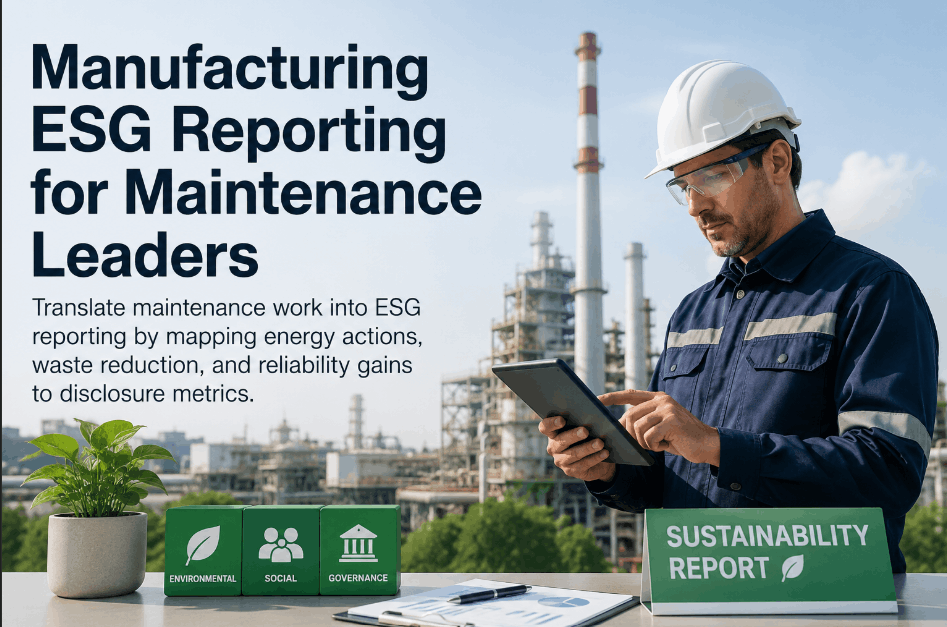
ESG reporting has moved from optional sustainability disclosure to a hard requirement for manufacturers — investors, customers, and regulators now demand verified, auditable data on carbon emissions, water stewardship, waste diversion, and workforce safety. The problem: most plants still assemble ESG reports from spreadsheets, utility bills, and manual logs that can't be traced back to source data. Oxmaint's CMMS platform connects maintenance activity, asset performance, and resource consumption into a single operational backbone — turning ESG reporting from an annual scramble into a continuous, defensible practice built on real plant data.
The Three Pillars of Manufacturing ESG Reporting
ESG is not one metric — it is a structured disclosure across environmental, social, and governance domains. Each pillar requires distinct data sources, verification methods, and reporting frameworks. Treating them as a single reporting task is why most manufacturing ESG programs stall at the starting line.
E
Environmental
Scope 1, 2, 3 GHG emissions
Energy consumption & intensity
Water withdrawal & stewardship
Waste diversion & circularity
Air quality & discharge compliance
Typical weighting: 50-60% of ESG score
S
Social
Workforce health & safety metrics
Training hours per employee
Supplier labor standards
Community impact disclosures
Diversity, equity & inclusion data
Typical weighting: 25-30% of ESG score
G
Governance
Board & leadership accountability
Risk management frameworks
Ethics & compliance programs
Data integrity & audit trails
Executive compensation alignment
Typical weighting: 15-20% of ESG score
The ESG Frameworks Manufacturers Must Navigate
Which Framework Applies to Your Plant?
GRI
Global Reporting Initiative
The most widely adopted framework globally. Covers environmental, social, and governance disclosures through a modular standards architecture used by 10,000+ companies worldwide.
Best for: Broad stakeholder reporting, multi-national operations
SASB
Sustainability Accounting Standards Board
Industry-specific standards focused on financially material sustainability metrics. Preferred by investors and integrated into IFRS Sustainability Disclosure Standards.
Best for: Investor communications, public companies
TCFD
Task Force on Climate-Related Financial Disclosures
Climate risk disclosure framework now embedded in regulations across the UK, EU, Japan, and increasingly the US. Requires scenario analysis and governance transparency.
Best for: Climate risk disclosure, regulatory compliance
CSRD
Corporate Sustainability Reporting Directive
EU-mandated reporting requiring assurance-level data for companies operating in Europe. Applies to 50,000+ companies and takes effect on a phased timeline through 2028.
Best for: EU operations, supply chain to EU customers
CDP
Carbon Disclosure Project
Questionnaire-based disclosure covering climate change, water security, and forests. Often required by large customers as part of supply chain ESG scoring.
Best for: Supply chain transparency, customer requirements
Core Metrics Every Manufacturing ESG Report Must Include
Essential Manufacturing Sustainability Metrics by Domain
Scroll horizontally to view complete metrics matrix
From Spreadsheets to Audit-Ready ESG Data
Stop Building ESG Reports from Scratch Every Year
Oxmaint captures maintenance events, asset performance, energy consumption, and safety incidents as they happen — creating the continuous, traceable data layer that modern ESG reporting demands.
The Carbon Accounting Challenge — Scope 1, 2, and 3
Scope 01
Direct Emissions
Owned & controlled sources
Natural gas combustion, boiler emissions, fleet vehicles, refrigerants, and on-site fuel use. The easiest to measure — direct meter readings and fuel invoices.
Difficulty: Low
Scope 02
Purchased Energy
Electricity, heat, steam
Emissions from purchased electricity, district heating, and steam. Calculated using grid emission factors. Renewable energy certificates reduce reportable impact.
Difficulty: Medium
Scope 03
Value Chain Emissions
Upstream & downstream
Supplier emissions, transportation, business travel, product use, and end-of-life disposal. Largest category — hardest to measure, now required by CSRD and SEC rules.
Difficulty: High
How CMMS Data Powers Credible ESG Reporting
Operational Data In
Asset runtime & utilization records
Energy & water meter readings
Preventive maintenance completion
Safety incident & near-miss logs
Waste generation by asset
Parts & consumable tracking
ESG Outputs Ready
Verified Scope 1 & 2 emissions data
Water stewardship disclosures
Waste diversion rate tracking
TRIR & safety performance trends
Energy intensity per production unit
Auditable asset compliance history
Common ESG Reporting Failures — and How to Avoid Them
01
Data From Disconnected Systems
Utility bills in accounting, meter readings in facilities, incident logs in EHS, maintenance records in a CMMS — and none of them talk to each other. The result: 6-week year-end assembly sprints that auditors still flag for gaps.
02
No Audit Trail Behind the Numbers
When a third-party auditor asks "how was this calculated," most plants cannot produce the source records. Without timestamped, immutable data from operational systems, the entire report becomes non-assurable.
03
Ignoring Scope 3 Until It's a Crisis
Most manufacturers underreport Scope 3 by 40-70% because supplier data is hard to collect. CSRD and SEC climate rules now make this a compliance issue — not a best practice.
04
Treating ESG as an Annual Project
ESG data collected once per year is already stale and often wrong. Modern frameworks expect continuous data collection with quarterly disclosure — the only way to catch measurement errors before they reach the report.
05
Undertrained Reporting Teams
Sustainability coordinators inheriting ESG work without framework training produce reports that fail assurance review. Training plus systems investment are both required — one without the other does not work.
Business Impact — Why Good ESG Reporting Pays
$4.5T
Capital Flowing to ESG
Annual sustainable investment pool actively screening manufacturers on verified ESG performance for capital allocation decisions.
73%
Customers Demand It
Of large B2B buyers now include supplier ESG disclosures as a contractual requirement — up from 28% five years ago.
10-15%
Valuation Premium
Typical enterprise value uplift for manufacturers with verified, third-party-assured ESG reporting versus peers with self-reported data only.
40%
Faster Permitting
Average reduction in environmental permit review times for plants with a documented sustainability management system and data trail.
Frequently Asked Questions
ESG Reporting Built on Real Operational Data
Your ESG Report Is Only as Credible as the Data Behind It
Oxmaint turns daily maintenance work, asset performance, and resource consumption into the verified, auditable, continuous data stream that modern ESG reporting demands — quarter after quarter, audit after audit.