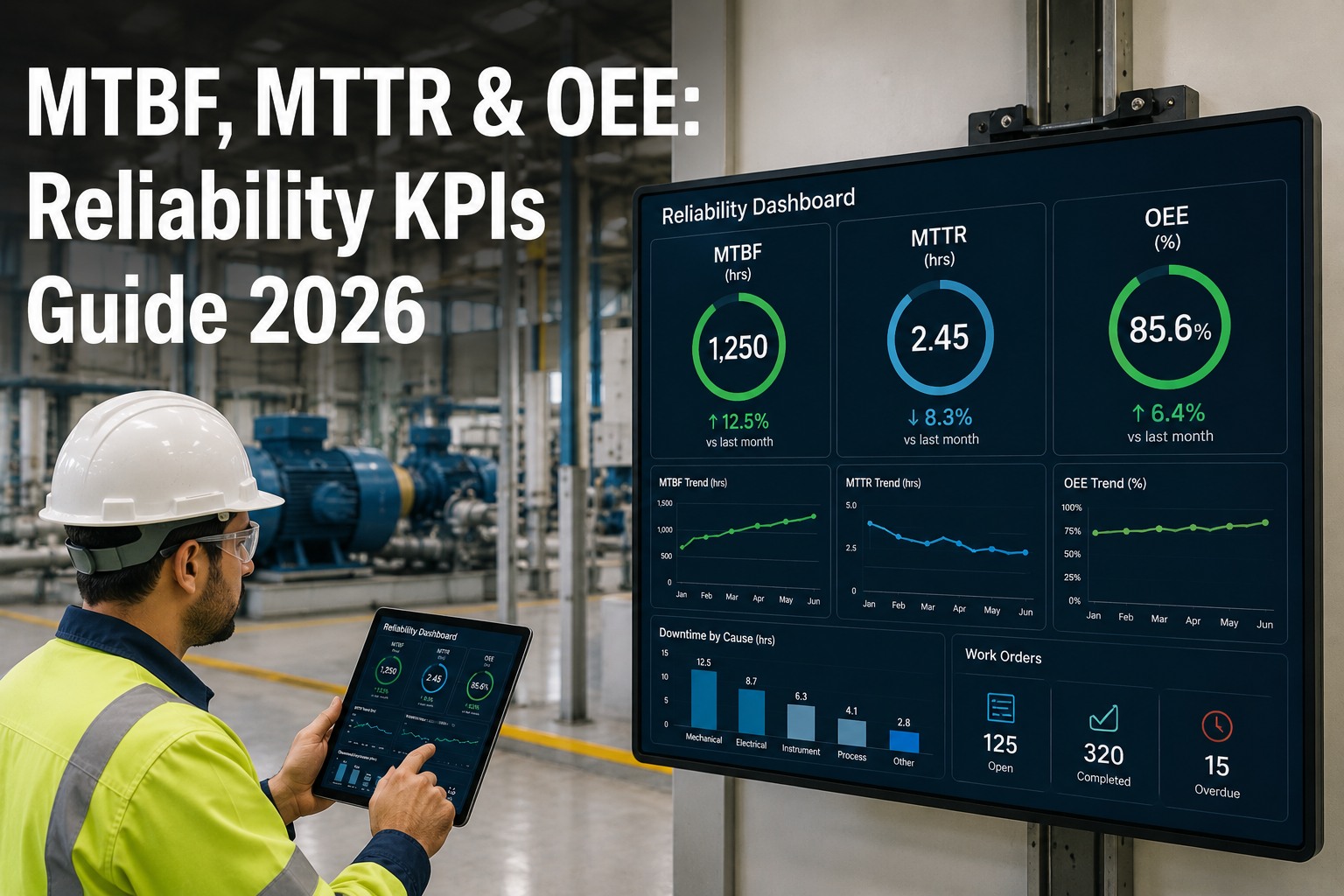
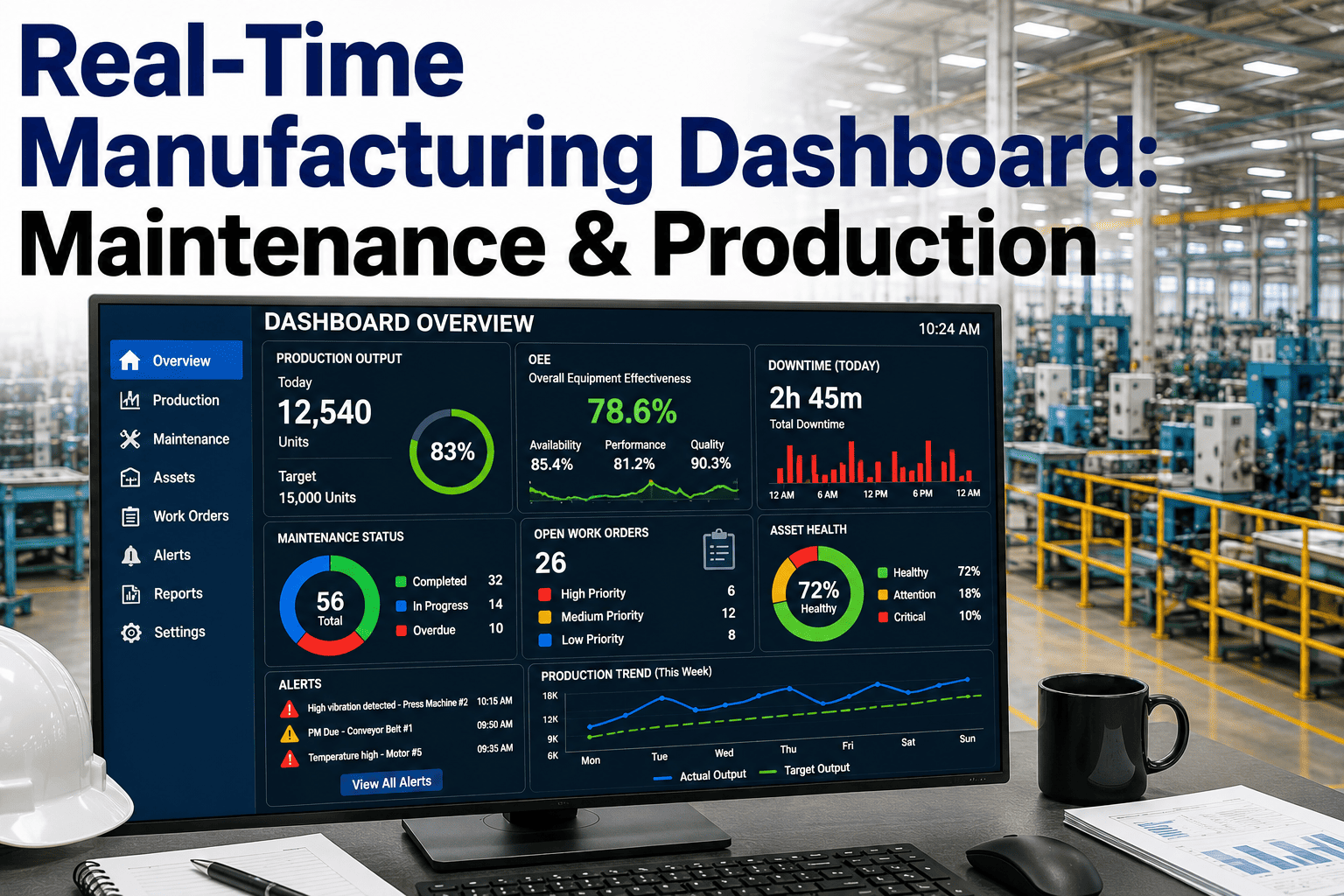
Most manufacturing plants are tracking the wrong numbers — or tracking the right ones with no system to act on them. Oxmaint's live KPI dashboard automatically calculates OEE, MTBF, MTTR, scrap rate, and 21 more production performance metrics from your work order data — no spreadsheets, no manual entry. According to McKinsey, plants using standardized KPI dashboards outperform peers by 25% in asset uptime and 20% in cost efficiency. This guide covers all 25 metrics your production team needs, with the exact formula for each, the benchmark to target, and what the number is actually telling you about your plant — so you can book a 30-minute demo and see every one of these KPIs calculated live from your own data.
Manufacturing KPI Framework
25 KPIs Across 5 Performance Pillars
A world-class production dashboard is built in layers — not all 25 at once. Start with Equipment Performance and Quality, add Maintenance Health next, then layer in Efficiency and Financial KPIs as your data matures.
5 KPIs
Equipment Performance
5 KPIs
Production Efficiency
5 KPIs
Maintenance Health
5 KPIs
Financial & Delivery
The Gold Standard KPI
Overall Equipment Effectiveness (OEE)
OEE = Availability × Performance × Quality
OEE is the single number that tells you how much of your planned production time is truly productive. The industry average sits at 60%. World-class is 85%+. The gap between those two numbers is often worth an entire additional production shift — with zero capital investment.
Overall Equipment Effectiveness (OEE)
Equipment
Availability × Performance × Quality
Measures true productive time as a percentage of planned production time. Tracks all three loss categories simultaneously — downtime, speed loss, and defects.
A 5-point OEE gain typically equals one full shift of additional capacity — no new equipment needed.
Asset Availability
Equipment
(Planned Time − Downtime) ÷ Planned Time × 100
Shows what percentage of scheduled production time equipment is actually available to run. Drops reveal unplanned failures or excessive setup time on critical assets.
Track by asset, not just plant-wide. A single bottleneck machine pulling Availability below 75% can cap OEE for the entire line.
MTBF — Mean Time Between Failures
Equipment
Total Operating Time ÷ Number of Failures
Measures average operating hours between unplanned breakdowns. A declining MTBF trend is the earliest warning that a preventive maintenance program needs adjusting before failures escalate.
Higher MTBF = longer intervals between failures. Track by equipment class to schedule PM tasks at the right frequency — not too often, not too late.
MTTR — Mean Time To Repair
Equipment
Total Repair Time ÷ Number of Repairs
Captures how long your team takes to restore equipment after a failure — from the moment it stops to the moment it restarts. Measures technician efficiency, parts availability, and diagnostic speed together.
MTTR below 2 hours is world-class. Every hour saved in repair response at $125K/hr downtime cost translates directly to recovered revenue.
Downtime Percentage
Equipment
Total Downtime ÷ Total Scheduled Time × 100
Expresses lost production time as a simple percentage of scheduled hours. Separates planned (PM, changeovers) from unplanned downtime so root cause analysis targets the right loss category.
Unplanned downtime above 15% is a signal to audit your PM program. Plants with mature predictive programs hold unplanned downtime below 5% consistently.
First Pass Yield (FPY)
Quality
Units Passing Without Rework ÷ Total Units Produced × 100
Measures the percentage of units that complete the entire production process and meet quality standards the first time — with no rework, repair, or scrapping required. The clearest signal of process stability.
Each 1% FPY improvement eliminates rework labor, reduces material waste, and cuts cycle time — without touching equipment or headcount.
Scrapped Units ÷ Total Units Produced × 100
Tracks the proportion of material or finished units that are discarded due to defects that cannot be reworked. High scrap rates signal process instability, equipment calibration issues, or incoming material quality problems.
Track scrap rate by machine, shift, and material lot — not just plant-wide. Most scrap concentrates in 2–3 root causes that are fixable once you can see the data at that resolution.
Reworked Units ÷ Total Units Produced × 100
Measures the share of production that requires additional processing to meet quality standards. Unlike scrap, reworked units are salvaged — but at the cost of labor, energy, and cycle time that disrupts downstream scheduling.
Rising rework rate is often the first indicator of gradual tooling wear or process drift — catchable weeks earlier with condition monitoring on production equipment.
Customer Defect Rate (PPM)
Quality
Defective Units Shipped ÷ Total Units Shipped × 1,000,000
Expressed in parts per million (PPM), this measures the fraction of defective products that reach the customer. It is the ultimate quality accountability metric — everything that slips past internal inspection shows up here.
Industry Avg
500–1,000 PPM
Automotive Standard
<50 PPM
A single PPM reduction at volume production prevents warranty claims, recall costs, and customer churn that can exceed the entire annual maintenance budget.
Total Defects ÷ Total Units Inspected
Counts the average number of defects per unit inspected, rather than just whether a unit passed or failed. Higher defect density reveals chronic process problems versus isolated failures and helps prioritize corrective action by defect type.
Target Range
<0.2 per unit
Track alongside FPY. FPY tells you how many units failed. Defect density tells you how badly — a critical distinction when prioritizing quality improvement resources.
Stop Calculating KPIs in Spreadsheets
Oxmaint Calculates All 25 KPIs Automatically From Your Work Order Data
Every work order your team closes, every PM completed, every failure logged — Oxmaint turns that raw activity data into live OEE, MTBF, MTTR, PMP, and 21 other production KPIs on a dashboard your entire team can act on. No manual calculation. No end-of-month data wrangling.
Throughput Rate
Production
Good Units Produced ÷ Time Period
Measures how many conforming units your line produces per hour, shift, or day. Throughput is the single clearest measure of production output and the first number to check when schedule attainment drops unexpectedly.
vs Design Capacity
Target 75–85%
World-Class
90%+ of design
Compare actual throughput against designed capacity by line, shift, and product type to isolate where loss concentrates across your production schedule.
Total Production Time ÷ Units Produced
Measures the average time to complete one production unit from start to finish. Increasing cycle time is an early indicator of equipment degradation, process drift, or material flow problems before they become visible failures.
vs Design Cycle
Within 10%
Lean Target
At or below Takt
Cycle time trending upward over 2–3 weeks without a recipe change is a maintenance signal — not a production planning problem. Act before it becomes a breakdown.
Available Production Time ÷ Customer Demand Rate
Takt time is the production rhythm your line must maintain to meet customer demand exactly — not faster, not slower. It is the target against which Cycle Time is compared to identify whether your process is keeping pace with orders.
If Cycle Time exceeds Takt Time, you will miss customer delivery commitments. If it falls far below, you may be overproducing and building unnecessary inventory.
Schedule Attainment
Production
Actual Output ÷ Scheduled Output × 100
Measures how consistently your production hits its planned daily or weekly targets. Schedule attainment below 90% is typically a symptom of underlying equipment reliability or maintenance planning issues rather than a scheduling problem.
Schedule attainment gaps reveal exactly where unplanned downtime is compressing production windows. Trace each miss to a specific asset or failure mode for targeted action.
Capacity Utilization
Production
Actual Output ÷ Maximum Possible Output × 100
Shows how much of your plant's theoretical maximum production capacity is being used. Too low signals wasted assets; too high sustained over long periods without maintenance windows accelerates equipment degradation and quality failures.
Sustainable Target
80–85%
Running consistently above 90% without maintenance windows is a reliability risk. Build PM windows into scheduling before sustained high utilization creates the failure event you cannot afford.
04 — Maintenance Health
Maintenance Health KPIs
These KPIs measure the quality and efficiency of your maintenance program itself — not just the assets it protects. A proactive maintenance team running these numbers weekly consistently outperforms reactive programs by 25% in asset uptime.
Planned Maintenance Percentage (PMP)
Maintenance
Planned Maintenance Hours ÷ Total Maintenance Hours × 100
The single most important indicator of maintenance program maturity. Shows what share of your team's time is spent on planned, proactive work versus reactive emergency repairs. Low PMP means your program is firefighting.
Start with MTBF, MTTR, and PMP. These three together give the highest diagnostic value of any KPI combination — covering reliability, recovery speed, and proactive maturity in a single view.
Active Repair Time ÷ Total Technician Hours × 100
Measures the percentage of a technician's shift actually spent doing hands-on maintenance work versus travelling, waiting for parts, waiting for permits, or completing paperwork. Industry data shows the average is surprisingly low.
Low wrench time is almost always a planning and parts staging problem — not a technician performance problem. Digital work orders with pre-staged parts and clear task descriptions routinely lift wrench time by 15–20 points.
Work Order Backlog (Days)
Maintenance
Total Backlog Hours ÷ Available Crew Hours per Day
Represents how many days of work are waiting in your maintenance queue relative to your team's capacity. A growing backlog means your PM program is generating more work than your crew can complete — a leading indicator of deferred maintenance risk.
A 2–4 week backlog is healthy and indicates planning buffer. Above 6 weeks, deferred work begins converting into unplanned failures — the exact outcome a PM program is designed to prevent.
Maintenance Cost as % of RAV
Maintenance
Annual Maintenance Cost ÷ Replacement Asset Value × 100
Normalizes maintenance spend against the value of the assets being maintained, enabling cross-facility benchmarking regardless of plant size or industry. The most reliable comparison metric for maintenance spending efficiency between sites.
Reactive plants commonly spend 8–12% of RAV annually. Predictive maintenance programs consistently push cost/RAV below 2% — often while maintaining more assets with the same or smaller team.
Cost Per Work Order
Maintenance
Total Maintenance Cost ÷ Number of Completed Work Orders
Tracks average spend per maintenance event — labor, parts, and overhead combined. A rising cost per work order signals either increasing emergency repair complexity or parts pricing issues that need to be addressed at the sourcing level.
Reactive Repairs
4–5× planned
Planned Repairs
Baseline 1×
Track planned vs unplanned cost per work order separately. The ratio between them quantifies exactly how much each avoided emergency repair is worth to your maintenance budget.
Manufacturing Cost Per Unit
Financial
Total Manufacturing Cost ÷ Units Produced
Combines all production costs — materials, labor, overhead, energy, and maintenance — into a single per-unit figure that directly determines product profitability. Rising cost per unit is often the financial symptom of falling OEE or rising scrap rates.
Direction
Minimize consistently
Track cost/unit trend alongside OEE trend. When OEE rises, cost/unit should fall proportionally. If it does not, the gap reveals hidden cost drivers worth investigating.
On-Time Delivery (OTD)
Financial
Orders Delivered On Time ÷ Total Orders × 100
Measures the percentage of customer orders fulfilled by the promised delivery date. OTD is the most customer-visible production KPI — poor OTD drives churn, contract penalties, and lost revenue faster than most other performance gaps.
OTD below 90% is almost always traceable to unplanned downtime disrupting the production schedule. Fixing the equipment reliability issues restores delivery reliability faster than adjusting lead times.
Inventory Turns
Financial
Cost of Goods Sold ÷ Average Inventory Value
Measures how many times inventory cycles through in a year. Low turns mean capital is tied up in excess stock — often because reactive maintenance creates uncertainty about when production lines will run, forcing safety stock buffers higher than necessary.
Industry Avg
6–8 turns/yr
Lean Target
12–15 turns/yr
Plants that improve OEE by 10+ points consistently see inventory turns improve in the same period, as predictable production schedules allow safety stock reductions without supply risk.
Manufacturing Lead Time
Financial
Order Receipt Date to Shipment Date (calendar days)
Measures total elapsed time from customer order through production completion to shipment. Long lead times reduce competitive advantage and require larger work-in-progress buffers. Unplanned downtime is the leading driver of lead time variance.
Goal
Minimize & reduce variance
Lead time variance — not just average lead time — is what damages customer relationships. Predictable equipment performance creates predictable lead times even when average throughput stays constant.
Energy Intensity
Financial
Total Energy Consumed ÷ Units Produced
Tracks energy consumed per unit of production output. Rising energy intensity with stable throughput is a direct signal of equipment degradation — motors drawing excess current, compressed air leaks, and poor heat exchange efficiency all show up here before they show up as failures.
PdM Impact
15–20% reduction
Predictive maintenance programs reduce energy intensity by 15–20% on average by keeping motors, HVAC, and compressed air systems operating at designed efficiency rather than degraded baselines.
World-Class Benchmarks at a Glance
Use this reference table to quickly identify which of your KPIs are in the healthy range, which need attention, and which represent an urgent performance gap relative to industry leaders.
Ready to Track All 25 — Without a Single Manual Calculation?
See Your Plant's KPIs on a Live Dashboard in Under 30 Minutes
Oxmaint pulls MTBF, MTTR, OEE, PMP, schedule attainment, and cost/RAV directly from your work order history — the data you already have — and displays them on a live dashboard your team reviews daily, not monthly. No ERP integration required to start.
Frequently Asked Questions
What is the most important KPI in manufacturing?
There is no single most important KPI — but the combination of MTBF, MTTR, and Planned Maintenance Percentage gives the highest diagnostic value with the least tracking effort. MTBF shows how reliable your equipment is, MTTR shows how fast you recover, and PMP shows whether your team is proactive or reactive. Together they explain the root cause of most OEE gaps.
Oxmaint calculates all three automatically from your existing work order data, so you can start benchmarking this week.
What is a good OEE score for a manufacturing plant?
An OEE of 85% or above is considered world-class for discrete manufacturing. The industry average sits around 60%, which means most plants have significant untapped capacity already inside their existing equipment. Even a 5-percentage-point OEE improvement — from 65% to 70% — typically equals the output of an entire additional shift with no capital investment.
Book a demo to see how Oxmaint identifies which of the three OEE components (Availability, Performance, Quality) is causing your largest losses.
How do I build a manufacturing KPI dashboard from scratch?
Start with the Big Three — MTBF, MTTR, and OEE — calculated weekly from your CMMS work order data. Add Planned Maintenance Percentage and Schedule Attainment in Month 2. Layer in cost KPIs (Cost/RAV, Cost Per Work Order) and quality KPIs (FPY, Scrap Rate) once your data quality is consistent. Avoid tracking more than 10 KPIs simultaneously until your team has a clear review cadence and defined owners for each metric.
Oxmaint's free account gives you a pre-built dashboard template with all 25 KPIs ready to populate from your first work order.
What is the difference between MTBF and MTTR?
MTBF (Mean Time Between Failures) measures how long your equipment runs reliably between breakdowns — higher is better. MTTR (Mean Time To Repair) measures how quickly your team restores equipment after a failure — lower is better. Used together, they define your asset's failure and recovery cycle: MTBF drives your PM schedule frequency, while MTTR benchmarks your repair process efficiency. A rising MTTR on equipment with stable MTBF usually points to parts availability or diagnostic procedure gaps, not technician skill issues.
Schedule a demo to see how Oxmaint tracks both metrics by asset type and failure mode.
How many KPIs should a manufacturing dashboard track?
Research consistently shows that 8–12 KPIs is the optimal range for a production dashboard. Tracking fewer than 8 leaves critical blind spots; tracking more than 12 creates data noise that dilutes focus and makes it harder to identify which metric is driving a performance change. The most effective approach is to define 3–4 KPIs per pillar (Equipment, Quality, Maintenance, Financial) and hold weekly reviews against targets rather than monthly reporting cycles.
Oxmaint's dashboard is designed for exactly this structure — surfacing the 8–12 metrics that matter most to your production operation in a single view.
What causes low OEE in manufacturing?
Low OEE has exactly three root causes corresponding to its three components. Low Availability means equipment is down more than planned — driven by unplanned failures, long setups, or changeovers. Low Performance means equipment is running slower than its ideal rate — driven by minor stoppages, tooling wear, or material feed issues. Low Quality means too many defective units are being produced — driven by process instability, incoming material variation, or equipment calibration drift. Diagnosing which of the three is pulling your OEE down tells you whether the solution is a maintenance, engineering, or quality intervention.
Book a session to see how Oxmaint separates and tracks each OEE loss category automatically.
Your Competitors Are Already Running These Numbers Weekly
Turn Your Work Order Data Into a Live KPI Dashboard Today
Every work order, PM completion, and failure log in your CMMS already contains the data behind MTBF, MTTR, OEE, PMP, and 21 more KPIs. Oxmaint surfaces all of them automatically — no custom reports, no spreadsheets, no data team required. The 25% asset uptime advantage McKinsey documents for data-driven plants starts with a dashboard your team actually uses.