A pharmaceutical tablet manufacturer moved their coating operation 47 meters closer to packaging and eliminated 6.2 hours of daily material handling labor — that single layout change saved $187,000 annually while cutting product damage by 34%. Plant layout isn't just where equipment sits, it's how material flows, where operators walk, and which bottlenecks prevent your production line from hitting target capacity. Companies that design layouts using systematic planning methods achieve 20-40% higher throughput than those who arrange equipment based on available floor space. OxMaint's facility layout module maps material flow paths directly onto your asset registry so every equipment move, process change, or capacity expansion gets evaluated against actual production data. Book a 15-minute demo to see how digital layout planning identifies bottlenecks before construction starts.
Manufacturing Plant Layout Design: From Material Flow to Workstation Optimization
Systematic approaches to facility layout, lean manufacturing principles, material handling optimization, and equipment placement strategies that reduce cost, increase throughput, and improve safety.
Five Core Principles That Define Effective Plant Layout
Manufacturing plant layout design balances competing objectives — minimize material movement, maximize equipment utilization, support flexible production, ensure worker safety, and allow future expansion. These five principles provide the framework for layout decisions that deliver measurable operational improvements.
Every meter material travels adds handling cost, cycle time, and damage risk. Straight-line flow from receiving to shipping with minimal backtracking reduces non-value-added activity. Target less than 500 meters total travel for high-volume products.
Arrange equipment in the order material transforms — raw material prep, primary processing, secondary operations, assembly, inspection, packaging. Process sequence layout prevents cross-flow and congestion at shared resources.
Layout must accommodate equipment capacity imbalances. If coating runs at 400 units/hour but packaging caps at 350 units/hour, layout needs buffer space between operations. Identify constraint operation and design flow around it.
Plant layout designed for today's product mix becomes obsolete when customer requirements shift. Modular equipment placement, relocatable utilities, and 15-20% open floor space enable reconfiguration without major construction.
Equipment packed tightly for flow efficiency creates maintenance access problems. Layout must provide clearance for component replacement, scheduled inspections, and emergency repairs. Minimum 1.2 meter access on equipment requiring regular service.
Four Standard Layout Configurations and When to Use Each
Plant layout type depends on production volume, product variety, and process requirements. No single layout fits all manufacturing operations — most facilities use hybrid approaches combining multiple configurations across different production areas.
Equipment arranged in sequence for single product or product family. Material flows in straight line from start to finish. Also called assembly line or flow line layout.
Similar equipment grouped together — all lathes in one area, all mills in another. Material moves between departments based on routing requirements. Also called functional or job shop layout.
Equipment organized into cells, each dedicated to product family with similar processing requirements. Combines benefits of product and process layouts. Workers cross-trained on multiple machines within cell.
Product remains stationary while workers and equipment come to it. Used when product too large or fragile to move. Material and tools staged around build location.
Map Your Material Flow Before Moving Equipment
OxMaint's layout planning module connects production data to floor space — track actual material movement patterns, identify bottlenecks from work order history, and simulate layout changes against real production volumes before construction starts.
7-Step Process for Data-Driven Layout Design
Effective plant layout design follows systematic methodology based on production requirements, not equipment availability or personal preference. This approach ensures layout decisions optimize measurable outcomes like throughput, cycle time, and material handling cost.
Document current and projected product volumes, processing requirements, and quality standards. Identify high-runner products that drive layout priorities. Use 80/20 analysis — design for products representing 80% of volume.
Create process flow diagrams showing operation sequence, standard cycle times, and equipment requirements for each product. Identify shared resources and potential bottlenecks. Calculate theoretical capacity at each operation.
Quantify material movement between operations using from-to matrix. Multiply trip frequency by distance and load size. High-intensity flows must have shortest distances in layout. Low-intensity flows can tolerate longer paths.
Calculate floor space for equipment, operators, material queues, maintenance access, and safety clearances. Add 15-20% buffer for flexibility. Industrial engineering standard: equipment footprint plus 40% for access and circulation.
Create 3-5 preliminary layouts showing major equipment placement and material flow paths. Evaluate each against criteria like total handling distance, flow congestion, and expansion capability. Select best option for detailed design.
Position equipment precisely with dimensions, clearances, and access requirements. Route utilities including electrical, compressed air, water, and drainage. Locate support functions like tool cribs and quality inspection stations.
Simulate layout performance under normal production, peak demand, and product mix changes. Identify potential congestion points and capacity constraints. Refine layout based on simulation results before implementation.
How Lean Principles Shape Modern Plant Layouts
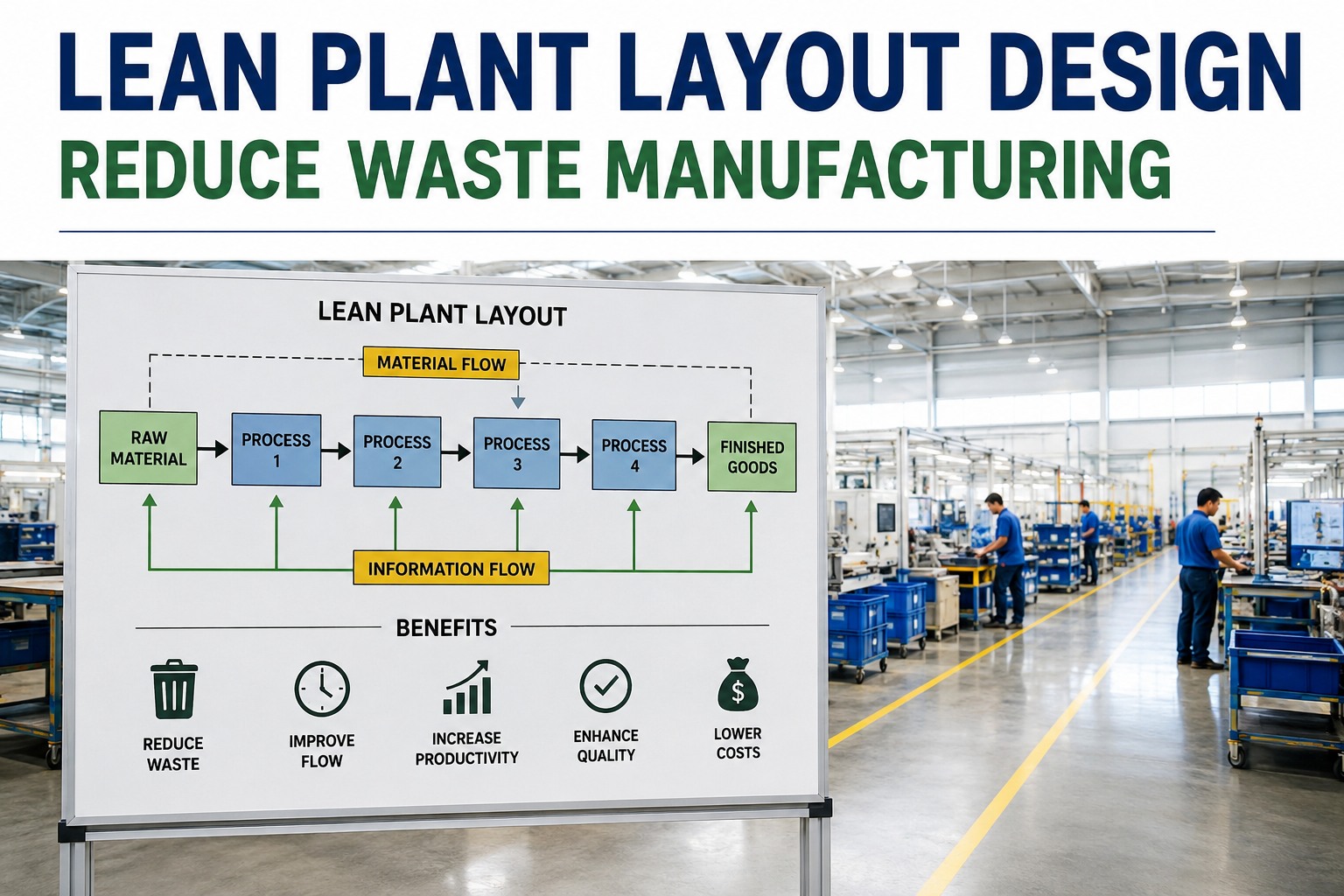
Lean manufacturing demands layout designs that minimize waste, support continuous flow, and enable rapid changeover. Traditional batch-and-queue layouts optimized for equipment utilization conflict with lean objectives focused on value stream velocity and one-piece flow.
Map current material and information flow to identify waste. Layout changes target non-value-added activities like excessive material handling, queue time between operations, and transportation distance. Measure success by value stream lead time reduction.
Arrange equipment to enable continuous flow without batching. Equipment spacing minimizes hand-off time while maintaining operator efficiency. U-shaped cells allow single operator to manage multiple machines with minimal walking.
Position material at point of consumption instead of central warehouse. Kanban systems trigger replenishment based on actual usage. Reduces material handling labor and makes inventory levels visible to production teams.
Allocate floor space for visual controls including production boards, quality charts, and problem escalation displays. Layout enables supervisors to see entire production area from single vantage point. Clear sight lines support gemba walks.
Workstation Design, Material Handling, and Safety Considerations
| Design Element | Key Requirements | Standard Specifications | Common Mistakes |
|---|---|---|---|
| Workstation Ergonomics | Adjustable work height, tool reach zones, proper lighting | Work surface 850-1050mm height, reach distance max 500mm, 500 lux minimum | Fixed height stations, tools stored outside reach, inadequate task lighting |
| Aisle Width | Material handling equipment clearance, two-way traffic, emergency egress | Main aisles 3.6-4.5m, secondary 2.4-3.0m, emergency exit paths 1.5m minimum | Undersized aisles causing congestion, blocked fire exits, blind corners |
| Material Queues | Buffer capacity for WIP, FIFO flow control, visual level indicators | 2-4 hours production at bottleneck rate, clearly marked max levels | Excessive buffer space encouraging overproduction, no flow control |
| Equipment Clearance | Maintenance access, door swing, service panel reach | 1.2m minimum on sides requiring regular access, 0.6m on infrequent | Equipment placed against walls, blocked access panels, no lift clearance |
| Quality Inspection | Adequate lighting, measurement equipment, reject segregation | 1000 lux for visual inspection, climate control for precision instruments | Inspection in production area without proper controls, no defect containment |
| Utilities Distribution | Flexible access points, equipment relocation capability, safety shutoffs | Overhead utilities on quick-disconnect, floor trenches for flexibility | Hard-piped utilities preventing moves, utilities crossing walkways |
Test Layout Changes Digitally Before Moving Physical Equipment
OxMaint connects equipment records to facility layout drawings. Simulate production scenarios, calculate material handling distances from actual work order routing, and validate capacity before investing in physical changes. Layout optimization based on operational data, not guesswork.
Five Layout Errors That Reduce Plant Performance
Placing new machines wherever floor space exists instead of optimizing material flow. Results in backtracking, cross-traffic, and excessive handling distance.
Tight coupling between operations with different cycle times causes blocking and starving. Upstream equipment waits for downstream to clear, downstream equipment starves when upstream breaks down.
Material handlers spend 40% of shift walking to and from central stores. Point-of-use storage reduces handling labor and makes consumption visible for kanban systems.
Layout designed for current production volumes with no room for capacity increases. Adding equipment requires moving entire production line or building addition.
Equipment placed against walls or too close together for major component replacement. Routine maintenance becomes difficult, emergency repairs require production shutdown to create access.
Plant Layout Design Questions Answered
Design Your Plant Layout Using Production Data, Not Floor Space Availability
OxMaint maps equipment locations, tracks material movement through work order routing, calculates actual handling distances, and identifies flow bottlenecks from production history. Layout optimization driven by operational reality, not theoretical ideal.