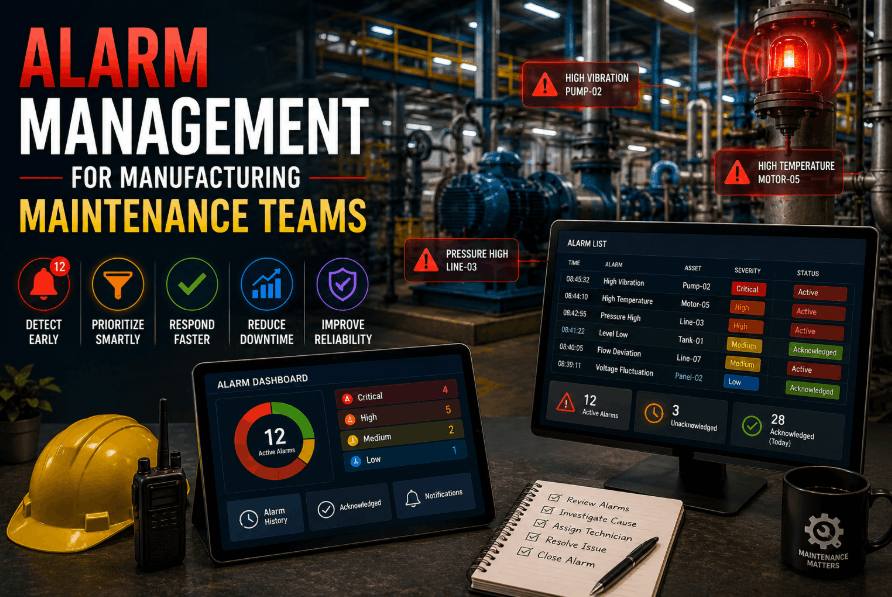
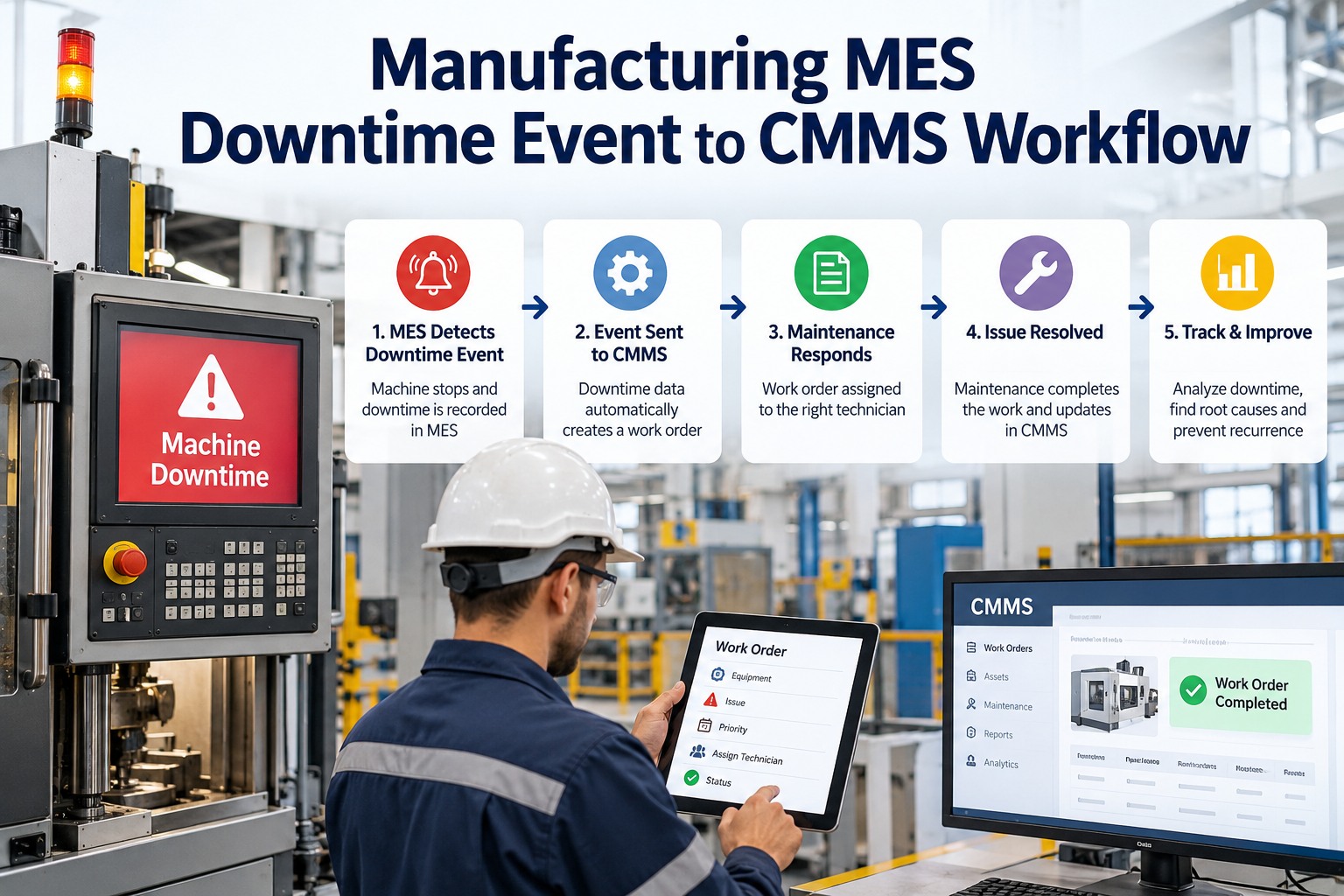
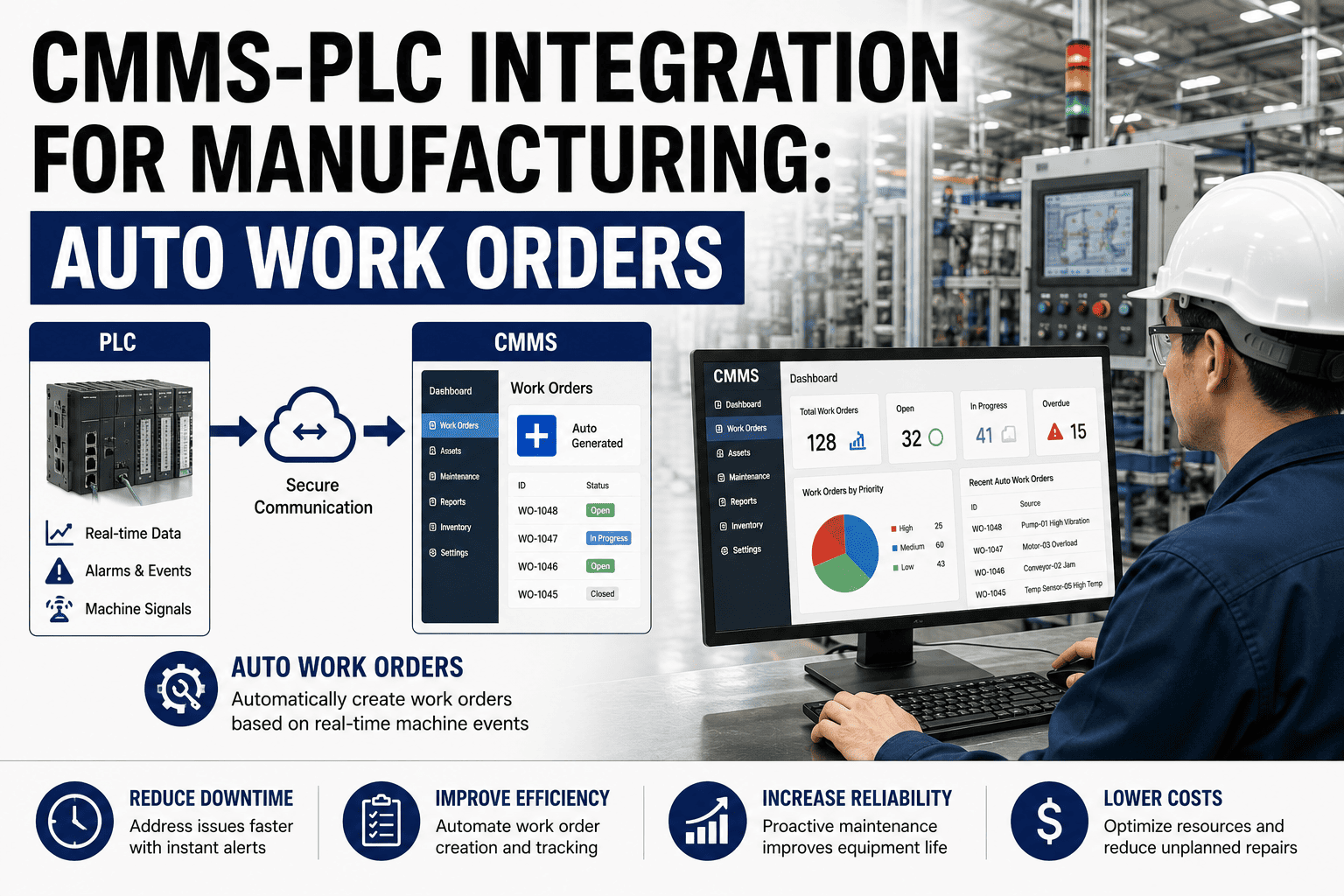
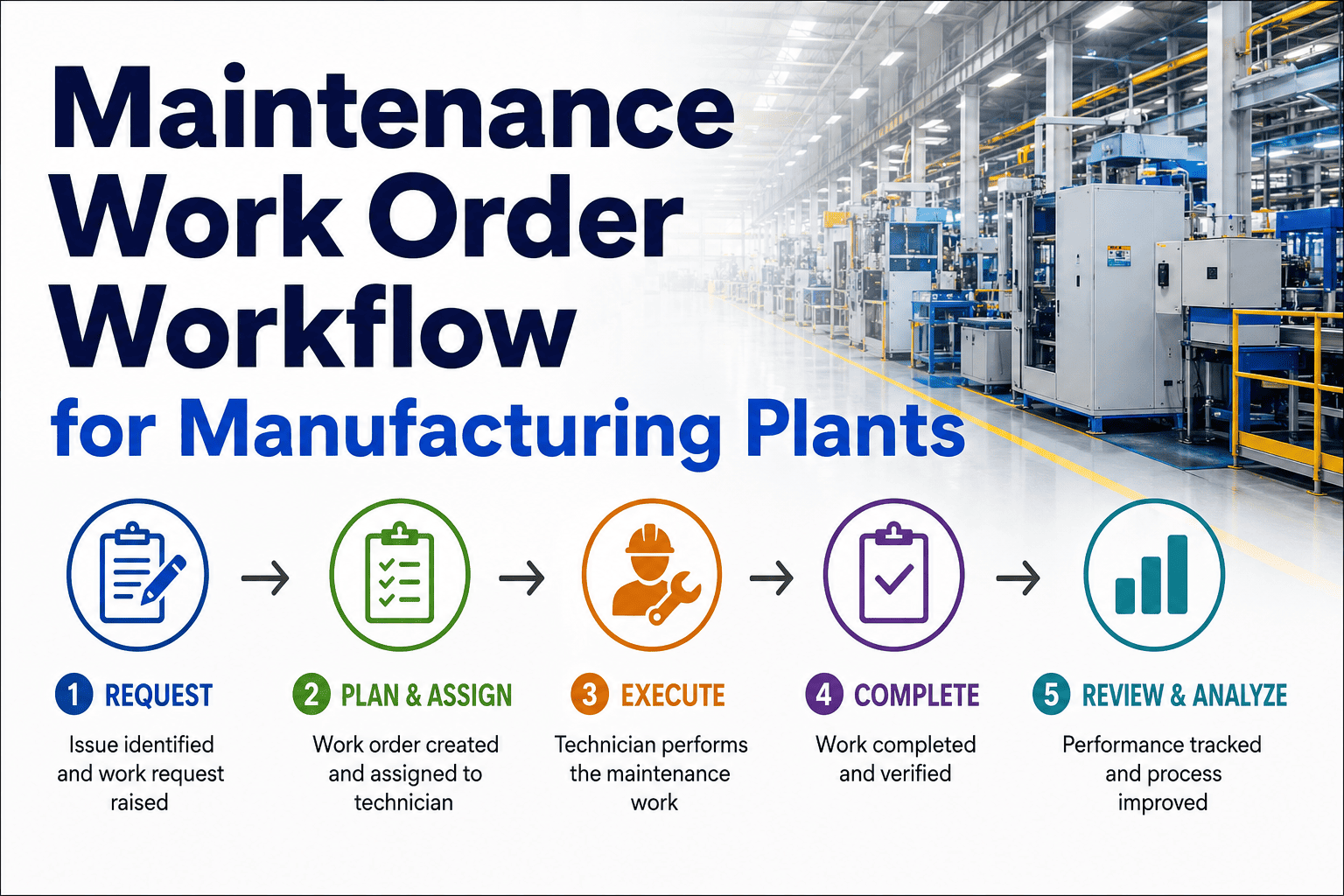
Alarm management in manufacturing plants has become one of the most pressing operational challenges maintenance teams face today. When alarm systems are poorly configured, improperly rationalized, or disconnected from maintenance workflows, the result is alert fatigue — where technicians receive so many alarms that critical equipment warnings are missed, delayed, or actively suppressed. Effective alarm management for manufacturing maintenance teams requires more than a DCS configuration review; it demands a structured response workflow, priority classification system, and direct integration with your CMMS to ensure every actionable alarm generates a documented maintenance response. With OxMaint, manufacturing maintenance teams can connect alarm events directly to work orders and asset records — turning raw alarm data into structured corrective actions with full traceability. This guide covers the complete alarm management lifecycle: rationalization, priority classification, response workflows, nuisance alarm elimination, and the KPIs that confirm your alarm system is actually protecting equipment. Book a Demo to see how OxMaint connects alarm-driven events to your maintenance program.
Alarm Management + CMMS Integration
Turn Equipment Alarms Into Structured Maintenance Actions — Not Noise.
OxMaint links alarm events to asset records and work orders so every critical alert generates a documented corrective action — assigned, tracked, and verified to completion.
Why Alarm Management Fails in Manufacturing Plants
The Root Causes of Alert Fatigue on the Plant Floor
01
No Alarm Rationalization
Alarm systems added incrementally over years generate thousands of unreviewed alerts. Without rationalization, technicians cannot distinguish critical equipment faults from nuisance noise — and stop responding to both.
02
Alarms Without Response Owners
When alarms fire without a defined responder, response time, or escalation path, critical equipment warnings sit unacknowledged. The alarm existed — but no maintenance action followed, and no record was created.
03
No CMMS Linkage
Alarm events that are not connected to work order generation leave no maintenance audit trail. Recurring alarms on the same asset go undetected, allowing the underlying fault to develop into unplanned downtime.
Alarm Management for Manufacturing: Step-by-Step Process
A Structured Alarm Management Framework for Industrial Maintenance Teams
Step 1
Conduct an Alarm Rationalization Review
Rationalization is the process of reviewing every alarm against a defined standard: does this alarm require a unique operator or technician response? If not, it should be removed, consolidated, or reclassified. EEMUA 191 and ISA-18.2 provide the recognized industry frameworks for alarm rationalization in manufacturing environments. OxMaint's asset register supports rationalization by providing historical maintenance records for each asset — helping teams identify which alarms have historically generated corrective actions versus which generate no useful response.
Sign Up Free to begin linking alarm history to asset records inside OxMaint.
Step 2
Implement a Three-Tier Alarm Priority Classification
Every alarm must be assigned a priority level that defines required response time and escalation path. A standard three-tier structure: Priority 1 (Critical) — immediate response within 5 minutes, direct work order generation; Priority 2 (High) — response within 30 minutes, technician dispatch; Priority 3 (Advisory) — response within shift, deferred to standard work queue. OxMaint's work order priority system maps directly to this classification, allowing alarm-triggered work orders to be created at the correct priority level and routed to the right technician automatically.
Step 3
Define Alarm Response Procedures for Every Critical Asset
Each Priority 1 and Priority 2 alarm must have a documented response procedure — what the technician should check first, what parameters to verify, what the safe operating range is, and what the escalation trigger is if the first response does not resolve the condition. These procedures are most effective when stored directly against the asset in your CMMS. OxMaint allows maintenance teams to attach standard operating procedures and response checklists to individual asset records, so technicians responding to an alarm have the correct procedure available on their mobile device at the asset location.
Step 4
Identify and Eliminate Nuisance Alarms
Nuisance alarms — those that fire frequently without requiring action — are the primary driver of alert fatigue in manufacturing plants. Identify your top 10 most frequently occurring alarms. For each: determine root cause (incorrect setpoint, process variation, sensor degradation), implement a corrective action, and re-evaluate after 30 days. OxMaint's corrective work order system enables maintenance teams to log nuisance alarm investigations as formal work orders, track corrective actions, and measure reduction in alarm frequency over time — creating an auditable alarm improvement record.
Book a Demo to see how OxMaint tracks nuisance alarm corrective actions to completion.
Step 5
Measure Alarm System Performance with Defined KPIs
Alarm management performance must be tracked continuously. Key metrics include: alarm rate per operator per hour (EEMUA 191 target: under 1 per 10 minutes), standing alarm count, alarm acknowledgement time by priority tier, percentage of alarms resulting in corrective action, and repeat alarm rate on the same asset within 24 hours. OxMaint surfaces the maintenance-side KPIs automatically — corrective action completion rate, repeat failure frequency, and response time by technician — giving maintenance managers the data to demonstrate alarm management improvement to operations leadership.
Core Components of an Industrial Alarm Management Program
What a Complete Manufacturing Alarm Management System Covers
Alarm Rationalization Register
Documented justification for every active alarm — confirming it requires a unique response action and is set at the correct priority level and setpoint.
Priority Classification System
Three-tier or four-tier alarm priority framework defining required response time, escalation path, and CMMS work order generation rule for each level.
Asset-Level Response Procedures
Documented response checklists for every critical alarm, stored against the asset record in the CMMS and accessible to technicians on mobile devices at the plant floor.
Nuisance Alarm Elimination Program
Systematic identification and corrective action process for the top-10 most frequent alarms — with before/after frequency measurement and CMMS audit trail.
Alarm-to-Work-Order Integration
Direct connection between alarm events and CMMS work order generation — ensuring every actionable alarm creates a documented maintenance response with full traceability.
Alarm Performance KPI Dashboard
Ongoing tracking of alarm rate, acknowledgement time, repeat alarm frequency, and corrective action completion rate — enabling continuous alarm system improvement.
Alarm Management Performance: Industry Benchmarks by Metric
EEMUA 191 and ISA-18.2 Benchmarks for Manufacturing Alarm Systems
| Alarm KPI |
Current Industry Average |
EEMUA 191 Target |
Impact on Maintenance |
| Alarm Rate (per operator/hour) |
10–30 alarms/hr |
Under 6/hr (manageable) |
High rate = missed critical alarms |
| Standing Alarm Count |
50–200+ standing |
Under 5 at any time |
Standing alarms mask new faults |
| Alarm Acknowledgement Time (P1) |
5–20 minutes average |
Under 5 minutes |
Delayed ack = equipment damage risk |
| % Alarms Requiring No Action |
40–70% of all alarms |
Under 5% |
Nuisance volume drives fatigue |
| Repeat Alarm Rate (same asset 24hr) |
15–30% of alarms |
Under 5% |
Recurring = unresolved root cause |
| Alarms with Documented Response |
Under 30% in most plants |
100% of P1 and P2 |
No procedure = inconsistent response |
CMMS for Alarm-Driven Maintenance
Connect Every Critical Alarm to a Tracked Maintenance Action.
OxMaint gives manufacturing maintenance teams the asset records, work order workflows, and mobile procedures needed to respond to alarms consistently — and prove every alarm was actioned.
Frequently Asked Questions: Alarm Management for Manufacturing Maintenance Teams
What is alarm management in manufacturing maintenance?
Alarm management is the systematic process of designing, rationalizing, prioritizing, and responding to equipment and process alarms in manufacturing plants. Its goal is to ensure that every alarm that fires requires a unique maintenance or operator response — and that response is documented and tracked to completion.
What causes alert fatigue in manufacturing plants?
Alert fatigue results from excessively high alarm rates — typically driven by un-rationalized alarm databases, incorrect setpoints, nuisance alarms that fire without requiring action, and standing alarms that are never resolved. When technicians are overwhelmed with volume, critical equipment warnings are missed or suppressed.
What is alarm rationalization and why does it matter?
Alarm rationalization is the review of every alarm to confirm it requires a unique, defined response action at the correct priority and setpoint. Without rationalization, alarm databases accumulate irrelevant alerts that drive fatigue and obscure genuine equipment faults requiring maintenance attention.
What are the EEMUA 191 alarm rate benchmarks for manufacturing?
EEMUA 191 defines a manageable alarm rate as under 6 alarms per operator per hour, with a maximum of 5 standing alarms at any time. Plants operating above 10 alarms per hour are classified as over-loaded, meaning critical equipment alerts are likely being missed by maintenance teams.
How should manufacturing plants prioritize alarms for maintenance response?
A three-tier priority structure is recommended: Priority 1 (Critical) requires immediate response within 5 minutes with direct work order generation; Priority 2 (High) requires technician response within 30 minutes; Priority 3 (Advisory) is addressed within the shift window. Each tier must have a defined escalation path inside your CMMS.
How does a CMMS support alarm management in manufacturing?
A CMMS like OxMaint provides the linkage between alarm events and formal maintenance responses — generating work orders at the correct priority, routing them to the right technician, storing response procedures at the asset level, and tracking corrective actions to completion with full audit trail.
What KPIs should maintenance managers track for alarm management performance?
Key metrics include alarm rate per operator per hour, standing alarm count, percentage of alarms requiring no action, alarm acknowledgement time by priority tier, repeat alarm rate on the same asset within 24 hours, and percentage of Priority 1 and 2 alarms with documented response procedures and closed corrective actions.
Start Improving Alarm Management Today
OxMaint Connects Alarm Events to Asset Records and Maintenance Actions.
Give your manufacturing maintenance team the CMMS infrastructure to respond to every alarm with a documented, tracked corrective action — reducing alert fatigue and equipment downtime across your plant.