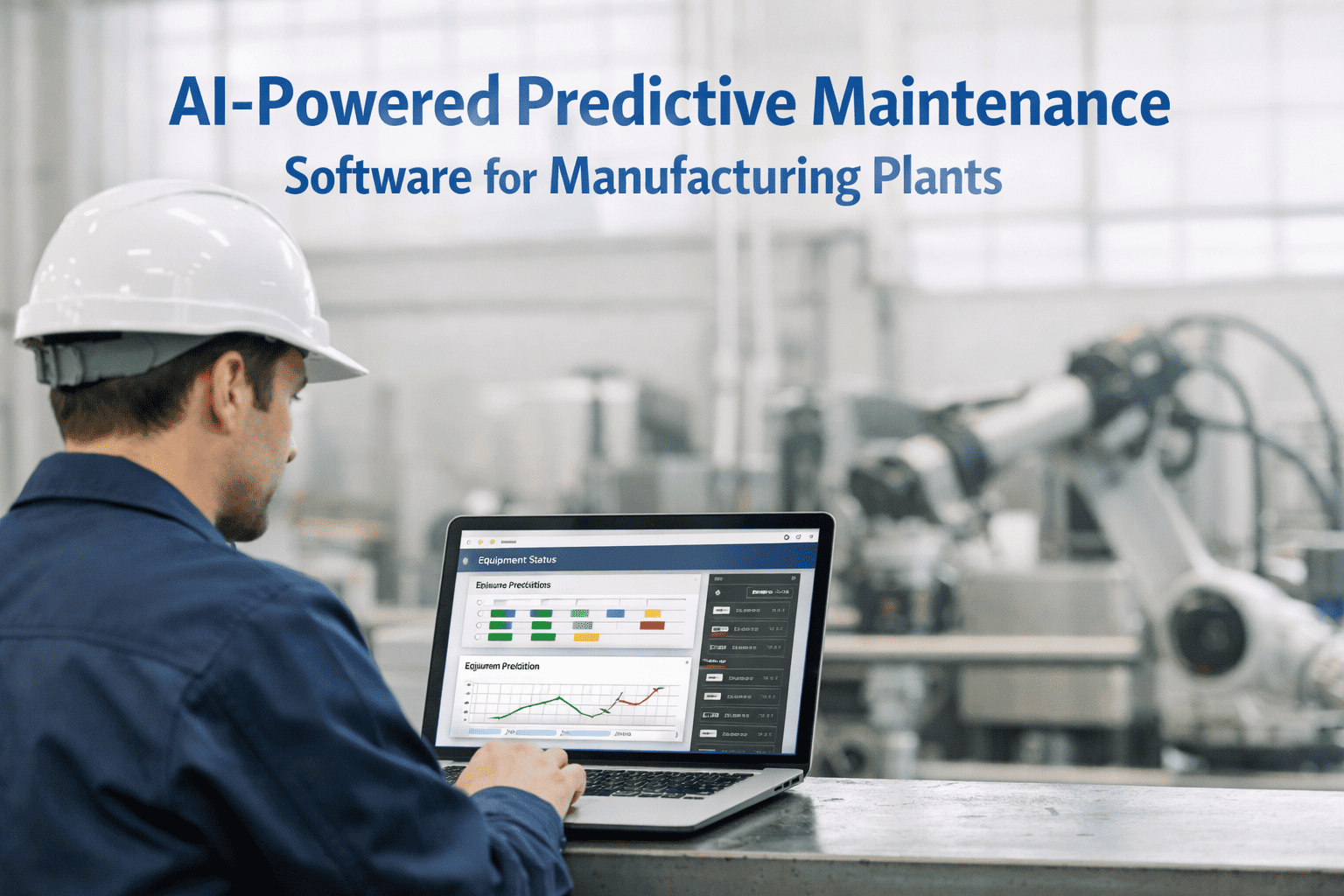
AI-powered CMMS software is transforming how manufacturing plants manage maintenance response times — replacing slow, manual dispatch workflows with intelligent automation that detects equipment issues, routes work orders, and mobilizes technicians in minutes rather than hours. Sign Up Free to connect your plant's assets to Oxmaint's AI-driven maintenance platform and cut average response times by 40–60%. From predictive fault detection on production lines to automated priority escalation for critical failures, modern AI-integrated CMMS platforms eliminate the communication gaps that allow small equipment anomalies to become costly unplanned shutdowns. Book a Demo to see how Oxmaint's intelligent work order engine routes the right technician with the right information at the first alert. Whether your plant runs continuous production or high-mix discrete manufacturing, faster maintenance response directly reduces mean time to repair (MTTR), protects OEE, and drives measurable ROI within the first operating quarter.
AI-POWERED CMMS · MAINTENANCE RESPONSE · MANUFACTURING UPTIME
Cut Maintenance Response Times with AI-Driven Work Order Automation in Oxmaint
Intelligent fault detection, automated technician dispatch, real-time asset health alerts, and MTTR tracking — built for manufacturing reliability teams who can't afford slow response.
Why Maintenance Response Time Is the Most Expensive KPI Most Plants Ignore
Every minute between fault detection and technician arrival is lost production. In high-throughput manufacturing, a 45-minute average response delay across 10 monthly breakdowns can represent $200,000–$500,000 in annual throughput loss. Traditional CMMS platforms record work orders but do not intelligently accelerate the time between problem identification and boots on the floor. AI changes this equation entirely — enabling plants to shift from reactive fire-fighting to proactive, data-guided maintenance dispatch that minimizes MTTR at every stage of the repair cycle.
TRADITIONAL CMMS VS AI-POWERED CMMS — RESPONSE TIME IMPACT
AI-Powered CMMS (Oxmaint)
Automated fault detection triggers work orders instantly
AI routes work to best-available technician by skill and location
Priority escalation prevents critical faults from sitting in queue
Technician receives full asset history and parts list on mobile
Predictive alerts allow pre-positioning before failure occurs
MTTR tracked automatically per asset and trade
Traditional CMMS / Manual Dispatch
Operators manually report faults — often delayed by shift handoffs
Supervisors manually assign work based on availability, not data
No automatic priority escalation — critical jobs wait in queue
Technicians arrive without asset context or parts confirmation
Reactive only — no early warning before equipment fails
MTTR calculated manually from paper logs or spreadsheets
How AI Reduces Maintenance Response Time Across Every Stage of the Repair Cycle
AI doesn't just speed up one part of maintenance — it compresses latency at every stage from initial fault signal to work order closure. Sign Up Free to activate Oxmaint's AI-powered dispatch engine and start measuring MTTR improvement across your asset register from day one.
AI CMMS RESPONSE ACCELERATION — STAGE BY STAGE
Stage 1
Fault Detection — From Hours to Seconds
Traditional plants rely on operators to notice and report equipment anomalies — introducing delays of 30 minutes to several hours. AI-connected sensors in Oxmaint detect deviations from normal operating parameters in real time, triggering work orders the moment a threshold is crossed.
Stage 2
Work Order Creation — Automated and Pre-Populated
Manual CMMS entry wastes 10–20 minutes per work order. Oxmaint auto-generates the work order with asset ID, failure mode, maintenance history, required parts, and priority level — giving technicians complete context before they arrive at the equipment.
Stage 3
Technician Dispatch — Intelligent Routing by Skill and Proximity
AI dispatch in Oxmaint matches each work order to the nearest available technician with the correct trade certification and equipment familiarity — reducing the average time-to-dispatch by 35–50% compared to supervisor-managed assignment queues.
Stage 4
Repair Execution — Mobile Access to Asset Intelligence
Oxmaint's mobile CMMS gives field technicians instant access to equipment manuals, previous repair records, parts inventory status, and OEM specifications — eliminating return trips to the maintenance shop that inflate MTTR by 20–40 minutes per job.
Stage 5
Closure and Learning — MTTR Analytics for Continuous Improvement
Every completed work order feeds Oxmaint's MTTR analytics engine — identifying which assets, failure modes, and technician assignments produce the fastest resolution times, and recommending process improvements to cut future response times further.
AI-CMMS Features That Directly Improve Maintenance Response Time
Not all CMMS platforms deliver the same response time improvements. The features below are the specific AI-driven capabilities in Oxmaint that compress MTTR and eliminate the manual handoffs that slow down manufacturing maintenance operations. Book a Demo to walk through how each feature maps to your facility's current maintenance workflow gaps.
OXMAINT AI FEATURES — RESPONSE TIME IMPACT
01
IoT-Triggered Work Order Automation
Sensor threshold breaches create and assign prioritized work orders in under 60 seconds — eliminating operator reporting delays that extend fault-to-dispatch time by hours.
02
Intelligent Priority Escalation
Oxmaint's AI monitors open work order age and automatically escalates priority when response time SLAs are at risk — preventing critical jobs from stalling in dispatcher queues.
03
Predictive Maintenance Alerts
AI models analyze historical failure patterns and sensor trends to issue pre-failure alerts — giving maintenance teams time to schedule repairs before breakdowns occur and eliminate emergency response entirely.
04
Mobile CMMS for Field Technicians
Technicians receive work orders, asset documentation, and parts availability on their mobile device — eliminating the shop-to-floor communication round trips that inflate MTTR on every job.
05
Real-Time Asset Health Dashboard
Reliability managers see live status on every monitored asset — enabling proactive intervention before threshold breaches rather than reactive scrambling after production loss has already started.
06
MTTR and Response Time KPI Reporting
Oxmaint automatically tracks average response time, MTTR, and first-time fix rate per asset class and technician — giving plant leadership the data to justify AI-CMMS investment and drive continuous improvement.
Industry Benchmarks: What Good Maintenance Response Time Looks Like in Manufacturing
Before optimizing response times, reliability teams need a performance baseline to measure against. The table below provides industry benchmark ranges for critical maintenance response KPIs in manufacturing environments. Sign Up Free to start tracking your facility's response time KPIs against these benchmarks inside Oxmaint's analytics dashboard.
MANUFACTURING MAINTENANCE RESPONSE TIME BENCHMARKS
Fault Detection to Work Order
30–90 minutes (manual reporting)
Under 2 minutes (automated)
IoT trigger automation
Work Order to Technician Dispatch
15–45 minutes
Under 5 minutes
AI routing engine
Mean Time to Repair (MTTR)
4–8 hours (critical assets)
Under 2 hours
Mobile CMMS + asset history
First-Time Fix Rate
55–65%
Above 85%
Pre-populated work orders
Emergency Work Order Share
30–45% of total WOs
Below 15%
Predictive alert program
Planned Maintenance Compliance
60–75%
Above 90%
Automated PM scheduling
AI CMMS · MTTR REDUCTION · MANUFACTURING RELIABILITY
Measure and Improve Maintenance Response Times with Oxmaint's AI-Powered Platform
Automated fault detection, intelligent dispatch, mobile technician tools, and real-time MTTR analytics — everything manufacturing maintenance teams need to cut response times and protect production uptime.
Frequently Asked Questions
Q1 How does an AI-powered CMMS reduce maintenance response time in manufacturing?
AI-powered CMMS platforms like Oxmaint automate fault detection, work order creation, and technician dispatch — eliminating manual handoffs that add 30–90 minutes to traditional response cycles. The result is significantly lower MTTR and fewer unplanned production stoppages.
Q2 What is a good MTTR benchmark for manufacturing maintenance teams?
Best-in-class manufacturing plants target MTTR under 2 hours for critical assets. Industry average MTTR for unplanned breakdowns ranges from 4–8 hours. AI-powered dispatch, mobile CMMS access, and pre-populated work orders are the primary levers for improvement.
Q3 Can Oxmaint integrate with existing plant sensors and monitoring systems?
Yes. Oxmaint connects to IoT sensors, PLCs, and third-party condition monitoring tools via API. When a sensor threshold is crossed, Oxmaint automatically generates and routes a prioritized work order without any manual intervention.
Q4 How does AI improve first-time fix rates in maintenance operations?
Oxmaint pre-populates work orders with full asset history, previous repair records, parts requirements, and OEM documentation. Technicians arrive fully informed — reducing return trips and repeat failures that inflate MTTR and push first-time fix rates below 65%.
Q5 How quickly can a manufacturing plant see response time improvements after deploying Oxmaint?
Most plants see measurable MTTR reduction within the first 30–60 days of Oxmaint deployment. Full AI-driven optimization — including predictive alert programs — typically delivers best-in-class response performance within 6–9 months.
Q6 What maintenance KPIs does Oxmaint track for response time improvement?
Oxmaint tracks fault-to-work-order time, dispatch lag, MTTR, first-time fix rate, emergency work order percentage, and planned maintenance compliance — giving reliability managers a complete view of response performance across all asset classes.
Q7 Is Oxmaint suitable for small and mid-sized manufacturing plants, not just large enterprises?
Yes. Oxmaint is designed to scale from single-facility SMEs to multi-site enterprise operations. Plants with as few as 50 assets see significant response time improvement within the first quarter of deployment.
AI-POWERED CMMS · MAINTENANCE RESPONSE TIMES · PLANT RELIABILITY
Start Cutting Maintenance Response Times Today with Oxmaint
IoT-triggered work orders, intelligent technician dispatch, mobile CMMS, and real-time MTTR analytics — built for manufacturing plants that can't afford slow maintenance response.

.png)