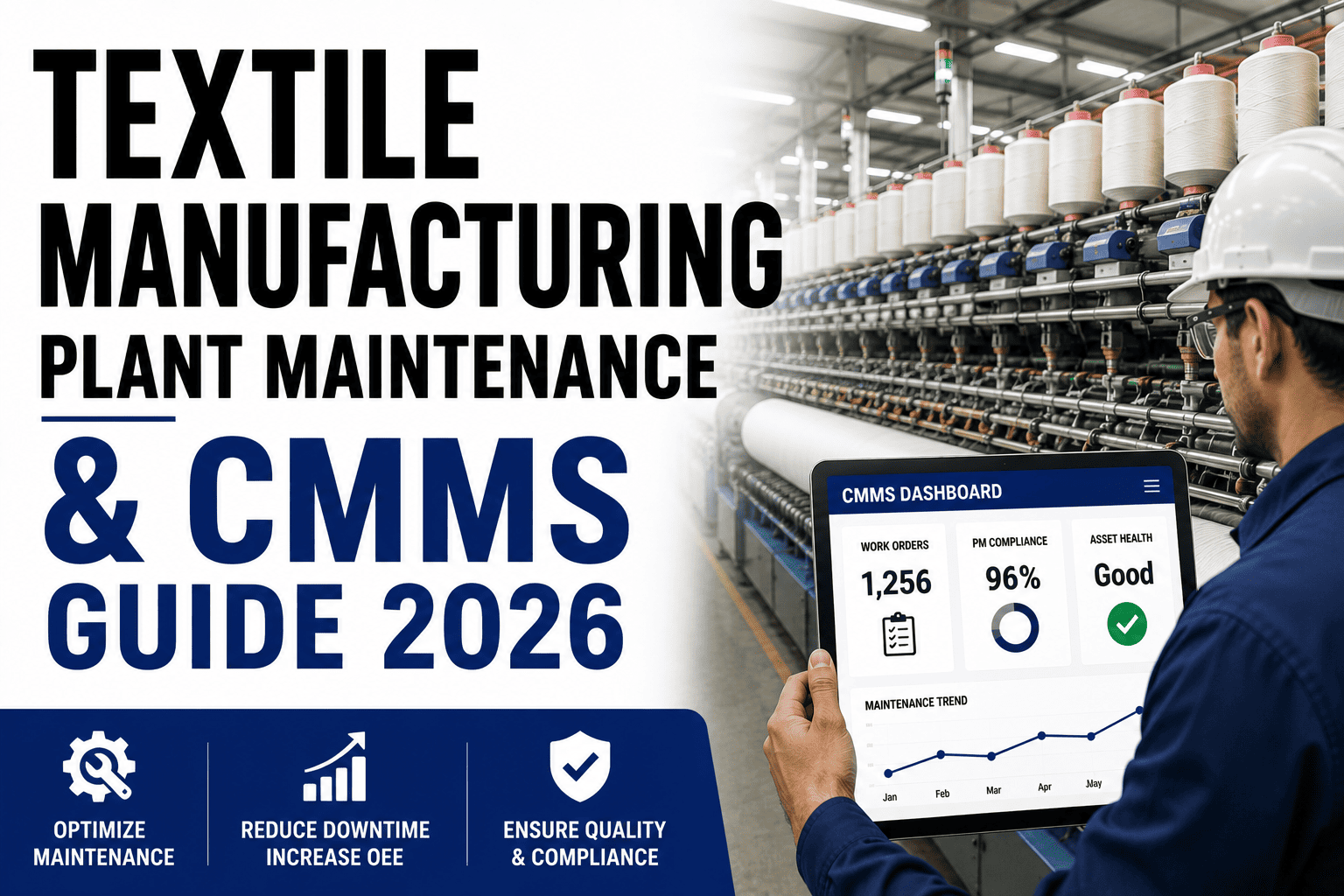
Textile manufacturing maintenance demands a disciplined approach to preventive care for spinning frames, weaving looms, knitting machines, dyeing equipment and humidification systems that operate around the clock in lint-heavy, high-humidity environments. A modern textile plant CMMS centralizes work orders, automates PM schedules and tracks spare-parts inventory so reliability teams can prevent yarn breakage, protect fabric quality and sustain production speed. This 2026 textile maintenance guide covers spindle upkeep, loom PM checklists, dye machine scheduling and how AI-driven predictive maintenance transforms reactive firefighting into planned, cost-effective execution. Ready to eliminate paper work orders and cut unplanned downtime? Start Free Trial and see how OxMaint streamlines textile maintenance management in days, not months.
Is lint, humidity and 24/7 operation quietly destroying your textile machinery?
Spinning frames, weaving looms and dye ranges run relentlessly in abrasive, fiber-laden environments. Without a structured textile plant maintenance strategy, unplanned downtime cascades into missed delivery windows, rejected fabric batches and eroded margins. The right CMMS changes the math.
Preventive maintenance schedules for spinning, weaving, knitting and dyeing equipment
A textile manufacturing plant running 6,000 hours per year per machine cannot afford reactive maintenance. Industry benchmarks show that structured PM reduces unplanned downtime by 30–50% and cuts spare-parts spend by 18–25%. Below is a textile CMMS guide to PM intervals for the four core production zones.
Spinning Frame & Rotor PM
- Daily: clear lint from drafting zones, verify spindle oil levels, check top-arm pressure
- Weekly: inspect cradle and grippper arms, measure spindle vibration with ultrasound
- Monthly: verify traveler replacement cycles (every 8–12 days for cotton), calibrate autoleveller
- Quarterly: full spindle drive inspection, bearing greasing, suction tube cleaning
Loom & Knitting Machine PM
- Daily: clean reed and healds, verify warp tension, inspect shuttle or projectile guides
- Weekly: lubricate dobby/jacquard mechanisms, check let-off and take-up drives
- Bi-weekly: inspect cam assemblies, clean weft insertion channel, verify selvage cutters
- Quarterly: bearing replacement on main drive, full geometry recalibration of beat-up mechanism
Dye Range & Finishing PM
- Daily: inspect valve seals on jet dyeing machines, verify liquor ratio sensors
- Weekly: descale heat exchangers, calibrate pH and temperature probes, drain compressor moisture
- Monthly: stenter chain lubrication, inspect fabric guiders and expanders, clean nozzle filters
- Quarterly: pressure-test autoclave vessels, verify PLC interlocks, replace gasket kits on dye kiers
Humidification & Compressed Air PM
- Daily: verify relative humidity setpoints (55–65% for spinning, 70–75% for weaving)
- Weekly: clean AHU filters, inspect spray nozzles and ultrasonic atomizers
- Monthly: compressed air dew point check, leak survey (a 3 mm leak wastes ~$1,800/yr)
- Quarterly: boiler TDS blowdown, cooling tower descaling, AHU belt replacement
What does textile plant maintenance cost — and what does a CMMS save?
Consider a mid-sized textile manufacturing plant with 180 critical assets (40 looms, 24 spinning frames, 12 dye ranges plus utility systems) spending roughly $42,000 annually on emergency callouts, expedited spares and production losses. Here is how the numbers shift when a textile CMMS takes over.
| Metric | Spreadsheet / Reactive | OxMaint CMMS | Improvement |
|---|---|---|---|
| PM compliance rate | 48–60% | 92–97% | +40% avg |
| Mean time to repair (MTTR) | 4.2 hours | 2.1 hours | −50% |
| Unplanned downtime hours/yr | 520 hrs | 310 hrs | −40% |
| Spare-parts inventory carrying cost | $85,000 | $64,000 | −25% |
| OEE (overall equipment effectiveness) | 61% | 74% | +13 pts |
| Audit preparation time | 3–5 days | 2 hours | −95% |
How to deploy a textile CMMS in 8 weeks — a step-by-step roadmap
Switching from spreadsheets or legacy software to an AI-powered CMMS does not require a multi-month IT project. The timeline below reflects a typical 180-asset textile plant going live with OxMaint.
Asset hierarchy & criticality
Import all 180 assets — spinning frames, looms, dye kiers, compressors, AHUs — into OxMaint. Assign criticality ratings (A/B/C) based on production impact and failure history. Upload OEM manuals and spare-parts BOMs.
PM schedule build-out
Convert daily, weekly, monthly and quarterly PM checklists into automated work-order triggers. OxMaint routes each task to the right technician with digital checklists, photos and required spare parts pre-attached.
Spare-parts & inventory sync
Link each asset to its spare-parts catalog. Set min/max reorder points for high-usage items like spindle tapes, heald wires and dye-nozzle filters. Enable barcode scanning for fast issue and return.
Mobile rollout & go-live
Deploy the OxMaint mobile app to all maintenance technicians. Run parallel week to validate workflows. Enable AI predictive alerts on vibration and temperature data from critical spindle and loom drives. Go live.
Why textile plants choose OxMaint for maintenance & reliability
OxMaint is an AI-powered CMMS and EAM platform built for the realities of textile manufacturing — lint, humidity, 24/7 shifts and tight delivery windows. Here is how specific capabilities map directly to textile plant outcomes.
Automated PM scheduling for textile equipment
OxMaint auto-generates work orders for spindle oiling, loom lubrication, dye-nozzle cleaning and AHU filter changes based on runtime hours, calendar intervals or meter readings — eliminating the missed-PM penalty that causes 37% of unplanned downtime.
Outcome: 35–50% fewer unplanned breakdownsAI predictive maintenance on vibration & temperature
Connect OxMaint to vibration sensors on spinning spindles and loom main drives. The AI engine detects bearing-wear signatures 2–6 weeks before failure, converting catastrophic breakdowns into planned weekend repairs.
Outcome: 25–40% reduction in emergency calloutsSpare-parts inventory with barcode tracking
Track every spindle tape, heald wire, jacquard harness and dye-nozzle filter by part number, bin location and reorder point. Technicians scan barcodes to issue parts from stock; OxMaint auto-creates purchase requests when min-levels hit.
Outcome: 18–25% lower inventory carrying costMobile work orders for 24/7 shift coverage
Technicians receive and complete work orders on mobile devices — with photo evidence, digital signatures and failure-code capture — directly at the machine. No paper, no lost data, no shift-handover gaps on night or weekend crews.
Outcome: 50% faster MTTR across all shiftsSee OxMaint on your textile assets — book a 30-min demo
Walk through a live textile plant setup: loom PM schedules, spindle vibration alerts, dye-range work orders and spare-parts barcode flow. Discover how OxMaint pays for itself in under 90 days.
Textile plant CMMS — frequently asked questions
What is a textile plant CMMS and how does it work?
A textile plant CMMS is a software platform that centralizes work orders, preventive maintenance schedules, asset records, spare-parts inventory and maintenance analytics for spinning, weaving, knitting and dyeing equipment. It automates PM triggers based on runtime or calendar intervals, routes tasks to technicians via mobile devices, and uses AI to predict failures from sensor data — replacing spreadsheets and paper logs with a single auditable system.
How much does a CMMS cost for a textile manufacturing plant?
Most textile CMMS platforms price per user per month, ranging from $35 to $90 per technician. For a 180-asset plant with 8 maintenance users, annual cost typically falls between $3,400 and $8,600. With OxMaint, the 35–50% reduction in unplanned downtime usually delivers full payback in under 90 days. You can Start Free Trial to evaluate the platform on your own assets first.
How long does it take to implement a CMMS in a textile plant?
A typical 180-asset textile plant goes live with OxMaint in 6–8 weeks. Weeks 1–2 cover asset hierarchy import and criticality ranking; weeks 3–4 build out PM schedules; weeks 5–6 sync spare-parts inventory; and weeks 7–8 deploy the mobile app and run parallel validation. Plants migrating from spreadsheets move faster because the data structure is simpler.
Can a textile CMMS connect to vibration and temperature sensors on spinning machines?
Yes. OxMaint integrates with vibration sensors, temperature probes and PLC data from spinning frames, looms and dye ranges via standard protocols. The AI engine analyzes bearing-wear signatures and thermal anomalies, generating predictive work orders 2–6 weeks before failure — turning catastrophic spindle or loom breakdowns into planned weekend interventions.
What are the biggest maintenance challenges in textile manufacturing?
The top challenges are lint and dust infiltration damaging bearings and drives, high-humidity corrosion of electrical components, 24/7 production leaving little maintenance windows, yarn-breakage quality losses from poorly maintained drafting zones, and difficulty tracking spare parts across hundreds of similar machines. A textile CMMS addresses each by enforcing PM checklists, capturing failure data and ensuring the right parts are in stock at the right time.
Stop firefighting. Start preventing.
Join textile manufacturers who cut unplanned downtime by 35–50%, eliminated paper work orders and lifted OEE by double digits. Deploy OxMaint in weeks — not months — and let AI protect your spindles, looms and dye ranges.
Free 14-day trial · No credit card

.png)