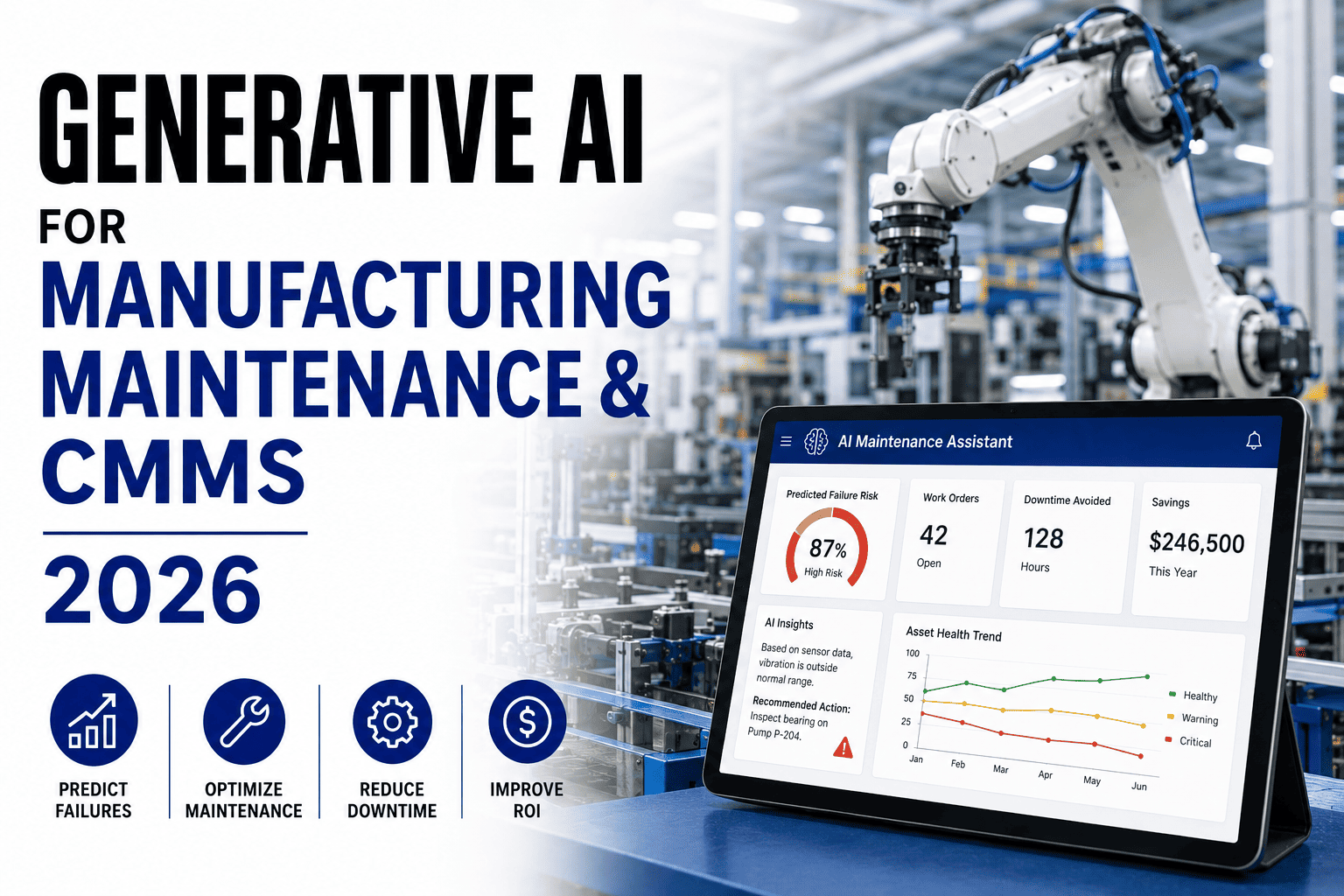
Generative AI for manufacturing maintenance is reshaping how reliability teams draft work orders, diagnose failures, write preventive maintenance procedures, and query CMMS data — faster than any technology since the CMMS itself. By 2026, an AI maintenance assistant can cut work-order writing time by 60–80%, summarize years of failure history in seconds, and generate step-by-step SOPs grounded in your own asset data. This guide covers proven generative AI CMMS use cases, prompt patterns, data-privacy safeguards, and how to deploy AI on the plant floor without letting hallucinations reach technicians. Ready to see it on your assets? Start Free Trial or read on for the full 2026 playbook.
Can generative AI write your next 10,000 work orders — without hallucinating on the shop floor?
From auto-drafted failure narratives to instant CMMS data Q&A, generative AI is now the fastest lever for maintenance teams chasing OEE above 75%. Here's how plants deploy it safely in 2026.
Why generative AI for manufacturing maintenance is a 2026 priority
Roughly 70% of plants still rely on spreadsheets or paper-based work orders, and the average maintenance tech spends 40–50% of a shift on administrative tasks — searching manuals, typing failure descriptions, and chasing history. Generative AI collapses that overhead by reading your CMMS data and producing natural-language output instantly.
A 180-asset plant spending $42K/yr on maintenance admin and losing 200 hours monthly to reactive firefighting can redirect that capacity toward preventive and predictive work the moment generative AI enters the workflow. The technology is no longer experimental — it is embedded in leading CMMS platforms and delivering measurable ROI within the first quarter.
5 proven generative AI CMMS use cases on the plant floor
These are not theoretical pilots. Each use case below is live in manufacturing plants today, grounded in real CMMS data to prevent hallucinations and deliver audit-ready output.
AI-generated work orders from natural language
A tech types or speaks "hydraulic pump on Line 3 making grinding noise after startup" and the AI drafts a complete work order: asset ID pulled from the CMMS, failure code mapped to ISO 14224, priority suggested from criticality, spare parts pre-listed, and safety permits flagged. Supervisors review and approve in one click — cutting work-order creation from 8 minutes to under 90 seconds.
Failure diagnosis narratives & history summaries
Generative AI reads 3 years of work-order history for an asset and produces a concise failure-pattern narrative: "This conveyor motor has failed 4 times in 18 months — 3 bearing seizures, 1 overload. Mean time between failures is 5.2 months. Recommend vibration analysis monthly and bearing replacement at 4-month intervals." This turns raw data into reliability decisions in seconds.
CMMS data Q&A in plain English
Ask "What's our MTTR on CNC-12 this quarter and what's driving it?" and get an instant answer with supporting data — no SQL, no exported spreadsheets, no waiting on a BI team. This democratizes maintenance analytics for supervisors, planners, and plant managers who need answers during a morning huddle, not after a week of report building.
AI-generated PM procedures & SOPs
Point the AI at an asset manual, OEM spec sheet, and historical PM checklist — it generates a step-by-step preventive maintenance procedure with torque values, safety lockout steps, required PPE, and estimated duration. New technicians follow consistent, audit-ready SOPs instead of tribal knowledge scrawled on a whiteboard.
Spare-parts recommendations & inventory optimization
When the AI drafts a work order, it cross-references the BOM and inventory to suggest required spares, flag stockouts, and recommend reorder quantities based on lead time and failure frequency. Plants using this pattern report 15–25% lower spare-parts carrying costs while reducing stockout-driven downtime.
How to deploy generative AI in your CMMS — a 90-day timeline
A phased rollout keeps hallucinations off the shop floor and builds technician trust before scaling. Here's the timeline plants follow when implementing an AI maintenance assistant inside their CMMS.
Data foundation & grounding
Cleanse asset records, standardize failure codes (ISO 14224), and verify work-order history is complete. Connect the CMMS as the single source of truth so the AI retrieves facts — not guesses. Define data-privacy rules: no proprietary data leaves your tenant, no model training on your data.
Pilot two use cases with human-in-the-loop
Launch AI work-order drafting and failure-history summaries with 5–10 assets. Every AI output is reviewed and approved by a supervisor before it reaches a technician. Collect feedback, refine prompt templates, and log accuracy. Target: 90% of AI-drafted work orders approved with zero edits.
Scale across all assets & add Q&A
Roll out to the full asset register, enable CMMS data Q&A for planners and managers, and generate PM procedures for top criticality assets. Measure KPIs: work-order completion rate, MTTR, PM compliance, and admin hours saved. Most plants see 30–50% reduction in unplanned downtime within the first quarter post-deployment.
Generative AI CMMS vs traditional CMMS: what changes for maintenance teams
The difference is not just automation — it's a shift from the technician serving the software (data entry, searches, report building) to the software serving the technician (drafted content, instant answers, proactive recommendations).
| Maintenance task | Traditional CMMS | Generative AI CMMS |
|---|---|---|
| Work-order creation | Manual entry, 6–8 min per WO | AI-drafted from description, <90 sec, supervisor-approved |
| Failure history review | Scroll through hundreds of WO records | AI narrative summary with patterns & MTBF in seconds |
| PM procedure writing | Manual SOP, updated annually if at all | AI-generated from OEM specs + history, updated dynamically |
| Data queries & reporting | Export to Excel, build pivot tables, wait for BI | Ask in plain English, get instant answer with data |
| Spare-parts linkage | Tech manually checks BOM & inventory | AI auto-suggests parts, flags stockouts, recommends reorders |
| New-tech onboarding | Shadowing, tribal knowledge, 4–6 week ramp | AI answers asset-specific questions on Day 1 |
Preventing AI hallucinations from reaching the shop floor
The single biggest concern reliability leaders raise about generative AI in maintenance is accuracy. A hallucinated torque spec or wrong safety procedure can cause equipment damage or injury. Here's how responsible deployment works.
Ground every output in CMMS data
The AI retrieves facts from your asset register, work-order history, BOM, and OEM documents — it does not generate from general internet knowledge. If the data isn't in your CMMS, the AI says "I don't have that information" rather than guessing.
Human-in-the-loop approval
Every AI-drafted work order, PM procedure, or failure narrative is reviewed by a qualified supervisor before it reaches a technician. The AI accelerates drafting; the human owns the final decision. This dual-layer model is the industry standard for safe deployment.
Data privacy & tenant isolation
Your CMMS data is never used to train public models. Queries run inside your isolated tenant with encryption in transit and at rest. Role-based access control ensures technicians only see AI output for assets they're authorized to access.
Audit trail & version control
Every AI-generated artifact is logged with a timestamp, the source data referenced, and the approver's signature. Auditors can trace any work order or SOP back to its origin — essential for ISO 55000, TPM, and regulatory compliance (FDA, FMCSA, OSHA).
See generative AI write work orders on YOUR assets
Book a 30-minute demo and we'll connect OxMaint to a sample of your asset data — watch the AI draft work orders, summarize failure history, and answer maintenance questions live.
How OxMaint embeds generative AI into your maintenance workflow
OxMaint is an AI-powered CMMS and EAM platform built for maintenance and reliability teams. Generative AI is not a bolt-on — it's woven into work orders, asset tracking, PM scheduling, inventory, and analytics. Here's what that looks like in practice.
AI work-order drafting
Technicians describe the issue in plain language; OxMaint's AI drafts a complete work order with asset ID, failure code, priority, parts, and safety notes — grounded in your CMMS data, approved by a supervisor in one click.
Failure diagnosis & history Q&A
Ask OxMaint any question about asset history, MTBF, MTTR, or failure patterns — get instant answers with supporting data. No spreadsheets, no SQL, no waiting on BI.
AI-generated PM procedures
OxMaint generates step-by-step preventive maintenance SOPs from OEM specs and historical data — with torque values, LOTO steps, PPE, and estimated duration. Always current, always audit-ready.
Predictive maintenance + GenAI
OxMaint's predictive analytics flag likely failures before they happen; generative AI translates the prediction into a recommended action plan — what to inspect, which parts to order, and when to schedule the intervention.
A 180-asset food-processing plant spending $42K/yr on maintenance admin and losing 200 hours/month to reactive work deployed OxMaint's AI work-order drafting and failure Q&A. Within 90 days: work-order creation time dropped from 8 minutes to under 90 seconds, PM compliance rose from 68% to 94%, and unplanned downtime fell 38% — freeing 140 hours/month for preventive and improvement work. Estimated first-year savings: $87K in labor and downtime costs combined.
Generative AI for manufacturing maintenance — frequently asked questions
What is generative AI in a CMMS for manufacturing maintenance?
Generative AI in a CMMS uses large language models to draft work orders, summarize failure history, write PM procedures, and answer maintenance data questions in plain English — all grounded in your own asset and work-order data. Unlike traditional CMMS software that stores data for humans to query manually, a generative AI CMMS actively produces useful content and insights, reducing admin time by 60–80%.
How do you prevent AI hallucinations in maintenance work orders?
The AI is grounded in your CMMS data — asset registers, work-order history, BOMs, and OEM documents — so it retrieves facts rather than generating from general knowledge. Every AI-drafted work order or procedure is reviewed and approved by a qualified supervisor before it reaches a technician, and all outputs include source references for audit traceability. If the data isn't in your system, the AI is configured to say so rather than guess. Book a demo to see the guardrails live.
Is my maintenance data used to train public AI models?
No. Reputable generative AI CMMS platforms like OxMaint run queries inside your isolated tenant with encryption in transit and at rest. Your asset data, work orders, and failure history are never used to train public models or shared across tenants. Role-based access control ensures users only see AI output for assets they're authorized to access.
How long does it take to deploy generative AI in a CMMS?
Most plants complete a phased rollout in 90 days: Month 1 focuses on data cleansing and grounding the AI in your CMMS; Month 2 pilots two use cases (typically work-order drafting and failure summaries) with human-in-the-loop approval on 5–10 assets; Month 3 scales across all assets and adds data Q&A. Plants using OxMaint typically see measurable ROI — reduced admin time and improved PM compliance — within the first quarter. Start Free Trial to begin in under an hour.
What ROI can a plant expect from generative AI for maintenance?
Plants deploying generative AI in their CMMS report 60–80% reduction in work-order writing time, 30–50% less unplanned downtime, 15–25% lower spare-parts carrying costs, and 20+ percentage-point gains in PM compliance. For a 180-asset plant, first-year savings typically range from $60K–$120K in labor and downtime costs combined. Payback periods average 3–5 months.
Ready to put generative AI to work on your assets?
Join the maintenance teams using OxMaint to draft work orders in seconds, predict failures before they happen, and eliminate spreadsheet-driven maintenance for good.
Free 14-day trial · No credit card