Manufacturing Plant Maintenance Training Programs: Complete Guide 2026
By oxmaint on February 9, 2026
Every hour of unplanned downtime in a manufacturing plant costs between $5,000 and $50,000 depending on the industry—and the majority of those breakdowns trace back to human error or insufficient technician skills. With over 40% of experienced maintenance professionals expected to retire within the next decade and 73% of manufacturers already struggling to hire qualified replacements, the plants that invest in structured workforce training programs today will be the ones that stay competitive tomorrow. The gap between what your team knows and what modern equipment demands is widening fast, but a well-built training program can close it. Schedule a free consultation to see how Oxmaint helps plants build, track, and optimize maintenance training programs.
The Maintenance Workforce Crisis: What the Numbers Reveal
Manufacturing is facing a workforce challenge unlike anything in the past three decades. The convergence of mass retirements, evolving technology requirements, and declining interest in skilled trades has created a perfect storm that threatens plant reliability and profitability across every sector.
2.1M
Manufacturing jobs could go unfilled by 2030 due to the skills gap
Deloitte & The Manufacturing Institute
87%of companies report existing or anticipated skills gaps
73%of businesses struggle to hire skilled maintenance technicians
6 in 10workers will require retraining before 2027 (World Economic Forum)
40%+of skilled technicians nearing retirement with no replacement pipeline
Close the skills gap before it closes your production lines. Oxmaint centralizes training records, certification tracking, and skill matrices so your workforce stays qualified, compliant, and ready.
The most effective maintenance training programs are not one-size-fits-all. They are modular, role-specific, and progressively structured—taking technicians from foundational safety and mechanical skills through advanced predictive analytics and digital system proficiency. Here is the training architecture that leading manufacturing plants are implementing in 2026.
Progressive Maintenance Training Architecture
Level 1
Safety & Compliance Foundations
OSHA 10/30 General IndustryLockout/Tagout (LOTO) ProceduresArc Flash & Electrical Safety (NFPA 70E)Confined Space Entry & Fall ProtectionHazard Communication (HazCom)
Weeks 1-3
Level 2
Core Mechanical & Electrical Skills
Bearings, Lubrication & AlignmentPower Transmission & Coupling SystemsBasic Electrical Theory & Motor ControlsBlueprint Reading & SchematicsWelding & Fabrication Fundamentals
CMMS Operation & Digital Work OrdersVibration Analysis & ThermographyOil Analysis & Ultrasonic TestingIoT Sensor Data InterpretationReliability-Centered Maintenance (RCM)
Weeks 19-26
Five Phases to Launch a Training Program That Actually Works
Most failed training initiatives share a common problem: they skip the assessment phase and jump straight into generic coursework. The plants that see real results follow a disciplined, data-driven process that connects every training hour to measurable performance outcomes.
Training Program Launch Roadmap
1
Weeks 1-2
Baseline Skills Assessment
Evaluate every technician across mechanical, electrical, automation, and digital literacy domains using standardized skill matrices. Identify where gaps are widest and which roles carry the highest operational risk if competency is insufficient.
2
Weeks 3-4
Custom Curriculum Architecture
Design role-specific learning paths that blend classroom theory, hands-on lab exercises, e-learning modules, and on-the-job mentoring. Map each training module to specific equipment types and competency benchmarks your plant requires.
3
Weeks 5-12
Blended Delivery & Hands-On Practice
Roll out training in cohorts to minimize production disruption. Use digital platforms for theoretical content, simulation tools for complex troubleshooting, and supervised equipment practice to build real-world confidence and retention.
4
Ongoing
Certification & Digital Competency Tracking
Record all completions, certifications, and competency scores in a centralized CMMS. Sign up for Oxmaint to automatically track certification expiry dates, send renewal alerts, and maintain audit-ready compliance records for your entire team.
5
Quarterly
Measure, Correlate & Refine
Link training data to maintenance KPIs—MTBF, MTTR, first-time fix rates, unplanned downtime, and safety incidents. Use the correlation to identify which training investments deliver the highest returns and continuously refine the program.
Manage Your Entire Training Program in One Place
Oxmaint gives maintenance leaders a single platform to assign training modules, track certifications, build skill matrices, attach SOPs to work orders, and connect workforce development directly to plant performance metrics.
How Leading Plants Deliver Training: Methods Compared
No single training format works for everything. The best programs strategically combine multiple delivery methods based on the skill type, risk level, and learning retention goals. Here is how the most commonly used methods stack up for manufacturing maintenance teams.
Plants achieving the highest training ROI combine hands-on practice with digital reinforcement and structured mentoring—never relying on a single format alone.
Certifications Worth Investing In
Industry-recognized certifications do more than validate skills—they create career progression pathways that retain your best people. Tracking these credentials manually is a compliance risk. A CMMS like Oxmaint automates expiry alerts and keeps every certification record audit-ready.
Priority Certifications for Maintenance Teams
SMRP
Certified Maintenance & Reliability Professional (CMRP)
Gold standard credential covering equipment reliability, work management, business operations, and organizational leadership in maintenance.
OSHA
OSHA 10 & 30 Hour General Industry
Mandatory safety training in hazard recognition, machine guarding, electrical safety, and emergency procedures required across most manufacturing facilities.
ISA
Certified Automation Professional (CAP)
Demonstrates mastery of automation systems including PLCs, instrumentation, control loops, and system integration—increasingly critical for Industry 4.0 plants.
VI
Vibration Analyst Certification (Category I-IV)
Progressive certification from basic data collection through advanced fault diagnosis. Essential credential for predictive maintenance specialists and reliability engineers.
NFPA
Certified Electrical Safety Worker (CESW)
Validates competency in electrical hazard assessment, safe work practices, and NFPA 70E compliance for technicians working on energized equipment.
Covers lubrication best practices, oil analysis interpretation, contamination control, and program management—often overlooked but critical for extending equipment life.
Never miss a certification renewal again. Oxmaint automatically sends alerts before credentials lapse—keeping your entire team compliant without spreadsheet headaches.
Proving the Return: Training Impact on Plant Performance
Maintenance training is one of the few investments that pays back across every operational metric simultaneously—downtime, safety, repair quality, and employee retention all improve when technicians have the right skills. Here is what the data shows from plants that have implemented structured programs.
32%
Less unplanned downtime
Plants with structured training reduce unplanned equipment failures by nearly a third within the first 12 months
45%
Higher first-time fix rate
Trained technicians diagnose root causes correctly on the first attempt far more often, eliminating costly repeat visits
25%
Fewer safety incidents
Proper training in LOTO, arc flash, and confined space procedures directly reduces maintenance-related injuries and OSHA violations
3x
Better employee retention
Technicians at plants with clear training paths and career progression are three times more likely to stay long-term
How CMMS Technology Supercharges Workforce Development
A modern CMMS is not just a work order system—it is the operational backbone that connects training programs to actual maintenance execution. When SOPs live inside work orders, skill matrices determine task assignments, and certification data triggers alerts, your training program stops being a binder on a shelf and starts driving daily performance. Book a demo to see how Oxmaint makes this work.
Oxmaint Training & Workforce Features
SOPs Embedded in Work Orders
Attach step-by-step procedures, photos, and videos directly to tasks so technicians access guided instructions exactly when and where they need them—on the floor, on their mobile device.
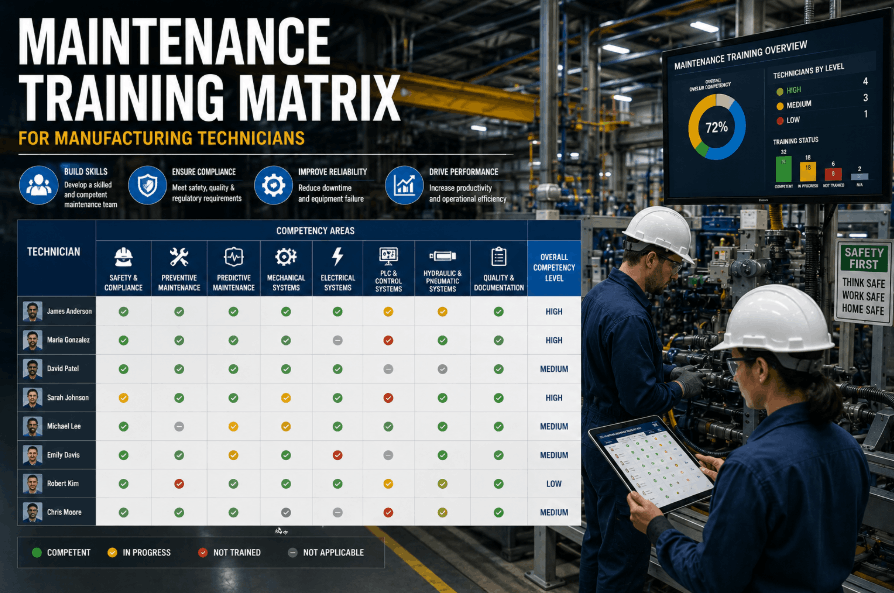
Live Skill Matrix Management
Maintain a real-time map of who is qualified for which equipment types and task categories. The system ensures only certified technicians are assigned to critical or regulated maintenance work.
Automated Certification Expiry Alerts
Set it once and forget it. Oxmaint monitors every certification expiration date and sends automated reminders to managers and technicians well before credentials lapse—eliminating compliance surprises during audits.
Training-to-KPI Performance Analytics
Correlate training completion data with maintenance KPIs like MTBF, MTTR, wrench time, and first-time fix rates. See exactly which training investments produce the biggest operational improvements.
See training management in action. Our team will walk you through skill matrices, SOP workflows, and certification tracking configured for your plant's specific needs.
Single-Skill vs. Multi-Craft: Why Cross-Training Wins
Plants that depend on single-skill specialists face constant bottlenecks—waiting for the one electrician on shift, or calling in overtime because no mechanic on duty is PLC-qualified. Building multi-craft capability through structured cross-training eliminates these constraints and creates a more resilient, flexible workforce.
Workforce Model Comparison
Single-Skill Specialists
Multi-Craft Cross-Trained
Bottlenecks waiting for the right technician per shift
Any on-shift technician handles most equipment issues
Excessive overtime to cover skill-specific absences
Reduced overtime through flexible task assignment
Institutional knowledge trapped in individual heads
Knowledge distributed and documented across the team
Every retirement creates a critical capability gap
Retirements manageable because expertise is shared
2-3xlonger average response to breakdowns
60%faster mean time to repair with cross-trained crews
Invest in Your People. Protect Your Production.
Your equipment is only as reliable as the team maintaining it. Oxmaint gives maintenance managers a mobile-first platform to track every certification, embed SOPs into daily work, manage skill development across the team, and prove training ROI with real performance data—so your workforce stays sharp and your production stays running.
How quickly can we implement a structured maintenance training program?
Most manufacturing plants can launch a foundational program within 8 to 12 weeks. The first two weeks focus on skills gap assessments, followed by curriculum design and a phased rollout that starts with safety compliance and critical equipment skills. Using Oxmaint accelerates the process with built-in templates for certification tracking and training documentation. Schedule a consultation for a customized timeline based on your plant's size and complexity.
What is the fastest way to get technicians comfortable with a new CMMS?
Start with a pilot group of 5-10 tech-forward technicians who become internal champions. Combine short walkthroughs with supervised practice during actual work order completion. Oxmaint's mobile-first design minimizes the learning curve—most teams handle core functions within a week. Sign up for a free account and let your team try it with no commitment.
How do we measure whether training is actually improving plant performance?
Track maintenance KPIs before and after training rollouts. Focus on mean time between failures (MTBF), mean time to repair (MTTR), first-time fix rates, unplanned downtime hours, and safety incident frequency. A CMMS collects this data automatically, making it straightforward to prove the connection between training investment and measurable operational improvement.
Should we build all training in-house or use external providers?
A blended approach works best. Use external providers for industry certifications like CMRP, vibration analysis, and OSHA compliance where third-party validation matters. Build in-house programs for plant-specific equipment training, SOPs, and institutional knowledge transfer through mentoring. Oxmaint stores and delivers both types of content so every technician has consistent access.
How does Oxmaint help manage maintenance training specifically?
Oxmaint provides centralized certification tracking with automated expiry alerts, digital SOP attachment to every work order, skill matrix management that maps technician qualifications to equipment types, and analytics that correlate training completion to operational KPIs. The platform is mobile-first so technicians access training materials directly from the shop floor. Book a demo to see it configured for your plant.

.png)

