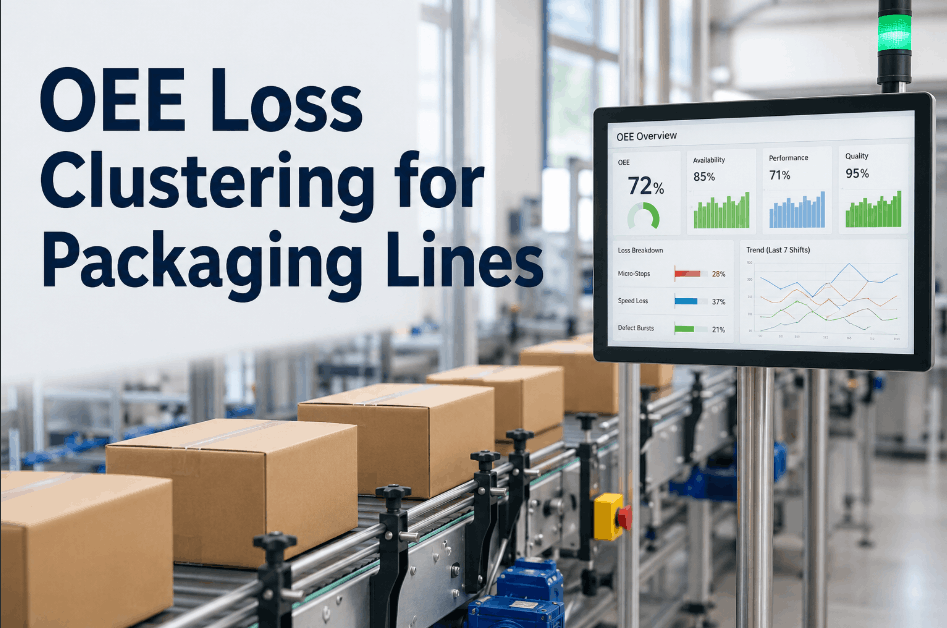
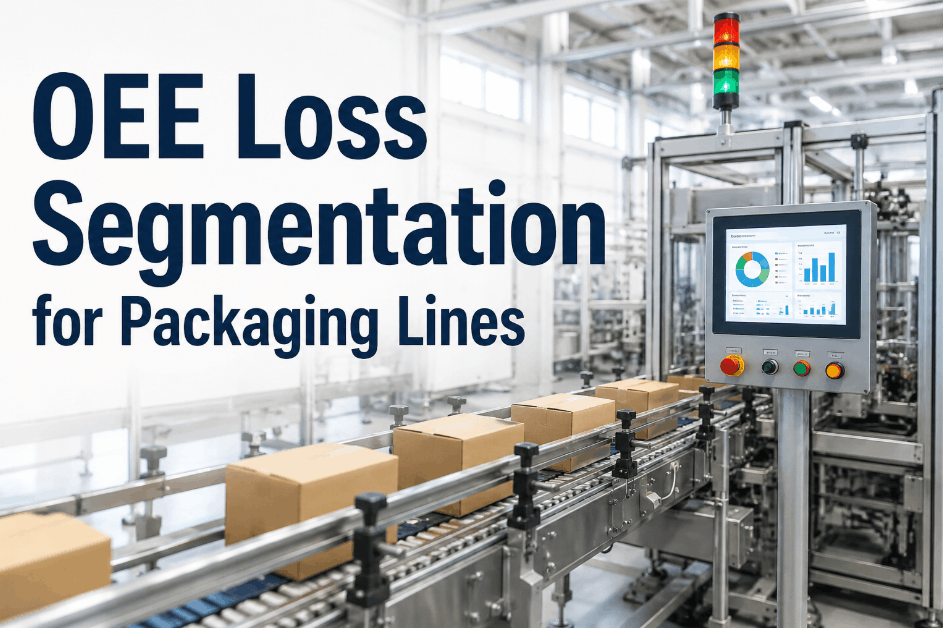
Packaging line stoppages in FMCG and food manufacturing do not just cost hours — they risk product shelf life, cause fill weight compliance failures, and in regulated food environments can trigger a line shutdown by the quality team. A packaging line runs as well as its weakest component: a worn sealing jaw, a miscalibrated coder, or a blocked filler nozzle can silently produce non-conforming product for an entire shift before detection. This checklist covers the five critical machine categories on every packaging line — fillers, sealers, labellers, coders, and conveyors — along with the changeover and audit trail checks that food safety standards demand. Maintenance teams using OxMaint's CMMS platform can schedule every task below by line, shift, or machine asset — and build the documented maintenance history that BRC, SQF, and FSSC 22000 auditors look for.
FMCG & Food Manufacturing · Packaging Line · PM Checklist
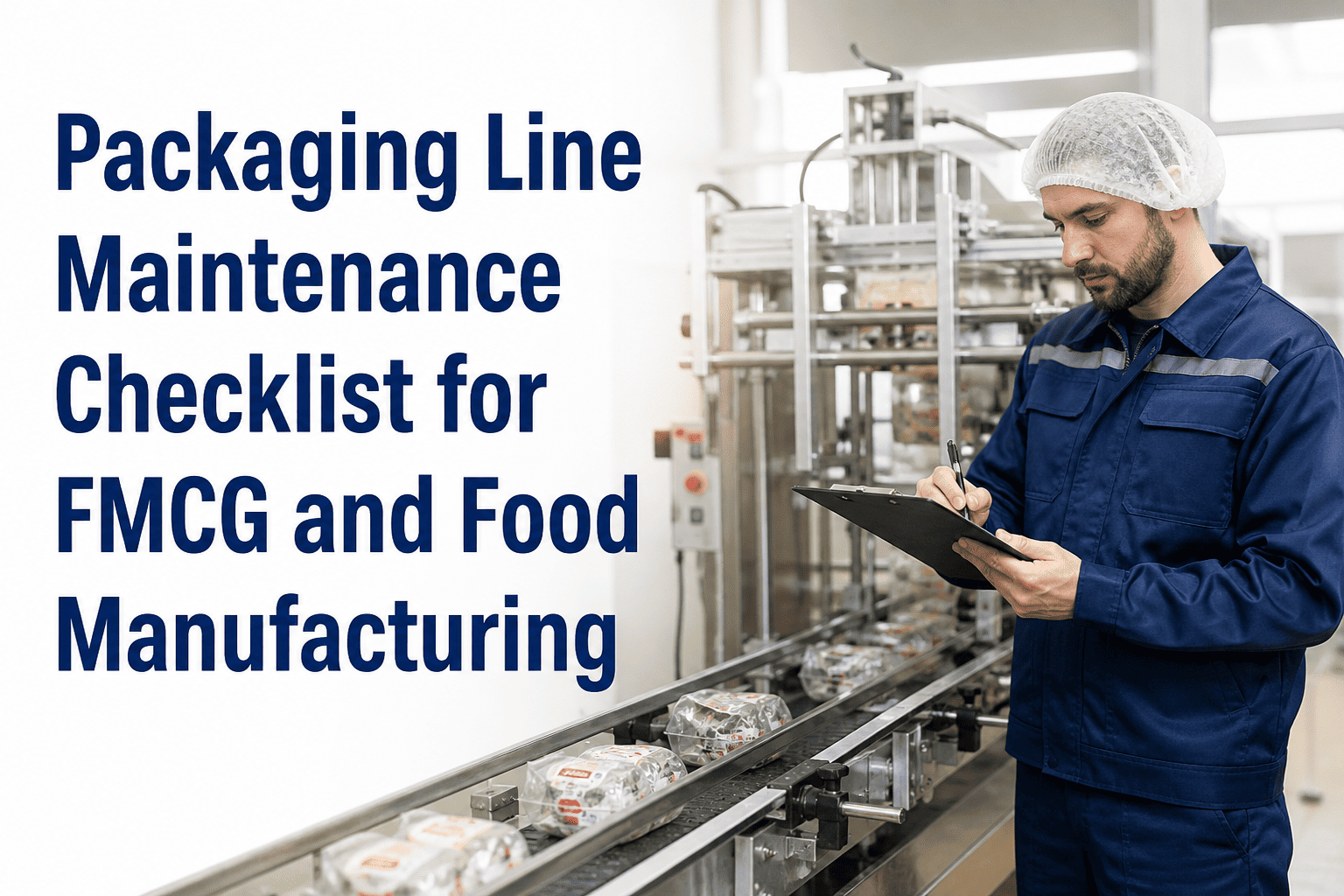
Packaging Line Maintenance Checklist for FMCG and Food Manufacturing
A structured preventive maintenance programme across five machine categories — built to maximise uptime, protect product quality, and satisfy food safety audit requirements.
5
Machine Categories
55+
Check Points
23%
Avg OEE Gain with PM
BRC / SQF
Audit Ready
Frequency:
D Daily
W Weekly
M Monthly
Q Quarterly
A Annual
Machine 01
Filling Machines
Fill weight accuracy and nozzle hygiene are the two failure modes that matter most in food and FMCG filling. Both can go undetected for a full shift when pre-run checks are skipped.
Fill weight verified against target with first-off check — minimum 10 samples weighed before line releases to production
Line Operator · First-off check record
All filler nozzles inspected for drip, clogging, or cross-contamination residue before each production run
Line Operator · Pre-run inspection form
Product contact surfaces sanitised to GMP standard and swab result within specification before start of production run
QA Technician · Sanitation log
Filler piston seals and O-rings inspected for wear, cracking, or deformation — deteriorating seals cause fill weight drift
Maintenance Tech · Weekly inspection log
Filling speed accuracy tested at maximum production rate — timing deviation above 1% flagged for servo or drive calibration
Maintenance Tech · Speed calibration log
Flow meter calibration verified against certified reference — out-of-calibration flow meters cause systematic fill weight non-compliance
Instrumentation Tech · Calibration certificate
Hopper level sensor calibration checked — misread levels cause filler starvation and package underfill downstream
Maintenance Tech · Sensor calibration log
Full CIP cycle validated against microbiological swab results — validation report retained for food safety audit trail
QA Manager · CIP validation report
Machine 02
Sealing Machines
Seal integrity is the single non-negotiable output of every sealing machine. A failed seal leaks, contaminates adjacent product, and voids the shelf-life claim. Sealing jaws are the most frequently replaced component on the packaging floor.
Seal temperature at setpoint confirmed before production begins — cold jaws produce weak seals that pass visual but fail peel test
Line Operator · Pre-run seal check
First-off seal integrity test completed — peel strength, seal width, and burst pressure all within specification before production releases
QA Technician · First-off seal integrity record
Sealing jaw faces inspected for wear grooves, contamination residue, or uneven contact surface — photograph damage findings
Maintenance Tech · Jaw inspection record
Sealing pressure verified at jaw closed position — pressure drift causes seal width variation and increases reject rate at downstream vision system
Maintenance Tech · Pressure log
Jaw temperature uniformity measured across full jaw width with thermocouple probe — hot or cold spots cause inconsistent seal quality
Maintenance Tech · Jaw temperature profile record
PTFE jaw coatings inspected for delamination or thinning — degraded PTFE causes product sticking and seal contamination in food environments
Maintenance Tech · PTFE inspection log
Jaw replacement scheduled based on seal cycle count from CMMS — proactive replacement before wear causes seal failure in production
Maintenance Planner · CMMS PM work order
Your packaging line's maintenance history in one place
OxMaint logs every PM task, seal integrity result, and corrective action against the line asset — giving your maintenance and QA teams the documentation food safety auditors expect on day one of an inspection.
Machine 03
Labelling Machines
An out-of-position label, a missing label, or a wrinkled label in a food or FMCG line is not just a cosmetic issue — it can mean a regulatory non-conformance, a retailer complaint, or a product recall.
Label position verified on first-off sample against approved artwork — front, back, and neck labels all within registration tolerance
QA Technician · First-off artwork check
Label detection sensor confirmed functional — vision system or mechanical detector tested with a blank-label sample before run
Line Operator · Pre-run checklist
Label reel drive tension rollers cleaned and inspected — contamination or wear on tension rollers causes label stretch and skip on high-speed machines
Maintenance Tech · Weekly drive inspection
Glue nozzle temperature and pressure within specification — cold or low-pressure glue causes label lift-off during retail shelf life
Maintenance Tech · Glue system log
Label head registration servo calibrated — servo drift causes cumulative position error that worsens through the shift on high-volume lines
Instrumentation Tech · Servo calibration record
Inspection camera or vision system cleaning and calibration verified — dirty lenses cause false accepts on mispositioned or missing labels
Maintenance Tech · Vision system calibration log
Full label application peel adhesion test conducted across the product range — adhesive performance degrades with temperature variation in cold storage lines
QA Engineer · Peel adhesion test report
Machine 04
Coding & Marking Systems
An unreadable best-before date is a regulatory violation. A wrong date code is a recall risk. Inkjet, laser, and thermal transfer coders all require maintenance routines that most packaging teams underestimate until a product leaves the factory with blank or incorrect date codes.
Date, batch, and best-before code verified correct on first-off sample before production begins — wrong codes are a recall trigger, not a rework item
QA Technician · First-off date code check
Code legibility confirmed — print contrast, character size, and barcode grade tested with verifier or scan test before line releases
Line Operator · Code legibility log
Inkjet printhead cleaned per OEM procedure — blocked nozzles cause character dropout invisible at line speed without magnification
Maintenance Tech · Printhead cleaning log
Ink viscosity and make-up fluid levels within specification — out-of-spec viscosity causes satellite droplets and character spread at high speed
Maintenance Tech · Ink system log
Laser coder lens and beam path cleaned — contaminated optics reduce code burn depth, causing codes that scan poorly after packaging
Maintenance Tech · Laser coder maintenance log
Barcode verification scan rate logged — GS1 specification requires minimum grade C (1.5) for retail supply chain; flag any batch below grade B
QA Technician · Barcode grade log
Thermal transfer ribbon supply system serviced — ribbon tracking, tension, and printhead pressure set to OEM specification for substrate in use
Maintenance Tech · TTR service record
Machine 05
Conveyors & Product Handling
Conveyors are the connective tissue of every packaging line — and the most under-maintained. Belt tracking issues, worn rollers, and accumulation zone blockages cause more stoppages per shift than any other single component category.
Belt tracking checked before production — belt running to one side causes edge wear and increases risk of product falling off line
Line Operator · Pre-shift belt check
All in-line metal detectors and checkweighers verified functional with test pieces before start of each production run
QA Technician · CCP verification log
Conveyor belts and frames cleaned to GMP standard after each run — food product residue in belt hinges causes contamination and accelerates belt degradation
Line Operator · End-of-run cleaning record
Drive chain and sprocket lubrication applied per OEM schedule — dry drive chains on accumulation conveyors cause jerky speed control and product spillage
Maintenance Tech · Lubrication log
All guide rails and side panels at correct height and spacing for current product format — wrong settings cause tippage and jams at high speed
Maintenance Tech · Format verification log
Belt tension measured on all conveyors — loose belts cause slippage under load, tight belts overload bearings and reduce motor service life
Maintenance Tech · Belt tension log
All conveyor roller bearings checked for noise, heat, or rough rotation — failed bearings on transfer sections cause product jam and belt damage simultaneously
Maintenance Tech · Bearing inspection log
Belt surface condition assessed for cuts, cracking, or delamination — replace belts before surface damage becomes a foreign body risk in a food environment
Maintenance Supervisor · Belt condition audit
Performance KPIs
Metrics That Show Your Line PM Is Working
FAQs
Frequently Asked Questions
How often should packaging line PMs be completed in a food manufacturing plant?
Daily operator checks before each run, weekly technician checks on drives and sealing systems, monthly calibration and deep inspection tasks, and quarterly audits of critical CCP equipment like metal detectors and checkweighers. Food safety standards including BRC and SQF typically require documented PM intervals with records retained for a minimum of 12 months.
OxMaint schedules every interval automatically.
What documentation does a BRC or SQF auditor look for in packaging line maintenance?
Auditors typically look for a written PM schedule, completion records for each task, calibration certificates for checkweighers and metal detectors, seal integrity test records, date code verification logs, and corrective action reports for any failures. Records must be dated, signed, and retained for the minimum period specified in the standard.
Book a demo to see how OxMaint produces audit-ready exports.
How do I reduce sealing machine downtime on a high-speed packaging line?
The most effective approach is tracking jaw cycle counts in a CMMS and scheduling proactive jaw replacement before wear-related failures occur. Most jaw failures in production are preceded by seal width drift and temperature uniformity degradation — both detectable through weekly inspection before they cause a stoppage. Maintaining a jaw exchange stock against the CMMS-tracked replacement interval eliminates emergency procurement delays.
What is the most common cause of incorrect date codes on a packaging line?
Manual code entry error at changeover is the most common root cause — particularly when the coder is set up by the line operator rather than through an integrated production management system. The second most common cause is a failed coder that continues to run without printing, producing blank or degraded codes that pass the line without detection. A CMMS-integrated CCP check before every run catches both failure modes.
Should packaging line maintenance tasks be performed during production or only during planned stoppages?
Daily pre-run checks and first-off sample tests happen before production starts. Weekly lubrication and visual inspections can be performed during planned stoppages, changeovers, or hygiene breaks without impacting OEE. Monthly and quarterly tasks should be scheduled into planned maintenance windows to avoid uncontrolled stoppages. Unplanned maintenance time costs typically three to five times more than planned maintenance windows.
Start building a planned schedule with OxMaint.
Ready to build a world-class packaging line PM programme?
Maximum Uptime. Zero Compliance Gaps. One Platform.
OxMaint gives FMCG and food packaging teams a complete CMMS built for the production floor — mobile work orders, photo evidence, automated PM scheduling, and the audit-ready documentation your food safety certification requires.