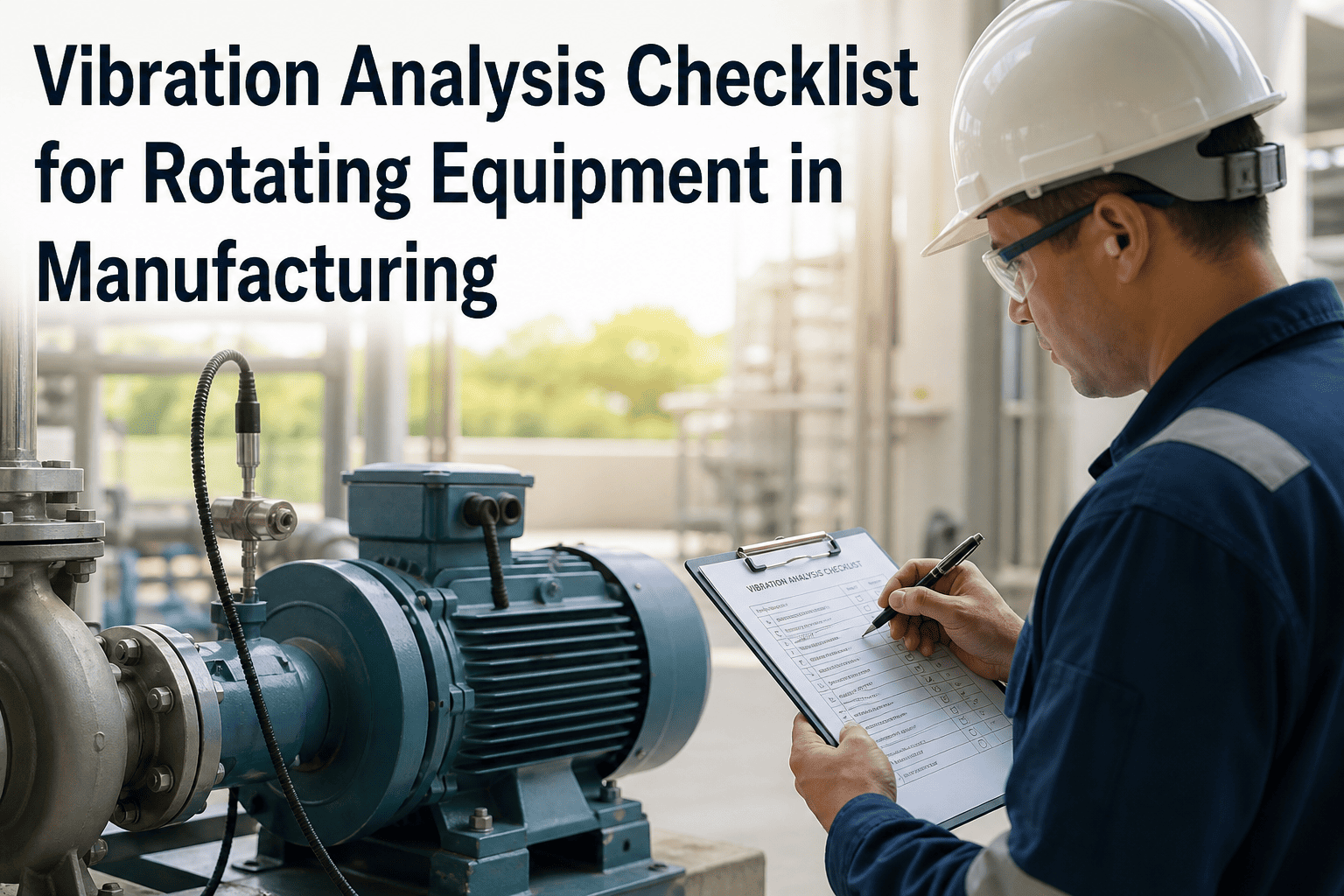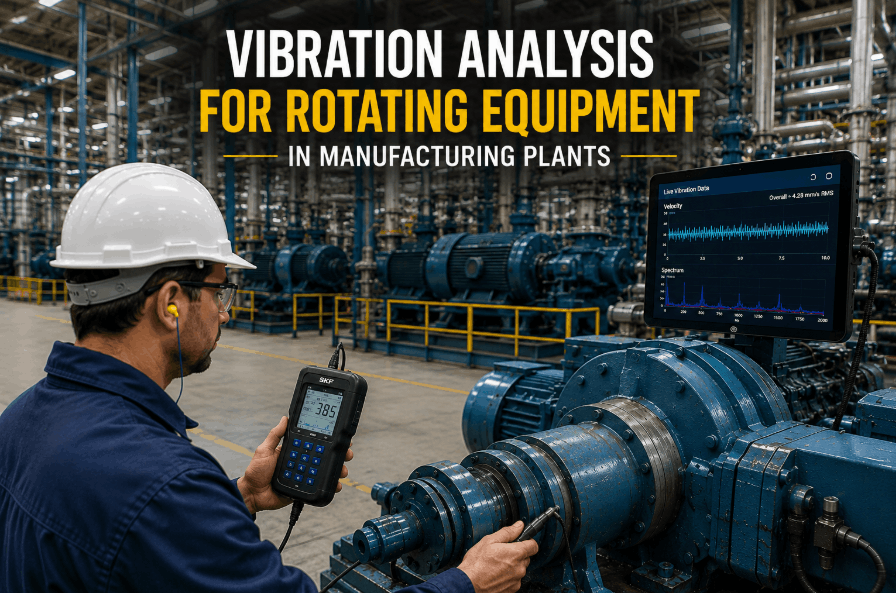
Vibration analysis for rotating equipment in manufacturing plants is one of the most powerful predictive maintenance strategies available to reliability engineers today. Motors, pumps, compressors, fans, and gearboxes account for the majority of unplanned downtime in industrial facilities — and vibration signatures reveal bearing wear, shaft misalignment, imbalance, and looseness weeks before catastrophic failure. Facilities that integrate structured vibration monitoring into their Sign Up Free CMMS-driven maintenance programs consistently report 30–50% reductions in emergency repair costs and measurable improvements in overall equipment effectiveness.
Why Vibration Analysis Is Critical for Manufacturing Plant Reliability
Rotating equipment failures in manufacturing plants rarely happen without warning — the warning just goes undetected when facilities rely on reactive maintenance models. Vibration analysis transforms that equation by continuously measuring mechanical energy patterns across bearings, shafts, and housings, converting raw signal data into actionable fault indicators. When integrated with a CMMS platform like Oxmaint, vibration trend data automatically triggers condition-based work orders, closing the gap between detection and intervention before production impact occurs. Book a Demo to see how Oxmaint maps vibration alerts directly to asset records and maintenance workflows across your plant floor.
Key Rotating Equipment Types Requiring Vibration Monitoring in Manufacturing
Every rotating asset in a manufacturing plant carries a unique vibration signature profile. Understanding which fault modes apply to each equipment type determines which measurement parameters and frequency bands to monitor. Sign Up Free to build your rotating equipment asset registry and link vibration baselines directly inside Oxmaint's condition monitoring module.
Electric Motors and Drive Trains
Electric motors are the most common rotating asset in any manufacturing facility. Key vibration fault indicators include rotor bar defects (sidebands around line frequency), bearing defect frequencies (BPFO, BPFI, BSF), and mechanical looseness patterns. Motor vibration trending in the 10–1000 Hz range provides the earliest detectable signatures of developing faults.
Centrifugal and Positive Displacement Pumps
Pump vibration analysis focuses on vane pass frequency (VPF), cavitation signatures in the ultrasonic range, and shaft misalignment patterns that appear as 2× running speed harmonics. Cavitation-induced vibration, if undetected, accelerates impeller erosion and seal failure — both costly repair scenarios in high-throughput manufacturing environments.
Gearboxes and Gear Trains
Gearbox vibration spectra are complex, requiring gear mesh frequency (GMF) analysis and sideband patterns to detect tooth wear, pitting, and gear eccentricity. Gearbox condition monitoring is particularly critical in manufacturing because gear failures propagate rapidly — a single failed tooth can destroy an entire gear set within hours of onset.
Industrial Fans and Blowers
Fan imbalance is the leading vibration fault in manufacturing ventilation and cooling systems, manifesting as elevated 1× running speed amplitude. Blade fouling and buildup change the mass distribution of fan wheels progressively — vibration trending detects the deterioration curve before the imbalance reaches a level that damages bearings or structural supports.
Air and Process Compressors
Reciprocating compressors generate complex vibration spectra requiring time-waveform analysis alongside frequency domain review. Screw and centrifugal compressor monitoring focuses on rotor pass frequency and sub-synchronous instability patterns that precede surge events — protecting process continuity in compressed air systems serving production lines.
Vibration Analysis Measurement Parameters and Severity Benchmarks
Effective vibration analysis for rotating equipment in manufacturing plants requires measuring the right parameters at the right frequency ranges and comparing results against established severity thresholds. The ISO 10816 and ISO 20816 standards provide internationally recognised vibration severity limits by machine class and mounting type — Book a Demo to see how Oxmaint stores ISO benchmark data alongside live sensor readings for instant severity classification.
| Parameter | Measurement Unit | Primary Fault Detected | Frequency Range | Action Threshold |
|---|---|---|---|---|
| Overall Vibration Velocity | mm/s RMS | Imbalance, misalignment, looseness | 10–1000 Hz | >4.5 mm/s (ISO Class II) |
| Bearing Acceleration (gSE) | g peak | Bearing inner/outer race defects | 1–20 kHz | >0.5 gSE trend increase |
| Displacement (Shaft Orbit) | µm peak-to-peak | Shaft bow, rubs, oil whirl | 0–200 Hz | Exceeds journal clearance |
| Crest Factor | Dimensionless ratio | Early bearing defects, impacting | Broadband | >6 indicates defect onset |
| Kurtosis | Statistical index | Impulsive bearing fault detection | Broadband | >4 warrants investigation |
| Gear Mesh Frequency Amplitude | mm/s or g | Gear tooth wear, pitting, eccentricity | GMF ± sidebands | 3 dB above baseline |
| Ultrasonic Emission | dBµV | Cavitation, early bearing defects | 20–100 kHz | 8 dB above baseline |
Vibration Fault Identification: Common Patterns in Manufacturing Equipment
Vibration Monitoring Strategy: Route-Based vs. Continuous Online Monitoring
Asset Criticality Classification
Rank every rotating asset as critical, important, or general based on production impact. Critical assets (no redundancy) need continuous sensors; general assets suit monthly route-based checks.
Measurement Point Standardisation
Fix measurement locations per machine — drive end horizontal, vertical, axial, and non-drive end. Consistent points are mandatory for valid trending; log any sensor position change in Oxmaint.
Baseline and Alarm Threshold Establishment
Collect 3–5 readings under steady load to set baselines. Apply alert at 150% and danger at 200% of baseline. Reset baselines after every major repair or bearing replacement.
CMMS Integration and Work Order Automation
Route vibration data into Oxmaint to auto-generate work orders on threshold breach. Condition data stays tied to the asset record — not locked inside a standalone analyser.
Root Cause Analysis and Corrective Action Tracking
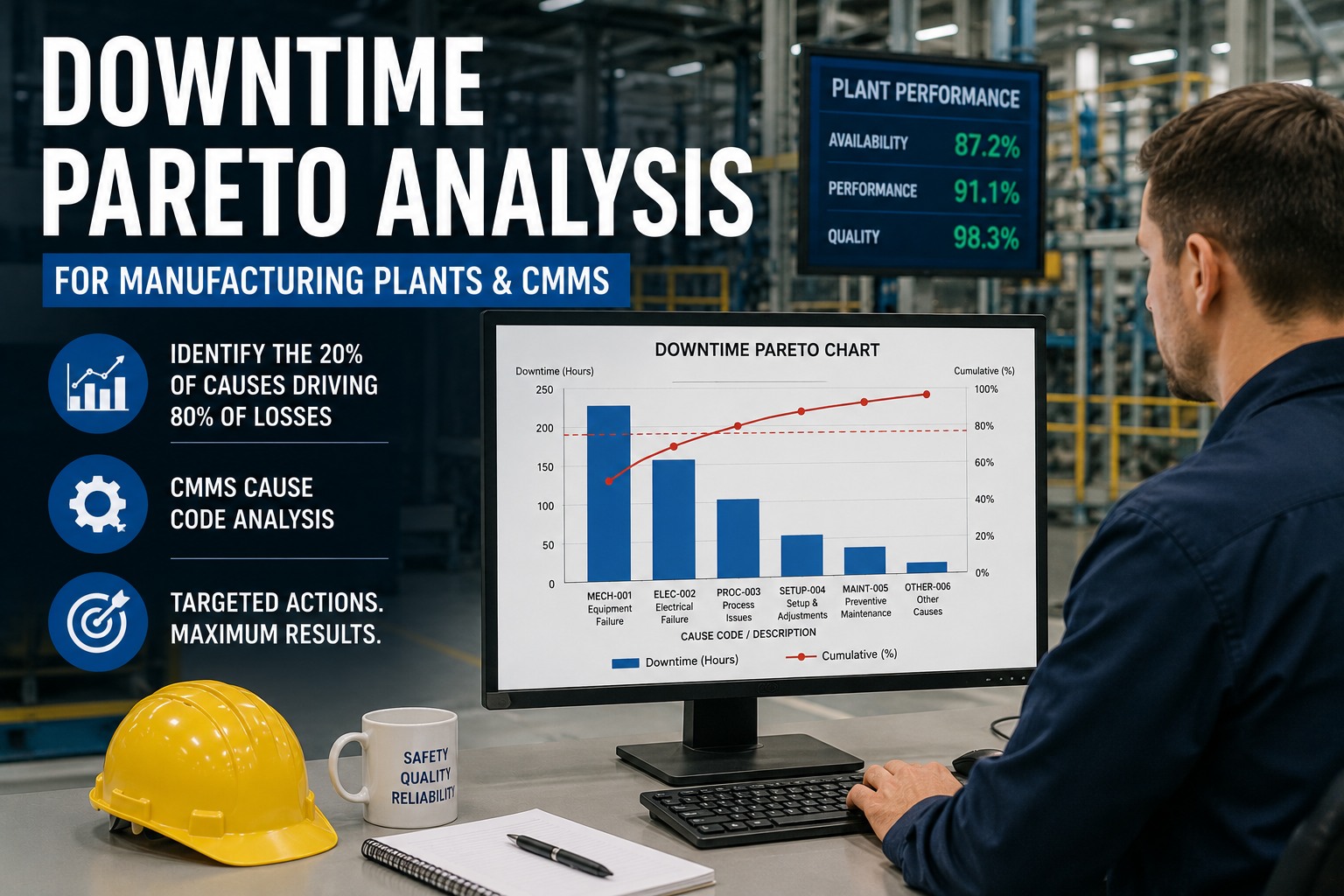
Log a root cause code (imbalance, misalignment, bearing, looseness) for every vibration-triggered repair. Patterns across assets expose systemic gaps in alignment or lubrication procedures.
| Factor | Route-Based (Handheld) | Continuous Online Sensors |
|---|---|---|
| Best For | Important & general assets with redundancy | Critical assets — no redundancy, high failure cost |
| Data Frequency | Monthly or quarterly spot readings | Continuous — 24/7 real-time streaming |
| Fault Warning Time | Detected at next scheduled route visit | Immediate alert on threshold breach |
| Upfront Cost | Low — shared analyser across many assets | Higher — dedicated sensor per measurement point |
| Labour Requirement | Technician time for data collection rounds | Minimal — automated data capture |
| Slow-Developing Faults | Good detection if interval is appropriate | Excellent — trend captured between visits |
| Rapid Fault Progression | High miss risk between route intervals | Caught immediately — alarm triggers work order |
| CMMS Integration | Manual upload or mobile data entry in Oxmaint | Automated feed via IoT gateway into Oxmaint |
| Recommended Interval | Monthly (important) / Quarterly (general) | Continuous — no interval required |
Integrating Vibration Analysis with Oxmaint CMMS for Predictive Maintenance
Vibration analysis for rotating equipment in manufacturing plants reaches its full potential only when condition data flows directly into maintenance workflows. Oxmaint's CMMS platform connects vibration readings — whether from handheld analysers, online sensor networks, or IoT gateways — to asset records, maintenance schedules, and technician work orders in a single system. Sign Up Free and connect your first rotating equipment asset to Oxmaint's condition monitoring dashboard today. Maintenance teams using Oxmaint report faster fault-to-fix cycle times, better spare parts forecasting, and measurable reductions in mean time to repair because vibration fault context travels with the work order to the technician's mobile device. Book a Demo to see the full rotating equipment predictive maintenance workflow in action.
Frequently Asked Questions: Vibration Analysis for Rotating Equipment
What is vibration analysis and how does it prevent equipment failure?
Vibration analysis detects developing faults — bearing wear, imbalance, misalignment, looseness — through mechanical oscillation patterns. It identifies abnormal signatures weeks before failure, letting teams plan repairs during scheduled downtime instead of reacting to unplanned breakdowns.
How often should vibration measurements be taken on manufacturing plant equipment?
Critical assets need continuous monitoring via permanently mounted sensors. Important assets suit monthly handheld route collection. General equipment can be measured quarterly, with intervals shortened whenever trending shows vibration approaching alert thresholds.
What vibration severity standards apply to manufacturing rotating equipment?
ISO 10816-3 and ISO 20816-3 are the primary standards, defining acceptable, alert, and danger velocity limits by machine power and mounting type. They provide a consistent alarm-setting basis across all rotating equipment classes in industrial plants.
Can Oxmaint integrate with vibration sensors and condition monitoring hardware?
Yes. Oxmaint connects with IoT sensor gateways and vibration monitoring platforms for automatic condition updates and work order generation. Manual route data is entered via mobile app, linking field measurements directly to asset records.
What is the ROI of implementing vibration analysis in a manufacturing plant?
Structured vibration programs typically deliver 30–50% less unplanned downtime and 20–40% lower maintenance costs through planned versus emergency repairs. Payback period is generally 6–18 months depending on asset criticality and historical failure frequency.
How does vibration analysis fit into a broader predictive maintenance strategy?
Vibration analysis works alongside oil analysis, thermography, and ultrasound — each covering different failure modes. Together in a CMMS like Oxmaint, they create a complete asset health picture that maximises early fault detection across the full equipment population.



.png)