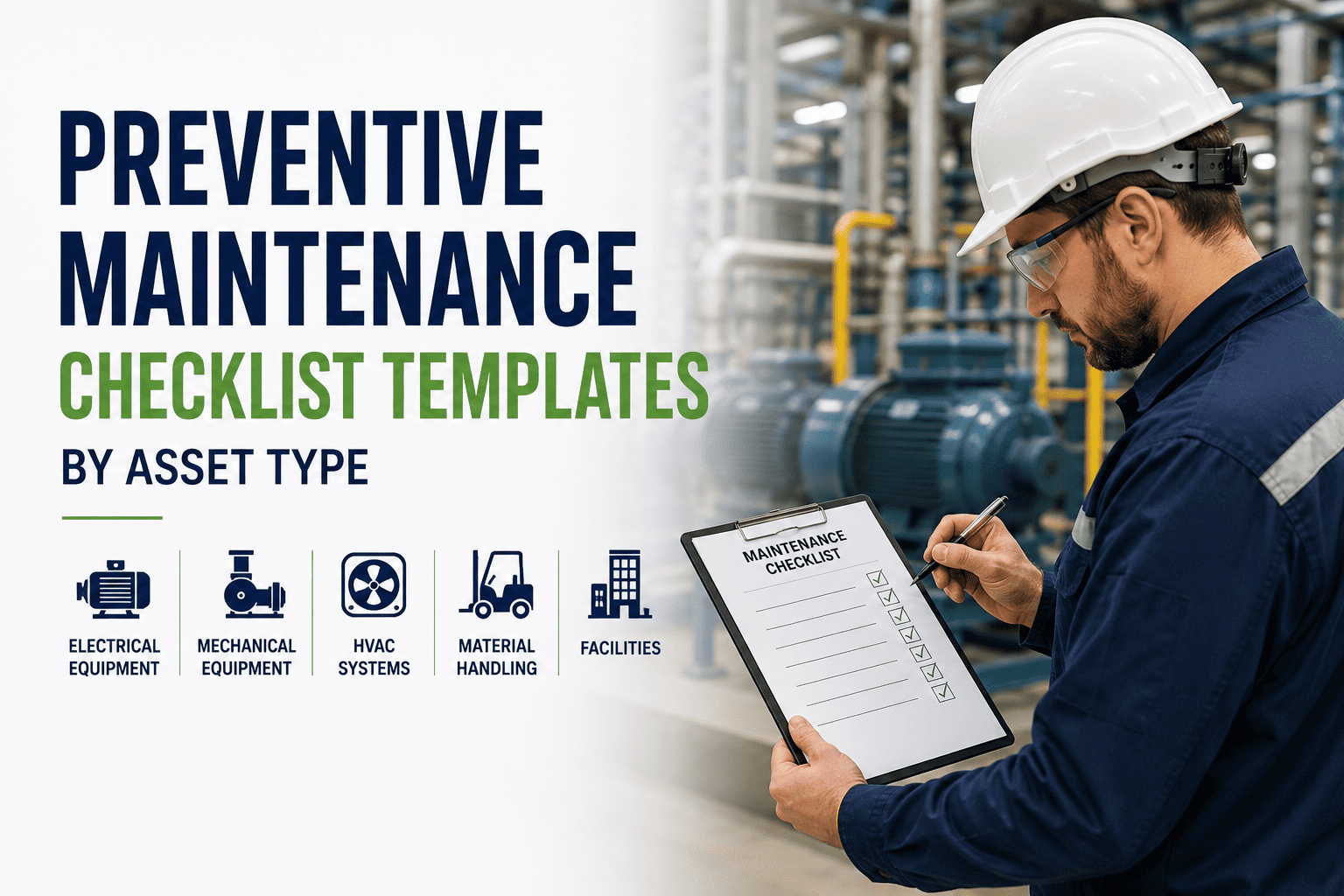
Preventive maintenance checklist templates give maintenance teams a repeatable, asset-specific starting point for inspections, lubrication, calibrations, and component replacements — eliminating the guesswork that turns routine PM into unplanned breakdowns. The biggest gap in most plants is not effort but structure: generic PM checklists do not map to real equipment, and paper forms that live in binders rarely get completed on time. Below you will find ready-to-adapt preventive maintenance templates for the most common manufacturing assets — pumps, motors, gearboxes, hydraulic units, HVAC, CNC machines, and conveyors — plus mobile-friendly formats you can load directly into a CMMS. When you are ready to digitize and automate these checklists, you can Start Free Trial of OxMaint and deploy them on day one.
PM Checklist Templates by Asset Type
Stop running maintenance from binders that technicians never open.
Industry studies show up to 40 percent of scheduled PM tasks are skipped, delayed, or pencil-whipped when checklists live on paper. OxMaint turns your preventive maintenance templates into mobile, asset-specific digital checklists that actually get done — with photos, pass/fail thresholds, and automatic work-order triggers.
The Real Cost of Paper PM
Why generic maintenance checklists fail manufacturing plants
A 250-asset plant running paper-based preventive maintenance typically loses $180K–$420K per year in avoidable downtime, overtime, and expedited parts — yet 60 percent of managers still rely on spreadsheets or clipboard forms.
40%
PM tasks skipped or pencil-whipped on paper
3.5x
Higher failure rate on assets without structured PM
$260K
Average annual downtime cost avoided by a 250-asset plant
14 days
Typical lag between a missed PM and the failure it caused
The pattern is predictable: a technician grabs a generic maintenance checklist template, finds that half the line items do not match the asset in front of them, checks every box anyway, and files the form. Two weeks later the bearing seizes because nobody actually measured vibration. OxMaint replaces that cycle with equipment PM checklists that are tailored to each asset class, enforced on a mobile app, and tied to failure history — so the right task gets done the right way, every time.
Equipment PM Checklist by Asset Type
Preventive maintenance templates for pumps, motors, gearboxes, and more
Each template below is structured for a specific asset class. Load these line items into your CMMS as digital PM checklists, adjust frequencies to match your operating context, and assign them to the right technicians.
Centrifugal Pumps
Frequency: Monthly / Quarterly
- Inspect mechanical seal for visible leakage (max 10 drops/min)
- Measure bearing housing vibration (alarm at 0.25 in/s, trip at 0.45 in/s)
- Check discharge and suction pressure gauges against baseline
- Verify coupling alignment and guard condition
- Lubricate bearings per OEM chart — record grease quantity
- Inspect baseplate for grout cracks and anchor bolt torque
Electric Motors
Frequency: Monthly / Semi-Annual
- Measure running amperage against nameplate FLA
- Perform thermography on junction box and bearings
- Check frame and foot mounting bolt torque
- Inspect cooling fan and air-discharge paths for blockage
- Megger test windings (min 100 MOhm at 500V DC)
- Lubricate if equipped with grease fittings — do not over-grease
Gearboxes & Reducers
Frequency: Monthly / Quarterly
- Check oil level via sight glass; top up with correct ISO grade
- Sample oil for particle count and water content (max 200 ppm)
- Inspect breather desiccant — replace if 50 percent pink
- Measure gearbox casing temperature (alarm above 180°F)
- Listen for abnormal gear mesh noise at full load
- Verify output shaft coupling and keyway condition
Hydraulic Power Units
Frequency: Weekly / Monthly
- Check reservoir fluid level and inspect for foaming
- Filter inspection — record differential pressure (change at 25 psi)
- Inspect hoses for abrasion, kinking, and fitting weep
- Verify system pressure relief setting matches OEM spec
- Measure pump case drain flow to detect internal wear
- Clean reservoir air breather and magnetic plug
HVAC & Air Handlers
Frequency: Quarterly / Seasonal
- Replace or clean filters (record final pressure drop)
- Inspect belts for tension, alignment, and cracking
- Clean evaporator and condenser coil surfaces
- Check refrigerant sight glass for bubbles and moisture indicator
- Verify damper actuator travel and end-limit switches
- Clear condensate drain line and verify float switch operation
CNC Machines
Frequency: Daily / Monthly
- Check way lube reservoir level and flow indicators
- Inspect spindle coolant flow and chiller temperature
- Clean chip auger and conveyor — verify interlocks
- Check hydraulic and pneumatic pressures against setpoints
- Run backlash and positioning diagnostic program
- Verify enclosure door seals and safety interlock function
Conveyor Systems
Frequency: Weekly / Monthly
- Inspect belt tracking and adjust tail pulley if wandering
- Check belt tension and splice condition
- Lubricate idler and drive bearings per schedule
- Inspect drive chain or V-belt for tension and wear
- Test emergency pull-cord and e-stop functionality
- Clear material buildup at transfer points and skirting
Pneumatic Systems
Frequency: Weekly / Monthly
- Drain moisture from receiver tank and filter bowls
- Check compressor oil level and operating temperature
- Inspect FRL units — verify regulator pressure and lubricator flow
- Test safety relief valve on receiver (manual lift)
- Audit fittings for audible leaks using ultrasonic detector
- Replace coalescing filter element per hour-meter interval
PM Frequency & Effort Matrix
How often should each asset class be inspected?
PM frequency should be driven by criticality, runtime hours, and failure history — not a default calendar interval. Use the matrix below as a baseline, then adjust based on condition-monitoring data from your CMMS.
| Asset Class | Daily / Weekly | Monthly | Quarterly | Annual | Est. Minutes / PM |
|---|---|---|---|---|---|
| Centrifugal Pumps | Visual leak check | Vibration & pressure | Lubrication & alignment | Seal & bearing overhaul | 20–35 min |
| Electric Motors | Temperature scan | Amperage & noise | Thermography | Megger & re-grease | 15–25 min |
| Gearboxes | Oil level check | Sample & temp | Breather & oil change | Internal inspection | 25–40 min |
| Hydraulic Units | Level & leak scan | Filter & pressure | Oil analysis | Full fluid exchange | 30–45 min |
| HVAC | — | Filter & belt check | Coil clean & refrigerant | Motor & compressor | 30–60 min |
| CNC Machines | Way lube & chip clear | Fluid levels & pressures | Backlash & geometry | Spindle service | 15–30 min |
| Conveyors | Tracking & e-stop | Belt & bearing lube | Drive & splice | Pulley & shaft | 20–40 min |
| Pneumatic Systems | Drain & leak audit | FRL & relief valve | Filter element | Compressor service | 15–25 min |
From Paper to Digital in Days
How OxMaint turns these PM templates into automated work orders
A 180-asset plastics plant was spending $42K per year on reactive repairs and paper-based PM scheduling. Within 90 days of deploying OxMaint, their PM compliance rate jumped from 61 percent to 96 percent and unplanned downtime dropped 38 percent. Here is how the platform maps to each step of your preventive maintenance workflow.
Asset-Specific Digital Checklists
Build equipment PM checklists for every asset class with mandatory fields, pass/fail thresholds, and photo capture. Technicians complete them on a phone or tablet — no signal required underground or in remote bays. Outcome: 95 percent+ PM compliance within the first quarter.
Automatic PM Scheduling by Runtime or Calendar
Trigger PM work orders on a calendar interval, meter reading, or condition threshold. OxMaint auto-assigns to the right technician, reserves spare parts, and escalates if a task is overdue. Outcome: zero missed PMs due to manual scheduling gaps.
AI-Driven Predictive Maintenance
OxMaint ingests vibration, temperature, and oil-analysis data, then uses machine-learning models to flag failure signatures weeks before breakdown. Your PM checklist dynamically adjusts frequency when risk rises. Outcome: 30–50 percent reduction in unplanned downtime.
Audit-Ready Records & Compliance
Every completed checklist is timestamped, geotagged, and archived with photos and e-signatures. Export compliance reports for ISO 55000, OSHA, or FDA audits in one click. Outcome: audit prep time cut from days to minutes.
See your asset PM checklists running live in OxMaint
Book a 30-minute demo and we will load your top 10 assets into a sandbox account before the call — so you see real checklists, real schedules, and real analytics on your equipment, not a generic slideshow.
Migration & Switching
Switching from spreadsheets and paper to a CMMS in under two weeks
Most plants delay CMMS adoption because they fear a months-long data migration. OxMaint's onboarding team imports your existing PM schedules, asset lists, and spare-parts data in days — not months — with templated checklists pre-loaded for 200+ asset types.
Import Your Asset Register
Upload a CSV of your equipment list or connect to your ERP. OxMaint auto-categorizes by asset class and suggests matching PM templates from its library. Typical setup time: 2–4 hours for a 500-asset plant.
Customize Checklist Templates
Start from the built-in preventive maintenance templates, edit line items to match your OEM manuals, and set pass/fail thresholds. Clone templates across identical assets with one click to save hours of duplicate work.
Deploy to Mobile in One Day
Invite technicians via email or SMS. They download the OxMaint app, log in, and immediately see their assigned PM checklists — offline-capable on iOS and Android. No special hardware, no RFID tags required.
Measure Compliance & ROI
Track PM completion rate, mean time between failures, and downtime cost on the live dashboard. Most plants see measurable improvement within 30 days and full ROI within the first quarter.
Frequently Asked Questions
Preventive maintenance checklist templates — common questions
What should be included in a preventive maintenance checklist?
A complete preventive maintenance checklist includes the asset ID and location, safety lockout/tagout steps, inspection tasks with measurable pass/fail thresholds, lubrication and calibration instructions, required spare parts and quantities, and a sign-off section with photo evidence. The checklist should be specific to the asset class — a pump PM template is very different from a CNC machine PM template — and structured so a technician can complete it in 15–45 minutes. You can build and deploy these checklists in OxMaint in minutes — Book a Demo to see it on your assets.
How often should preventive maintenance be performed on manufacturing equipment?
PM frequency depends on asset criticality, runtime hours, environmental conditions, and OEM recommendations. Most rotating equipment requires monthly inspections with quarterly deep tasks; HVAC systems are typically serviced quarterly and seasonally; CNC machines need daily way-lube and chip-clearance checks with monthly fluid and pressure verification. The best practice is to start with OEM baseline intervals, then use condition-monitoring data from your CMMS to shift from time-based to condition-based PM — reducing over-maintenance on healthy assets and catching failures earlier on degrading ones.
Can I customize these PM checklist templates for my specific equipment?
Yes — every template in this guide is a starting point designed to be adapted to your specific make, model, and operating context. In OxMaint you can edit any checklist line item, add mandatory photo fields, set numeric pass/fail thresholds, and clone the template across all identical assets in your plant. The platform also supports dynamic checklists that add or remove steps based on the asset's condition data, so your PM evolves as the equipment ages.
What is the difference between preventive and predictive maintenance checklists?
Preventive maintenance checklists are scheduled at fixed intervals — calendar-based or runtime-based — and instruct a technician to inspect, lubricate, or replace components regardless of actual condition. Predictive maintenance checklists are triggered by condition-monitoring data (vibration, temperature, oil analysis) that indicates a failure is developing, and they focus on verifying the specific degradation mode detected. OxMaint supports both: scheduled PM templates for routine care and AI-triggered work orders when sensor data crosses a risk threshold, giving you the cost efficiency of condition-based maintenance without abandoning structured inspections.
How do I move my PM checklists from paper or Excel into a CMMS?
Start by auditing your existing paper forms and Excel schedules, then standardize task descriptions, frequencies, and parts lists into a single CSV template. Most CMMS platforms — including OxMaint — can import that CSV and auto-generate PM schedules and digital checklists. OxMaint's onboarding team handles the migration for you, mapping your existing forms to its template library and pre-loading asset registers, so a typical 250-asset plant goes live in under two weeks. Start Free Trial to test the import on your own data.
Your PM checklists should work as hard as your technicians do
Stop losing uptime to paper forms and pencil-whipped inspections. Deploy asset-specific preventive maintenance templates, automate scheduling, and catch failures before they happen — all in one AI-powered CMMS built for maintenance and reliability teams.
Free 14-day trial · No credit card required
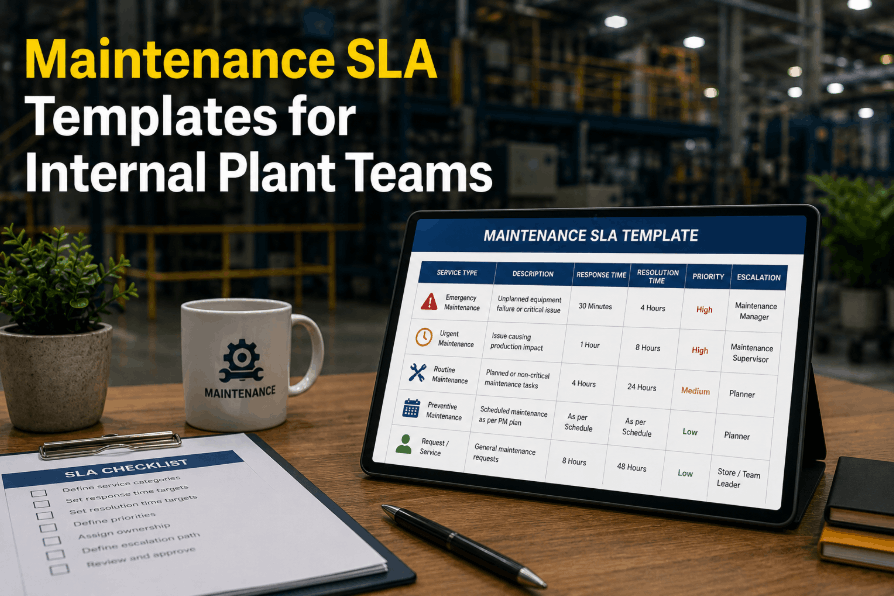

![equipment-asset-register-template-for-manufacturing-plants-[free-excel]](./manage-post-2k26/uploads/equipment-asset-register-template-for-manufacturing-plants-[free-excel].png)
![preventive-maintenance-task-list-template--manufacturing-[download-free]](./manage-post-2k26/uploads/preventive-maintenance-task-list-template--manufacturing-[download-free].png)


