Unplanned equipment failure is the single most expensive operational risk in manufacturing. Industry research estimates that unexpected downtime costs manufacturers roughly $50 billion each year across the United States alone, with the average plant losing around 800 hours of productive machine time annually. The root cause is rarely a mystery — it is almost always inadequate or inconsistent maintenance. A well-structured preventive maintenance checklist eliminates guesswork, standardizes inspections across shifts, and catches small problems before they shut down entire production lines. This guide breaks down exactly what to include in your factory PM program, organized by equipment type, frequency, and criticality — so your team can reduce breakdowns, extend asset life, and keep output on schedule. Schedule a free walkthrough to see how Oxmaint automates preventive maintenance scheduling for manufacturing plants.
What Makes Equipment Fail — And How Scheduled Maintenance Prevents It
Equipment breakdowns in manufacturing rarely happen without warning. Bearings overheat gradually. Belts wear unevenly over weeks. Electrical connections loosen under vibration long before they arc or short. The challenge is that manual observation alone cannot catch these early signals across dozens or hundreds of assets operating simultaneously. A preventive maintenance checklist ensures that every critical inspection point is covered at the right interval, by the right person, with documented results that reveal trends over time.
Top Causes of Unplanned Downtime in Manufacturing
Aging Assets & Mechanical Failures
62%
Operator Error & Skipped Procedures
48%
Poor or No Preventive Maintenance
42%
Supply Chain & Spare Parts Delays
31%
Sources: Plant Engineering, Forbes, Siemens True Cost of Downtime reports
42% of downtime comes from poor maintenance practices — your plant does not have to be part of that statistic. Sign up for Oxmaint to build automated PM schedules that catch equipment problems early, assign tasks to the right technicians, and keep every inspection documented and on time.
Daily, Weekly, and Monthly Inspection Tasks for Production Machinery
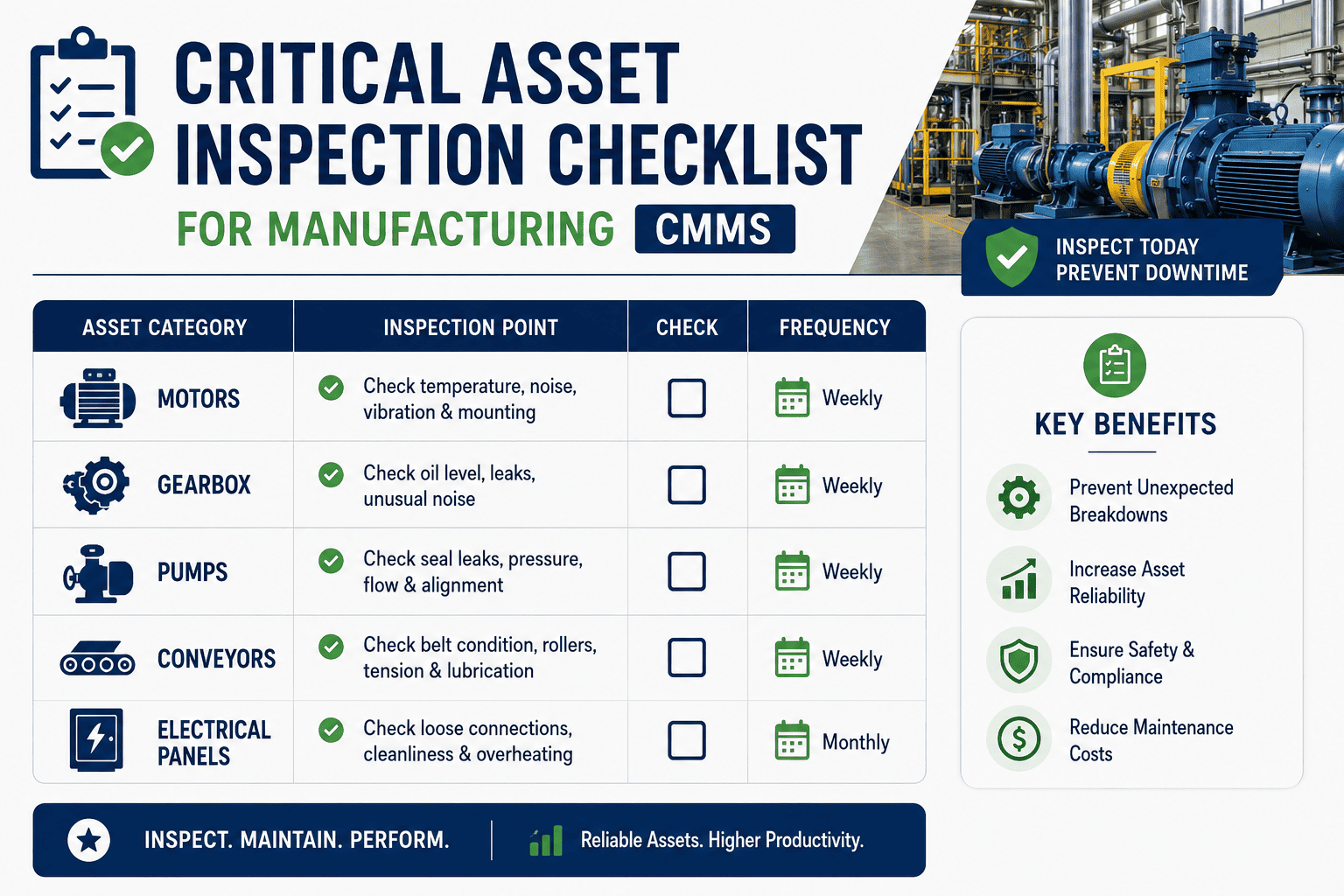
The foundation of every effective PM program is a frequency-based task schedule tied to each asset type. The checklist below covers the most common production equipment found in manufacturing plants. Use it as a baseline framework, then customize intervals based on manufacturer recommendations, equipment age, and your plant's operating conditions.
Listen for abnormal vibration, grinding, or rattling during operationVerify temperature and pressure gauges are within operating rangeCheck for visible oil, water, or coolant leaks around seals and fittings
Weekly Checks
Inspect and adjust belt tension and pulley alignmentTop up lubrication levels on bearings and gearboxesClean cooling vents, intake screens, and fan blades
Monthly Checks
Grease or re-lubricate bearings per OEM scheduleTest vibration levels and record readings for trendingInspect shaft coupling alignment and replace worn couplings
Quarterly / Annual
Thermal imaging scan on motor housings and connectionsFull oil change on hydraulic systems and compressorsInspect and torque all mounting bolts and base anchors
Visual scan of panels for warning lights or error codesCheck for unusual heat, burning odor, or discolored wiring
Monthly Checks
Test all emergency stop buttons and safety interlock switchesInspect wiring for fraying, corrosion, or loose terminal connectionsVerify circuit breaker and fuse ratings match load requirements
Quarterly Checks
Perform infrared thermography on main panels and bus barsRe-torque all terminal connections to manufacturer specificationsCalibrate temperature, pressure, and level sensors and transmitters
Annual Checks
Megger test (insulation resistance) on main feeder cablesFull functional test of protective relays and trip circuitsAudit and update single-line electrical diagrams
C
Conveyors, Material Handling & Transport SystemsBelts, rollers, chains, drives, structural frames
Daily Checks
Verify belt tracking is centered and tension is correctClear material buildup, debris, and foreign objects from beltsListen for abnormal roller, bearing, or chain noise
Weekly Checks
Lubricate chains, sprockets, and roller bearings as neededInspect belt edges for cuts, fraying, or delaminationConfirm all safety guards and emergency pull cords function
Monthly Checks
Inspect gearbox oil levels and drive motor conditionCheck belt splice joints for separation or wearVerify conveyor speed matches production line requirements
Annual Checks
Full structural inspection of frames, supports, and anchorsReplace worn belts, idler rollers, and tensioning componentsOverhaul or rebuild drive assemblies and reducers
Verify coolant level and concentration before first runClear chips and swarf from work tables, ways, and enclosuresRun spindle warm-up cycle and confirm axis home positions
Weekly Checks
Inspect way covers, chip conveyors, and coolant filtrationVerify hydraulic and pneumatic system pressuresCheck tool holder taper condition and turret indexing accuracy
Monthly Checks
Drain, clean, and replace coolant in the machine sumpBack up CNC programs, offsets, and machine parametersInspect spindle taper for scoring, wear, or contamination
Annual Checks
Full geometric accuracy test — laser alignment and ballbar checkReplace way lube oil, hydraulic oil, and all filtration mediaInspect ballscrews, linear guides, and servo drive performance
Inspect fire extinguisher pressure, pin, seal, and placementTest emergency lighting, exit signs, and battery backup systemsVerify machine guarding is intact and properly secured on all equipment
Quarterly Checks
Functional test of fire suppression and sprinkler systemsAudit lockout/tagout (LOTO) devices, tags, and written proceduresFlush and test eyewash stations and emergency safety showers
Annual Checks
Comprehensive OSHA compliance review across all plant areasRecertify cranes, hoists, pressure vessels, and lifting devicesConduct full emergency evacuation drill and update response plans
These checklists are only effective if your team actually completes them — every time, on schedule. Book a demo to see how Oxmaint converts each checklist above into automated work orders with mobile completion, photo verification, and real-time tracking so no task is ever missed or forgotten.
Not every piece of equipment in your plant requires the same maintenance attention. The most effective approach is to rank assets by criticality — how severely their failure impacts production, safety, and cost — and allocate PM resources accordingly. This prevents the common trap of over-maintaining low-impact equipment while under-servicing the machines that actually keep your production lines running.
Tier 1 — Production Critical
Main production line motors, CNC machining centers, primary compressors, bottleneck equipment
Monthly visual checks + quarterly inspections + annual deep service
Failure affects comfort or compliance, but production continues.
The True Cost of Skipping Preventive Maintenance
Many plant managers understand the value of PM in theory, but still struggle to justify the investment in time and resources. The data makes the case clearly — reactive maintenance costs significantly more than prevention, and the gap is growing as equipment complexity and labor rates increase.
Reactive vs. Preventive: Where Your Maintenance Budget Actually Goes
Run-to-Failure Approach
Emergency repairs at 2-3x premium labor ratesOvernight parts shipping and expedited procurementCascading production delays across downstream operationsShortened equipment lifespan — assets replaced years earlySafety incidents from unexpected failures under load
$260K
Average cost per hour of unplanned downtime in manufacturing
VS
Scheduled PM Approach
Planned repairs during off-peak or shift-change windowsBulk-ordered spare parts at standard pricingProduction schedules maintained with minimal disruptionExtended asset life through consistent, documented careFewer safety incidents with regularly inspected equipment
30-50%
Reduction in total downtime with a consistent PM program and CMMS
Stop Paying for Breakdowns. Start Preventing Them.
Oxmaint gives your maintenance team a single platform to schedule every PM task, assign it to the right technician, track completion in real time, and build a complete asset history — replacing spreadsheets, paper checklists, and memory with automated, auditable workflows.
Maintenance KPIs That Prove Your PM Program Is Working
A checklist without measurement is just a to-do list. The most effective maintenance teams track a small set of key performance indicators to identify whether their PM program is actually reducing failures, improving uptime, and delivering return on investment. These are the four metrics that matter most for manufacturing plants.
90%+
Overall Equipment Uptime
Percentage of scheduled production time that equipment is actually available and running. Target 90%+ for critical assets.
80%
PM Task Completion Rate
Percentage of scheduled PM work orders completed on time. Below 80% signals insufficient staffing or scheduling issues.
70:30
Planned vs. Unplanned Work
Ratio of scheduled to emergency maintenance. World-class plants achieve 80% planned work or better.
MTBF
Mean Time Between Failures
Average run time between breakdowns. A rising MTBF trend confirms your PM program is extending equipment reliability.
You cannot improve what you do not measure — and you cannot measure with spreadsheets at scale. Sign up for Oxmaint to get a live dashboard that tracks equipment uptime, PM completion rates, MTBF trends, and maintenance costs across every asset in your plant — updated in real time as your team completes work orders.
Why Spreadsheets Fail and CMMS Software Succeeds for Factory PM
Most manufacturing plants start with spreadsheets or paper-based checklists to manage preventive maintenance. It works when you have a handful of assets and a small team. But as the plant grows, shifts multiply, and compliance audits arrive, manual tracking collapses under its own weight. A CMMS like Oxmaint replaces fragile manual processes with automated, mobile, and fully auditable maintenance workflows.
Auto-Scheduled Work Orders
Set time-based or meter-based triggers for every asset. Oxmaint creates and assigns work orders automatically at the correct interval.
Mobile Checklists on the Floor
Technicians complete inspections, log readings, and attach photos directly from their phone — no clipboards, no lost paperwork.
Complete Asset History
Every inspection, part replacement, and repair is logged permanently. Identify repeat failures and make data-backed repair vs. replace decisions.
Team Accountability
Assign tasks by skill, shift, or location. Know who completed what, when, and how long it took — built-in accountability at every level.
Real-Time Alerts
Notifications fire when PM tasks are due, overdue, or when a technician flags a problem during an inspection. No task falls through the cracks.
Audit-Ready Compliance
Generate timestamped, digital records for OSHA, ISO, and industry-specific audits. Prove compliance without digging through file cabinets.
From Checklist to Fully Automated PM: A 5-Step Launch Plan
Building a preventive maintenance program does not require months of planning. With the right approach and a capable CMMS, most manufacturing plants can go from reactive chaos to a structured, measurable PM system in under a month. Here is the implementation path that works.
01
Inventory Every Asset and Rank by Criticality
List every piece of equipment in your facility. Assign each one a criticality tier based on production impact, safety risk, and replacement cost. This ranking determines which assets get PM attention first.
02
Define Tasks, Frequencies, and Responsible Technicians
For every Tier 1 and Tier 2 asset, create a specific list of inspection tasks with clear frequencies. Assign ownership to individual technicians or shift teams. Use manufacturer manuals and operator input to build realistic task lists.
03
Load Everything Into Oxmaint
Enter your asset register, PM schedules, checklists, and team assignments into the platform. Configure automated work order generation, mobile access, and notification preferences. Sign up and start configuring — most teams finish setup in under a week.
04
Train Your Floor Technicians and Go Live
Walk your maintenance team through the mobile app, work order workflows, and checklist completion process. Start with Tier 1 critical assets to demonstrate quick wins before rolling out to the full plant.
05
Review KPIs Monthly and Continuously Improve
Track uptime, PM compliance, and work order completion monthly. Adjust task frequencies based on real failure data. The difference between a good PM program and a great one is the discipline to keep optimizing.
Your Maintenance Team Deserves Better Than Spreadsheets
Paper checklists get lost. Spreadsheets go stale. Tasks fall through the cracks between shifts. Oxmaint replaces all of it with one platform that auto-schedules every PM task, pushes mobile work orders to your technicians, records every inspection with timestamps and photos, and gives you the dashboards you need to prove your maintenance program is working and getting better.
How often should a manufacturing plant perform preventive maintenance?
It depends on asset criticality, manufacturer specifications, and operating conditions. Critical production-line equipment typically needs daily visual checks, weekly detailed inspections, and monthly full service. Support equipment may only need monthly or quarterly attention. The key is matching inspection frequency to failure impact — not treating every asset the same. Book a demo to see how Oxmaint lets you set custom PM frequencies for each asset.
What is the difference between preventive and predictive maintenance in a factory?
Preventive maintenance follows a fixed schedule — tasks are performed at set intervals regardless of current equipment condition. Predictive maintenance uses real-time sensor data (vibration, temperature, oil analysis) to determine exactly when service is needed. Most plants begin with a solid PM foundation and add predictive capabilities as they mature. Both strategies are far more cost-effective than running equipment to failure.
What should a preventive maintenance checklist include for manufacturing equipment?
At minimum, your checklist should cover lubrication, vibration monitoring, belt and chain inspection, electrical connection checks, fluid level verification, filter replacement, safety device testing, and calibration. Each task should specify the frequency, the responsible technician, required tools and parts, and any safety procedures such as lockout/tagout. Sign up for Oxmaint to access customizable checklist templates for common manufacturing equipment.
How does a CMMS help with OSHA and ISO compliance for maintenance?
A CMMS automatically generates scheduled work orders, tracks completion with timestamps and digital signatures, stores inspection photos and notes, and produces audit-ready reports on demand. This eliminates the manual record-keeping burden that causes most compliance gaps. Oxmaint's digital trail gives auditors exactly what they need — proof that every required maintenance task was completed on time, by a qualified technician.
How quickly can a manufacturing plant implement a PM program with Oxmaint?
Most teams go live within one to two weeks. Setup involves loading your asset register, building PM schedules and checklists, assigning team roles, and training technicians on the mobile app. Many plants start seeing measurable results — fewer emergency work orders, higher task completion rates, and better uptime — within the first 30 days. Schedule a consultation to map out a rollout plan for your specific facility.

![equipment-asset-register-template-for-manufacturing-plants-[free-excel]](./manage-post-2k26/uploads/equipment-asset-register-template-for-manufacturing-plants-[free-excel].png)
![preventive-maintenance-task-list-template--manufacturing-[download-free]](./manage-post-2k26/uploads/preventive-maintenance-task-list-template--manufacturing-[download-free].png)
