Every defect that reaches the customer began as an error that the process was designed to allow — and poka-yoke is the discipline of redesigning processes so those errors become physically or digitally impossible. Modern manufacturers integrating AI and computer vision into their mistake-proofing programs are reducing defect rates by up to 90%, catching assembly errors in real time rather than downstream inspection, and building the kind of traceable quality management records that lean audits and customer scorecards now demand. This page covers the full poka-yoke framework — from classical Toyota Production System principles to AI-powered error proofing — with practical examples across manufacturing verticals.
Poka-Yoke + AI Error Proofing
Make Defects Impossible Before They Happen
From classical mistake-proofing to AI-driven zero-defect manufacturing — the complete guide for lean quality teams.
90%
Defect reduction with AI poka-yoke systems
35%
Error rate drop from traditional mistake-proofing
14%
Of total manufacturing cost lost to operator errors
60%
Cycle time improvement from mistake-proofing programs
What Poka-Yoke Actually Means — and Why Most Facilities Misapply It
Poka-yoke (ポカヨケ) is a Japanese term meaning "mistake-proofing" — developed by Shigeo Shingo as part of the Toyota Production System in the 1960s. The core principle is deceptively simple: design the process so the error either cannot be made, or is detected and corrected before it passes downstream. What most facilities get wrong is treating poka-yoke as an inspection layer rather than a prevention layer. Inspection finds defects. Poka-yoke eliminates the conditions that create them. The distinction matters enormously in cost — a defect caught at the source costs a fraction of one caught at final QC or, worst, by the customer.
Prevention (Seigyo)
The process is designed so the error cannot physically occur. A fixture that only accepts a part in the correct orientation. A connector that cannot be inserted backwards. No operator decision required — the design prevents the mistake.
Highest impact
Detection (Shutsu)
When prevention is not possible, the system detects the error at the point of occurrence and halts the process before the defective part moves downstream. A sensor that stops the line when a component is missing. A vision system that flags a label applied in the wrong position.
High impact
Warning (Keikoku)
The system alerts the operator to an abnormal condition without stopping the line. Andon lights, audible alerts, and on-screen prompts that signal a deviation. Less powerful than prevention or detection — relies on operator response — but better than no check at all.
Lowest of three
The Three Classical Poka-Yoke Methods — With Manufacturing Examples
Shingo defined three technical approaches to implementing poka-yoke. Understanding which method fits which failure mode is the starting point of any mistake-proofing program.
Classical Poka-Yoke Methods
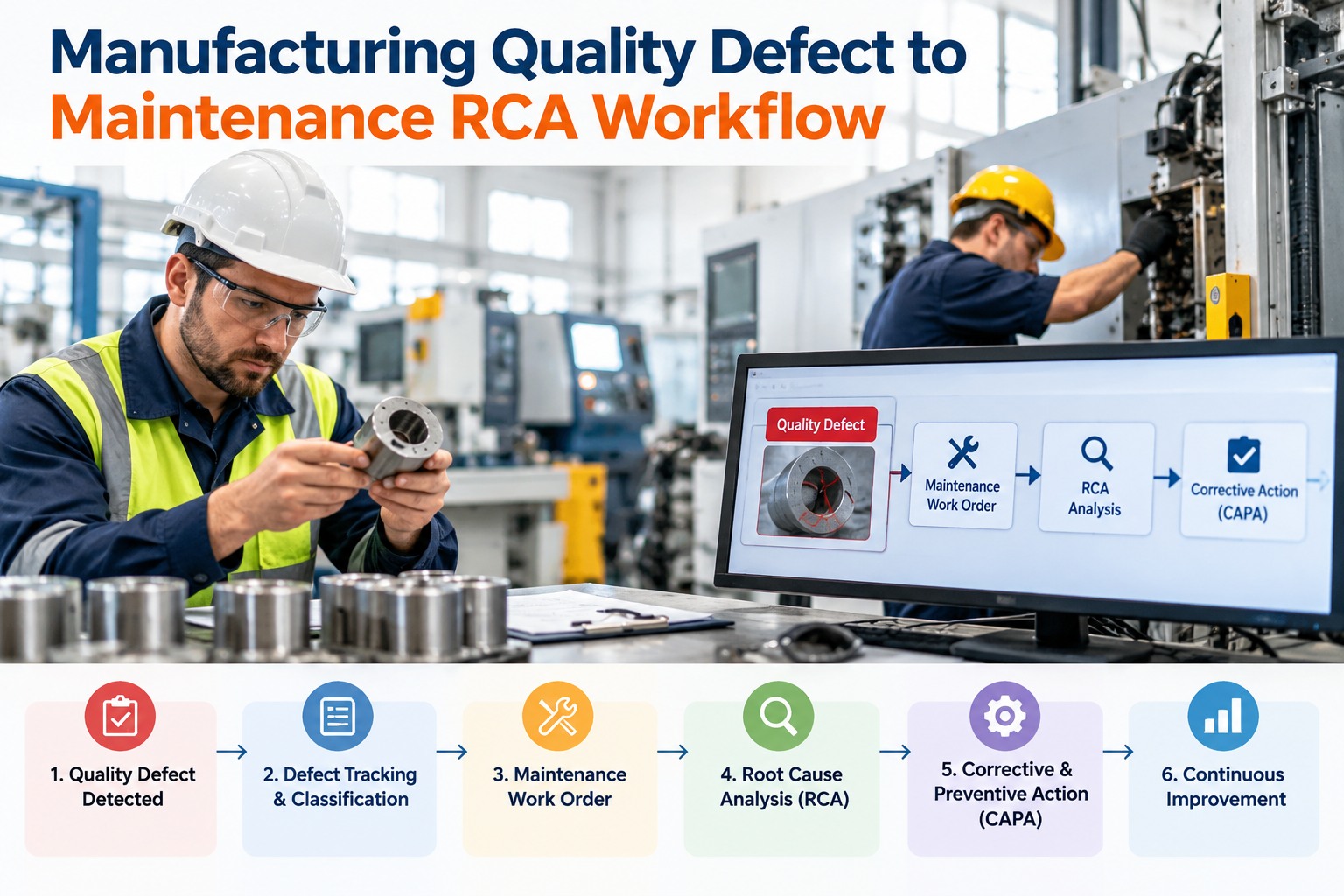
Connect Your Poka-Yoke Findings to Maintenance Work Orders
Recurring defect patterns are often rooted in equipment degradation — fixtures wearing out of tolerance, sensors drifting, or jigs developing play. Oxmaint links quality defect records to asset maintenance history so root cause analysis reaches the equipment level, not just the process level.
AI-Powered Poka-Yoke: How Computer Vision Changes the Game
Classical poka-yoke handles predefined, known failure modes. AI-powered mistake-proofing handles the failure modes that mechanical methods cannot reach — visual defects, color and orientation variations, label placement, dimensional tolerances across complex assemblies, and process deviations that only become apparent by comparing video frames against a learned baseline. The shift from traditional to AI-powered is not a replacement — it is an extension into territory where physical constraints are impossible or impractical.
Traditional Poka-Yoke
Predefined, static failure modes only
Physical fixtures require retooling for each product variant
Cannot detect visual anomalies (color, label, surface defects)
Binary pass/fail — no trend data
High setup cost for complex assemblies
No audit trail beyond line stop records
AI-Powered Poka-Yoke
Learns from production data — adapts to new failure modes
Software-configurable — no retooling for new variants
Detects visual, dimensional, and process deviations simultaneously
Generates defect trend data for continuous improvement
Scalable across multiple stations and product families
Full video traceability — each unit's build recorded and searchable
Five Industries Where Poka-Yoke Delivers Measurable ROI
Mistake-proofing applies universally, but the highest-impact deployments share a common trait: the cost of the defect reaching downstream significantly exceeds the cost of prevention at the source. These five industries have documented programs with clear financial returns.
Automotive
Assembly Line Safety-Critical Components
Torque verification on safety fasteners, presence detection for airbag components, vision inspection of weld quality. A single recall event makes the case for prevention investment at any scale.
Defect cost avoided: $500–$5,000 per unit at point of recall
Electronics
PCB Assembly & Component Placement
Vision systems verify polarity, component presence, and solder joint quality at each station. Wrong component placement on a PCB is undetectable after conformal coating — prevention is the only viable strategy.
Rework cost per defective board: $200–$2,000
Pharma & Medical
Dispensing, Labeling & Packaging Integrity
Poka-yoke on fill volume, label verification, and seal integrity. In regulated environments, a single mislabeled batch triggers a full lot recall with documented CAPA — prevention cost is trivial by comparison.
Average pharmaceutical recall cost: $50M–$600M
Food & Beverage
Foreign Object Detection & Fill Level
Metal detection, X-ray inspection, and seal integrity checks as poka-yoke devices at critical control points. HACCP compliance requires documented prevention at CCPs — error-proofing and regulatory compliance are the same investment.
Foreign object recall: $10M–$100M average cost
Aerospace
Fastener Torque & Component Traceability
Every fastener on a flight-critical assembly requires documented torque verification. Poka-yoke tools track each rundown, reject under-torqued fasteners, and create the AS9100 work order record in a single operation.
Rework on flight-critical assemblies: $10K–$500K per event
General Manufacturing
Assembly Sequence & Material Verification
Pick-to-light systems, barcode verification at each station, and weigh-in-motion checks for kit completeness. Applies across any high-mix, low-volume operation where operator attention is the primary quality variable.
Changeover error rate reduced by 50% with digital poka-yoke
How Oxmaint Connects Poka-Yoke Defect Data to Equipment Maintenance
The most underused insight in mistake-proofing programs is that recurring defect patterns are often maintenance signals — a fixture wearing out of tolerance, a vision sensor drifting, a jig developing play, or a feeder bowl mis-timing components. Defect data and maintenance history need to live in the same system for root cause analysis to reach the equipment level.
1
Defect Record Created at Station
When a poka-yoke device rejects a part or the line stops, Oxmaint logs the event against the specific station asset — not just as a quality record, but as a maintenance signal tied to the equipment's condition history.
2
Pattern Analysis Across Rejection Events
Oxmaint tracks rejection frequency by station, shift, and time of day. A sensor that rejects 2% of parts in the first hour of each shift and 8% by the fourth hour is a sensor that needs calibration or replacement — not an operator problem.
3
Maintenance Work Order Auto-Generated
When rejection rates on a station asset exceed configured thresholds, Oxmaint automatically generates a corrective maintenance work order for inspection, calibration, or replacement of the poka-yoke device itself — closing the loop between quality and maintenance.
4
Full Traceability for Quality Audits
Every defect event, maintenance response, and resolution is linked in a single audit trail. ISO 9001 clause 10.2 requires documented nonconformance handling and corrective action — Oxmaint generates that record automatically from the defect-to-work-order workflow.
Frequently Asked Questions
What is the difference between poka-yoke and regular quality inspection?
Inspection detects defects after they have been created and passes that information back to be corrected or sorted. Poka-yoke prevents defects from being created at all — or catches them at the exact moment of occurrence before they move downstream. The cost difference is substantial: a defect caught at the source costs a fraction of one identified at final inspection, and exponentially less than one discovered by the customer.
Oxmaint helps connect poka-yoke rejection data to maintenance records so equipment-driven defect sources are identified and fixed at the root, not managed through inspection.
How do AI and computer vision improve on traditional poka-yoke devices?
Traditional mechanical poka-yoke handles predefined failure modes — a part that cannot be inserted backwards, a fastener that cannot be skipped. AI-powered systems extend this to visual defects, subtle dimensional variations, label placement errors, and process deviations that physical fixtures cannot detect. AI systems also generate trend data across thousands of inspections, enabling continuous improvement rather than static pass/fail outcomes.
Book a demo to see how Oxmaint integrates AI-driven quality event data into maintenance work order workflows for closed-loop defect management.
Which type of poka-yoke — prevention, detection, or warning — should manufacturers prioritize?
Prevention (Seigyo) always delivers the highest ROI because it eliminates the error entirely without relying on operator response or system reaction time. Detection (Shutsu) is the next best when prevention is physically impractical — it catches the error at the source before downstream contamination. Warning (Keikoku) should be the last resort, as it introduces human judgment into the loop. Most mature programs use all three in combination, with prevention applied wherever geometry allows, detection for visual and process deviations, and
Oxmaint work orders managing the corrective response when any detection or warning event occurs.
Can poka-yoke be applied in high-mix, low-volume manufacturing environments?
Yes — and digital poka-yoke is particularly well-suited to high-mix environments because software-configurable systems can load different error-proofing parameters per product variant without physical retooling. Pick-to-light systems, barcode scan verification, and AI vision systems that accept new product profiles via software update are all examples used in high-mix production.
Oxmaint manages the scheduling and traceability for poka-yoke device verification across any product mix, and
our team can walk through how this works for your specific operation.
How does poka-yoke support ISO 9001 and lean manufacturing compliance?
ISO 9001 Clause 10.2 requires documented nonconformance control and corrective action whenever a defect occurs. Poka-yoke provides the prevention layer, and a CMMS like
Oxmaint provides the documented corrective action trail when a poka-yoke device triggers a line stop or rejection. Lean manufacturing's zero-defect philosophy treats any defect as a system failure requiring a structural response — which maps directly to the poka-yoke principle that errors should be designed out, not inspected out. The combination of mistake-proofing and digital work order management satisfies both the lean and ISO requirements simultaneously.
Start Building a Defect-Free Process — With Full Maintenance Traceability
Oxmaint connects poka-yoke quality events, defect trends, and corrective maintenance work orders in one platform — giving quality and maintenance teams a shared view of where defects originate and what equipment condition is driving them. Book a 30-minute walkthrough or explore the platform free.