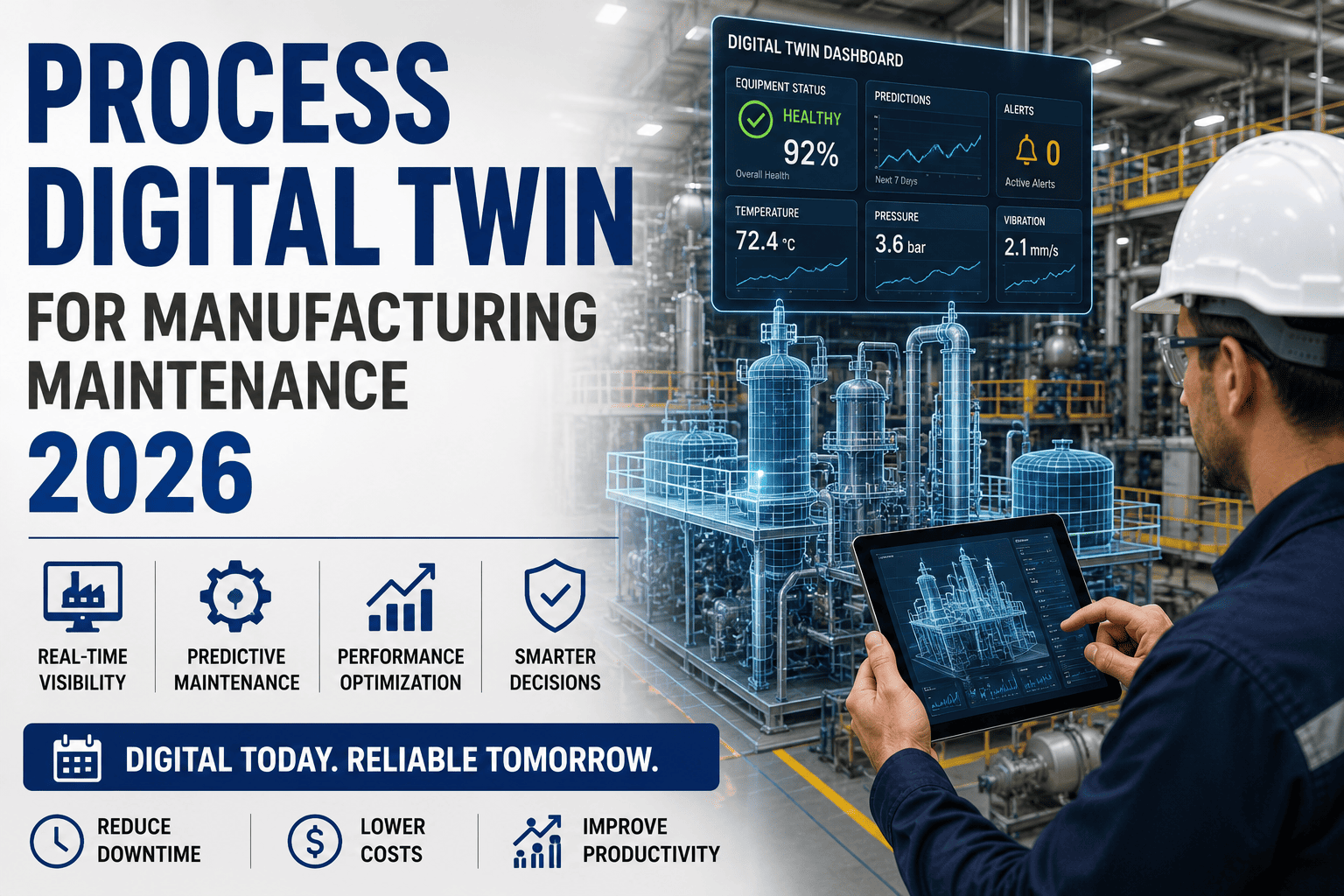
A process digital twin for manufacturing maintenance is a live, physics-based virtual replica of your production line that ingests real-time sensor data so reliability teams can simulate equipment behavior, test preventive maintenance changes, and predict downtime impact before touching a single physical asset. By 2026, the manufacturing digital twin has evolved from a novelty dashboard into a practical maintenance optimization engine, especially when tightly integrated with a CMMS — bridging process simulation maintenance with work-order execution. Plants that connect a process twin to their CMMS report 25–45% reductions in unplanned downtime and 15–30% lower maintenance spend. This guide covers what a process digital twin can and cannot do for plant maintenance, the data and integration requirements, and where the technology genuinely pays back — and you can Start Free Trial of OxMaint to see the CMMS side in action today.
2026 Process Twin Guide
Can you simulate a PM change and predict the downtime impact — before touching real equipment?
A process digital twin lets manufacturing plants model full line performance, test failure scenarios, and optimize maintenance schedules in a risk-free virtual environment. By 2026, teams pairing a process twin with an AI-powered CMMS are cutting unplanned downtime by 25–45% and avoiding costly trial-and-error on live production lines.
What It Solves
What a process digital twin for manufacturing maintenance actually does
A process digital twin creates a live virtual model of an entire production line — not just one asset — so reliability teams can see how a change to one machine cascades through the whole process before committing to it on the floor.
Virtual process modeling
Replicate line speed, throughput, buffer states and equipment interdependencies so you can see exactly where a bottleneck or a single-point-of-failure sits in the sequence — without shutting the line down to find out.
Failure scenario simulation
Inject a bearing failure, motor trip or valve stuck-open event into the twin and watch the downstream impact propagate. Quantify the production loss in units, minutes and dollars before the failure ever happens.
PM change testing
Move a weekly PM to bi-weekly, shift an inspection window, or add a redundancy path — then simulate a full quarter of operations to measure the impact on OEE, labor hours and spare-parts consumption.
Downtime impact prediction
When IIoT sensors flag an anomaly, the twin projects the remaining useful life and calculates the cost of acting now vs. deferring — so maintenance is scheduled in the cheapest, safest window possible.
Real-World Payback
The cost of NOT simulating: a 180-asset plant scenario
Consider a mid-size food packaging plant with 180 tracked assets, running two shifts and spending roughly $42,000 per year on reactive repairs and unplanned line stoppages. Here is how the math changes when a process twin enters the picture.
Annual Maintenance Cost — Without a Process Twin
Unplanned downtime cost ($28K) + Emergency repair labor ($9.5K) + Rush-ordered spares ($4.5K) = $42,000 / yr lost
Annual Maintenance Cost — With a Process Twin + CMMS
Predicted downtime cost ($15.4K) + Scheduled repair labor ($6K) + Stocked spares ($3K) = $24,400 / yr — a 42% reduction
What It Can and Can't Do
Process digital twin capabilities vs. limitations for plant maintenance
A process twin is powerful, but it is not magic. It will not replace your CMMS, your technicians, or your spare-parts strategy. The payback comes from knowing exactly where the twin adds value — and where a good CMMS does the heavy lifting on its own.
| Maintenance Use Case | What the Process Twin Does | What a CMMS Alone Does | Combined Payback |
|---|---|---|---|
| PM frequency optimization | Simulates 90 days of operations under different PM intervals to find the OEE-optimal schedule | Stores PM templates, triggers schedules, logs completion and labor hours | High — 15–25% fewer unnecessary PMs |
| Failure prediction | Models degradation curves and remaining useful life from IIoT sensor streams | Generates the work order once a threshold is crossed and assigns a technician | High — 25–45% less unplanned downtime |
| Spare-parts strategy | Predicts which parts will be needed and when, based on simulated failure scenarios | Tracks stock levels, auto-reorders at min, links parts to asset BOMs | Medium — 20–30% lower spare-parts carry cost |
| Line changeover planning | Simulates the changeover sequence and identifies the fastest reconfiguration path | Schedules the changeover work order and captures checklist completion | Medium — 10–18% faster changeovers |
| Compliance & audit trail | Provides a modeled risk profile for each asset — useful for ISO 55000 alignment | Maintains the full audit-ready record: who, what, when, with what parts | High — audit prep time cut 50%+ |
How OxMaint Helps
How OxMaint brings your process digital twin to life
OxMaint is the AI-powered CMMS layer that turns a process twin's simulations into executed action — closing the loop between "the twin says this bearing will fail in 9 days" and "the work order is assigned, the part is reserved, and the technician is notified." Here is what that looks like in practice.
IIoT data ingestion & predictive triggers
OxMaint ingests vibration, temperature and pressure streams from your IIoT sensors, applies AI anomaly detection, and auto-generates a work order the moment the process twin flags a deviation — cutting unplanned downtime 30–50%.
Simulated PM scheduling, executed in reality
Test a new PM interval in the twin, then push the optimized schedule directly into OxMaint's preventive maintenance engine — no manual re-entry, no spreadsheet drift. Plants see 15–25% fewer unnecessary PMs within one quarter.
Spare-parts reservation from failure predictions
When the twin predicts a failure, OxMaint automatically checks spare-parts inventory, reserves the part against the work order, and triggers a reorder if stock is below min — reducing rush-order spend by 20–30%.
Maintenance analytics that close the loop
OxMaint feeds actual work-order completion data, labor hours and MTBF back into the process twin, so the virtual model self-corrects and gets sharper every cycle — turning your CMMS data into a continuously improving predictive asset.
See OxMaint on your assets — book a 30-min demo
Watch how OxMaint connects your process twin simulations to real work orders, predictive alerts and spare-parts reservations in one platform. Bring your asset list — we will model it live.
FAQ
Process digital twin maintenance — your questions answered
What is a process digital twin in manufacturing maintenance?
A process digital twin is a live virtual model of an entire production line that ingests real-time IIoT sensor data, letting reliability teams simulate equipment behavior, test PM changes, and predict downtime impact before acting on physical assets. Unlike an asset-level twin, a process twin models how every machine in the line interacts with the others.
How does a digital twin integrate with a CMMS?
The process twin runs simulations and predicts failures; the CMMS executes the response — generating work orders, reserving parts, and assigning technicians. When the twin flags an anomaly, it sends a trigger to the CMMS (like OxMaint), which auto-creates a work order and notifies the team. See it in action — Book a Demo to watch the live handoff.
What data do you need to build a process digital twin for a plant?
At minimum you need an asset hierarchy (from your CMMS or EAM), real-time sensor data from critical machines (vibration, temperature, pressure, current), historical work-order and failure logs for at least 6–12 months, and production throughput data. The richer the data, the more accurate the twin's failure-scenario simulations become.
How much does a manufacturing digital twin cost in 2026?
A process digital twin for a single production line typically ranges from $40K to $120K for build and integration, plus $8K–$25K/year for cloud compute and model maintenance. Most plants achieve payback in 8–14 months through downtime avoidance and PM optimization, especially when the twin is paired with an AI-powered CMMS like OxMaint.
Can a process twin replace preventive maintenance software?
No — a process twin optimizes and predicts, but it does not schedule, assign, track or audit maintenance work. You still need a CMMS to manage work orders, spare-parts inventory, compliance records and technician assignments. The twin makes your CMMS smarter; it does not replace it. You can Start Free Trial of OxMaint to see the CMMS execution layer today.
Ready to connect your process twin to a CMMS that executes?
Start your free OxMaint trial and see how AI-powered work orders, predictive maintenance and spare-parts automation turn your digital twin's insights into measurable downtime savings.
Free 14-day trial · No credit card