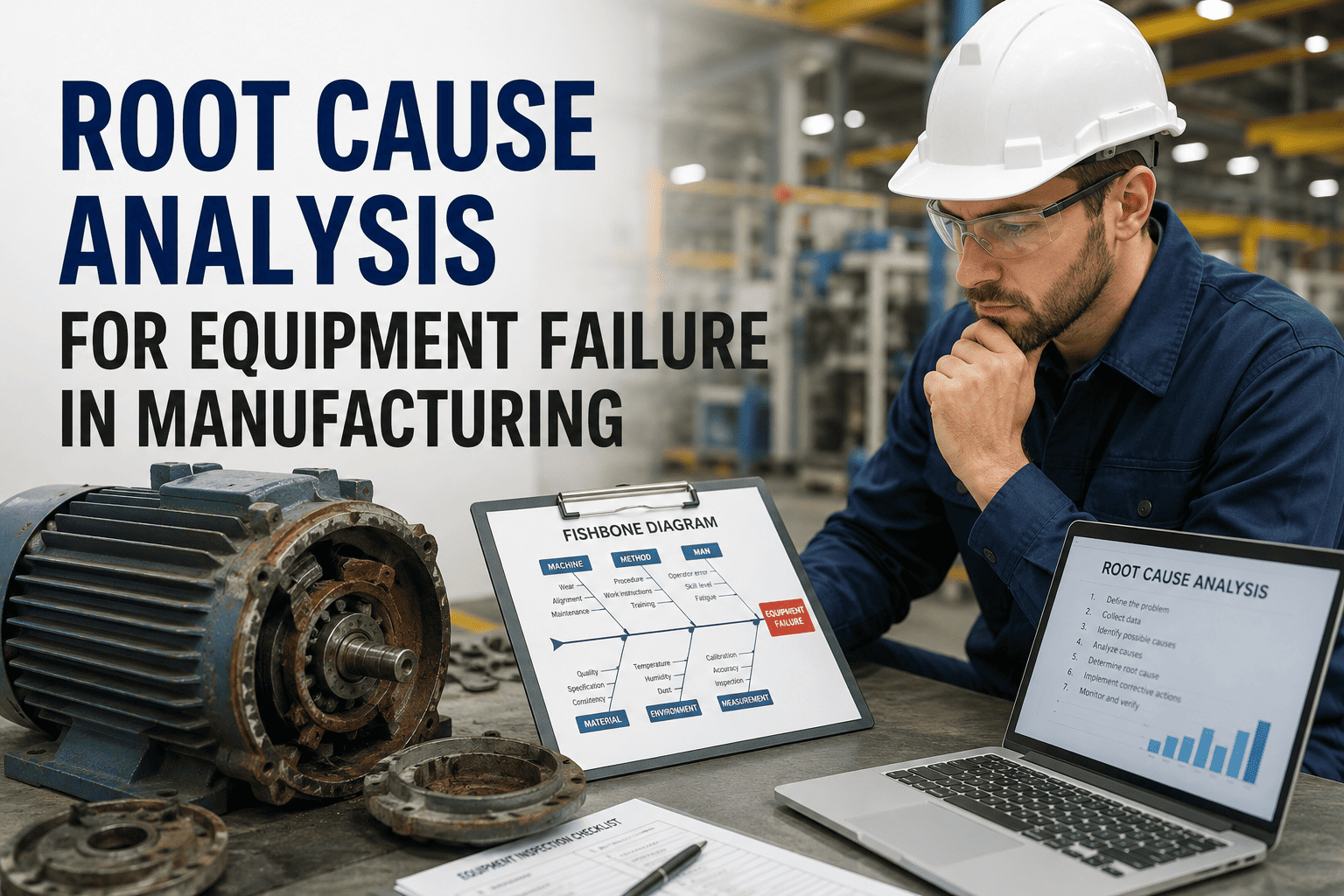
Repeat equipment failures cost manufacturing plants 2–5× more than one-time breakdowns because the same root cause keeps regenerating downtime, spare parts, and operator fatigue. Structured root cause analysis (RCA) — 5 Whys, fishbone diagrams, fault tree analysis — uncovers the true driver of failure so your team can eliminate it permanently instead of re-fixing symptoms shift after shift. This guide walks through a practical RCA workflow built for maintenance teams, from the 5 Whys to corrective action creation and CMMS-based recurrence tracking. Start by logging your next failure in Start Free Trial and watch recurring downtime shrink week over week.
Why does the same asset fail three weeks after you just repaired it?
Because 70% of "fixed" equipment failures return within 90 days when the root cause is never logged, verified, or closed out. A disciplined RCA workflow inside your CMMS is how you break the loop — and recover the 2–5× cost premium of repeat downtime.
The hidden tax of repeat equipment failure
When a pump, conveyor, or gearbox fails a second time for the same reason, the bill isn't just labor and parts — it's the cascading production loss, overtime, and the slow erosion of maintenance credibility on the floor.
A 180-asset food-packaging plant spent $42,000/yr on re-repairing the same four filler motors. After implementing 5 Whys + fishbone RCA logged inside their CMMS, technicians identified misaligned mounting plates causing premature bearing wear. One corrective PM later, motor failures dropped 81% in the next six months — a $34K annual savings on four assets alone.
5 Whys, Fishbone, and Fault Tree — when to use each
No single RCA technique fits every failure. Match the method to the complexity of the breakdown — a 10-minute 5 Whys for simple mechanical failures, a fishbone for multi-factor issues, and a fault tree for safety-critical or catastrophic events.
5 Whys Analysis
Fishbone (Ishikawa) Diagram
Fault Tree Analysis
The 6-step RCA workflow — from failure to closed corrective action
A repeatable RCA process turns one-off investigations into a plant-wide habit. Each step feeds the next, and every output is logged in your CMMS so the knowledge compounds instead of evaporating.
Contain & Document the Failure
Make the asset safe, restore production with a backup or workaround, and capture the failure in the CMMS work order within 2 hours — photos, sensor logs, operator statements, and the exact failure mode code (per ISO 14224).
Assemble the RCA Team & Evidence
Pull the maintenance tech, operator, reliability engineer, and (for critical assets) quality/safety. Gather work-order history, MTBF data, vibration/thermography trends, and parts-consumption records for the asset.
Select & Run the RCA Technique
Simple mechanical failure → 5 Whys. Multi-factor breakdown → fishbone across the 6Ms. Safety-critical event → fault tree. Document the full chain of reasoning — not just the final answer.
Validate the Root Cause
Confirm the identified root cause actually produces the observed symptom — reverse-test on the asset if possible, check whether the same cause exists on identical sister equipment, and verify against historical failure patterns.
Design & Assign Corrective Actions
Specify the fix (PM update, redesign, training, parts spec change), assign an owner, set a due date, and link it directly to the originating failure work order in the CMMS so nothing slips through.
Verify & Close — Track Recurrence
After 30/60/90 days, check whether the same failure mode reappears on the asset. If MTBF improves, close the RCA. If it recurs, reopen and re-run — the root cause was wrong or the corrective action incomplete.
Logging RCA inside your CMMS so failures actually get eliminated
RCA done on a whiteboard dies on a whiteboard. When every RCA finding, root cause code, corrective action, and recurrence check lives inside your CMMS, the plant builds a permanent knowledge base that compounds with every failure investigated.
What changes when RCA replaces "fix it and move on"
The difference between a plant that runs and a plant that improves is whether each failure makes the next one less likely. Here's what shifts when RCA becomes the default response to every equipment breakdown.
| Dimension | Without RCA (Symptom Fix) | With RCA (Root Cause Fix) |
|---|---|---|
| Failure recurrence | 70% chance the same failure returns within 90 days | Same failure mode eliminated — MTBF extends 3–10× |
| Cost per failure | 2–5× premium from repeat labor, parts, and downtime | One-time investigation cost, then zero recurrence spend |
| Knowledge retention | Lives in the head of the senior tech who fixed it | Permanently logged in CMMS, searchable by anyone |
| PM plan evolution | Static — same PMs year after year regardless of failures | PMs continuously refined based on RCA findings |
| Sister-asset risk | Identical equipment fails the same way, one by one | Corrective action rolled across all similar assets proactively |
| Maintenance credibility | Operators see "the same thing broke again" — trust erodes | Operators see failures stop — maintenance becomes strategic |
Turn your next equipment failure into the last one of its kind
Oxmaint gives your maintenance team a structured RCA workflow — 5 Whys, fishbone, corrective actions, and 90-day recurrence tracking — built directly into every work order. No more root causes lost to whiteboards and memory.
Root cause analysis for equipment failure — your questions answered
How long should a root cause analysis take for a typical equipment failure?
A 5 Whys analysis for a straightforward mechanical failure takes 10–20 minutes and should be completed within 48 hours of the breakdown while evidence is fresh. A fishbone session with a 3–6 person team runs 45–90 minutes. Fault tree analysis for safety-critical events can take 2–4 hours over several days. The key metric isn't time spent — it's whether the root cause is validated and the corrective action closed out within 30 days.
When should I use 5 Whys vs a fishbone diagram vs fault tree analysis?
Use 5 Whys for single-cause mechanical or electrical failures where the chain from symptom to root is linear — a seized bearing, a tripped overload, a blown seal. Switch to a fishbone (Ishikawa) diagram when multiple factors across people, process, materials, or environment contribute to the failure. Reserve fault tree analysis for catastrophic, safety-critical, or regulatory events where formal boolean logic and documentation are required. You can Book a Demo to see how Oxmaint templates guide your team to the right technique per failure type.
How do I log RCA findings in a CMMS so failures don't recur?
Tag the originating work order with an ISO 14224 failure mode code, attach the full 5 Whys or fishbone document as a linked file, create the corrective action as a child work order with an owner and due date, and set an automated 30/60/90-day recurrence check on the asset. The RCA isn't "closed" until the CMMS confirms MTBF has improved and the same failure mode hasn't reappeared on that asset or its sister units.
What's the biggest mistake teams make in equipment failure RCA?
Stopping at the first plausible cause instead of drilling to the true root. "The bearing failed because it wore out" is a symptom, not a root cause — the root cause is why it wore out prematurely (misalignment, contamination, lubrication gap, spec error). The second-biggest mistake is completing the RCA but never logging the corrective action in the CMMS, so the finding evaporates and the same failure returns within a quarter. You can test a closed-loop RCA workflow by signing up for a Start Free Trial and running your next failure through it.
How do I measure whether RCA is actually reducing equipment failures?
Track three KPIs per asset class: MTBF (mean time between failures) should trend upward after a corrective action, repeat-failure rate (same failure mode within 90 days) should drop below 15%, and reactive maintenance percentage should decline as preventive tasks evolve from RCA findings. A plant running disciplined RCA typically sees MTBF improve 3–10× on investigated assets and a 20–40% reduction in unplanned downtime within the first year.
Run your first equipment RCA inside Oxmaint today
Log a failure, run 5 Whys, assign a corrective action, and set a 90-day recurrence check — all in one workflow. See why manufacturing plants trust Oxmaint to turn every breakdown into a permanent fix.
Free 14-day trial · No credit card