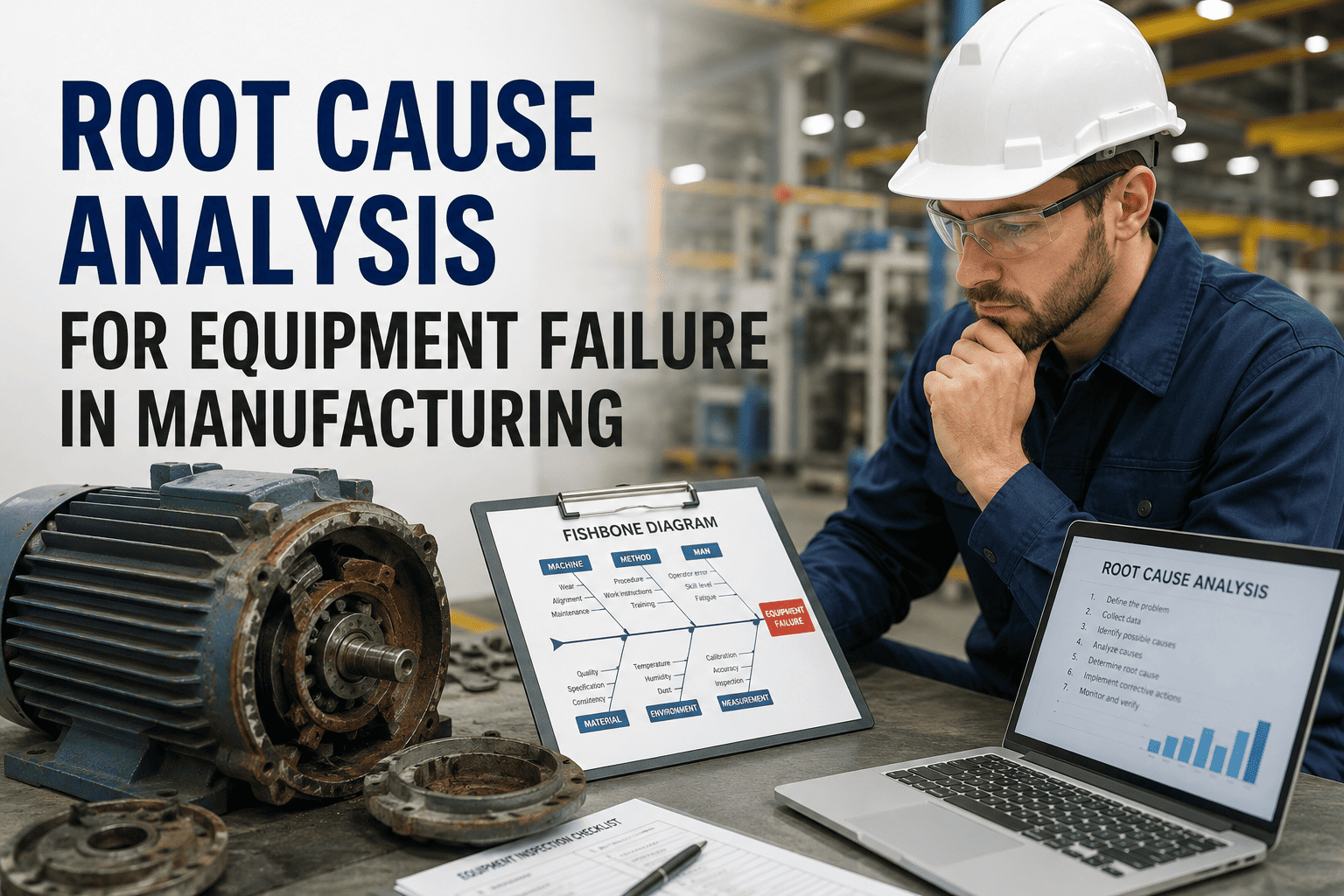
Most manufacturing equipment failures are not accidents — they are predictable, preventable events that get misdiagnosed as bad luck. Start eliminating repeat failures with Oxmaint's CMMS-driven RCA workflow — free trial, up and running in under an hour. Nearly three-quarters of manufacturers have experienced at least one product recall in the past five years, and the majority of those incidents trace back to a root cause that was never properly identified the first time the equipment failed.
AI Vision & Quality Control · Failure Analysis · Manufacturing
Root Cause Analysis (RCA) for Manufacturing Equipment Failure
When a conveyor belt snaps at 2 AM and halts your production line, the instinct is to replace the belt and restart. Six weeks later — same belt, same location, same shift — it snaps again. The real question was never about the belt. RCA is the discipline that stops this cycle permanently.
74%
Manufacturers hit by product recalls in 5 years
45%
Failure reduction after structured RCFA programs
$930K
Spent on repeat pump failures before RCA at one plant
80%
Of failures traced to just 20% of root causes (Pareto)
The Core Idea
What Is Root Cause Analysis — And Why Does Manufacturing Need It?
Root Cause Analysis (RCA) is a systematic investigation process that traces equipment failures back to their true point of origin — not just the visible symptom. When a bearing fails, RCA does not stop at "replace the bearing." It asks: was it lubrication starvation? Misalignment? Operating load beyond rated capacity? A PM schedule that no longer matches actual run time?
The American Society of Quality defines the root cause as the core issue that sets in motion the entire cause-and-effect chain leading to the problem. Corrective maintenance without RCA means your replacement bearing is already on a countdown to the same failure.
RCA shifts your maintenance strategy from reactive — fix it fast — to proactive: prevent it forever. For manufacturing operations where unplanned downtime directly hits production throughput, quality output, and customer delivery, that shift is worth millions per year.
The Reactive Loop RCA Breaks
↓
↓
↓
RCA breaks this loop at step 3
Stop Fixing Symptoms. Start Solving Problems.
Oxmaint captures every failure event, links it to asset history, and guides your team through structured RCA — so root causes get found, corrective actions get assigned, and repeat failures disappear.
RCA Techniques
5 Methods That Actually Find the Root Cause in Manufacturing
No single method fits every failure. Best-in-class maintenance teams select based on failure complexity, severity, and available data. Here are the five most widely used — and what each is built for.
Most Used
5 Whys
15–60 min | No special tools
Developed by Sakichi Toyoda at Toyota. Ask "why" five times to drill past symptoms. Works best for straightforward failures with a single causal chain. Ideal for shop floor investigations without cross-functional teams.
Example: CNC Mill Out of Spec
Why? Wrong part depth → Backlash in ball screw
Why? Backlash → Worn thrust bearings
Why? Worn bearings → Insufficient lubrication
Why? No lubrication → PM was skipped
Root: Schedule didn't match new high-duty cycle
Multi-Cause
Fishbone Diagram
60–120 min | Team required
Also called the Ishikawa or Cause-and-Effect diagram. Organizes potential causes into the 6M categories: Machine, Method, Material, Manpower, Measurement, Mother Nature. Prevents teams from fixating on the most obvious cause while overlooking hidden contributors.
Problem
Machine
Method
Material
Manpower
Measurement
Environment
Complex Failures
Fault Tree Analysis (FTA)
Half to full day | Engineering-led
A top-down logic model that maps every possible contributing factor using Boolean logic gates. Best for high-consequence failures where multiple independent pathways can lead to the same catastrophic outcome. Common in critical infrastructure and safety-critical systems.
Proactive
FMEA
Ongoing | Before failures occur
Failure Mode and Effects Analysis identifies potential failures before they happen. Each failure mode is scored on Severity × Occurrence × Detection to generate a Risk Priority Number (RPN). High-RPN modes get PM actions assigned before the first failure event occurs.
Data-Driven
Pareto Analysis
30–60 min | Requires failure history
Based on the 80/20 principle: 80% of your downtime comes from 20% of your failure causes. A Pareto chart plots failure frequency and cumulative impact, directing your RCA effort toward the few causes producing the most pain — not spreading resources thin across everything.
Step-by-Step Process
How to Conduct RCA for Equipment Failure — The Right Sequence
Skipping steps is how root causes get missed. Each phase builds on the previous one. A $300 pump seal and a $300,000 line shutdown both deserve the same structured process.
01
Preserve the Failure Scene
Before anything gets repaired, photograph the failed component, record operating conditions, note who was present, and log the exact failure time. In a CMMS, this means creating a failure event record linked to the asset with all initial observations captured — not reconstructed from memory hours later.
02
Define the Problem Precisely
Write a clear, objective problem statement that all team members agree on. Vague problems produce vague root causes. "Pump failed" is not useful. "Condensate pump Unit 3 lost prime three times in 60 days during shift changeover" gives your team something to investigate.
03
Pull the Complete Asset History
Review all past work orders, PM compliance records, previous failure events, and any available sensor data for this asset. Interview the operators who work with it daily — their observations often contain critical clues that digital data alone cannot reveal. This is where a CMMS earns its value: history that walks out the door with retiring technicians is history your RCA can never access.
04
Apply the Right RCA Method
Select the method suited to this failure's complexity and impact. A recurring conveyor issue may need only a 5 Whys analysis. A catastrophic motor failure that shut down an entire line warrants Fishbone plus FTA. Avoid over-engineering simple failures or under-investigating complex ones.
05
Identify Root Causes — Usually More Than One
Good RCA almost always finds multiple root causes, not one. A pump failure might involve misalignment, pipe stress, loose foundations, and a missing operational procedure — all contributing simultaneously. Continue asking "why" until you reach a cause that is actionable at the process or design level, not just the symptom level.
06
Implement and Validate Corrective Actions
Develop solutions that address root causes directly — not band-aids. Update SOPs, revise PM schedules, modify equipment, provide targeted training. Then monitor the asset's failure history and MTBF trend over the following 60–90 days to confirm the fix held. Without validation, the root cause may quietly return.
Before vs After
Reactive Maintenance vs. CMMS-Driven RCA — The Operational Gap
| Area |
Without Structured RCA |
With Oxmaint RCA Workflow |
| Failure Documentation |
Recalled from memory hours after the event — incomplete, inaccurate |
Timestamped at the moment of failure via mobile — always precise |
| Repeat Failures |
Same asset fails every 4–6 weeks with no pattern detected |
MTBF trends flag degradation before the next failure occurs |
| Root Cause Identification |
Identified as "equipment wear" — same replacement, same result |
Structured 5 Whys and Fishbone templates built into work orders |
| Asset History Access |
Lost when experienced technicians retire or change shifts |
Permanently stored per asset — searchable by any engineer anytime |
| Corrective Action Tracking |
Assigned verbally — no ownership, no follow-up, no validation |
Actions assigned, dated, and linked to the original failure record |
| Downtime Cost Visibility |
Unknown — downtime treated as a technical issue, not financial |
Cost per failure event tracked and reported against asset history |
| Cross-Team Learning |
Findings stay with the investigating technician — never shared |
RCA findings standardized and accessible across all teams and sites |
When to Investigate
Which Failures Actually Warrant a Full RCA?
Not every failure needs a full investigation. RCA requires time, manpower, and expertise. Prioritize based on three factors: impact, recurrence, and criticality.
Always Investigate
Any failure that caused production shutdown or safety incident
Same asset failing more than twice within 90 days
Failures causing regulatory non-compliance or product recall risk
Critical single-point-of-failure equipment with no redundancy
Failures that involved near-miss injury or environmental release
Investigate Based on Cost
Failures with repair cost exceeding a defined threshold (e.g. $5,000+)
Assets showing declining MTBF trend over three or more cycles
New equipment failing within the first year of installation
Failures occurring outside expected parameters without obvious cause
Equipment under active warranty where vendor accountability matters
Document Only
First-time low-cost failures on non-critical assets
Consumable wear items replaced per PM schedule
Failures with clear, known, and already-addressed cause
Minor auxiliary equipment with full redundancy available
End-of-life equipment already flagged for CapEx replacement
Common Pitfalls
Why RCA Investigations Fail in Manufacturing — And How to Avoid It
01
Blame Over Analysis
A mistake is rarely the root cause — it is a symptom. Effective RCA treats failures like a diagnosis, not a tribunal. If your investigation ends with "technician error," you haven't found the root cause — you've found a contributing human factor that itself has a root cause in training, procedure, or oversight design.
02
Rushing Back to Production
High production pressure leads teams to close out investigations the moment equipment restarts. The RCA gets shelved incomplete. Without time to identify and document true root causes, corrective actions are never assigned, and the next failure event is already scheduled by default.
03
Missing Real-Time Data
RCA built on historical records alone misses the dynamic factors — temperature spikes, load surges, shift-change behaviors — that often prove to be the true cause. Plants that integrate IoT sensor data with their CMMS detect these invisible patterns that paper-based investigations never surface.
04
No Cross-Department Input
Maintenance teams often focus narrowly on mechanical factors, missing process inefficiencies, material handling practices, or operational conditions that operators know are contributing. RCA without frontline operator input routinely misses the actual root cause in plain sight on the production floor.
05
Corrective Actions Without Owners
The most technically accurate RCA produces zero benefit if corrective actions are assigned verbally and never tracked. Without named ownership, due dates, and digital accountability in a CMMS, recommendations sit in a report nobody reads until the failure recurs and the cycle restarts.
06
Inconsistent Methods Across Teams
When maintenance applies 5 Whys while production does its own Pareto and quality runs a separate FMEA — with no shared terminology or template — findings stay fragmented and cannot be aggregated into plant-wide learning. Standardized RCA templates inside a CMMS solve this at scale.
Oxmaint RCA Platform
How Oxmaint Turns Equipment Failures Into Permanent Fixes
Capture
Failure Events Logged at the Moment of Discovery
Technicians open work orders via mobile — even offline in areas with zero connectivity. Failure timestamps are locked at report time, not entered retrospectively. Every failure is linked to the asset's complete history from the moment it's created.
Analyze
Built-In 5 Whys and Fishbone Templates
RCA investigation templates are embedded directly into work orders. Teams complete structured analysis before closing a failure event — not in a separate spreadsheet that gets lost. Findings are stored against the asset record permanently.
Track
Corrective Actions With Ownership and Due Dates
Every corrective action identified in RCA is assigned to a named team member with a due date and priority level. Action completion is tracked and linked to the original failure record — creating a closed-loop accountability chain.
Monitor
MTBF Trends Validate Whether Fixes Actually Held
After corrective actions are implemented, Oxmaint monitors the asset's MTBF trend. If the failure pattern returns, the system flags it before the next breakdown. Your RCA is validated by data — not by gut feeling or the outgoing shift leader's opinion.
Learn
RCA Knowledge Shared Across Every Site
Findings standardized across units and plants. When your best-performing facility solves a failure mode permanently, every other site in your portfolio gets the corrective action template — not just the engineers who happened to attend that one meeting.
Predict
AI-Assisted Failure Pattern Detection
Oxmaint aggregates work order history, sensor data, and MTBF trends to surface recurring failure patterns before they become the next RCA trigger. The goal is fewer RCA investigations — because the failures that would have prompted them never happen.
Every Repeat Failure Is a Root Cause That Was Never Found
Oxmaint gives your team built-in RCA templates, failure history per asset, corrective action tracking, and MTBF validation — all in one platform. The next failure event can either cost you time and money again, or become the last time that asset fails for that reason.
Common Questions
What Manufacturing Teams Ask About RCA Every Week
How is RCA different from troubleshooting?
Troubleshooting is trial and error — swap parts until the machine runs again. RCA is a formal, evidence-based examination of physical, human, and organizational factors behind a failure. Troubleshooting gets equipment back online today; RCA prevents it from failing again next month. In high-failure environments, running only troubleshooting means you are perpetually behind.
Start tracking failure events in Oxmaint so your RCA has complete asset history to work from.
How long does a proper RCA investigation take?
A 5 Whys analysis for a straightforward failure takes 15 to 60 minutes on the shop floor. A full Fishbone or Fault Tree investigation for a complex, multi-factor failure typically takes one to two days including data collection, cross-functional team sessions, and documentation. The cost of that time is consistently less than the cost of the next repeat failure.
See how Oxmaint's built-in RCA templates cut investigation time significantly.
Does Oxmaint support FMEA and Fishbone templates natively?
Yes. Oxmaint includes structured RCA investigation templates — including 5 Whys and Fishbone frameworks — embedded directly into the work order workflow. Teams complete the analysis within the same platform where the failure was reported, keeping findings permanently attached to the asset record rather than in a separate spreadsheet.
Try the RCA workflow free — no implementation required.
How do we know when a corrective action from RCA actually worked?
The validation metric is MTBF — Mean Time Between Failures for that asset. After corrective actions are implemented, Oxmaint tracks the asset's subsequent failure history. If MTBF improves and holds above threshold over the following 60–90 days, the root cause was addressed. If it declines again, the platform alerts your team before the next breakdown.
Book a demo to see how MTBF validation works in the Oxmaint dashboard.
Can Oxmaint help us prioritize which failures to investigate first?
Yes. Oxmaint applies Pareto-style analysis across your work order history to surface the top failure causes consuming the most downtime and repair cost. This directs your RCA resources toward the 20% of root causes driving 80% of your losses — rather than spreading investigation effort evenly across every failure event.
Start free and let the data show you where to investigate first.
Your Next Equipment Failure Is Already Building. RCA Catches It First.
Plants running structured RCA with CMMS-linked failure data reduce recurring breakdowns by up to 45% within the first year. Those still fixing symptoms will spend that year rebuilding the same components, losing the same production hours, and wondering why nothing changes. Start today — free trial, no implementation fees, RCA templates ready from day one.