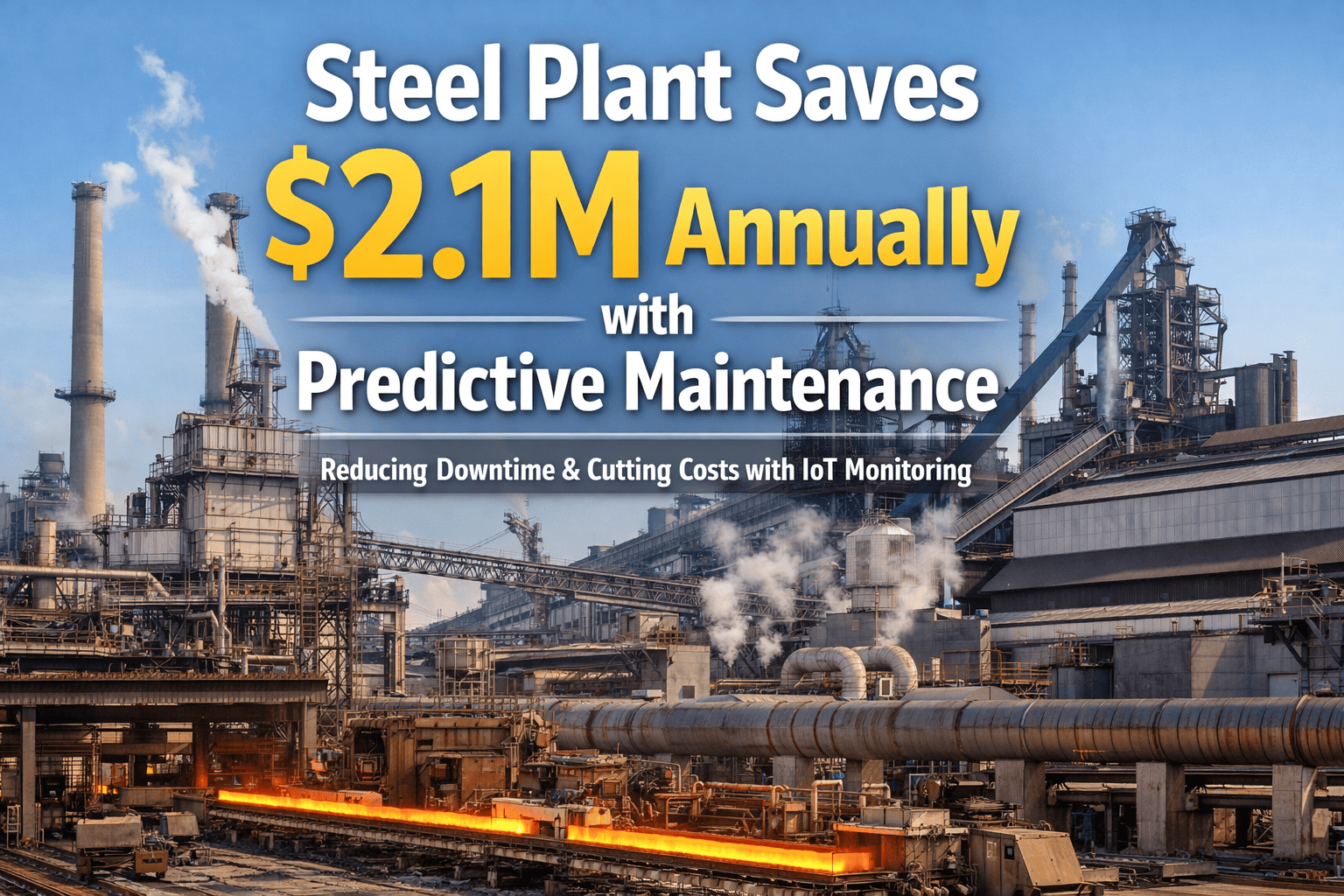
An integrated steel manufacturing facility in the Midwest was experiencing catastrophic equipment failures on critical production assets — blast furnace blowers, hot strip mill rolling stands, and continuous caster systems — resulting in $3.8 million annual losses from unplanned shutdowns and emergency repairs. Maintenance operated on fixed intervals with no visibility into actual equipment condition, while spare parts inventory exceeded $12 million without preventing stockouts during failures. After implementing OxMaint's IoT-enabled predictive maintenance platform, the plant achieved $2.1 million in verifiable annual savings, reduced critical equipment failures by 67%, and recovered the full implementation investment within six months. Book a demo to see how predictive maintenance applies to your steel production environment.
Operational Baseline
The Cost of Reactive Maintenance in Integrated Steel Production
$3.8M
Annual cost impact from unplanned equipment failures and extended downtime
18 failures
Critical asset breakdowns per year on blast furnace, caster, and rolling mill equipment
14-26 hrs
Average downtime per failure including diagnosis, parts procurement, and repair execution
$12M
Spare parts inventory value — yet 40% of critical failures required emergency parts orders
The plant operated two blast furnaces, a basic oxygen furnace steelmaking shop, continuous casting, and a hot strip mill producing 2.4 million tons annually. Equipment maintenance followed manufacturer-recommended schedules supplemented by operator observations. When a hydraulic coupling failed on the hot strip mill finishing stand, production stopped for 22 hours while technicians diagnosed the root cause, sourced a replacement from Europe via air freight, and completed repairs — costing $680,000 in lost production plus $140,000 in emergency parts and expedited shipping.
Implementation Approach
IoT Sensor Deployment and Predictive Analytics Integration
Engineering team identified 32 critical assets across the production chain where failures caused complete production stoppage. For each asset, failure modes were cataloged from historical maintenance records — bearing failures, hydraulic system degradation, motor winding breakdown, gearbox wear, and cooling system failures. Sensor requirements specified per failure mode: vibration monitoring for rotating equipment, thermal imaging for electrical systems, pressure transducers for hydraulics, and oil analysis sensors for lubrication systems.
Total of 156 wireless IoT sensors deployed across 32 critical assets. Installation completed during planned maintenance windows without additional production downtime. Industrial mesh network configured to relay sensor data from high-temperature zones like the caster platform and furnace areas to OxMaint's cloud analytics platform. Baseline data collection initiated immediately with 24/7 monitoring active by end of week 8.
OxMaint's AI algorithms trained on combination of real-time sensor data and 24 months of historical maintenance records. Models learned normal operating signatures for each asset under varying production loads. Anomaly detection thresholds calibrated to minimize false positives while ensuring genuine degradation patterns triggered alerts with sufficient lead time for planned intervention.
Predictive alerts configured to create work orders automatically in OxMaint CMMS with equipment ID, detected anomaly type, predicted failure window, and recommended corrective actions. Maintenance planners trained on alert interpretation and intervention scheduling. Spare parts reservation linked to predictive work orders ensuring required components available before job execution. First predictive interventions completed successfully with zero false alarms.
Financial Impact
Documented Annual Savings Breakdown — First Full Operating Year
Total Verified Annual Savings
$2,108,000
Based on 12-month post-implementation performance vs. baseline year
Avoided Production Losses
$1,440,000
12 prevented critical failures x average 18-hour stoppage x $6,700/hour production value
Reduced Emergency Repairs
$385,000
Eliminated premium labor rates, expedited parts shipping, and contractor call-outs for 67% of historical failure events
Optimized Spare Parts Inventory
$180,000
15% inventory reduction through better demand forecasting while improving critical parts availability to 98%
Extended Asset Life
$103,000
Early intervention prevented secondary damage — bearing failures caught before gear damage, motor issues before winding burnout
Implementation Cost
$425,000
First-Year Savings
$2,108,000
Payback Period
6.1 months
Five-Year ROI
2,382%
Achieve Similar Results in Your Steel Manufacturing Operation
OxMaint's predictive maintenance platform combines IoT sensor networks with AI-powered failure prediction to prevent costly unplanned downtime in steel production. Steel plants typically achieve 50-70% reduction in critical equipment failures and recover implementation costs within 6-9 months through avoided production losses.
Failure Prevention Examples
Three Critical Failures Predicted and Prevented
Detection Event
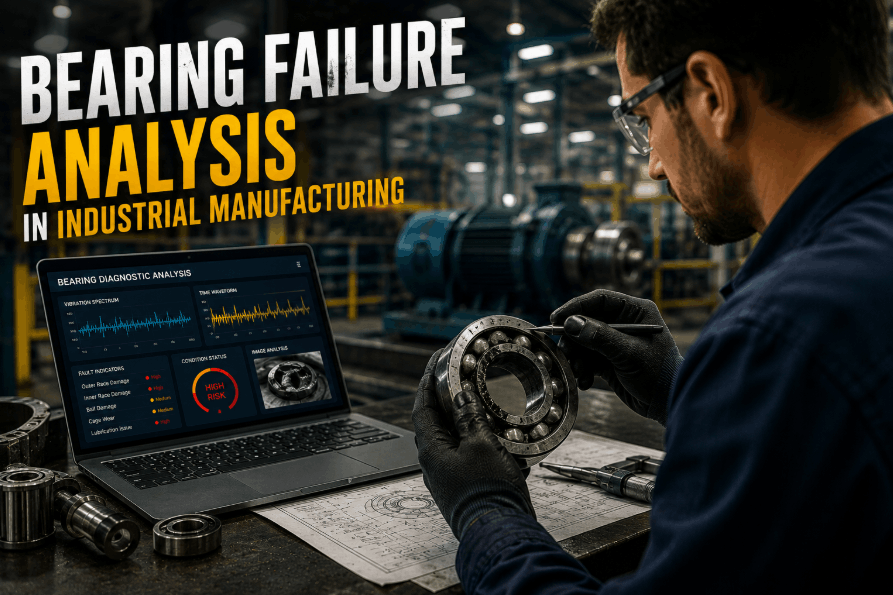
Vibration sensor detected bearing degradation signature 16 days before predicted failure. Amplitude increase of 3.2mm/s over baseline accompanied by characteristic high-frequency components indicating race defect progression.
Intervention Executed
Bearing replacement scheduled during planned furnace maintenance window. Required bearing sourced from inventory and technician team briefed on exact failure location from vibration analysis, reducing repair time by 60% compared to reactive diagnosis.
Impact Avoided
Catastrophic bearing seizure would have caused immediate blower failure, forcing blast furnace shutdown for minimum 28 hours including cooling, motor removal, bearing replacement, and restart sequence. Avoided loss: $187,600 production value plus $45,000 emergency repair premium.
Detection Event
Pressure transducers identified hydraulic accumulator pre-charge loss manifesting as increased pressure fluctuation during rolling. Temperature sensors on pump showed gradual rise indicating compensating behavior for reduced accumulator capacity.
Intervention Executed
Accumulator servicing completed during weekend maintenance shift. Pre-charge restored to specification and seal condition verified. Total intervention time 4 hours with mill available for Monday startup as scheduled.
Impact Avoided
Complete hydraulic system failure during production would have required mill shutdown, emergency contractor response, and potential pump replacement if run-to-failure caused secondary damage. Avoided minimum 18-hour unplanned stoppage worth $120,600 plus $28,000 emergency service costs.
Detection Event
Thermal imaging detected localized temperature increase on segment roller bearing — 22°C above adjacent rollers. Pattern consistent with lubrication breakdown preceding bearing failure. Alert triggered with 9-day predicted failure window.
Intervention Executed
Bearing inspection during next scheduled caster downtime confirmed grease contamination. Bearing cleaned, re-lubricated, and monitored. Temperature returned to normal within 48 hours post-service, confirming successful intervention before permanent damage occurred.
Impact Avoided
Bearing seizure on caster roller forces immediate production halt to prevent steel breakout safety incident. Minimum 12-hour unplanned shutdown for emergency bearing replacement plus risk of strand breakout causing additional equipment damage. Avoided loss: $80,400 production plus safety incident risk.
Plant Leadership Perspective
Impact Beyond the Financial Numbers
"
The financial ROI was clear within six months, but the operational transformation went deeper. Our maintenance culture shifted from reactive firefighting to planned precision interventions. Technicians had diagnostic data before arriving at the asset rather than troubleshooting on site under production pressure. The most significant change was eliminating the fear of catastrophic weekend failures that previously defined our maintenance management. We went from managing crisis to managing reliability, and that confidence change is worth more than the $2.1 million annual savings we can quantify on the spreadsheet.
Common Questions
Steel Plant Engineers Ask These Before Starting
What types of sensors are required and can they work in high-temperature steel plant environments?
OxMaint supports industrial-grade sensors rated for steel plant conditions including high-temperature zones up to 85°C ambient. Typical sensor package includes wireless vibration sensors, infrared thermal cameras, pressure transducers, and current monitoring clamps. All sensors ruggedized for dust, moisture, and electromagnetic interference common in steel facilities.
Book a demo to discuss sensor specifications for your equipment.
How long does deployment take and is production disruption required?
Typical steel plant deployment completes in 12-16 weeks from contract signing to full predictive alerts active. Sensor installation occurs during planned maintenance windows with zero additional production downtime required. Most plants phase deployment starting with highest-criticality assets like blast furnace blowers and caster systems, then expanding to secondary equipment over subsequent quarters.
What failure prediction accuracy can we expect and how much lead time for intervention?
Alert accuracy typically starts at 70-75% during initial learning period and improves to 85-92% by month six as AI models refine. Lead time varies by failure mode: bearing degradation provides 10-25 days notice, hydraulic system failures give 7-18 days, electrical issues show 5-12 days before breakdown.
Sign in to see prediction accuracy tracking for your assets.
Can OxMaint integrate with our existing maintenance management system and ERP?
Yes. OxMaint integrates with SAP PM, Oracle EAM, Maximo, and other enterprise systems via standard APIs. Predictive alerts can create work orders directly in your existing CMMS, and spare parts data can sync with ERP inventory modules. Plants typically use OxMaint for predictive analytics while maintaining existing systems for transactional maintenance records and procurement workflows.
Prevent Your Next Catastrophic Equipment Failure Before It Costs You Millions
Steel plants implementing OxMaint's predictive maintenance platform achieve 50-70% reduction in critical equipment failures, recover implementation costs within 6-9 months, and generate $1.5M-$3M in annual savings from avoided production losses and optimized maintenance spending. Your equipment is already showing failure signatures — predictive maintenance makes them visible before the breakdown occurs. Free trial includes sensor deployment planning and AI model training on your historical maintenance data.