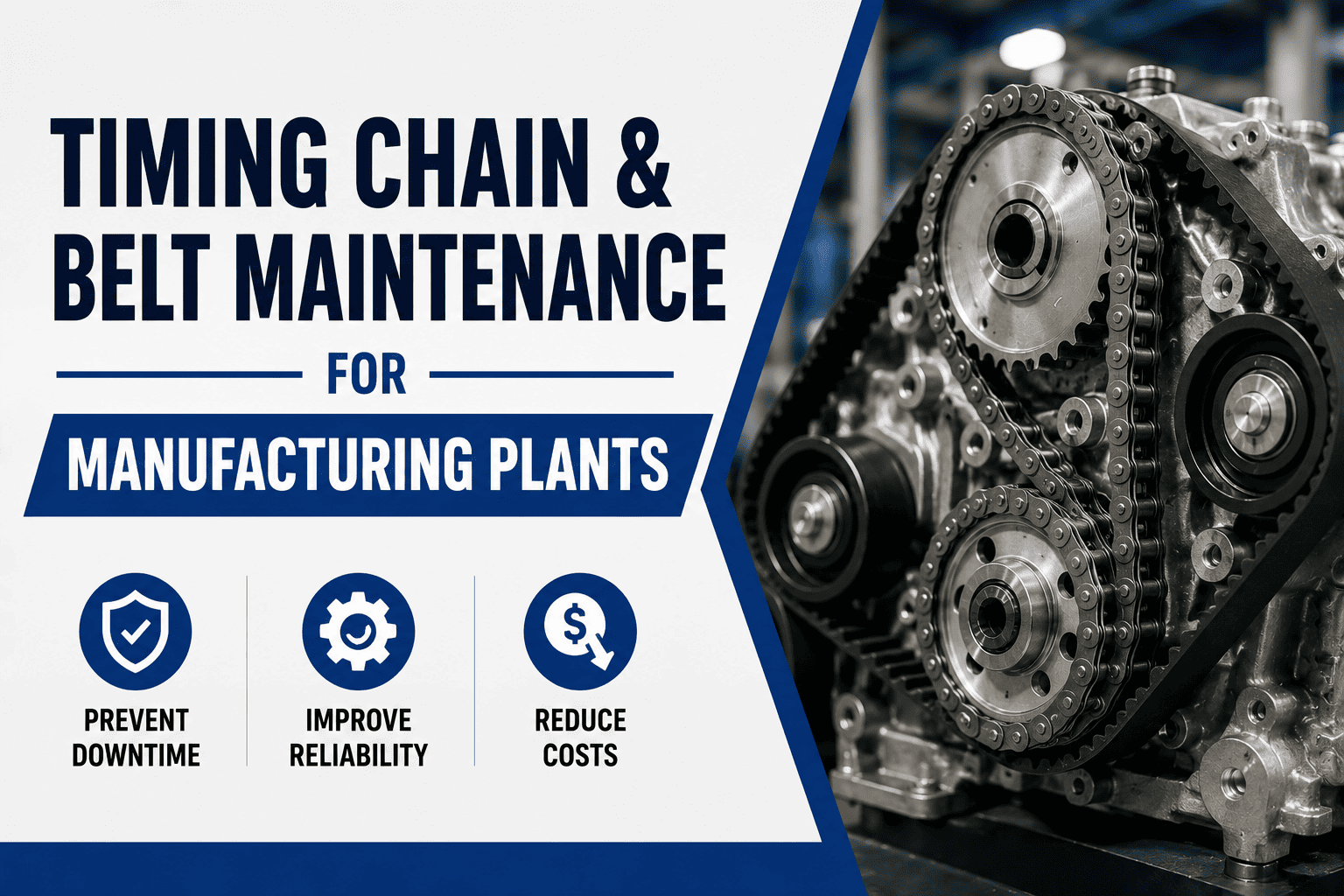
Timing chain and belt maintenance in manufacturing plants is the difference between a synchronized, high-OEE production line and a cascading unplanned downtime event that costs $12,000 or more per hour. Timing drives synchronize motion in packaging, printing, food processing, and CNC machinery, and their failure often destroys adjacent tooling, damages drive shafts, and halts entire production zones within seconds. This guide covers how maintenance and reliability teams can use tension measurement, sprocket wear tracking, and hour-based CMMS scheduling to prevent timing drive failures. Ready to eliminate reactive maintenance and automate your preventive maintenance triggers? You can Start Free Trial of OxMaint today or book a personalized walkthrough to see it on your assets.
TIMING DRIVE RELIABILITY GUIDE
Are aging timing belts and chains quietly threatening your production line?
Timing drive failures rarely give warning — they snap, skip, or jam, instantly halting packaging, printing, and processing equipment. Transitioning from calendar-based guessing to condition-based, hour-run preventive maintenance stops cascading failures before they start.
INSPECTION & WEAR THRESHOLDS
How to inspect timing belts and chains for manufacturing equipment
A robust timing belt inspection routine catches 90% of impending failures before they escalate. Use these tiered checklist grids during routine PMs to standardize reliability checks across all plant timing drives.
Belt & Chain Tension
- Measure deflection with a sonic tension meter; target 0.020–0.030 inch deflection at 4 oz of force.
- Inspect for over-tensioning, which accelerates bearing wear by up to 35% on drive motors.
- Verify chain slack allows 2% to 4% of center distance for standard roller chains.
Sprocket & Pulley Wear
- Use a sprocket tooth gauge to check for hooking; replace sprockets when tooth profile wears past 30%.
- Examine pulley grooves for shiny bottoms, indicating the belt is riding too low and the pulley is worn.
- Always replace sprockets and belts as paired sets to prevent premature wear on new components.
Visual & Sync Verification
- Look for cracking, fraying, or glazing on belt sidewalls; replace immediately if backside cracks exceed 3 per inch.
- Verify timing marks align precisely on CAM and CRANK sprockets after reinstallation.
- Check guard integrity and ensure proper ventilation to prevent heat buildup above 185°F.
CMMS TRIGGER SCHEDULING
Timing belt PM schedule: Why hours-run beats calendar days
Timing drives degrade based on usage cycles, thermal stress, and load — not the date on a calendar. A 24/7 packaging line wears a belt 3.5x faster than a single-shift operation. Scheduling CMMS timing maintenance by meter readings or hours-run ensures components are replaced exactly when their service life expires, eliminating both premature changeouts and unexpected snaps.
| Timing Component | Standard Hours-Run Interval | Inspection Trigger Point | Key CMMS Metric Tracked |
|---|---|---|---|
| Polyurethane Timing Belts | 15,000 – 20,000 hours | 10,000 hours | Tension loss (Hz) & visual cracks |
| Rubber Synchronous Belts | 10,000 – 15,000 hours | 7,500 hours | Belt width wear & tooth shear |
| Roller Timing Chains | 8,000 – 12,000 hours | 5,000 hours | Elongation limit (max 2%) |
| Sprockets & Pulleys | 2x belt/chain interval | With every belt/chain PM | Tooth profile gauge measurement |
WORKED EXAMPLE & ROI
The cost of ignoring timing chain PM in manufacturing
Consider a 180-asset food packaging plant running two shifts. A single timing chain failure on the main bagging line costs $4,200 per hour in lost throughput, plus an average of $2,800 in emergency repair labor and expedited parts. If that line goes down for 6 hours, the total impact is $28,000. Over a year, the plant averages 4 such failures, totaling $112,000 in preventable losses.
Stop guessing. Start scheduling timing maintenance by actual runtime.
See how OxMaint automatically tracks asset hours and triggers preventive work orders before timing belts and chains reach their failure point.
CMMS AUTOMATION
How OxMaint solves timing drive maintenance for plants
OxMaint is an AI-powered CMMS and EAM platform that eliminates spreadsheet tracking and calendar-based guessing. By tying timing belt and chain replacement schedules directly to real-time equipment runtime data, maintenance teams cut unplanned downtime by up to 50%.
Meter-Based PM Triggers
Automatically generate work orders based on actual hours-run or cycle counts, ensuring timing belt replacement schedules perfectly match real component fatigue — no early swaps, no unexpected snaps.
Digital Inspection Checklists
Enforce standardized tension measurements and sprocket wear checks via mobile checklists. Capture pass/fail data and photos directly on the floor, driving 100% audit readiness for ISO 55000 compliance.
Spare Parts Auto-Reservation
When a timing drive PM triggers, OxMaint automatically reserves the correct belt, chain, and sprocket kit from inventory, eliminating parts hunting and reducing mean-time-to-repair (MTTR) by up to 40%.
Predictive Wear Analytics
AI-driven analytics track historical tension loss and vibration data to predict timing component failures weeks before they happen, shifting your team from preventive to true predictive maintenance.
IMPLEMENTATION ROADMAP
Transitioning to CMMS-based timing maintenance in 90 days
Moving from reactive fixes to structured timing drive PM takes a disciplined approach. Follow this 3-month timeline to migrate your manufacturing timing belt and chain maintenance into a CMMS.
Asset & Baseline Audit
Map every timing drive across the plant. Input make, model, current hours-run, and last-known replacement date into OxMaint. Set up parent-child asset hierarchies so belts link directly to drive motors and gearboxes.
PM Schedule Configuration
Build hour-based PM templates for inspection (5,000 hrs) and replacement (10,000–15,000 hrs). Attach digital checklists, safety lockout procedures, and required spare parts to each automated work order trigger.
Execution & Analytics Review
Technicians complete PMs via the mobile app. Review the first 30 days of data to identify outlier assets wearing faster than benchmarks, then refine replacement intervals based on actual condition data.
FREQUENTLY ASKED QUESTIONS
Common questions about timing chain and belt maintenance
How often should timing belts be replaced in manufacturing equipment?
Manufacturing timing belts should typically be replaced every 10,000 to 15,000 hours of runtime, depending on load and environmental conditions. It is critical to schedule replacements based on actual hours-run rather than calendar days, as a 24/7 production line will degrade a belt three times faster than a single-shift operation. You can automate these hour-based triggers by setting up Start Free Trial meter-based PMs in your CMMS.
What are the signs of a failing timing chain in plant machinery?
The most common signs of a failing timing chain include unusual rattling or grinding noises from the drive housing, visible elongation exceeding 2% of original length, skipped timing marks, and inconsistent machine synchronization. Routine sprocket wear checks and chain slack measurements during scheduled PMs are essential to catching these failure modes before they cause catastrophic downtime.
Can a CMMS automate timing belt inspection schedules?
Yes, a CMMS like OxMaint automates timing belt inspection by generating work orders based on equipment runtime meters or cycle counts rather than static dates. The system enforces digital checklists, tracks tension measurement history, and automatically reserves replacement parts, ensuring your team inspects and replaces timing drives exactly when needed.
Why should sprockets be replaced with timing belts?
Sprockets and pulleys should always be replaced as paired sets with timing belts or chains because worn sprocket teeth will rapidly destroy a new belt. When a sprocket tooth profile wears down by 30%, the chain or belt cannot seat properly, causing accelerated fatigue, skipping, and premature failure that negates the cost of the new component.
How do you measure timing belt tension correctly?
Timing belt tension is best measured using a sonic tension meter that detects the belt's vibration frequency when plucked, providing a precise readout in Newtons or Hertz. For manual checks, apply 4 ounces of force at the midpoint of the span and measure deflection, ensuring it falls between 0.020 and 0.030 inches to prevent both slippage and excessive bearing load.
Eliminate timing drive failures with OxMaint
Join the manufacturing plants using OxMaint to automate hour-based PMs, track asset wear, and cut unplanned downtime by up to 50%. See the platform configured for your exact production lines.
Free 14-day trial · No credit card




.png)