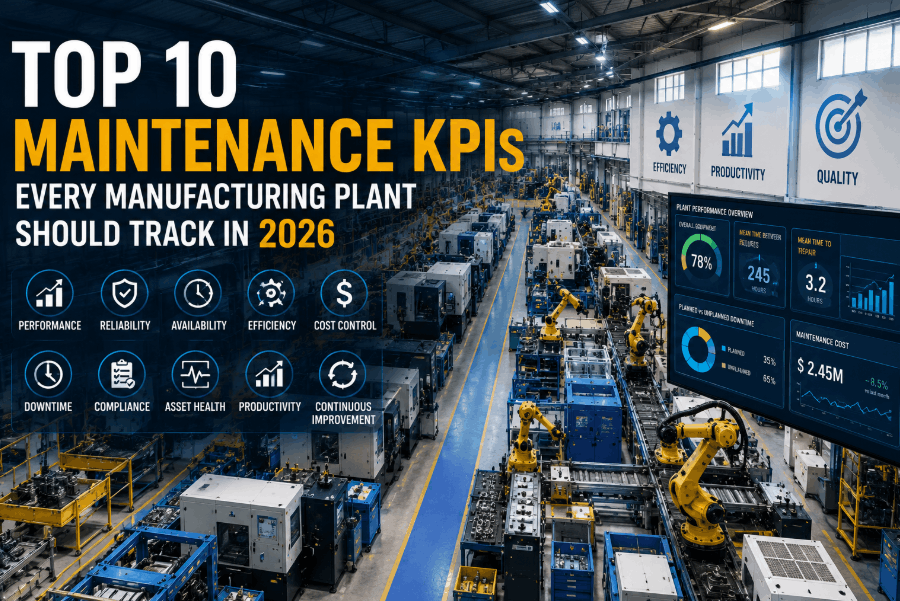
Top 15 Manufacturing Plant KPIs to Track in 2026

By oxmaint on February 7, 2026

top-15-manufacturing-plant-kpis-to-track-in-2026

Every manufacturing plant generates thousands of data points daily, but only a handful of metrics truly determine whether your operation is thriving or falling behind. In 2026, the gap between top-performing plants and the rest comes down to which KPIs they track and how fast they act on them. Whether you manage a single facility or oversee operations across multiple sites, the right Key Performance Indicators reveal hidden inefficiencies, prevent costly breakdowns, and keep production targets on track. This guide walks you through the 15 most critical manufacturing plant KPIs for this year, with formulas, benchmarks, and practical strategies to improve each one. Schedule a free consultation to explore how Oxmaint helps plants monitor these KPIs in real time.

Why KPI Tracking Is Non-Negotiable in 2026

Rising material costs, tighter environmental regulations, and increasing customer expectations have made gut-instinct management obsolete. Plants relying on monthly spreadsheet reviews consistently underperform those using real-time KPI dashboards. The difference is not just visibility but the ability to catch problems while they are still minor and fix them before they halt production.

25%
Reduction in unplanned downtime with real-time KPI dashboards

3x
Faster anomaly response vs. manual spreadsheet tracking

18%
Average OEE improvement in first year of structured KPI programs

12%
Cost-per-unit reduction through data-driven process optimization
Track every KPI from a single dashboard. Oxmaint centralizes maintenance, asset, and production data so you can monitor plant performance in real time.
Sign Up Free

Equipment and Reliability KPIs

Equipment reliability is the backbone of every manufacturing operation. These five KPIs measure how well your physical assets perform, how often they fail, and how quickly your team gets them running again.

01
Overall Equipment Effectiveness (OEE)
The Gold Standard
OEE = Availability x Performance x Quality

OEE is the single most comprehensive metric for measuring manufacturing productivity. It combines three critical dimensions into one percentage that reveals true productive capacity. World-class plants target 85% or higher, while most facilities operate between 60-75%.

Below 65% needs attention 65-85% average 85%+ world-class
02
Mean Time Between Failures (MTBF)
Reliability Indicator
MTBF = Total Operating Time / Number of Failures

MTBF measures the average duration equipment runs before a failure occurs. A rising MTBF indicates improving asset reliability and effective preventive maintenance. Tracking this per asset helps prioritize which machines need attention and validates whether your maintenance management strategy is delivering results.

Higher is better. Goal: continuously increasing trend
03
Mean Time to Repair (MTTR)
Recovery Speed
MTTR = Total Repair Time / Number of Repairs

MTTR captures how quickly your maintenance team restores equipment after failure. Every hour of MTTR is an hour of lost production. Plants using a CMMS platform typically reduce MTTR by 20-30% through better coordination and faster diagnosis.

Under 2 hrs world-class 2-4 hrs good Over 6 hrs needs work
04
Production Downtime Rate
Loss Metric
Downtime Rate = (Unplanned Downtime / Scheduled Production Time) x 100

This KPI quantifies the percentage of scheduled production time lost to unplanned equipment failures or disruptions. Every percentage point of downtime directly impacts throughput and revenue. Leading plants keep unplanned downtime below 5%.

Under 5% best-in-class 5-10% acceptable Above 15% critical
05
Capacity Utilization
Asset Efficiency
Capacity Utilization = (Actual Output / Maximum Possible Output) x 100

This metric reveals how much of your total production capacity is actually being used. Underutilization wastes resources, while running near 100% leaves no room for maintenance. The optimal range for most plants falls between 80-90%.

80-90% optimal Below 70% underutilized Above 95% over-stressed

Maintenance Efficiency KPIs

Maintenance efficiency determines whether your team spends more time preventing problems or firefighting them. These five KPIs measure and optimize how your maintenance resources are deployed.

06
Preventive Maintenance Compliance
Discipline Metric
PM Compliance = (Completed PMs / Scheduled PMs) x 100

PM compliance measures how consistently your team executes scheduled preventive maintenance on time. Low compliance leads to equipment degradation and unplanned failures. Tracking this in a CMMS like Oxmaint ensures no task slips through the cracks. Target 90% or higher.

90%+ world-class 75-90% needs work Below 70% high risk
07
Wrench Time (Technician Productivity)
Labor Efficiency
Wrench Time = (Hands-on Repair Time / Total Shift Time) x 100

Wrench time measures the percentage of a technician's shift actually spent on hands-on work. The industry average sits around 30-35%. Improving wrench time to 55%+ delivers the output equivalent of adding extra technicians without increasing headcount.

55%+ best-in-class 35-55% average Below 30% inefficient
08
Maintenance Backlog
Workload Health
Backlog = Total Pending Work Order Hours / Weekly Maintenance Capacity

Maintenance backlog represents identified but not yet completed work, expressed in weeks. A healthy backlog is 2-4 weeks. Below 2 weeks suggests underreporting; above 6 weeks means critical tasks are being deferred.

2-4 weeks healthy 4-6 weeks stretched 6+ weeks critical
09
Planned vs. Unplanned Maintenance Ratio
Strategy Indicator
Planned % = (Planned Maintenance Hours / Total Maintenance Hours) x 100

This ratio reveals whether your maintenance culture is reactive or proactive. Reactive plants spend over 50% on emergencies, costing 3-5x more than planned work. World-class operations maintain an 80/20 split favoring planned activities.

80%+ planned world-class 60-80% improving Below 50% reactive
10
Maintenance Cost as % of RAV
Spending Benchmark
Maintenance Cost % = (Annual Maintenance Cost / Replacement Asset Value) x 100

This benchmarks total maintenance spending against asset replacement value. Most plants should aim for 2-3% of RAV. Spending below often means deferred maintenance; spending well above suggests inefficiencies.

2-3% optimal 3-4% acceptable Above 6% overspending
See how Oxmaint calculates maintenance KPIs automatically. Get a personalized walkthrough of real-time dashboards built for plant managers.
Book a Demo

Production and Quality KPIs

Production quality directly affects profitability, customer satisfaction, and brand reputation. These five KPIs measure the output side of your operation.

11
First Pass Yield (FPY)
Quality Metric
FPY = (Good Units First Time / Total Units Started) x 100

First Pass Yield measures the percentage of products manufactured correctly the first time without rework or scrap. A high FPY means fewer resources wasted on corrections and higher customer satisfaction. Track per production line.

95%+ excellent 85-95% average Below 85% quality issue
12
Scrap Rate
Waste Tracker
Scrap Rate = (Scrapped Units / Total Units Produced) x 100

Scrap rate tracks output that must be discarded due to defects. Reducing scrap by even 1-2% can save hundreds of thousands in material costs annually. Correlating scrap data with maintenance history often reveals root causes.

Under 2% excellent 2-5% acceptable Above 5% investigate
13
Throughput
Output Volume
Throughput = Total Good Units Produced / Time Period

Throughput measures the volume of quality products a machine, line, or plant produces within a time period. It is the most direct indicator of production capability and essential for capacity planning and delivery commitments.

Track per line, per shift for granular visibility
14
Cycle Time
Speed Metric
Cycle Time = Process End Time - Process Start Time

Cycle time captures the total time to produce one unit from start to finish. Shorter cycle times mean higher throughput without additional resources. Measure at product, component, or operation level to pinpoint bottlenecks.

Goal: steadily decreasing trend quarter over quarter
15
Cost Per Unit
Profitability Core
Cost Per Unit = Total Production Cost / Number of Units Produced

Cost per unit is the most direct indicator of manufacturing profitability. It includes materials, labor, overhead, and operating expenses. A declining cost per unit with stable quality is the clearest sign of operational excellence.

Track monthly with trend analysis against production volume

Quick-Reference Benchmark Table

Use this table to instantly assess where your plant stands relative to industry standards. Adjust targets based on your specific equipment, product complexity, and environment.

2026 Manufacturing KPI Benchmarks
KPIAverage PlantBest-in-ClassHow to Improve
OEE60-65%85%+Address the biggest of the six big losses first
MTBF120-200 days300+ daysStrengthen preventive and predictive maintenance
MTTR4-6 hoursUnder 2 hoursImprove parts availability and technician training
PM Compliance70-75%90%+Use CMMS automated scheduling and alerts
Wrench Time30-35%55%+Reduce travel, paperwork, and parts wait time
Planned Maint. %50-60%80%+Build PM discipline, reduce emergency work
First Pass Yield85-90%95%+Root cause analysis on defects and rework
Scrap Rate3-5%Under 2%Calibration, SPC, and operator training
Benchmarks are industry averages. Your targets should reflect your specific operating context, equipment age, and production type.

Spreadsheet Tracking vs. CMMS-Powered KPI Management

The tool you use to track KPIs determines how actionable your data becomes. Here is why plants switching from manual methods to a CMMS see dramatically better outcomes.

Manual and Spreadsheet Methods
Data collected weekly or monthly, always lagging reality
Prone to human error, inconsistent entries, formula breaks
No alerts when KPIs cross thresholds
Hours spent compiling reports instead of acting
Data siloed across departments and shifts
Result: Reactive. Problems found after damage is done.
CMMS-Powered Tracking with Oxmaint
Real-time data from every work order, auto-calculated
Automated calculations eliminate manual errors
Instant mobile alerts when metrics breach thresholds
Auto-generated dashboards save hours weekly
Unified view across all sites and teams
Result: Proactive. Issues caught and resolved in real time.
Stop Guessing. Start Measuring What Matters.
Oxmaint automatically calculates MTBF, MTTR, PM compliance, downtime rates, and more from every work order your team completes. No spreadsheets. Just clear, real-time visibility into the metrics that move your plant forward.

Building Your KPI Dashboard in 5 Steps

A dashboard is only useful if it shows the right metrics to the right people in a format they can act on immediately. Follow this framework to build dashboards that drive real improvement.

1

Define Strategic Objectives
Start with your plant's top 3-5 business goals. Every KPI on the dashboard must connect to one of these. If a metric does not influence a strategic goal, it is noise.
2

Select 10-15 Core Metrics
Resist tracking everything. Focus on leading indicators that flag problems early and lagging indicators that confirm progress. The 15 KPIs in this guide are a proven starting point.
3

Automate Data Collection
Manual entry is the enemy of accuracy. Use a CMMS for maintenance data, IoT sensors for equipment metrics, and integrations for production numbers. Sign up for Oxmaint to automate from day one.
4

Set Thresholds and Alerts
Define red, yellow, and green zones for each KPI. Configure automated notifications when metrics breach limits so your team responds immediately.
5
Review, Act, and Iterate
Hold daily stand-ups around your dashboard. Review trends weekly and adjust targets quarterly. Every review should produce action items with owners and due dates.
Need help configuring your KPI dashboard? Our team will set up Oxmaint dashboards tailored to your plant's specific equipment and goals.
Book a Demo

Measured Results from KPI-Driven Plants

Structured KPI tracking delivers measurable financial returns. Plants with CMMS-driven KPI programs consistently report improvements across reliability, cost, and output.
30%
Reduction in unplanned downtime
25%
Decrease in maintenance costs
20%
Improvement in equipment lifespan
15%
Increase in production throughput
Turn Plant Data Into Competitive Advantage
Spreadsheets cannot calculate MTBF automatically, alert you when PM compliance drops, or display real-time OEE across every production line. Oxmaint does all of this and more. Join thousands of maintenance and plant teams using Oxmaint to track KPIs, automate work orders, and drive continuous improvement.

Frequently Asked Questions

How many KPIs should a manufacturing plant track?
Most experts recommend 10-15 core KPIs aligned with strategic objectives. Start with this guide's metrics and refine based on what drives the biggest improvements. Sign up for Oxmaint to start tracking the KPIs that matter most.
What is the single most important manufacturing KPI?
OEE is widely considered the most comprehensive single metric because it combines availability, performance, and quality. However, the most important KPI depends on your challenges. If downtime is the issue, focus on MTBF and MTTR. If quality is the concern, prioritize First Pass Yield and Scrap Rate.
How does a CMMS help with KPI tracking?
A CMMS like Oxmaint automatically captures data from every work order, PM completion, and equipment event. It calculates MTBF, MTTR, PM compliance, and backlog in real time with zero manual input. Book a demo to see how it works for your plant.
How often should manufacturing KPIs be reviewed?
Critical KPIs like downtime and OEE should be monitored daily at minimum. Maintenance KPIs such as PM compliance are reviewed weekly. Strategic metrics like cost per unit benefit from monthly trend analysis with quarterly target adjustments.
What is a good OEE score for a manufacturing plant?
World-class OEE is 85% or higher. The average plant operates between 60-65%. The key is not the number itself but the trend. Consistent improvement of 1-2% per quarter compounds into substantial gains within a year.

Share This Story, Choose Your Platform!