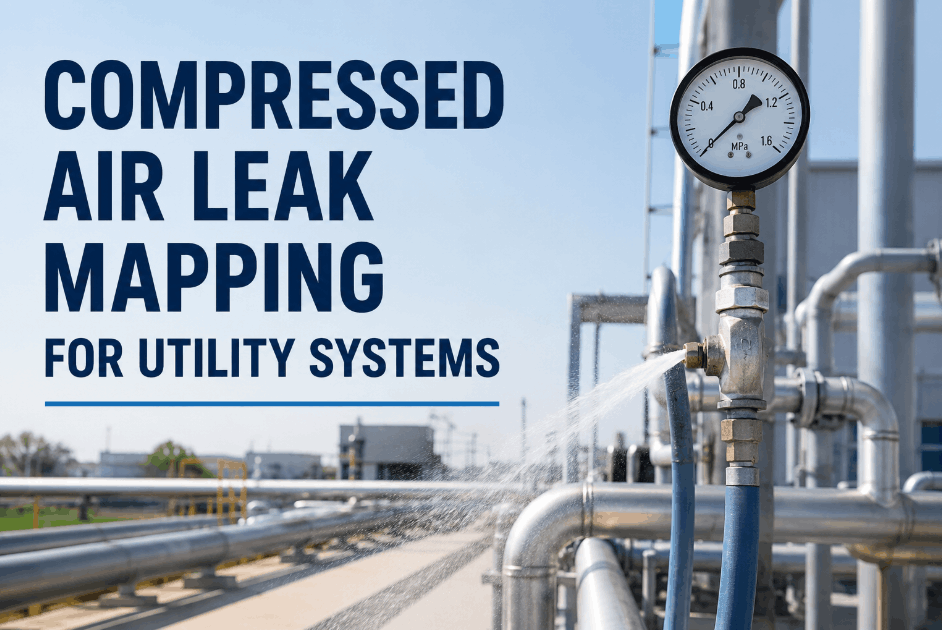
Compressed air systems are among the highest energy consumers in industrial facilities — and undetected leaks silently drain between 20 and 40 percent of total compressed air output before any operator notices pressure loss. Ultrasonic leak ranking is the discipline of surveying compressed air networks with acoustic detection equipment, quantifying each leak by sound signature and estimated flow loss, and prioritising repair crews toward the highest-impact wastage points first. Without a structured ranking methodology, repair teams patch the nearest accessible leaks rather than the biggest energy losses — and facilities continue overpaying for compressed air generation while the largest leaks continue unchecked. Sign Up Free to start managing compressed air leak surveys and repair work orders with complete digital tracking. Oxmaint AI helps energy and maintenance teams schedule leak surveys, capture ultrasonic findings, and prioritise repair sequences by measured energy loss impact. Book a Demo to see how Oxmaint supports compressed air energy savings programs across plant utility assets.
Stop Losing Energy to Leaks You Haven't Ranked
Oxmaint AI tracks compressed air leak survey work orders across plant utility systems — capturing ultrasonic findings, loss estimates, and repair outcomes that prove your energy savings program is targeting the biggest waste first.
Why Compressed Air Leak Programs Fail Without Ultrasonic Ranking
Gap #1
No Loss Quantification
Leak surveys identify leak locations but do not estimate flow loss or energy cost — leaving repair crews with no basis for prioritising which leaks to fix first based on actual savings potential.
Gap #2
Proximity-Based Repairs
Without loss rankings, technicians repair the most accessible leaks rather than the most costly — maximising task completion counts while the largest energy losses continue unaddressed in hard-to-reach network sections.
Gap #3
No Repair Verification
Repair work orders close without post-repair acoustic verification — so facilities cannot confirm that addressed leaks have been eliminated or that estimated energy savings have actually been achieved.
Gap #4
Infrequent Survey Cycles
Compressed air surveys are conducted annually or less frequently — allowing new leaks to develop and grow for months before the next survey cycle captures them in the repair backlog.
Gap #5
No Network Zone Mapping
Leak findings are recorded as individual point locations without mapping to compressed air network zones — making it impossible to identify high-loss sections where pipe age, fittings, or operating pressure drive disproportionate leakage.
Gap #6
Energy Savings Untracked
Actual energy savings from leak repairs are never calculated against pre-repair loss estimates — so facilities cannot demonstrate compressed air energy program ROI or justify budget allocation for ongoing survey programs.
How Oxmaint AI Supports Ultrasonic Leak Survey Programs
01
Network Asset Register
Build a compressed air network register in Oxmaint with zone classifications, pressure ratings, and energy cost parameters for each network section and connection point.
→
02
Survey Work Order Dispatch
Oxmaint generates scheduled leak survey work orders and delivers them to technicians via mobile — with ultrasonic reading fields, loss estimation inputs, and zone mapping checklists pre-loaded.
→
03
Field Leak Data Capture
Technicians record leak location, acoustic signal strength, estimated flow loss, and energy cost impact directly in the Oxmaint mobile app — generating a ranked repair priority list at survey completion.
→
04
Repair Tracking and Savings Reporting
Oxmaint tracks repair work orders against ranked leak findings and generates energy savings reports showing actual loss reduction achieved versus pre-repair estimates across each survey cycle.
What Oxmaint Captures Per Compressed Air Leak Survey Record
Survey Measurement Data
Ultrasonic signal strength recorded per leak point
Estimated flow loss and energy cost captured at field level
Network zone classification recorded per leak finding
Repair Priority Records
Leak rankings generated automatically from loss estimates
Repair work orders linked to ranked leak findings
Technician digital signoff on every survey and repair record
Energy Savings Monitoring
Pre- and post-repair loss estimates tracked per leak point
High-loss network zones flagged for priority resurvey
Survey cycle comparison reports generated on demand
Program Outcome
Energy savings reports exportable for management review
Highest-loss leaks targeted before smaller accessible ones
Compressed air audit ROI demonstrated with actual data
30%
Average compressed air loss in unmanaged industrial facilities attributable to undetected network leaks
3.4×
Higher energy savings per repair crew hour when leaks are ranked by loss impact before repair dispatch
48hrs
Typical Oxmaint deployment time from setup to first compressed air survey work orders tracking in field
60days
Average time to first measurable energy savings report after deploying Oxmaint leak survey tracking
Oxmaint AI vs Standard CMMS for Compressed Air Leak Management
Standard CMMS — Limited Leak Survey Visibility
Work orders track repair tasks but capture no ultrasonic survey findings or loss quantification data
No leak ranking fields — repair crews work by proximity rather than energy loss priority
Survey findings stored in separate spreadsheets with no link to repair work order outcomes
Network zone mapping unavailable — high-loss sections cannot be identified for priority resurvey
No energy savings tracking — repair program ROI cannot be calculated or reported
Leak records lack traceability chain for energy audit or utility compliance documentation
Oxmaint AI — Leak Survey Compliance Tracked in Real Time
Ultrasonic findings and loss estimates captured in mobile app with automatic ranking — Sign Up Free
Repair work orders linked to ranked leak findings — highest-loss leaks dispatched first
Required survey fields enforced before leak survey work order closure
High-loss network zones flagged automatically for priority resurvey scheduling
Energy savings tracked across consecutive survey cycles with actual versus estimated comparison
Compressed air audit reports generated in one click for energy or management review — Book a Demo
6 KPIs to Measure Ultrasonic Leak Ranking Program Effectiveness
These KPIs help energy and maintenance teams confirm that ultrasonic leak ranking is concentrating repair resources on the highest-loss points and delivering measurable compressed air savings. Book a Demo to see how Oxmaint calculates all six automatically across your compressed air network register.
KPI 01
Total Estimated Leak Loss Rate
Aggregate estimated compressed air flow loss across all identified leak points per survey cycle. Declining total loss rates confirm that repair programs are reducing network wastage over time.
Energy Baseline
KPI 02
High-Priority Leak Repair Rate
Percentage of top-ranked leaks by loss impact repaired within the target response window. Low rates indicate repair resources are being deployed to accessible low-loss leaks rather than the biggest energy waste.
Repair Priority
KPI 03
Survey Completion Rate
Percentage of scheduled compressed air leak surveys completed on time across all network zones. Overdue surveys allow new leaks to accumulate undetected between planned survey cycles.
Survey Compliance
KPI 04
Energy Savings Achieved Rate
Percentage of estimated pre-repair energy savings confirmed by post-repair acoustic verification. This metric validates that repair quality is sufficient to eliminate the identified leak and capture the projected savings.
Savings Verification
KPI 05
Leak Recurrence Rate
Percentage of repaired leak points that reappear at the same location within the next survey cycle. High recurrence rates identify inadequate repair methods, failing fittings, or systemic pressure regulation issues.
Repair Quality
KPI 06
High-Loss Zone Identification Rate
Percentage of total leak loss concentrated in the top 20 percent of network zones by cumulative loss ranking. High concentration identifies ageing pipe sections or fitting types requiring targeted infrastructure investment.
Zone Analytics
Industries Using Oxmaint for Compressed Air Leak Survey Management
Automotive Manufacturing
Compressed Air Energy Programs for Assembly Plants
Automotive assembly facilities use Oxmaint to manage ultrasonic leak survey schedules and repair work orders across large compressed air networks — tracking energy savings and demonstrating utility cost reduction for sustainability reporting. Sign Up Free for your energy team.
Food and Beverage
Utility Leak Control for Food Processing Facilities
Food processing plants use Oxmaint to schedule compressed air leak surveys and track repair outcomes across production and packaging areas — maintaining energy efficiency and supporting utility compliance documentation. Book a Demo for your facility program.
Chemicals and Petrochemicals
Instrument Air Loss Control for Process Plants
Chemical process facilities use Oxmaint to manage instrument air and utility air leak survey programs — prioritising repairs on instrument air systems where pressure loss creates control and safety risks in addition to energy waste.
General Manufacturing
Plant Utility Energy Savings Through Leak Ranking
Manufacturing facilities use Oxmaint to conduct structured ultrasonic leak surveys and prioritise repair crews by loss ranking — delivering measurable compressed air energy savings and reducing compressor runtime across plant utilities.
Your Repair Crew's Time Is Only as Valuable as the Leaks They Target.
Oxmaint AI helps energy and maintenance teams manage ultrasonic leak survey schedules, rank findings by loss impact, and track the compressed air savings that structured repair prioritisation delivers. Book a Demo to see leak survey tracking applied to your compressed air network.
Frequently Asked Questions
What is ultrasonic leak ranking and why does it matter for compressed air energy programs?
Ultrasonic leak ranking uses acoustic detection to measure leak signal strength and estimate flow loss, then ranks findings by energy cost impact. This ensures repair crews target the highest-loss leaks first rather than working by convenience or proximity.
How does Oxmaint support compressed air leak survey work orders?
Oxmaint generates scheduled survey work orders, captures ultrasonic findings and loss estimates in the mobile app, links repair orders to ranked leak priorities, and tracks energy savings achieved across survey cycles.
Can Oxmaint demonstrate ROI from compressed air leak repair programs?
Yes. Oxmaint compares pre-repair loss estimates against post-repair survey findings to calculate actual energy savings achieved — generating reports suitable for energy management, utility compliance, or sustainability documentation.
Does Oxmaint identify high-loss network zones for targeted investment?
Yes. Oxmaint aggregates leak findings by network zone and flags sections with disproportionate loss concentration — enabling facilities to target pipe replacement or fitting upgrades where they deliver the greatest energy impact.
How quickly can Oxmaint be deployed for a compressed air leak survey program?
Most facilities have Oxmaint live and tracking leak survey work orders within 48 hours. The compressed air network register can be set up from existing drawings or asset lists and technicians can begin capturing acoustic survey data immediately via the mobile app.
Know Which Leaks Cost the Most. Fix Those First.
Oxmaint AI tracks compressed air leak survey compliance, ranks findings by energy loss impact, and builds the digital records your energy savings and utility efficiency programs require — across every compressed air network in your facility.