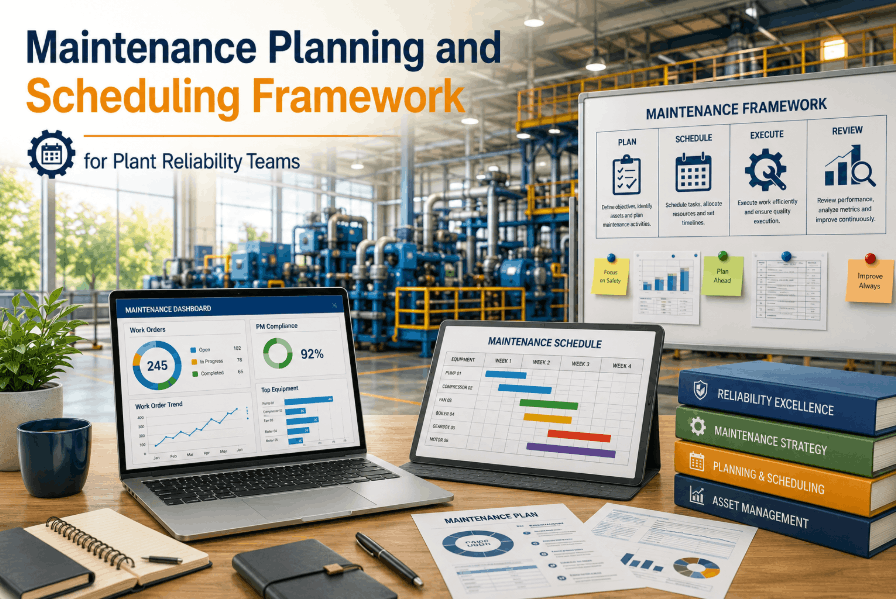
Most manufacturing plants do not have a maintenance strategy — they have a maintenance habit. Schedules inherited from the previous shift supervisor, PMs nobody questions, and reactive firefighting that consumes 65–75% of every technician's day. The data is stark: the average large plant now loses $253 million annually to unplanned downtime, mean time to repair has climbed from 49 to 81 minutes, and 45% of maintenance leaders cite resource scarcity as their top obstacle. A world-class maintenance strategy is what separates plants running at 85% OEE from those stuck at 60% — and the gap is rarely about budget. It is about framework, sequencing, and execution discipline. This guide walks through the exact roadmap reliability leaders use to build that strategy from the ground up, anchored by Oxmaint's CMMS platform for execution and measurement.
The Maintenance Maturity Ladder
Every plant sits on one of five rungs. Knowing your current rung is the precondition for choosing what to fix first — climbing two levels in a year is realistic, climbing five is not. World-class is not a destination you reach overnight; it is a deliberate ascent.
Tier 01
Reactive
90% breakdown work
Fix-when-broken. No PM cadence, no asset register, no data. Costliest mode of operation — typically 4–6% of replacement asset value spent annually.
Tier 02
Preventive
50–60% planned
Calendar-based PMs running blindly across all assets. Better than reactive, but 82% of failures are random — fixed schedules cannot prevent them.
Tier 03
Condition-Based
Sensors deployed
Vibration, thermal, and oil sensors on critical assets. Maintenance triggered by condition rather than calendar — the first true reliability gain.
Tier 04
Predictive
AI-driven alerts
Machine learning forecasts failure weeks ahead. Inventory waste falls 66%, planning time drops 20–50%. Standard at competitive plants in 2026.
Tier 05
World-Class
85%+ OEE
RCM-led, predictive-enabled, operator-owned. Maintenance functions as a profit center — every asset gets the strategy it needs, no more, no less.
What Strategy Drift Actually Costs
The Reactive Plant — Annual Hidden Burden
$253M
Average annual unplanned downtime cost in a large plant — doubled since 2019
326 hrs
Lost production hours per year from 25 unplanned events each month
81 min
Average MTTR — up from 49 minutes, driven by skills gaps and parts delays
25–35%
Technician wrench time — the rest is wasted on travel, paperwork, and waiting
The Five Pillars of a World-Class Strategy
Strategy is not a binder on a shelf. It is five operating disciplines, executed in sequence, that compound on each other. Skip a pillar and the ones above it collapse — this is why most maintenance transformations stall at month nine.
01
Asset Criticality Ranking
Every asset gets a score on production impact, safety risk, and replacement cost. Without ranking, every piece of equipment looks equally important — which means none of them are.
Foundation
FMEA per critical asset class — what can fail, how, and what happens. SAE JA1011 is the standard. This is where 70% of programs fail by skipping straight to scheduling.
Analysis
Each failure mode gets matched to one of four responses: predictive, preventive, run-to-failure, or redesign. The mix is the strategy — not blanket PMs everywhere.
Decision
Strategy lives or dies in work orders. Mobile dispatch, digital checklists, parts integration, and time-stamped completion data are the execution layer. No CMMS, no strategy.
Execution
Weekly KPI cadence, quarterly strategy reviews, annual FMEA refresh. Strategy is a living system — the moment it freezes, drift begins and the maturity ladder slides backwards.
Discipline
Maintenance Strategy Built for Manufacturing
Stop Running on Inherited Schedules
Oxmaint operationalizes every pillar of a world-class strategy — criticality ranking, FMEA documentation, strategy assignment per asset, work order execution, and live KPI dashboards. The framework, the tool, and the data, in one platform.
The 90-Day Roadmap to Strategic Maintenance
Programs that try to overhaul everything at once never finish. The plants that succeed move in 30-day waves — narrow scope, measurable output, visible wins that buy organizational permission for the next phase.
Days 1–30
Assess & Baseline
Build the asset register with location, hierarchy, and criticality scores
Capture baseline OEE, MTBF, MTTR, and PM compliance on the pilot line
Audit existing PMs — kill the ones that prevent nothing
Days 31–60
Analyze & Decide
Run FMEA on top-tier critical assets with cross-functional team
Assign each failure mode a strategy: predictive, preventive, run-to-fail, redesign
Build PM templates and work order workflows in CMMS
Days 61–90
Execute & Prove
Roll out mobile work orders to every technician
Launch weekly KPI review with maintenance and production together
Document the OEE delta — this is the case for plant-wide expansion
Strategy Selection Matrix
Match Each Asset Class to the Right Maintenance Strategy
Scroll horizontally to view the full matrix
The KPIs That Prove Strategy Is Working
World-Class Benchmarks vs. Industry Average
85%+
OEE Target
Industry average sits at 60–65% — every 5-point gain unlocks a full shift of capacity
90%+
Planned Work Ratio
Plants below 50% planned spend 2–5× more per repair — and run hotter on safety
55–65%
Wrench Time
Most plants run 25–35% — mobile work orders alone close most of the gap
1.5–2.5%
Maintenance Cost / RAV
Reactive plants run 4–6% — cutting this in half is a multimillion-dollar swing
Strategy Mistakes That Kill Programs
Mistake 01
Skipping Criticality Ranking
Treating every asset as critical means resources scatter and nothing gets the right level of care. Programs that score every asset on production impact, safety, and replacement cost concentrate effort where it matters and stop wasting hours on assets that should run to failure.
Mistake 02
PM Calendar With No Logic
Inheriting PMs from the OEM manual or the previous supervisor produces a calendar that nobody can defend. Research shows 82% of failures are random — meaning a meaningful fraction of those PMs prevent nothing and consume labor that should go elsewhere.
Mistake 03
No Operator Involvement
Strategy that lives only in the maintenance department fails. Operators see the asset every shift — autonomous inspections, cleaning, and minor adjustments shift workload off maintenance and catch failures days before they become breakdowns.
Mistake 04
Strategy Without a CMMS
Spreadsheet-based strategy collapses within 90 days. Without digital work orders, mobile execution, and automated KPI calculation, there is no execution data — and no execution data means no continuous improvement and no proof of value to leadership.
Frequently Asked Questions
Build Your Strategy. Run It in Oxmaint.
From Reactive Habit to World-Class Discipline
Oxmaint gives reliability leaders the framework, the workflows, and the live KPI dashboards to climb every rung of the maintenance maturity ladder — with measurable OEE gains in the first 90 days.