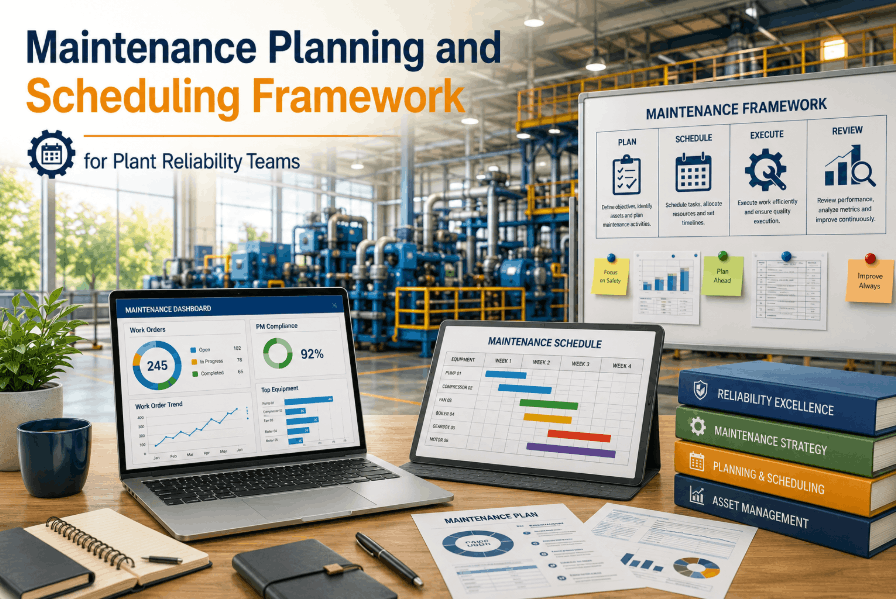
A structured maintenance planning and scheduling framework for plant reliability teams is the difference between a maintenance department that drives uptime and one that constantly reacts to failures. In 2026, reliability-focused plants are moving beyond break-fix cultures by implementing formal planning and scheduling processes — where every PM, inspection, and corrective job is scoped, resourced, and scheduled before a technician picks up a wrench. Without this framework, plants suffer high reactive ratios, technician overtime, and asset failures that could have been avoided. Sign Up Free to see how OxMaint's CMMS gives plant reliability teams the planning and scheduling infrastructure they need to build a proactive maintenance program from the ground up. Organizations that implement formal maintenance planning see 20–40% reductions in maintenance labor costs and significantly higher equipment availability — because planned work is always more efficient than emergency repair.
Build Your Maintenance Planning Framework with OxMaint
Automated PM scheduling. Work order planning tools. Real-time reliability analytics. Built for plant reliability teams.
Why Plant Reliability Teams Need a Formal Planning and Scheduling Framework
Most plants have maintenance programs — but far fewer have maintenance planning and scheduling frameworks. The distinction matters. A program defines what maintenance to do; a framework defines how, when, by whom, with what resources, and how success is measured. Without this structure, reliability teams spend the majority of their time reacting to failures rather than preventing them. Book a Demo to see how OxMaint structures planning and scheduling workflows for plant reliability operations.
Planners and Schedulers Operating Separately
When maintenance planning and scheduling functions are disconnected, work gets scoped but not resourced, or scheduled without the right parts and skills available — leading to job delays and repeat visits.
PM Schedules Built on Assumptions
Many plants set PM frequencies based on OEM defaults rather than actual asset condition, failure history, or production criticality — over-maintaining low-risk assets while under-servicing high-impact equipment.
Reactive Maintenance Consuming Capacity
Without a scheduling framework that protects planned work windows, reactive jobs fill technician calendars and planned PMs get deferred — locking plants in a cycle that increases both cost and failure risk.
No Visibility on Planning Efficiency
Reliability teams cannot improve their planning quality without tracking metrics like schedule compliance, planner effectiveness, and estimated vs. actual job hours — data that requires a structured CMMS to capture.
Shutdown Planning Done in Spreadsheets
Turnaround and shutdown maintenance events require coordinating hundreds of work orders across contractors and internal teams. Spreadsheet-based planning creates version control failures and missed critical path tasks.
Reliability Data Not Feeding Back Into Plans
Failure data, MTBF trends, and condition monitoring readings should continuously update PM frequencies and task scopes — but without a CMMS linking operations data to planning decisions, this feedback loop never closes.
The Maintenance Planning and Scheduling Framework — 5 Core Components
A world-class maintenance planning and scheduling framework for plant reliability teams is built on five interconnected components. Each layer builds on the previous, creating a closed-loop system where maintenance activities are planned, executed, measured, and continuously optimized. Sign Up Free to implement this framework using OxMaint's built-in planning, scheduling, and analytics tools.
| Framework Component |
Core Activities |
OxMaint Module |
Reliability Outcome |
| Asset Criticality Ranking |
Classify assets by failure impact on safety, production, and cost |
Asset Management + Risk Matrix |
Resources focused on highest-risk assets |
| Maintenance Strategy Selection |
Assign PM, predictive, or run-to-fail strategy per asset class |
Preventive Maintenance Scheduler |
Right maintenance at the right frequency |
| Work Order Planning |
Scope jobs, define parts/skills/tools required before scheduling |
Work Order Management Module |
First-time fix rate improvement |
| Weekly Schedule Build |
Allocate technician capacity to planned work orders for the coming week |
Team Management + Scheduling |
Schedule compliance > 90% |
| Condition Monitoring Integration |
PLC/sensor data triggers predictive work orders based on thresholds |
Predictive Maintenance + PLC Integration |
Early failure detection, MTBF improvement |
| KPI Review and Plan Adjustment |
Weekly/monthly reliability metrics drive PM frequency and scope updates |
Analytics & Reporting Module |
Continuous improvement cycle |
| Shutdown and Turnaround Planning |
Multi-work-order shutdown events planned and tracked in one platform |
Shutdown Management Module |
On-time, on-scope turnarounds |
| Compliance and Inspection Scheduling |
Regulatory inspections scheduled with advance alerts and digital sign-off |
Inspection Management + Safety/Compliance |
Zero regulatory violations |
How OxMaint Supports Each Layer of the Reliability Planning Framework
01
Asset Criticality and Strategy Foundation
OxMaint's asset management module allows reliability engineers to build a complete asset hierarchy, assign criticality ratings, and configure maintenance strategies per asset class. This foundation ensures that PM frequencies, inspection intervals, and predictive monitoring thresholds are set based on actual failure consequences — not generic OEM defaults.
Book a Demo to see the asset management configuration in action.
02
Proactive Work Order Planning
OxMaint separates the planning function from execution. Maintenance planners scope upcoming work orders — defining task steps via smart checklists, identifying required parts from inventory, specifying skill requirements, and estimating job duration — before the work order reaches the scheduling queue. This pre-planning step is what drives first-time fix rates above industry average.
03
Weekly Scheduling and Technician Allocation
OxMaint's team management module gives schedulers visibility into technician availability, current task loads, and skill profiles — enabling balanced weekly schedule builds that protect planned work capacity from reactive job override. Supervisors see real-time schedule compliance and can reallocate resources as production demands shift during the week.
04
Predictive and Condition-Based Triggers
OxMaint integrates with PLC systems and sensor networks to receive real-time condition data. When vibration, temperature, or pressure readings cross defined thresholds, OxMaint automatically generates a predictive maintenance work order — inserting it into the planning queue before the asset fails.
Sign Up Free to configure condition-based triggers for your critical assets.
Reliability Framework Results Across Plant Types
The following examples reflect how different plant types implement the maintenance planning and scheduling framework using OxMaint — and the reliability outcomes they achieve.
Cement Plant
Criticality-Based PM Planning
ChallengeKiln and mill breakdowns with no structured PM strategy
Framework AppliedAsset criticality ranking, OEM-adjusted PM frequencies, predictive vibration monitoring
Result55% reduction in unplanned stoppages, MTBF increased by 40%
Steel Plant
Shutdown Planning Optimization
ChallengeAnnual turnaround overrunning schedule by 15–20% due to spreadsheet planning
Framework AppliedOxMaint shutdown module with work order sequencing and contractor management
ResultTurnaround completed on schedule for first time in 4 years
Power Plant
Condition-Based Reliability Program
ChallengeTurbine failures not predicted; reactive maintenance consuming 60% of labor
Framework AppliedPLC sensor integration, threshold-triggered predictive WOs, OEE analytics tracking
ResultReactive ratio dropped from 60% to 22% within 6 months
Food Manufacturing
Compliance-Integrated Scheduling
ChallengeInspection and food-safety maintenance tasks not integrated into weekly planning
Framework AppliedCompliance calendar, inspection WOs with checklist sign-off, advance expiry alerts
Result100% inspection compliance rate; passed regulatory audit with zero findings
Step-by-Step: Implementing the Maintenance Planning and Scheduling Framework in OxMaint
Step 1
Build Your Asset Register and Criticality Matrix
Import your asset list into OxMaint and assign criticality ratings — high, medium, low — based on each asset's impact on safety, production continuity, and replacement cost. This criticality matrix drives all downstream planning decisions: PM frequency, monitoring intensity, and stocking priority.
Book a Demo to see the asset criticality configuration process.
↓
Step 2
Configure Maintenance Strategies per Asset Class
For each asset category, define whether the appropriate strategy is time-based PM, meter-based PM, condition-based predictive maintenance, or run-to-failure. OxMaint supports all four strategies and allows reliability engineers to adjust intervals based on failure history data captured in the platform over time.
↓
Step 3
Establish the Weekly Planning and Scheduling Cycle
Use OxMaint's work order queue and team management module to establish a weekly planning rhythm: planners scope and prepare work orders by Wednesday; schedulers build and publish the following week's schedule by Friday. This structured cycle ensures technicians begin each week with a complete, resourced task list — not an inbox of unplanned requests.
↓
Step 4
Integrate Condition Monitoring and Predictive Triggers
Connect OxMaint to your PLC sensor infrastructure or condition monitoring tools. Define threshold values for vibration, temperature, pressure, and other parameters on critical assets. When readings exceed thresholds, OxMaint automatically generates a predictive work order and routes it to the planning queue — giving your team time to respond before failure occurs.
Sign Up Free to activate predictive maintenance workflows.
↓
Step 5
Close the Loop with Reliability KPI Reviews
Run weekly and monthly reliability KPI reviews using OxMaint's analytics module — tracking schedule compliance, MTBF trends, reactive vs. planned ratios, and PM completion rates. Use this data to adjust PM frequencies, update maintenance strategies, and identify assets requiring deeper engineering analysis or replacement consideration.
Book a Demo to see the analytics dashboard configured for reliability teams.
Key Reliability KPIs Your Planning Framework Should Track
A maintenance planning and scheduling framework is only as strong as the metrics used to evaluate it. The following KPIs give plant reliability teams the data needed to measure framework effectiveness and drive continuous improvement. Sign Up Free to access these KPIs automatically in OxMaint's analytics module.
Schedule Compliance Rate
Percentage of planned work orders completed as scheduled. Target above 85%. Low schedule compliance indicates insufficient planning preparation or reactive job override — both solvable with structured framework enforcement.
Reactive vs. Planned Ratio
Percentage of total work orders that are unplanned emergency responses. Best-in-class reliability teams maintain below 20% reactive. Higher ratios signal gaps in PM strategy or criticality prioritization.
Mean Time Between Failures (MTBF)
Average operating hours between asset failures. A rising MTBF trend confirms that your PM strategy and predictive monitoring are delivering improved asset reliability over time.
PM Compliance Rate
Percentage of scheduled preventive maintenance tasks completed on time. Reliability programs targeting greater than 90% PM compliance experience significantly fewer unplanned failures compared to reactive-dominated programs.
Planner Effectiveness Ratio
Ratio of estimated job hours to actual hours completed. Tracks whether job scoping is accurate — a key indicator of planner skill and the quality of your maintenance procedure library.
Overall Equipment Effectiveness (OEE)
Availability × Performance × Quality — the composite metric that connects maintenance program quality directly to production output. OxMaint's OEE analytics module tracks this metric per asset and production line in real time.
Build a World-Class Reliability Planning Framework with OxMaint
Automated PM scheduling. Predictive maintenance triggers. Shutdown planning tools. Real-time reliability KPI dashboards. All in one CMMS built for plant reliability teams.
Maintenance Planning and Scheduling — Frequently Asked Questions
What is a maintenance planning and scheduling framework for plant reliability?
It is a structured system that defines how maintenance work is scoped, resourced, scheduled, executed, and measured — ensuring plant reliability teams operate proactively rather than reactively, with formal processes for both routine PMs and emergency repairs.
What is the difference between maintenance planning and maintenance scheduling?
Planning defines what work needs to be done and prepares the job — identifying parts, skills, tools, and task steps. Scheduling determines when and who will do it, allocating technician capacity and fitting work into production windows. Both functions must work together for a high-performing reliability program.
How does OxMaint support maintenance planning for reliability teams?
OxMaint provides work order templates with smart checklists, parts and inventory integration, PM auto-scheduling, predictive maintenance triggers from PLC sensors, technician scheduling tools, and reliability KPI analytics — giving reliability teams a complete planning and execution platform in one system.
What KPIs measure the effectiveness of a maintenance planning framework?
Schedule compliance rate, reactive vs. planned ratio, PM compliance rate, MTBF, planner effectiveness ratio, and OEE are the core KPIs. OxMaint tracks all of these automatically from work order and asset data — no manual calculation required.
How does predictive maintenance integrate into the planning and scheduling framework?
Condition monitoring data from PLC sensors, vibration analyzers, and thermal cameras feeds into OxMaint's predictive maintenance module. When asset condition crosses defined thresholds, OxMaint auto-generates a work order and routes it to the planning queue — enabling proactive intervention before failure occurs.
Can OxMaint handle shutdown and turnaround planning for plant reliability teams?
Yes. OxMaint's shutdown management module supports multi-work-order turnaround events with task sequencing, contractor coordination, compliance tracking, and real-time progress monitoring — replacing spreadsheet-based shutdown planning with a structured digital platform.
Book a Demo to see shutdown planning configured for your facility.
Give Your Plant Reliability Team the Planning Tools They Need
OxMaint delivers maintenance planning, automated scheduling, predictive triggers, shutdown management, and real-time reliability analytics — purpose-built for plant reliability teams who are serious about reducing downtime.