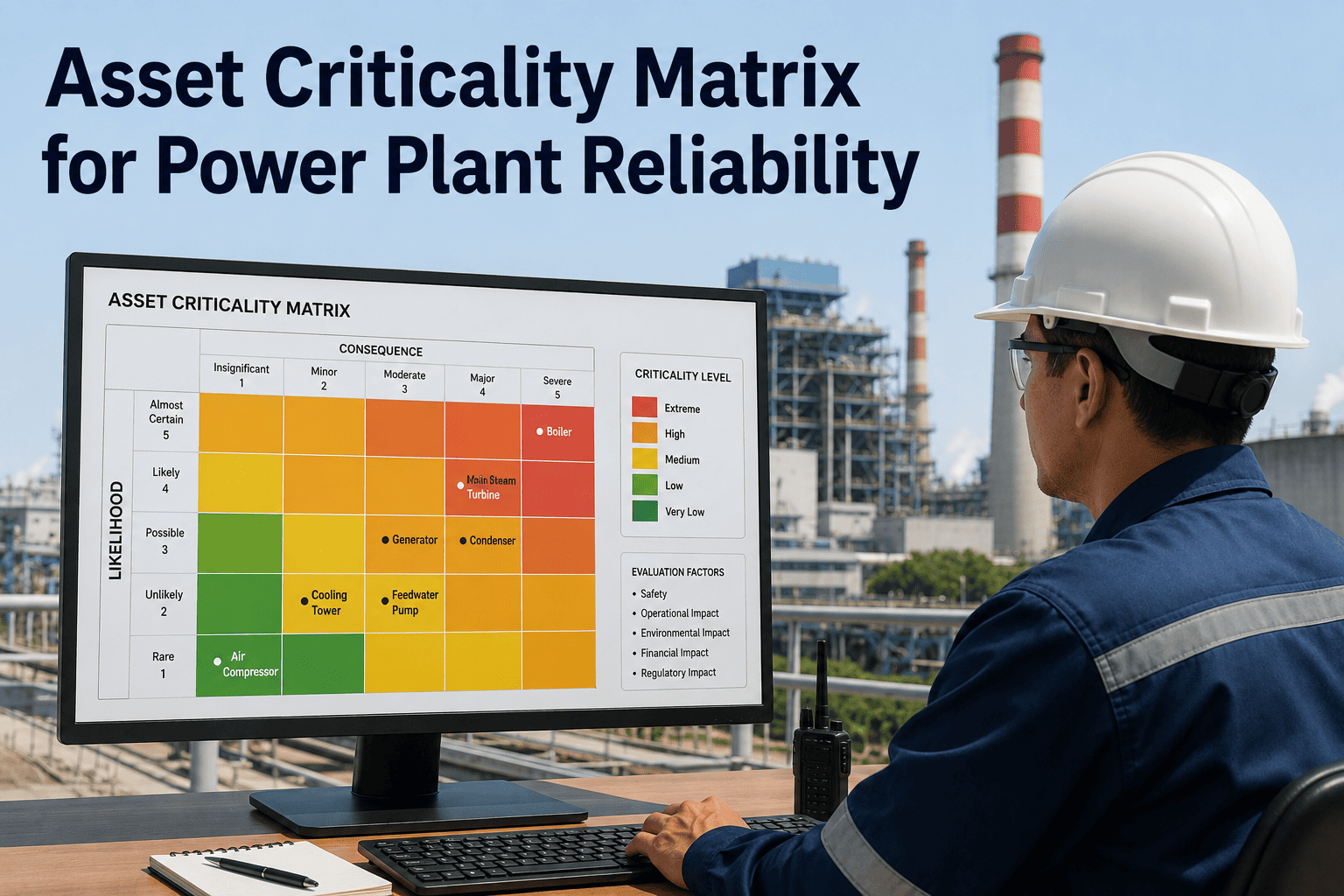
When a turbine bearing fails unexpectedly at a thermal power plant, the replacement components alone can have an 8 to 16 week lead time — and each day of unplanned outage costs between $1.5 million and $2.8 million in lost generation revenue. AI asset health scoring changes this equation fundamentally: instead of waiting for alarms, the system continuously calculates a real-time health index for every critical asset class and surfaces degradation trends weeks before threshold breaches occur. OxMaint's Predictive Maintenance module delivers AI-driven health scores for generators, transformers, turbines, boilers, and rotating equipment — integrating directly with your existing plant historian and SCADA data streams. If your plant is still relying on calendar-based PM intervals for critical equipment, schedule a 30-minute demo to see how health scoring transforms your maintenance planning cycle.
AI Asset Health Scoring for Power Plant Critical Equipment
Real-time health indices that replace calendar-based maintenance with condition-driven decisions — across every critical asset class in your plant.
How AI Calculates Asset Health: The 5-Factor Model
OxMaint's health score algorithm continuously evaluates five weighted inputs for each critical asset. The composite score updates in real time as sensor data streams in — not once per shift or once per day.
Critical Asset Classes Scored by OxMaint AI
| Asset Class | Primary Failure Mode Detected | Lead Time Before Failure | OxMaint Score Inputs |
|---|---|---|---|
| Steam Turbine | Blade erosion, bearing degradation, seal leakage | 3–8 weeks | Vibration, thermal, performance ratio |
| Generator | Winding insulation breakdown, partial discharge, rotor eccentricity | 4–10 weeks | Partial discharge, thermal, electrical signature |
| Power Transformer | Insulation deterioration, hot spot, DGA anomaly | 2–12 weeks | DGA trend, thermal, load profile |
| Boiler / HRSG | Tube thinning, tube leak, refractory degradation | 2–6 weeks | Flue gas analysis, pressure differential, thermal scan |
| Feedwater Pumps | Cavitation, impeller wear, bearing failure | 1–4 weeks | Vibration spectrum, flow efficiency, motor current |
| Air Compressors / FD Fans | Blade fouling, motor degradation, belt wear | 1–3 weeks | Vibration, current draw, pressure ratio |
See Live Asset Health Scores on Your Equipment
Our 30-minute demo shows AI health scoring applied to turbines, generators, and transformers using real plant data — not a canned demo environment.
Reading the Health Score: Action Zones Explained
OxMaint assigns every scored asset to one of four action zones. Each zone triggers a different maintenance response — from no action to immediate intervention.
What Power Plant Engineers Say About Health Scoring
Health scoring is the most practical translation of predictive maintenance data into decisions that plant management can act on. A vibration spectrum or DGA number by itself requires expert interpretation — a health score from 0 to 100 does not. It gives every level of the organisation from the technician to the plant director a shared language for asset condition. The key is that the model has to be asset-specific: a score algorithm trained on industry averages will generate false positives constantly. The best implementations I have seen train on 90 to 120 days of the specific asset's operating data and refine continuously. Plants that implement health scoring correctly report fewer forced outages within the first operating year, and their outage planning becomes significantly more accurate because they can predict which assets will need attention during the next scheduled maintenance window — rather than discovering problems during disassembly.
Frequently Asked Questions
Stop Reacting. Start Predicting.
OxMaint's AI health scoring gives your plant a real-time, composite health index for every critical asset — so your team acts on evidence, not intuition, and every outage window is planned, not forced.