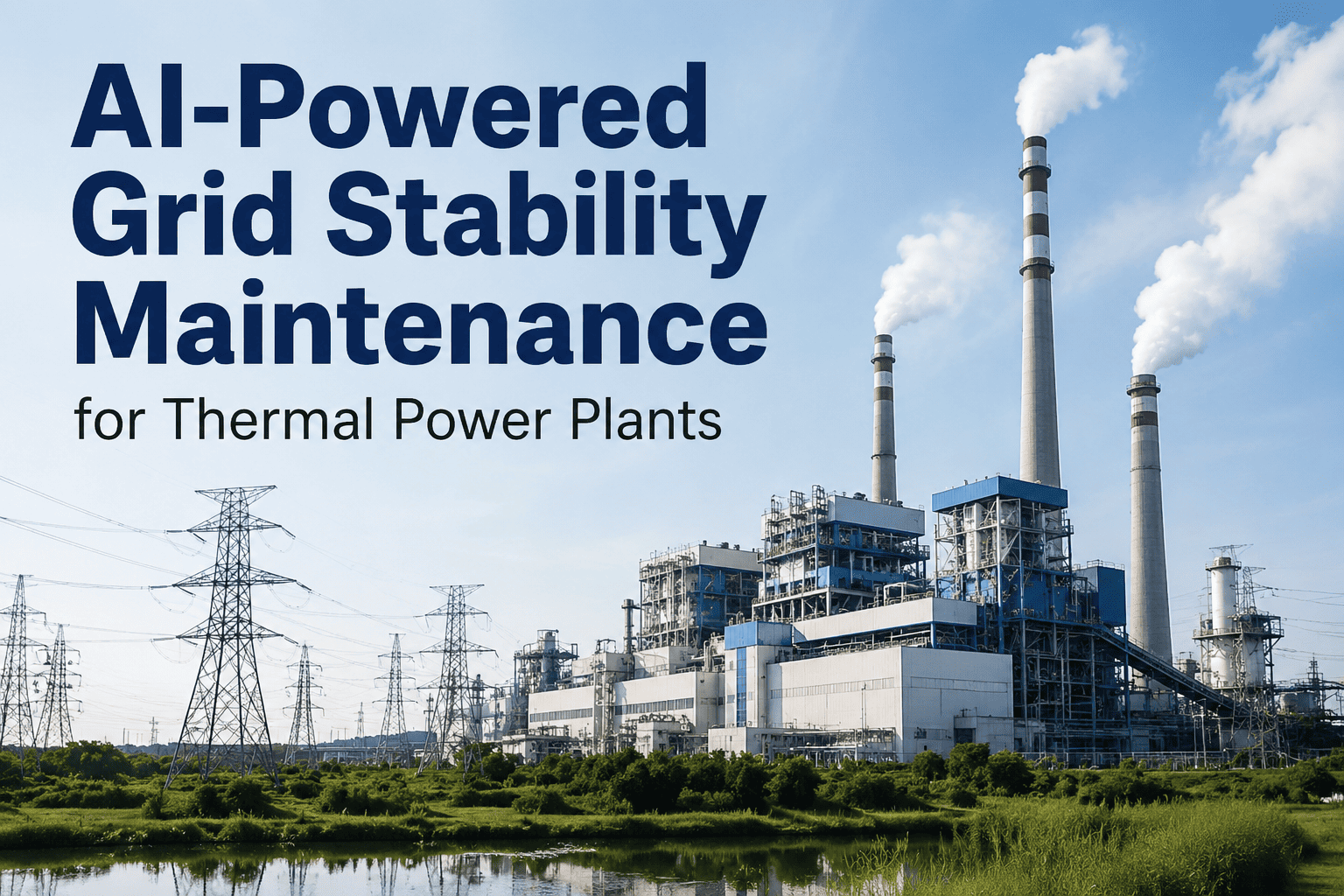
Every megawatt-hour a thermal power plant fails to deliver ripples through the grid as voltage sags, frequency deviations, and cascading demand mismatches that grid operators must correct in seconds. The uncomfortable math: a single forced outage on a 500 MW coal unit costs between $800,000 and $2.4 million in replacement power, start-up fuel, and regulatory penalties — and the majority of forced outages trace back to maintenance gaps that AI-enabled condition monitoring could have detected 72 hours or more in advance. Thermal plants are grid stability assets first and generation assets second; their maintenance programs must be engineered to that priority. This guide covers the AI monitoring architecture, critical asset degradation signatures, and CMMS scheduling logic that keeps your plant's contribution to grid frequency regulation uninterrupted — and shows how OxMaint's predictive maintenance platform is used by power generation teams to convert sensor data into scheduled interventions before the grid ever feels the consequence.
AI · Grid Stability · Thermal Power Maintenance
When the Plant Fails, the Grid Feels It in Milliseconds
Grid frequency is a real-time balance between generation and load. Every unplanned trip of a thermal unit breaks that balance. The only defense is a maintenance program that predicts failure before it becomes a grid event.
72 hrs
Advance warning window AI condition monitoring delivers before most failure modes
$2.4M
Maximum replacement power cost from a single forced 500 MW outage event
68%
Of forced outages traceable to assets with detectable pre-failure signatures
14:1
ROI ratio on predictive maintenance programs versus run-to-fail approaches
Why Grid Stability Starts in the Maintenance Schedule
Grid operators manage frequency by dispatching reserves when generation suddenly drops. Those reserves are expensive, limited, and — in tight grid conditions — unavailable. A thermal plant that trips unexpectedly does not just lose revenue; it imposes balancing costs on every other participant in the market and, in extreme cases, triggers load shedding. The maintenance program is the first line of defense against that chain of events.
Undetected asset degradation
Bearing wear, fouling, winding insulation — all invisible without sensors
→
Forced unit trip
Protection relay operates; unit disconnects from grid in under 200 ms
→
Grid frequency drops below 59.95 Hz; system operator declares emergency
Grid frequency event
→
Spinning reserve deployed
Fast-response peakers and batteries cover the shortfall at 4–8× baseload cost
→
Financial and reliability penalty
NERC reliability standard potential violation, replacement power charges, insurance impact
AI Maintenance Intercept Point
OxMaint's predictive engine intercepts this chain at the first node — before the asset degrades to failure. Sensor fusion across vibration, temperature, oil quality, and electrical signature gives a 72-hour intervention window that transforms a forced trip into a scheduled outage planned around grid demand.
The Seven Critical Assets That Determine Grid Stability Contribution
Not every asset in a thermal plant has equal grid impact. The seven below drive the highest proportion of unplanned capacity loss. OxMaint's asset criticality matrix weights monitoring frequency and alert thresholds accordingly.
Main turbine bearing
Spalling, oil starvation
Full trip
Vibration RMS, temperature rise
48–120 hrs
Generator stator winding
Insulation breakdown
Full trip
Partial discharge, temperature gradient
7–30 days
Boiler feed pump
Cavitation, seal failure
Load derating
Flow/head curve deviation, noise
24–72 hrs
Condenser cooling tubes
Fouling, biofouling
Load derating
Terminal temperature difference rise
3–14 days
Excitation system
AVR failure, diode open
Full trip
Reactive power oscillation, field current trend
6–48 hrs
Main transformer
DGA hydrogen rise, bushing fault
Full trip
DGA dissolved gas ratio, bushing capacitance
14–90 days
Induced draft fan
Blade erosion, bearing failure
Partial derating
Vibration spectrum, current signature
12–48 hrs
AI Monitoring Architecture for Grid-Critical Assets
Effective AI-driven grid stability maintenance is not about adding more sensors. It is about connecting the right sensors to a CMMS that can act on the signal. The architecture below is what OxMaint deploys in thermal plants contributing to grid frequency regulation services.
Layer 1
Sensor & Data Acquisition
Vibration sensors
Accelerometers on turbine pedestals, pump casings, and fan bearings — 10 kHz sampling rate, continuous streaming to edge processor
Thermal imaging
Fixed IR cameras on switchgear, busbar connections, and transformer tap changers — 15-minute scan cycle with delta threshold alerting
Oil quality monitoring
Inline particle counters on turbine lube oil, transformer DGA sensors — ISO 4406 cleanliness class tracked against OEM limits
Electrical signature analysis
Motor current spectrum on large drives — rotor bar, eccentricity, and bearing defect frequencies extracted from current waveform
SCADA / OPC-UA / Modbus integration
Layer 2
OxMaint AI Analytics Engine
Anomaly detection
Multivariate baseline per asset — flags when parameter combination deviates beyond 2-sigma from operating-mode-normalized baseline
RUL estimation
Remaining useful life model per asset class — projects maintenance window based on degradation rate trend, not fixed calendar interval
Grid dispatch correlation
Maintenance window scheduler checks grid dispatch forecast before creating work order — avoids scheduling outage during peak demand periods
Automated work order generation
Layer 3
CMMS Execution & Audit Trail
01
Work order created
Priority, crew, parts list, and procedure auto-populated from asset profile
02
Technician dispatched
Mobile notification with asset location, sensor history, and OEM reference
03
Resolution logged
Before/after readings, parts consumed, time to repair — full NERC audit record
From sensor to scheduled repair
Connect Your Plant's Condition Data to Work Orders That Protect Grid Commitments
OxMaint integrates with your existing SCADA, historian, and DCS to surface degradation signals as scheduled maintenance before they become forced outages. No new hardware required for most integrations.
Grid Stability KPIs Your Maintenance Program Must Own
A maintenance program aligned to grid stability is measured differently from a standard plant maintenance program. These six KPIs link directly to grid reliability performance and NERC compliance reporting.
Target: <2%
Equivalent Forced Outage Rate (EFOR)
NERC's primary reliability metric. Every percentage point above 2% signals a maintenance program not aligned to grid stability. OxMaint tracks EFOR per unit in real time and correlates it to work order completion rates.
Target: >95%
Predictive Maintenance Coverage Rate
Percentage of grid-critical assets monitored with AI condition data rather than fixed-interval PM. Below 80% means calendar-based schedules are your primary risk management tool — a reactive posture for grid-critical equipment.
Target: >85%
Planned Outage Rate
Ratio of planned to total outage hours. World-class thermal plants hold planned outage rates above 85%. The maintenance program's job is to convert every potential forced trip into a planned maintenance window timed to grid valleys.
Target: <4 hrs
Mean Time to Detect (MTTD)
Average time between when an AI anomaly first flags and when a work order is created. A 4-hour or better MTTD ensures the 72-hour intervention window is preserved. OxMaint auto-creates work orders the moment alert thresholds cross.
Target: 100%
Dispatch Commitment Compliance
Percentage of grid dispatch commitments honored. Maintenance scheduling must be coordinated with the energy trading desk — a plant that trips during a frequency regulation commitment faces both reliability and commercial penalties simultaneously.
Target: <12 hrs
Mean Time to Restore (MTTR)
Average restoration time after an unplanned trip. Pre-staged spare parts, pre-written work orders for common failure modes, and mobile technician dispatch all compress MTTR — OxMaint's spare parts integration ensures critical components are always in stock.
Maintenance Scheduling Around Grid Dispatch Windows
The most underrated capability in a grid-aligned maintenance program is the ability to schedule planned outages during low-demand grid windows rather than defaulting to calendar quarters. OxMaint's scheduler integrates with dispatch forecasts to find the right window for every maintenance action.
Calendar-Based Scheduling
Quarterly overhaul scheduled for first week of February regardless of grid demand
Cold snap arrives — plant needed for frequency regulation during scheduled outage
Outage postponed into a hot-weather period — technicians working in 45°C conditions
Deferred work piles up — next quarter already overloaded before it starts
Plant misses dispatch window and incurs compliance penalty. Maintenance team firefighting deferred backlog.
VS
AI-Optimized Scheduling with OxMaint
RUL model projects turbine bearing needs service in 18–24 days based on vibration trend
OxMaint checks 30-day dispatch forecast — identifies 4-day low-demand window in mid-period
Work order created, crew assigned, spare parts confirmed in stock — 72 hours pre-outage
Outage executed during grid valley; unit back online before next demand peak
Zero dispatch commitment breach. Maintenance executed at optimal conditions. Audit trail complete.
Expert Perspective
"
The thermal plants that have the most reliable grid contribution are not the newest or the biggest. They are the ones where the maintenance manager and the dispatch scheduler talk to each other every morning. AI condition monitoring gives you the data — but the real transformation comes when that data drives a work order that is scheduled in coordination with grid commitments rather than against them. What I see OxMaint do that most CMMS platforms cannot is close the loop between the anomaly signal and the grid calendar. That is the difference between a maintenance program and a grid stability program.
Rajiv Menon, P.E.
Former Senior Reliability Engineer — 500 MW Supercritical Unit · 19 years in thermal power generation · Specialization: predictive maintenance integration and NERC compliance
Frequently Asked Questions
Q1 How does AI condition monitoring reduce forced outage rates in thermal plants?
AI condition monitoring reduces forced outages by detecting degradation signatures — vibration anomalies, temperature rises, oil quality changes — 48 to 120 hours before they reach failure thresholds. That detection lead time converts a forced trip into a planned maintenance window. In thermal plants with OxMaint, teams have seen EFOR drop from 4.2% to under 1.8% within 18 months of full deployment because the maintenance program shifts from calendar-based PM to condition-triggered intervention on every grid-critical asset.
Start a free OxMaint trial to benchmark your current EFOR against the predictive maintenance baseline.
Q2 Which sensors deliver the most value for grid stability monitoring in a thermal plant?
Turbine bearing vibration sensors and generator stator temperature monitoring deliver the fastest ROI because turbine and generator trips are the highest-impact single events for grid frequency. The second tier — transformer DGA sensors and boiler feed pump flow/head monitoring — catches the next largest proportion of capacity loss events. Electrical signature analysis on large auxiliary motors rounds out a complete grid-stability monitoring program. The key is not adding more sensors but integrating existing sensor data into OxMaint's AI analytics layer, which most thermal plants can do via their existing DCS and historian without new hardware.
Book a demo to see the integration architecture for your specific DCS.
Q3 How do we schedule maintenance without violating grid dispatch commitments?
The answer is combining remaining useful life projections with a dispatch forecast calendar. OxMaint's scheduler cross-references the AI-generated maintenance urgency window — typically a 7- to 21-day range within which maintenance should occur — against the grid dispatch calendar provided by your energy trading team or market operator. When a low-demand window aligns with the RUL-based maintenance window, the work order is created and the outage is notified to the grid operator under planned outage procedures, avoiding the reliability penalties associated with unplanned trips. Most plants implement this integration in four to six weeks.
Q4 What NERC reliability standards does AI-based maintenance help us comply with?
The primary standard is NERC FAC-001 and FAC-002 (facility ratings and supporting documentation), which requires that generation facilities maintain equipment within rated capabilities — a requirement AI condition monitoring directly supports by catching degradation before derating. NERC MNT-001 (maintenance and testing for protection systems) and MOD-025 (generator verification) also have direct maintenance documentation requirements that OxMaint's audit trail satisfies. Every work order generated by OxMaint carries a complete chain of evidence — detection, classification, assignment, resolution — that maps directly to NERC audit documentation requirements.
Q5 How long does it take to implement OxMaint at a thermal power plant?
For a standard thermal plant with an existing DCS and historian, the OxMaint integration timeline runs 6 to 10 weeks. Weeks 1 to 2 cover asset hierarchy build and criticality classification. Weeks 3 to 4 cover sensor integration via OPC-UA, Modbus, or API to your historian. Weeks 5 to 6 establish AI baselines per asset and configure alert thresholds against OEM limits. Weeks 7 to 10 run shadow mode — the system flags anomalies and creates draft work orders that are reviewed by your reliability team to tune false positive rates before full live cutover.
Book a demo to see the implementation playbook mapped to your specific plant configuration.
Grid reliability starts here
Your Plant's Next Forced Outage Is Detectable. Make Sure You Act Before the Grid Feels It.
OxMaint's predictive maintenance platform connects thermal plant condition data to grid-aligned work orders — so the next bearing failure, winding degradation, or pump anomaly becomes a scheduled intervention rather than a dispatch emergency. Purpose-built for power generation teams who answer to both a plant manager and a grid operator.