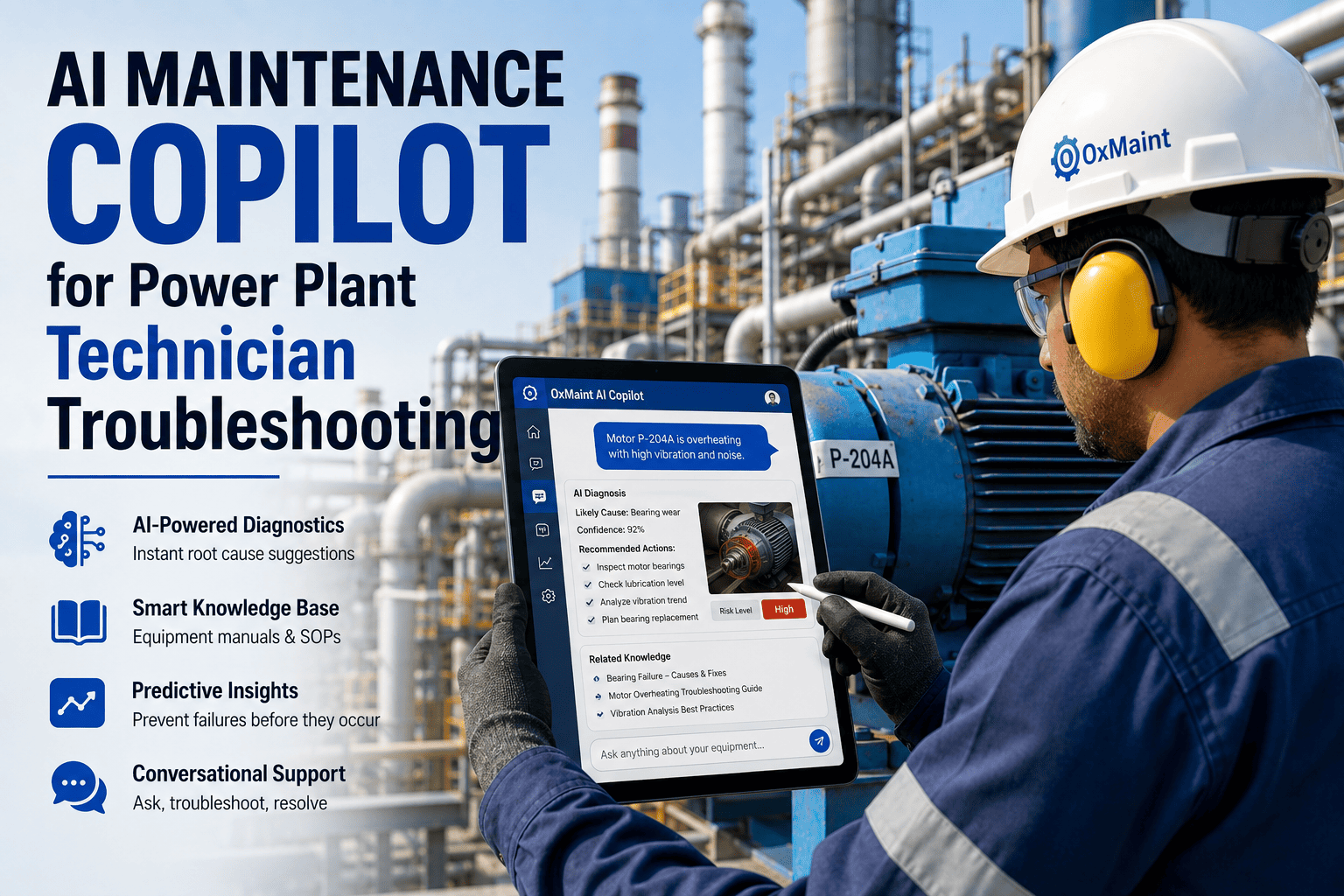
Power plant technicians spend up to 20% of their shift searching for information — flipping through binders, calling colleagues, or waiting for someone to locate the right OEM manual. That is diagnostic time lost before a single wrench turns. An AI maintenance copilot changes that equation by putting asset history, previous fixes, OEM documentation, and suggested work steps directly on the technician's mobile device, inside the work order, at the moment the fault is being diagnosed. This is not a search engine — it is a contextual assistant that knows your equipment. Start a free OxMaint trial to see AI-assisted troubleshooting on your asset base, or book a demo to watch a live fault diagnosis session in under 30 minutes.
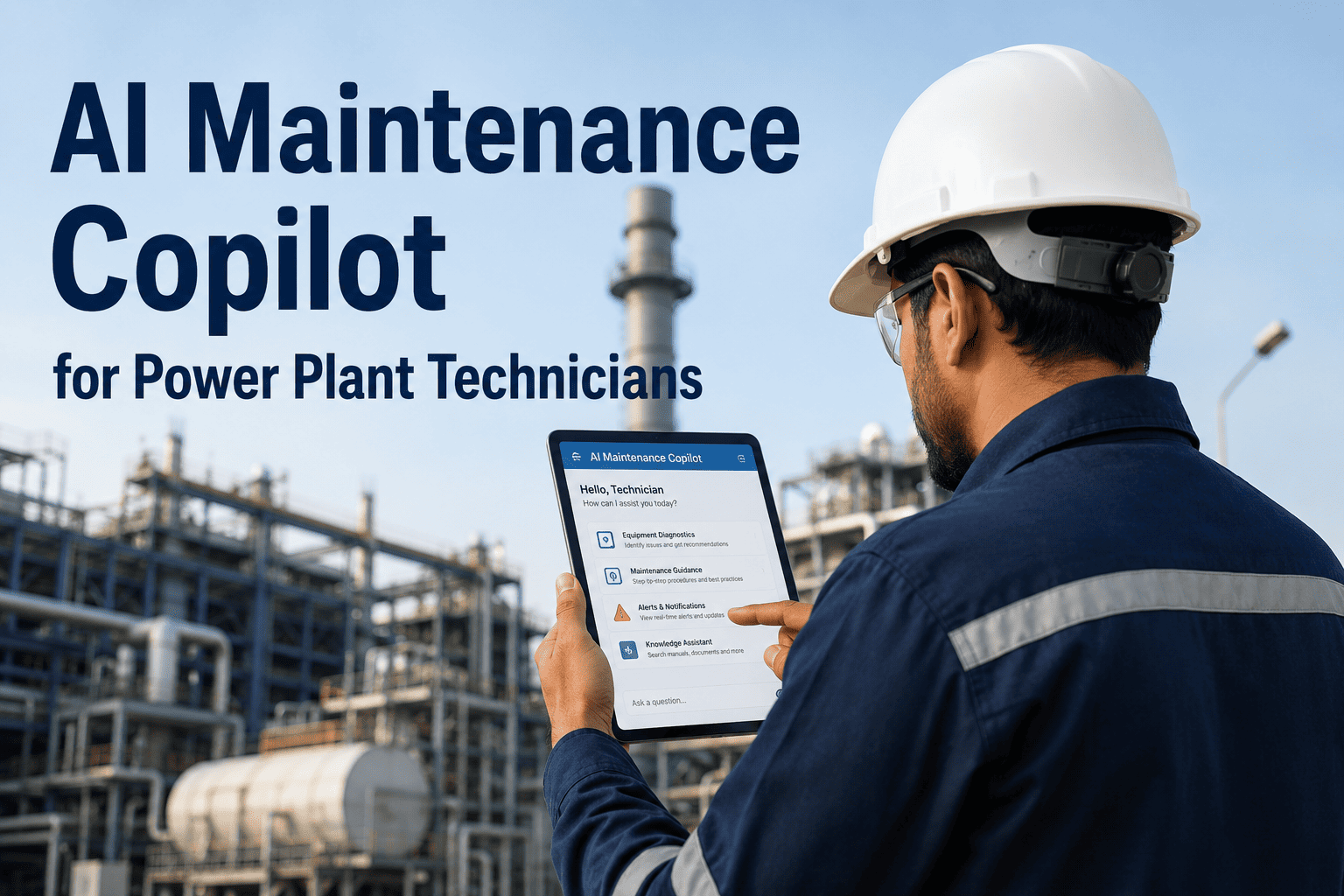
AI Maintenance Copilot for Power Plant Technicians
Asset history, OEM manuals, previous fixes, photos, and step-by-step guidance — surfaced inside mobile CMMS the moment a technician opens a fault work order.
The Hidden Cost of Slow Troubleshooting in Power Plants
When a turbine trips or a pump alarms, every minute of diagnostic delay is lost generation. Yet most power plant technicians still start troubleshooting by searching — through paper manuals, old work orders, and memory. The AI copilot eliminates that search cost by answering before the technician has to ask twice.
Nearly half of equipment downtime in industrial plants is spent figuring out what went wrong — not fixing it. AI copilot compresses the diagnostic phase dramatically.
Technicians spend one in five working hours hunting for manuals, repair history, and part numbers. That is 8 hours per week per technician of non-productive search time.
Experienced technicians carry decades of asset-specific knowledge. Without an AI system capturing and structuring that knowledge, it is permanently lost when they leave.
What OxMaint AI Copilot Does Inside a Work Order
The copilot is not a standalone chatbot. It lives inside the work order, activated at the point of diagnosis — pulling from your plant's actual maintenance records, not generic internet knowledge.
Full repair history for the specific asset on the work order — previous faults, technician notes, parts replaced, and resolution times — displayed without navigating away from the active job. A technician diagnosing a compressor trip sees every prior trip for that unit in one view.
Technicians type the fault code or describe the symptom in plain language — the copilot returns the relevant OEM manual section, procedure page, and torque spec. No binder flipping, no document management system login, no waiting for someone in the office to send a PDF.
When a fault matches a previous resolution pattern, the copilot surfaces the exact steps the last technician used — with photos, part numbers, and the outcome noted. Junior technicians get senior-level repair guidance on their first encounter with a fault type.
Before-and-after photos from previous work orders on the same asset are accessible directly inside the copilot view. Visual context for what "normal" looks like — and what the last fault looked like at the point of discovery — reduces misdiagnosis on repeat faults.
When a senior technician resolves a complex fault, the copilot prompts structured knowledge capture — what they found, what they tried, what worked, and what to check first next time. That knowledge becomes searchable institutional memory, not a person walking out the door.
OxMaint's AI copilot surfaces asset history, previous fixes, and OEM guidance inside every work order — giving your technicians expert-level diagnostic support on every fault, on every shift.
Junior vs Senior Technician: How AI Copilot Closes the Gap
In power plants with aging workforces, the knowledge gap between a 25-year veteran and a 2-year technician is enormous. AI copilot does not replace experience — it packages it into something transferable.
| Scenario | Without AI Copilot | With AI Copilot |
|---|---|---|
| Unfamiliar fault code on legacy turbine | 30–60 min searching manuals and calling colleagues | Relevant manual section and prior fix in under 5 minutes |
| Repeat fault on same asset | Diagnosis restarts from zero — prior context unavailable | Previous resolution steps and photos surfaced automatically |
| Senior technician transfers or retires | Institutional knowledge permanently lost | Knowledge captured in structured form and searchable by any technician |
| Part number identification under time pressure | Manual lookup, often wrong — trip to stores wasted | Part number confirmed from asset BOM inside work order |
| Post-repair documentation | Handwritten notes, often incomplete or illegible | Structured capture with AI-prompted fields and photo attachment |
Frequently Asked Questions
OxMaint AI Copilot puts asset history, repair knowledge, OEM guidance, and suggested work steps inside every work order on every technician's mobile device — shortening diagnosis, preserving knowledge, and closing the skill gap at scale.