Predictive maintenance promises to tell you a machine will fail before it does. In practice, most projects stall for ordinary reasons: the wrong assets were chosen, the data was not ready, the alerts went nowhere or the pilot never turned into a routine. A power plant does not need a huge AI programme to start. It needs a few well-chosen assets, trustworthy data, a clear route from alert to work order and a team that reviews the results. This guide lays out that path in order, with the decisions, checks and gates that keep a pilot on track, using OXMAINT AI, the AI-powered CMMS for power plant maintenance teams.
Power Plants · AI Predictive Maintenance · Implementation Guide
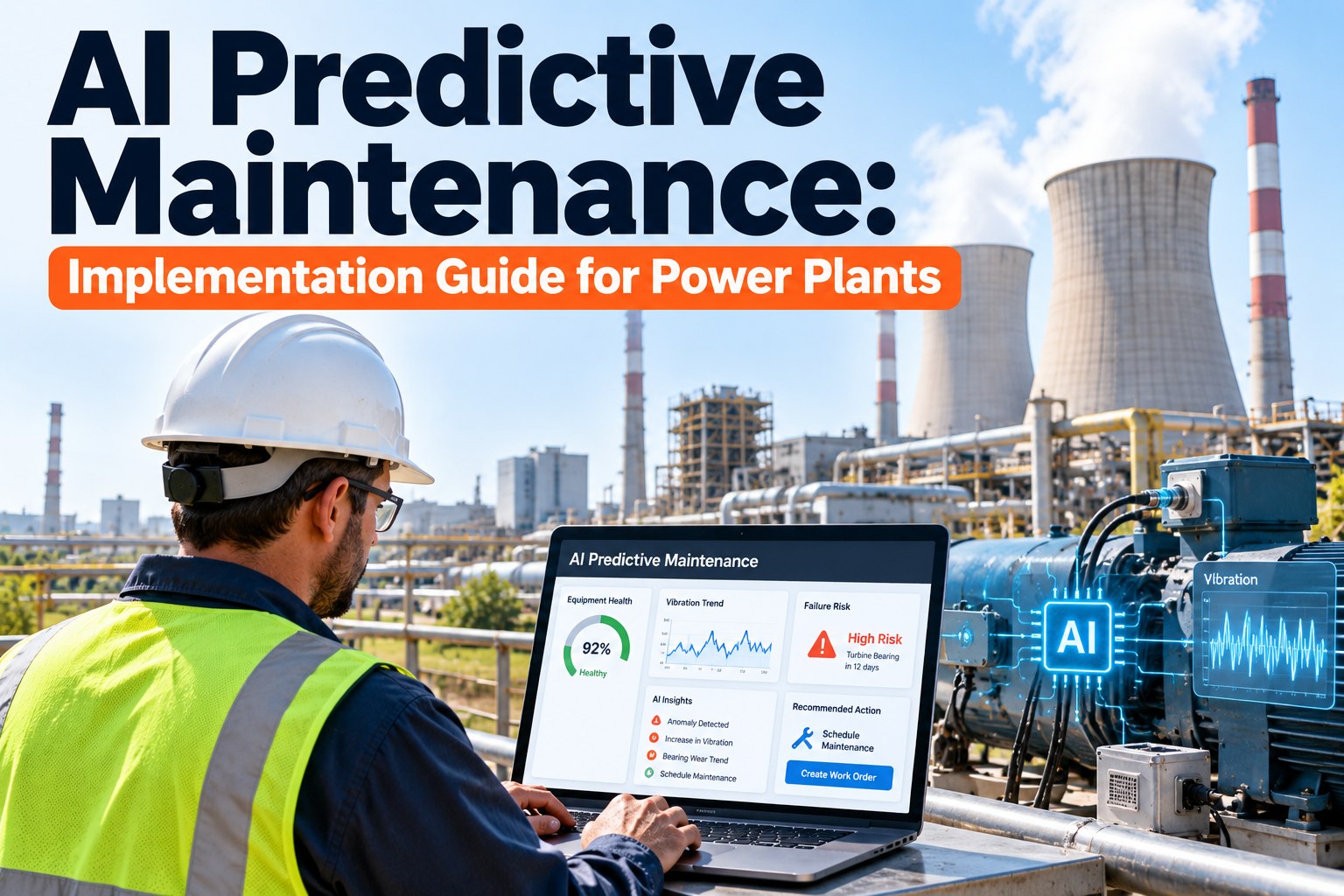
AI Predictive Maintenance: Implementation Guide for Power Plants.
A prediction that never becomes a job is just a notification. OXMAINT AI connects the workflow in one CMMS: sensor anomalies and inspections raise issues, issues become ranked, asset-tagged work orders, repairs are recorded in the asset history, and preventive and predictive maintenance improve from what each finding teaches.
1Anomaly or Inspection
→
2Issue Flagged
→
3Work Order
→
4Repair Recorded
→
5PM & Predictive Updated
Predictive Maintenance
SCADA & Historian Connectivity
Work Order Management
Preventive Maintenance
Know Your Starting Rung: The Maintenance Maturity Ladder
Predictive maintenance sits near the top of a ladder. Teams that skip rungs usually find the AI has nothing solid to stand on. Be honest about where you are today, then plan the next step, not the last one. Sign up free and build the rungs below the AI first.
4
Predictive
Models flag developing faults early. Alerts become reviewed, ranked work orders.
3
Condition-based
Work is triggered by measured condition and thresholds, not only by the calendar.
2
Preventive
Scheduled PM, clean asset register, repair history and failure codes are in place.
1
Reactive
Fix it when it breaks. Records are patchy and priorities change daily.
Step 1: Choose Assets Worth Predicting
Do not start with the most famous asset. Start where a failure matters and the early signs can actually be measured. Two questions sort most candidates. Book a demo to rank your assets by criticality.
How much does a failure matter?
Important, hard to detect
Plan other strategies first, such as inspection and redundancy, and add sensors later.
START HERE
Important and detectable. Rotating equipment with measurable condition is often a good pilot.
Low value
Keep on simple PM or run-to-failure, depending on risk.
Easy, but low impact
Good for learning, but not a business case on its own.
How well can early warning signs be measured? →
Illustrative selection grid. Your reliability team decides the cut-offs.
Examples of Pilot Candidates and Their Early Signals
These are common starting points, not a prescription. Choose based on your own failure history, criticality and what you can already measure. Start free and register your candidate assets.
Asset class
Signals that can show early change
Why it suits a pilot
Pumps & motors
Vibration, bearing temperature, motor current, discharge pressure
Common failure modes, often well instrumented
Fans & blowers
Vibration, bearing temperature, damper position, motor current
Clear condition trends and measurable baselines
Gearboxes & drives
Vibration, oil temperature, lube oil pressure
Costly when they fail unexpectedly
Turbine auxiliaries
Bearing temperature, lube oil, vibration, differential pressures
Condition data is often already in the historian
Compressors & air systems
Pressure, temperature, runtime and load patterns
Performance drift appears before failure
Predict Less. Act on More.
Start with a few critical assets, connect their data and turn every alert into a tracked job with OXMAINT AI.
Step 2: Check Data Readiness Before You Buy Anything
AI cannot predict from data that is missing, mislabelled or unreliable. Review these six areas for your pilot assets first. Many plants find they already have most of what they need, and the gaps are about quality, not volume. Book a demo to review your data readiness.
Signals exist
Are the relevant measurements already collected in SCADA, DCS or a historian?
Sampling is adequate
Is data logged often enough to show the behaviour that precedes failure?
Sensors are trusted
Are key sensors calibrated and checked, not frozen or drifting?
Tags map to assets
Does every tag link to the right asset in the register?
Failures are recorded
Do work orders capture what failed, when and why, using consistent codes?
Operating context is known
Can you tell load, start-ups and outages apart from true faults?
Step 3: Run a Pilot With Gates, Not Hope
A pilot should earn the right to grow. Four gates keep it honest, and each one has a clear question to answer before moving on. Set the success criteria with your reliability and operations leads before you start. Sign up free and map your pilot to a work order flow.
GATE 1
Connect & baseline
Is the data flowing, mapped and trustworthy?
Connect pilot tags, confirm sensor health and capture normal behaviour across operating states.
→
GATE 2
Shadow mode
Are the alerts sensible?
Let the system flag anomalies while engineers review them, before any job is created.
→
GATE 3
Alerts to work orders
Do confirmed alerts get acted on?
Route reviewed alerts into ranked work orders with owners, then record the findings.
→
GATE 4
Scale or stop
Is it worth extending?
Review usefulness, workload and lessons, then extend to more assets or fix the gaps.
Step 4: Design the Alert So Someone Acts on It
The alert is where most programmes quietly fail. Design its journey before the first one fires: who sees it, how it is checked and what happens next. Dismissed alerts are not failures. They are how the system learns. Book a demo to see alert routing.
DETECT
Anomaly appears against the asset's normal behaviour.
▶
FILTER
Duration and context rules reduce brief spikes and known noise.
▶
ROUTE
An asset-tagged inspection or work order goes to the right owner.
▶
CHECK
A technician inspects and confirms or dismisses with a reason.
▶
LEARN
Findings feed rules, PM tasks and the asset's history.
Who Does What: AI and People
Predictive maintenance works when each side does what it is good at. Start free and assign clear owners.
The AI and software
Watch many signals around the clock
Spot departures from normal behaviour
Rank and route alerts with asset context
Keep a searchable history of every finding
The people
Choose assets and agree success criteria
Inspect and confirm what the alert found
Decide repair timing with operations
Tune rules and PM from what they learn
Six Traps That Stall Predictive Maintenance
Most failed pilots trip over the same few things. Knowing them in advance is cheaper than learning them mid-project. Book a demo to talk through your plan.
1
Too many assets at once
Start small enough to review every alert properly.
2
No route to action
Alerts need an owner and a work order, not an inbox.
3
Unreliable sensors
Bad data produces confident but wrong predictions.
4
Weak failure records
Without failure codes, the system cannot learn what mattered.
5
Alert fatigue
Too many weak alerts teach people to ignore all of them.
6
No owner after go-live
Someone must keep tuning rules and reviewing results.
How OXMAINT AI Supports Your Predictive Maintenance Rollout
OXMAINT AI reads control-system, historian and IoT data over standard protocols such as OPC UA, Modbus and APIs, runs anomaly detection and lands each result in the CMMS as a work order with asset context. Your OT and IT teams should review access, security and the network boundary before connecting. Start free and add your first assets.
Plant Data Connectivity
Read DCS, SCADA, historian and IoT feeds, scoped to the assets you choose.
Anomaly Detection
Flag developing issues for review, instead of waiting for a limit to trip.
Alert-to-Work-Order Routing
Turn reviewed anomalies into ranked, asset-tagged jobs with trend and context attached.
Preventive Maintenance
Keep PM schedules and tune them from what predictive findings reveal.
Asset History & Reporting
Track findings, repairs and repeat faults to see what the pilot is teaching you.
Mobile Inspections
Let technicians confirm or dismiss alerts on site, with photos and notes.
Implementation Readiness Checklist
Tick these before launching the pilot. Gaps in the left column are the most common reason for a stalled project. Book a demo to review your readiness.
Maintenance Foundation
Critical assets are in a clean register with clear IDs
PM schedules and repair history are being recorded
Failure codes or causes are captured on work orders
An owner is named for the pilot and for alert review
Data & Governance
Pilot signals are listed, mapped to assets and checked
Success criteria are agreed with operations and reliability
OT and IT have approved access and security approach
A review rhythm is booked for alerts, rules and results
Frequently Asked Questions
What is AI predictive maintenance in a power plant?
It uses equipment data and AI to spot developing problems early, so maintenance can plan repairs before a failure forces an outage. It works best when alerts feed a clear work order process.
Sign up free and explore OXMAINT AI.
How many assets should a pilot include?
Do we need new sensors?
Not always. Many plants already collect useful signals in SCADA, DCS or a historian. Check what exists and its quality first, then add sensors only where a critical asset has gaps.
Start free and map your existing signals.
Will this affect our control systems?
The aim is to read plant data without changing control logic, and the plant should keep operating as usual. Your OT team should still confirm access, security and the network boundary before any connection.
Book a demo to review the security model.
Do we need a CMMS before predictive maintenance?
A working CMMS foundation makes predictive maintenance far more useful: a clean asset register, PM, failure records and work orders give predictions somewhere to go.
Sign up free and build that foundation.
From Prediction to Planned Repair.
Bring plant data, anomaly detection, inspections, work orders and PM together in OXMAINT AI, and give every critical asset a clear next step.