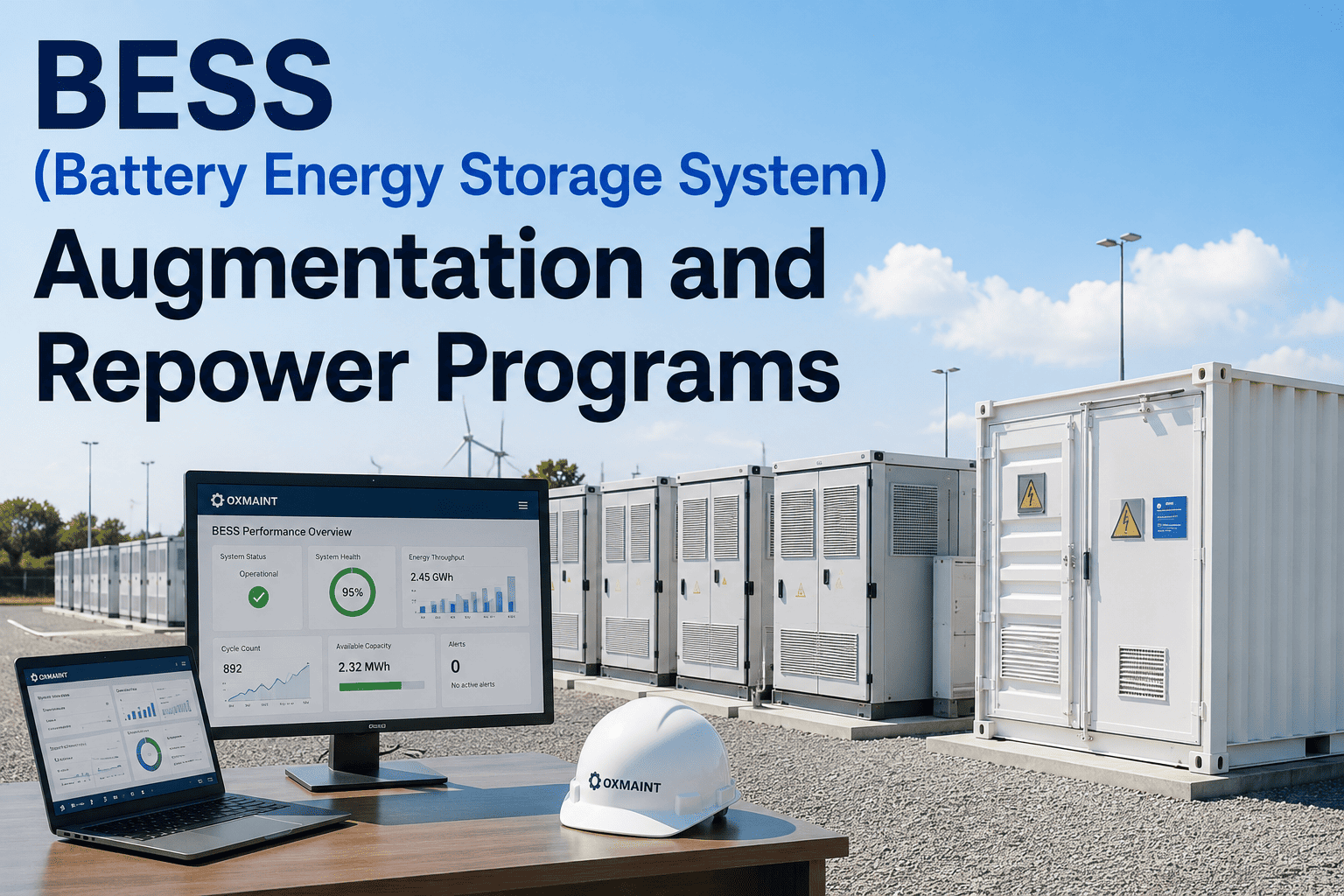
Battery Energy Storage Systems degrade silently — losing 2–4% of usable capacity every year while grid operators, asset owners, and O&M teams work from incomplete cycle counts, outdated SOH estimates, and warranty records buried in spreadsheets. By the time a capacity contract shortfall is discovered, you're already paying liquidated damages. OxMaint's CMMS gives BESS operators the real-time cycle tracking, SOH trending, and PM automation to protect capacity commitments, extend battery life, and make augmentation decisions from data — not guesswork. Start your free trial — no credit card, live in under 60 minutes.
BESS Lifecycle Management · Augmentation · Repower Programs
Your BESS Is Degrading.
Is Your Maintenance Program Keeping Up?
Most BESS operators discover capacity shortfalls at contract review — not during O&M. AI-backed cycle tracking, SOH trending, and automated PM records change that equation entirely.
2–4%
Annual capacity loss in lithium-ion BESS without optimized cycling
10–15 yr
Expected design life — often missed without structured PM programs
$80K–$200K
Cost per MWh for augmentation — decisions that require accurate RUL data
Why This Matters
The Hidden Cost of Poor BESS Lifecycle Records
Grid-scale BESS projects operate under capacity contracts with defined performance thresholds. Miss those thresholds and the financial exposure is immediate. But the root cause — degraded cells, missed PM intervals, inaccurate cycle counts — almost always traces back to fragmented recordkeeping and reactive maintenance.
01
Cycle Count Drift
BMS logs and SCADA data often disagree with O&M records. When cycle counts are unreliable, warranty claims fail and augmentation timing becomes a guess. CMMS-integrated cycle tracking creates a single audit-ready source of truth.
02
SOH Blindspots
State of Health degrades non-linearly. Without trended SOH records tied to PM events, operators can't distinguish normal fade from accelerated degradation — and miss the intervention window before it becomes a repower event.
03
Capacity Contract Risk
PPA and tolling agreements define minimum capacity thresholds. When SOH data isn't tracked against contract milestones, shortfalls surface at the quarterly test — not weeks earlier when augmentation could still be planned and budgeted.
04
Unplanned Repower
Reactive repower costs 2–3x more than planned augmentation. Without Remaining Useful Life modeling fed by maintenance history, repower decisions are forced by failure — not driven by data at the optimal replacement point.
BESS Lifecycle Stage — What OxMaint Tracks at Each Phase
Commissioning
Baseline capacity test, initial SOH record, warranty activation log, cell serial number register
Year 1–3 (High Performance)
Quarterly capacity verification, thermal management PM, cycle count reconciliation, BMS firmware log
Year 4–7 (Active Monitoring)
SOH trending against contract thresholds, augmentation planning triggers, cell replacement tracking, RUL modeling inputs
Year 8–10 (Augmentation Window)
Augmentation decision records, new module integration PM, updated warranty documentation, re-baselined capacity tests
Year 11+ (Repower Assessment)
Full lifecycle audit export, repower cost vs. continue analysis, decommission records, residual value documentation
OxMaint Capabilities
How CMMS-Backed Records Transform BESS O&M
OxMaint connects PM scheduling, cycle tracking, and SOH records into a single platform — giving every stakeholder from site technicians to asset managers the data they need, when they need it. See this live in a 30-minute demo.
Cycle Tracking
Audit-Ready Cycle Count Records
Every charge-discharge cycle logged against asset ID, date, depth of discharge, and temperature. Reconcile BMS data with O&M records. Export full cycle history for warranty claims or investor reporting — in one click.
SOH Trending
State of Health Dashboard with Threshold Alerts
SOH measured at every capacity test, trended over time, and compared against contract minimums. When degradation rate accelerates beyond model, alerts fire weeks before the next scheduled test — not after a contract event.
PM Automation
Automated PM Scheduling Across All BESS Assets
PM templates for thermal management, cell inspection, cooling system service, and BMS calibration deploy across every unit. Work orders auto-generate on schedule. Completion records time-stamp every task — no paper logs, no missed intervals.
Augmentation
Data-Driven Augmentation Decision Support
When SOH trends indicate a capacity threshold will be breached before the next contract period, OxMaint surfaces the data needed to plan augmentation on your timeline — not under emergency procurement conditions at 3x cost.
Warranty
Complete Warranty Compliance Documentation
OEM warranties require documented PM intervals and cycle records. OxMaint maintains the complete paper trail — work orders completed on schedule, parts used, technician sign-off — so warranty claims never get denied for missing records.
RUL Model
Remaining Useful Life Projections
RUL models fed by real maintenance history, actual cycle depth, and ambient temperature logs give asset managers a defensible timeline for repower planning — enabling budget allocation 18–24 months before the decision must be made.
Free Trial · No Credit Card · Live in 60 Minutes
Know Your BESS SOH Before Your Next Capacity Test.
Every capacity contract shortfall that could have been predicted and prevented costs more than a year of OxMaint. Start tracking what matters — before the next quarterly audit.
Program Comparison
BESS O&M: Spreadsheet-Based vs. CMMS-Managed
| O&M Function |
Spreadsheet / Manual |
OxMaint CMMS |
| Cycle Count Accuracy |
BMS data only — no O&M reconciliation |
Integrated cycle log — single audit-ready record |
| SOH Trending |
Snapshot at test dates — no trend visibility |
Continuous trend with threshold alert triggers |
| PM Scheduling |
Calendar reminders — frequently missed |
Auto-generated work orders with completion records |
| Warranty Compliance |
Incomplete records — claims frequently denied |
Full documentation trail — OEM-ready export |
| Augmentation Planning |
Reactive — triggered by contract failure |
Proactive — 18-24 month advance data signal |
| Multi-Site Visibility |
Site-by-site calls and email reports |
Portfolio dashboard — all sites, real-time |
| Repower Decision |
Forced by failure — emergency costs |
Data-driven RUL model — planned budget |
Measurable Outcomes
What Structured BESS Programs Deliver
Up to 18 months
Earlier augmentation signal vs. reactive programs
2–3x
Lower repower cost when planned vs. emergency-triggered
95%+
Warranty claim success rate with complete CMMS records
1–3 yr
Extended useful life from optimized cycling and thermal PM
Frequently Asked Questions
BESS Augmentation and O&M — What Teams Ask Most
How does OxMaint track BESS cycle counts for warranty compliance?
OxMaint logs every charge-discharge cycle against asset ID, date, depth of discharge, and operating temperature. Records reconcile with BMS data exports and are timestamped for audit. Warranty claims require this complete documented history — OxMaint generates OEM-ready reports in one click.
Try cycle tracking in a free trial.
Can OxMaint alert me when SOH is trending toward a capacity contract threshold?
Yes. You define the SOH thresholds from your capacity contract. OxMaint monitors degradation rate between test cycles — if the trend projects a breach before the next scheduled test, an alert fires with enough lead time to plan a response.
See threshold alerts in a demo.
Does OxMaint support multi-site BESS portfolio management?
Yes. OxMaint gives portfolio managers a single dashboard showing SOH, PM compliance, cycle counts, and open work orders across every site. No weekly status calls, no email attachments — all data in one place, updated in real time.
How does CMMS data support augmentation planning decisions?
Augmentation decisions need accurate remaining capacity data, degradation rate trends, and maintenance cost history. OxMaint provides all three from live operational records — giving asset managers a defensible, data-backed case for timing and scope of augmentation.
Book a demo to see augmentation planning tools.
What PM tasks does OxMaint automate for BESS systems?
OxMaint automates work order generation for thermal management system inspections, cooling loop service, BMS calibration checks, cell voltage balancing records, fire suppression system tests, and cabinet seal inspections — all on configurable schedules with mobile completion records.
Built for BESS O&M Teams
Protect Every MWh of Contracted Capacity.
Your capacity contract doesn't care about missing PM records or BMS data gaps. OxMaint gives you the CMMS backbone to track every cycle, trend every SOH point, and make augmentation decisions months ahead — not days after a contract breach.