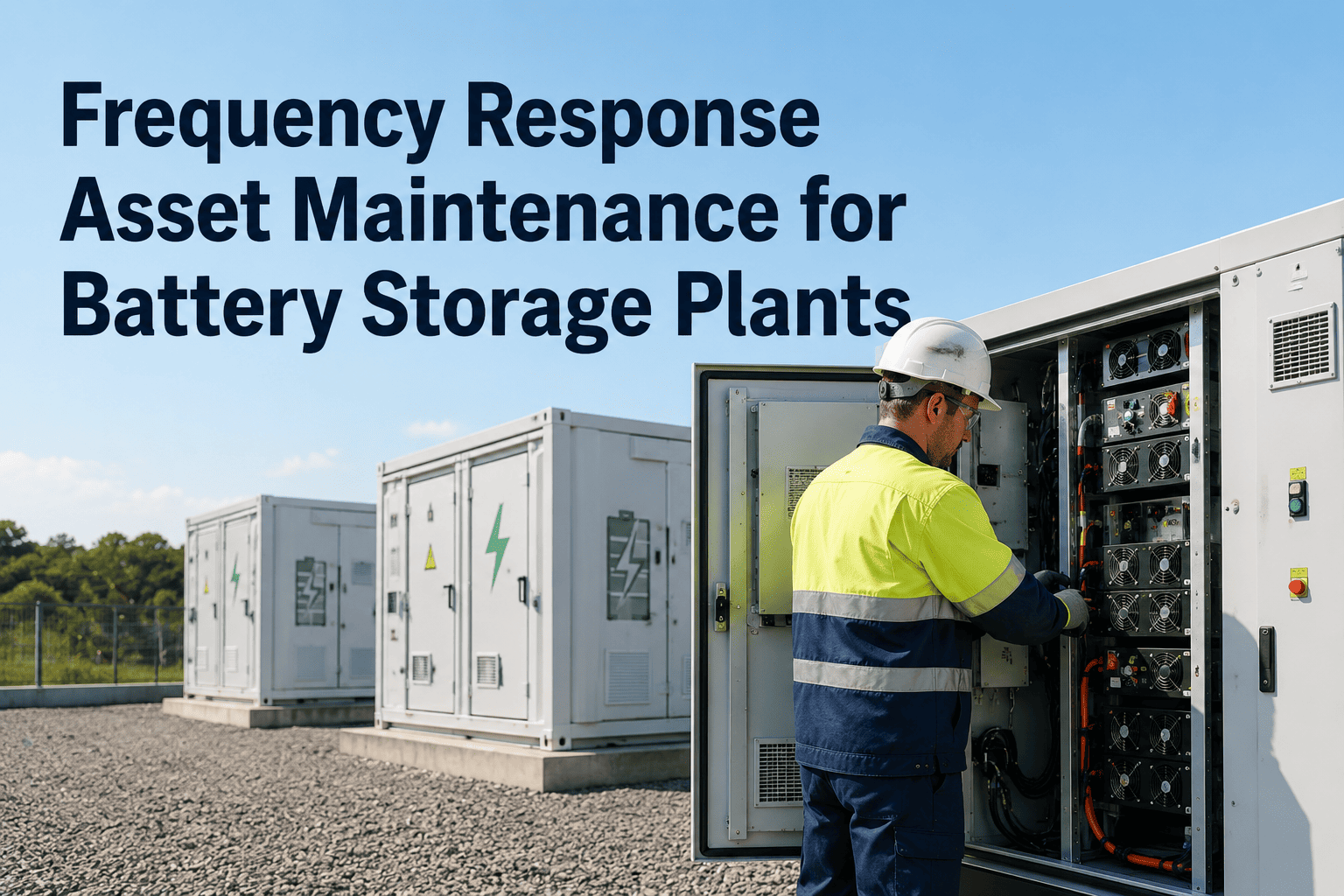
Battery energy storage systems are the fastest-growing asset class in grid infrastructure — and also the one with the least institutional maintenance knowledge, the fewest purpose-built O&M tools, and the highest consequence of getting thermal management wrong. A lithium-ion BESS is not a passive storage tank; it is a complex electrochemical system where cell-level temperature gradients, state-of-health decline, and charge cycling history interact in ways that escalate from manageable degradation to thermal runaway with very little warning if your maintenance program is not tracking the right parameters at the right intervals. OxMaint's BESS maintenance CMMS integrates directly with your Battery Management System, converts BMS fault alerts into structured work orders, tracks module-level temperature trends and capacity fade across cycles, and gives your O&M team the compliance documentation that NFPA 855, IEC 62619, and AHJ inspections require. If your team is managing a grid-scale BESS on spreadsheets and generic work order tools, book a 30-minute demo and see what a purpose-built energy storage maintenance platform looks like.
BESS · Battery Management · Thermal Monitoring · BMS Integration
Battery Energy Storage Maintenance Built for the Electrochemical Reality of What You're Operating
Grid-scale BESS degrades cell by cell, module by module — invisibly, until it doesn't. Structured thermal monitoring, BMS-triggered work orders, and capacity fade tracking are the only tools that keep your storage asset at rated performance across its full 15-year design life.
30%
Capacity loss by year 10 in BESS systems without structured thermal management and degradation tracking
$4.2M
Average replacement cost for a 10MWh BESS container — preventable with condition-based maintenance
80%
of BESS thermal events are preceded by detectable temperature anomalies 48–96 hours in advance
2°C
Cell temperature differential that doubles lithium-ion degradation rate — detectable only with module-level monitoring
How BESS Fails
The Seven Degradation Mechanisms That Reduce Your BESS From 100% to Replacement — and When Each One Becomes Visible
Every lithium-ion BESS degrades through a combination of calendar aging and cycle aging. Calendar aging happens even when the system is idle — electrolyte decomposition, SEI layer growth, and lithium plating on anode surfaces advance continuously regardless of dispatch. Cycle aging accelerates with every charge and discharge event, particularly at high C-rates, at temperatures above 35°C, and at states of charge above 90% or below 10%. Understanding which mechanism is dominant for your system determines which maintenance parameters matter most and what your CMMS needs to track.
Year 1–3
Early Life
SEI Layer Formation
Initial Capacity Settling
Cell Matching Spread
SOH: 98–100%
CMMS: Establish baseline capacity and temperature profiles per module
Year 3–7
Mid Life
Gradual Capacity Fade
Impedance Rise
Temperature Spread Growth
SOH: 88–98%
CMMS: Quarterly capacity tests, monthly temperature differential checks, BMS alert trending
Year 7–12
Mature Life
Accelerated Capacity Fade
Lithium Plating Risk
Cell Balancing Frequency Increase
SOH: 75–88%
CMMS: Monthly capacity tests, bi-weekly thermal scans, cell replacement work orders on SOH threshold breach
Year 12+
End of Life
Thermal Runaway Risk Increase
Rapid Impedance Growth
Replacement Planning Required
SOH: Below 75%
CMMS: Replacement procurement work orders, augmentation feasibility tracking, decommission planning
OxMaint Feature — Thermal Monitoring
Thermal Management Is Not a Safety Checkbox — It Is the Core Determinant of Your BESS Lifespan and Revenue
Lithium-ion battery cells are extraordinarily sensitive to temperature. The optimal operating window is narrow — typically 15°C to 35°C for most grid storage chemistries. Below 5°C, lithium plating accelerates and permanent capacity loss begins. Above 40°C, electrolyte degradation accelerates and thermal runaway risk increases nonlinearly. And critically: the temperature that matters is not the container ambient temperature monitored at the HVAC sensor — it is the cell-level and module-level temperature, the temperature differential between the hottest and coolest module in a rack, and the trend in that differential over time.
Module Temperature Heatmap — Container C-02, Rack 3
Row A
28.1
28.4
27.9
31.2
28.8
29.1
Row B
27.8
28.0
32.4
36.7
33.1
29.4
Row C
28.3
27.6
28.9
31.8
29.0
28.5
Row D
27.4
27.9
28.1
29.3
28.6
27.8
M01M02M03M04M05M06
Active Alert
B-04 at 36.7°C — 8.8°C above rack average. HVAC cooling flow inspection work order auto-generated. Last cleaned: 147 days ago.
What OxMaint Monitors and Acts On
Module Delta-T
Temperature difference between hottest and coolest module in a rack. Threshold breach auto-generates cooling system inspection work order with rack location, current delta, and last HVAC service date attached.
Trend Rate (°C/week)
Rate of temperature increase at each module location across weekly readings. Modules trending upward faster than rack peers are flagged for cooling airflow investigation before they reach alarm threshold.
HVAC Performance Index
Container inlet-to-outlet temperature differential compared to design spec. Degrading HVAC performance shows as increasing average container temperature before any individual module alarm fires.
Post-Discharge Thermal Soak
Time for module temperature to return to ambient after full discharge event. Extended soak time indicates increased internal resistance — an early capacity fade signal trackable across discharge cycles.
BMS Integration
From BMS Fault Code to Structured CMMS Work Order — Automatically
Your Battery Management System monitors thousands of cell-level parameters every second and generates fault codes when any cell, module, or system-level parameter exceeds its configured boundary. The problem is that BMS fault codes are designed for control system engineers — they are alphanumeric identifiers that mean nothing to a maintenance technician who receives a phone notification at 02:00 without context, asset history, or a defined response procedure. OxMaint maps your BMS fault code library to maintenance work order templates, so every BMS alert becomes a structured, contextualized work order before anyone picks up a tool.
BMS Alert Layer
F0042 — Cell OV
F0118 — Module High Temp
F0205 — SOC Divergence
F0311 — Insulation Fault
F0417 — Contactor Fault
F0512 — Coolant Flow Low
OxMaint API
Fault Code Mapping
Context Enrichment
Asset: Container C-02, Rack 3, Module B-04
Last inspection: 63 days ago
Prior alerts: Same fault x2 in 30 days
Current SOH: 91.4% (trending −0.6%/month)
Procedure: High Temp Investigation SOP-BESS-07
Assigned crew: Site B thermal team
Auto-Generate
Under 60 seconds
CMMS Work Order
Module Thermal Inspection — PRIORITY HIGH
Asset: C-02 / Rack 3 / Module B-04
Trigger: F0118 — 36.7°C (3rd occurrence in 30 days)
Procedure: SOP-BESS-07 attached
Assigned: Site B Thermal Team
Priority: Complete within 4 hours
Start Managing BESS Maintenance Today
Connect Your BMS to Structured CMMS Maintenance Workflows in Under 60 Minutes
Map your BMS fault codes to work order templates, configure thermal alert thresholds, and set up your BESS asset hierarchy — no IT project, no implementation fee, no minimum contract.
Compliance Requirements
BESS Regulatory Compliance — What Each Standard Requires and What Your CMMS Must Document
Grid-scale BESS installations are subject to a layered compliance framework that has grown significantly since 2020 following a series of high-profile thermal runaway incidents at utility-scale storage sites in the US, Korea, and Australia. NFPA 855, IEC 62619, and UL 9540A each impose specific inspection, documentation, and maintenance record-keeping obligations that generic CMMS platforms are not structured to fulfill.
| Standard |
Inspection Requirement |
Frequency |
Documentation Required |
OxMaint Record Type |
| NFPA 855 |
Visual inspection of all electrical connections, fire suppression system operability check, ventilation system verification |
Annual minimum, quarterly recommended for grid-scale |
Signed inspection report with findings, corrective actions, and inspector credentials |
Structured inspection work order with technician sign-off and corrective action linkage |
| IEC 62619 |
Cell and module SOH verification, thermal management system performance confirmation, insulation resistance testing |
Per cycle count intervals and annual calendar |
Capacity test results with date, ambient conditions, and equipment calibration records |
Capacity test data fields with calibration certificate attachment and SOH trend calculation |
| UL 9540A |
Thermal runaway propagation barrier integrity, fire suppression activation test, egress and access pathway verification |
Commissioning and every 5 years or after any thermal event |
Test report with video evidence, barrier condition photographs, suppression system activation log |
Photo-attached inspection records with test result classification and event linkage |
| IEEE 1188 |
Battery capacity verification test at 80% rated capacity threshold, connection resistance measurement, jar and rack visual inspection |
Every 2 years or when capacity test shows 10% degradation from baseline |
Capacity test data sheet with individual cell or module readings, ambient temperature, discharge rate, and duration |
Structured capacity test forms with automatic baseline comparison and threshold alert generation |
| Local AHJ |
Varies by jurisdiction — typically incorporates NFPA 855 plus site-specific requirements from permit conditions |
Annual — inspector visit with documentation review |
Complete maintenance history with dates, findings, corrective actions, and responsible party signatures |
Full audit trail export with all work orders, inspections, and corrective actions for AHJ review |
Maintenance Workflows
The Five BESS Maintenance Programs That Must Run Simultaneously — and How OxMaint Coordinates Them
Program 01
Thermal Management System Maintenance
Every 90 Days
HVAC filter inspection and replacement per differential pressure reading
Liquid cooling loop fluid sample and quality check
Coolant flow rate verification against design spec per circuit
Container temperature uniformity scan — 8-point measurement
OxMaint tracks: Differential pressure readings, fluid sample results, flow rate per circuit, delta-T trending across 90-day cycles
Program 02
Capacity and State of Health Testing
Every 6 Months
Full discharge capacity test at 0.5C rate — measured vs rated capacity
Module-level capacity deviation check — identify outlier modules
Round-trip efficiency measurement — charge and discharge energy accounting
Internal resistance test per module — baseline and trend comparison
OxMaint tracks: Capacity per test date per module, SOH curve across test history, module outlier flags, efficiency trend line
Program 03
Electrical Connection and Insulation Maintenance
Annual
Inter-module bus bar connection torque verification and thermal imaging
DC string insulation resistance measurement per container
PCS and transformer connection thermal scan
Ground fault detection system functional test
OxMaint tracks: Torque values per connection point, IR test results with pass/fail against threshold, thermal image library with prior-year comparison
Program 04
Fire Suppression and Safety Systems
Annual + Post-Event
Fire suppression agent quantity and pressure verification
Smoke and gas detection sensor functional test
Emergency disconnect operability and response time test
Thermal barrier integrity visual inspection per NFPA 855
OxMaint tracks: Suppression agent readings with recharge triggers, sensor test results with date and technician, EDS response time against 500ms standard
Program 05
BMS Calibration and Software Maintenance
Every 12–18 Months
Cell voltage sensor calibration verification — compare BMS reading to calibrated DMM
Temperature sensor drift check — 5-point comparison across rack
SOC estimation algorithm accuracy verification via reference test
BMS firmware version review and update with change log documentation
OxMaint tracks: Calibration deviation per sensor with pass/fail against ±1% standard, firmware version history, SOC accuracy test results with ambient conditions
Measurable Impact
What BESS Operators Measure After Implementing Structured CMMS Maintenance Programs
2–4 Years
Extended Useful Life
Structured thermal management, proactive cell replacement at SOH threshold, and optimized charging strategy extend BESS design life by 2–4 years versus unmanaged operation — deferring $4M+ replacement capital expenditure.
18%
Better Capacity Retention at Year 5
Industry data from managed vs unmanaged BESS fleets shows 18% better capacity retention at the 5-year mark in systems with quarterly thermal management and semi-annual capacity testing programs in place from commissioning.
65%
Fewer Emergency Shutdowns
BMS-triggered work order automation converts reactive emergency shutdowns into planned maintenance interventions. Plants with CMMS-integrated BMS monitoring report 65% fewer unplanned outage events versus those relying on manual alarm response.
100%
AHJ Audit Readiness
OxMaint maintains a complete, timestamped audit trail of every inspection, capacity test, thermal scan, and corrective action — structured for NFPA 855 and IEC 62619 compliance reporting without manual document assembly before AHJ visits.
We had a 40MWh BESS at year four with no structured maintenance program beyond annual NFPA compliance inspections. When we ran the first capacity tests through OxMaint, three of our twelve containers were already at 83% SOH — two years ahead of where the degradation curve should have been. The thermal trending data showed those three containers had been running 4–6°C hotter than average for at least 18 months based on BMS data we had but were not trending. We caught it before it became irreversible. Two of those containers are now back within 2% of fleet average after the HVAC remediation.
BESS Asset Manager · 40MWh Grid-Scale Storage Facility · ISO New England Market
Free Trial · No Credit Card · BMS-Agnostic · NFPA 855 Compliant Records
Your BESS Is Degrading Right Now. The Question Is Whether Your Maintenance Program Can See It.
OxMaint gives your energy storage O&M team the BMS integration, thermal monitoring records, capacity fade tracking, and compliance documentation to manage your BESS through its full design life. Set up your first BESS asset hierarchy and BMS alert mapping today — no implementation fee, no minimum contract.
Frequently Asked Questions
BESS Maintenance and CMMS — What Energy Storage Teams Ask Most
Which Battery Management Systems does OxMaint integrate with for automated work order generation?
OxMaint integrates with BMS platforms from major BESS OEMs including Tesla Megapack, Fluence Gridstack, BYD, CATL, LG Energy Solution, and Saft via API or MODBUS TCP/IP connection. For custom or proprietary BMS configurations, OxMaint accepts structured fault data via JSON or CSV import from your SCADA historian. The BMS fault code library is mapped to maintenance work order templates during initial configuration — so every fault code your system generates is translated into a structured, context-rich work order with the appropriate inspection procedure attached.
Book a session to confirm compatibility with your specific BMS platform.
How does OxMaint track State of Health degradation and generate alerts when capacity falls below configured thresholds?
Capacity test results are entered into OxMaint against a three-level asset hierarchy — container, rack, and module — with the test date, ambient temperature, discharge rate, and measured capacity recorded. OxMaint calculates SOH as a percentage of the commissioning baseline and builds a trend line across test dates. When any module's SOH falls below a configurable threshold — typically 90% for early warning and 80% for replacement planning — OxMaint generates a module replacement or augmentation planning work order automatically. Trend rate calculations also project when the threshold will be breached if the current degradation rate continues.
Configure your first SOH threshold in a free trial.
Does OxMaint generate the documentation required for NFPA 855 annual inspections and AHJ compliance?
Yes. OxMaint maintains a complete, timestamped audit trail covering every inspection work order, test result, corrective action, and technician sign-off — structured to meet NFPA 855 documentation requirements for annual AHJ inspections. Reports are generated directly from the platform in PDF format with all findings, dates, responsible parties, and corrective action status — no manual assembly from spreadsheets before an inspector visit. For sites subject to IEC 62619 requirements, capacity test data fields capture all required parameters including ambient conditions, discharge rate, and calibration equipment references.
See a sample NFPA 855 compliance report in a demo.
Can OxMaint manage BESS maintenance across multiple storage sites with different chemistries and OEM configurations?
Yes. OxMaint's asset hierarchy and inspection template system accommodates multi-site BESS portfolios with different chemistries — LFP, NMC, NCA — different OEMs, and different system architectures at each site. Each site has its own asset hierarchy, BMS fault code mapping, and inspection checklists configured independently, while the portfolio manager sees all sites in a single fleet dashboard. SOH thresholds, temperature alert levels, and capacity test intervals are configurable per site and per chemistry, since NMC and LFP have different optimal operating parameters and degradation characteristics.
Start your free trial and configure your first BESS site today.
How does OxMaint help identify which specific modules or racks are degrading faster than the fleet average?
OxMaint stores capacity test and temperature data at module level, enabling direct comparison of any module's SOH and thermal history against the rack average, container average, and fleet average simultaneously. Modules with below-average SOH trajectories are automatically flagged in the fleet dashboard with their current SOH, deviation from fleet average, and projected time to threshold breach. This module-level visibility allows your O&M team to prioritize inspection and replacement resources on the specific units that need attention — rather than treating all modules in a container identically.
See module-level degradation tracking in a live demo session.