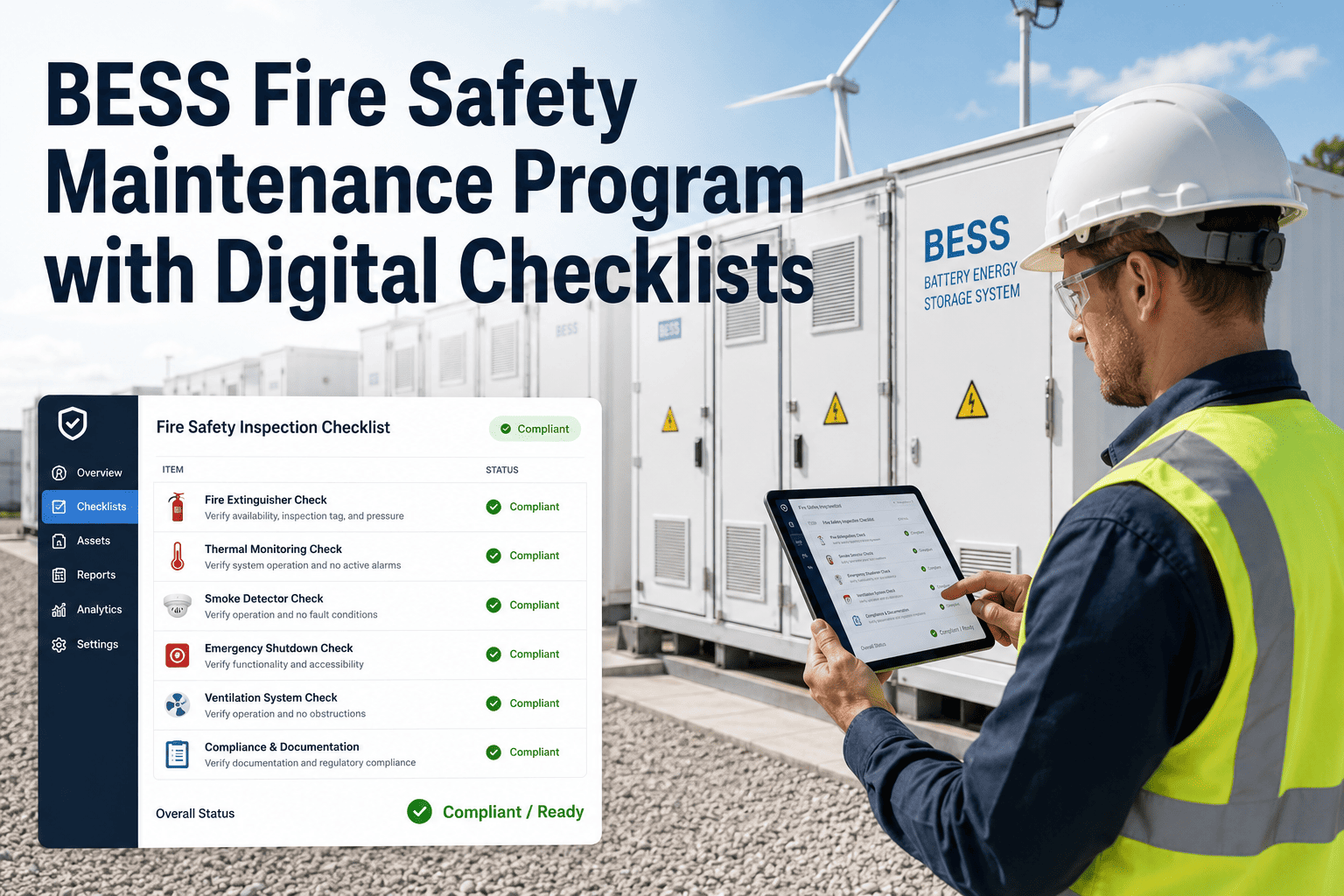
BESS Fire Safety Maintenance Program with Digital Checklists

By Johnson on June 23, 2026

bess-fire-safety-maintenance-program-with-digital-checklists

A Battery Energy Storage System fire is not like any other industrial fire — it cannot be extinguished with water alone, it can reignite hours or days after apparent suppression, and a single thermal runaway event in one cell can cascade through an entire battery rack within minutes if the fire safety maintenance programme has gaps. BESS installations at power plants, grid substations, and renewable energy sites face a fire risk profile that conventional maintenance approaches are not designed to address. Lithium-ion cells under degraded thermal management, damaged battery management systems, or compromised enclosure integrity do not give visible warning before ignition. The maintenance programme is the warning system — and it must be digital, systematic, and tied to corrective work orders that close before the next inspection cycle. OxMaint's Inspection Management platform gives BESS operators a structured digital checklist framework that covers every fire safety maintenance requirement from cell-level thermal monitoring to suppression system certification.

Battery Storage · Fire Safety · Inspection Management

BESS Fire Safety Maintenance Program with Digital Checklists

A comprehensive fire safety maintenance framework for lithium-ion Battery Energy Storage Systems — covering thermal runaway prevention, suppression system inspection, BMS monitoring, enclosure integrity, and emergency response readiness.

High Priority classification for BESS fire safety under NFPA 855 and IEC 62933
72 hrs Maximum reported re-ignition window for lithium-ion battery fires after suppression
NFPA 855 Primary installation and maintenance standard for stationary energy storage systems
Monthly Minimum fire safety inspection frequency for operational BESS installations
Risk Framework

Understanding BESS Fire Risk — The Thermal Runaway Chain

Trigger
Cell-Level Stress

Overcharge, over-discharge, external short circuit, mechanical abuse, or manufacturing defect initiates internal heat generation in a single cell or group of cells.


Escalation
Thermal Runaway

Cell temperature exceeds 130–150°C, triggering exothermic decomposition of the cathode material. Self-heating becomes self-sustaining — the cell cannot cool down without external intervention.


Propagation
Rack-Level Spread

Heat from the first cell in thermal runaway transfers to adjacent cells. Without adequate thermal barrier design and active cooling, rack-level fire develops within 2–10 minutes of the initiating cell event.


Consequence
Enclosure Fire + Gas Hazard

Thermal runaway releases flammable and toxic gases (CO, HF, hydrogen). Combined with the fire event, these create a confined-space explosive atmosphere hazard that makes BESS fires unsuitable for standard fire brigade approach without specialised training and equipment.

BESS Fire Safety Programme — Inspection Scope
Cell Thermal Monitoring BMS Alarm Verification HVAC & Cooling System Fire Detection System Gas Detection System Suppression System Enclosure Integrity Emergency Response
Monthly Checklist

Monthly BESS Fire Safety Inspection

Monthly inspections form the backbone of the BESS fire safety programme. Every item below must be completed, documented, and linked to a corrective work order if any finding is outside the accepted range.

Thermal Monitoring — Cell & Module Level

Review BMS temperature log for the previous 30 days — flag any cell or module that exceeded the OEM-specified maximum operating temperature at any point; a single over-temperature event requires root cause investigation before the next charge cycle Record: BMS temperature log review · Role: BESS Engineer · Frequency: Monthly

Conduct infrared thermal imaging of all battery racks and module interconnects — hot spots more than 5°C above adjacent cells in the same rack require immediate investigation; inter-cell temperature differentials indicate localised degradation or contact resistance issues Record: IR scan archive · Role: Reliability Engineer · Frequency: Monthly

Verify BMS over-temperature alarm and shutdown setpoints are active and match the OEM-approved protection settings — unauthorised setpoint increases to reduce nuisance trips represent the most dangerous single maintenance error in BESS fire safety Record: BMS setpoint verification form · Role: BESS Engineer · Frequency: Monthly
Fire & Gas Detection System

Test smoke and heat detectors inside BESS enclosure using a detector test instrument — detectors that fail to activate within OEM-specified response time must be replaced before the system is returned to operational status Record: Detector test log · Role: Fire Safety Technician · Frequency: Monthly

Test gas detectors for CO and hydrogen at the BESS enclosure — verify sensor reading against a calibration gas standard; sensors that drift more than 10% from the calibration gas concentration require immediate recalibration or replacement Record: Gas detector calibration log · Role: Fire Safety Technician · Frequency: Monthly

Verify fire alarm panel is in service with no faults or disabled zones — any disabled detector zone must be documented with a reinstatement date; no detector zone should be disabled for more than 72 hours without a written risk assessment and alternative fire watch in place Record: Fire alarm panel log · Role: Fire Safety Officer · Frequency: Monthly
Cooling & HVAC System

Verify HVAC setpoint and actual enclosure temperature are within OEM-specified operating range — most lithium-ion BESS installations require enclosure ambient temperature between 15°C and 35°C; sustained operation above this range accelerates cell degradation and fire risk Record: HVAC temperature log · Role: BESS Engineer · Frequency: Monthly

Check liquid cooling circuit (for liquid-cooled BESS) — verify coolant level, coolant pH within 7.0–8.5, and leak-free condition at all manifold connections; coolant leaks onto battery modules are a primary electrical fault initiation mechanism Record: Cooling circuit inspection form · Role: Mechanical Technician · Frequency: Monthly

Every BESS fire safety finding becomes a tracked corrective work order in OxMaint — assigned, due-dated, and closed before the next inspection cycle.

Quarterly Checklist

Quarterly Fire Safety Inspection — Suppression System & Enclosure

Fire Suppression System

Verify cylinder pressure on all suppression agent cylinders (CO2, inert gas, or clean agent) — cylinder pressure must be within 10% of the OEM-specified charge pressure; undercharged cylinders may not achieve the design flooding concentration required for fire control Record: Cylinder pressure log · Role: Fire Safety Technician · Frequency: Quarterly

Inspect all discharge nozzles for blockage, corrosion, or physical damage — conduct airflow test through nozzle orifices if physical inspection reveals partial blockage; blocked nozzles create uneven agent distribution that leaves sections of the BESS enclosure unprotected Record: Nozzle inspection form · Role: Fire Safety Technician · Frequency: Quarterly

Test suppression system control panel for alarm-to-discharge signal integrity — simulate a fire alarm signal and verify that the suppression control panel initiates the pre-discharge alarm, delay timer, and discharge output signal in the correct sequence without manual intervention Record: Suppression system test report · Role: Fire Safety Engineer · Frequency: Quarterly
Enclosure & Cable Integrity

Inspect all BESS container or room enclosure penetrations — cable transit seals, conduit entries, and ventilation dampers must be intact and certified for fire resistance; unsealed penetrations allow fire to spread to adjacent enclosures and negate the passive fire compartmentation design Record: Enclosure integrity inspection form · Role: Reliability Engineer · Frequency: Quarterly

Inspect DC bus bar connections and terminal blocks using calibrated torque wrench — loose connections at high-current DC junctions are a leading cause of arc flash and fire initiation in BESS enclosures; retorque to OEM specification and document torque values recorded Record: Torque inspection log · Role: Electrical Technician · Frequency: Quarterly
Annual Requirements

Annual BESS Fire Safety Certification Checklist

Full Suppression System Discharge Test

Annual full discharge test of the fixed suppression system to verify agent concentration reaches the design flooding level throughout the enclosure volume. Concentration measurement must be performed using calibrated equipment per NFPA 2001 or equivalent standard. Third-party certification required.

Battery Capacity & State of Health Test

Full capacity test of the BESS at the rated C-rate to verify State of Health (SoH) against the OEM degradation curve. BESS operating at SoH below 80% may exhibit accelerated self-heating under high charge/discharge rates — SoH below this threshold triggers a replacement planning requirement, not continued operation.

Emergency Response Drill

Conduct a full BESS fire emergency response drill including alarm acknowledgement, evacuation, fire brigade notification, and suppression system engagement sequence. All personnel with access to the BESS area must participate annually. Drill debrief findings must be incorporated into the Emergency Response Plan update.

Third-Party Safety Inspection

Commission an independent safety inspection covering BMS firmware version, protection coordination, suppression system design adequacy, and compliance with the latest edition of NFPA 855 or IEC 62933-5-2. Annual third-party inspection is increasingly required by BESS insurance underwriters and grid connection agreements.

Standards Reference

Key Standards Governing BESS Fire Safety

Standard Scope Key Fire Safety Requirement Applicability
NFPA 855 Stationary storage battery systems Installation, suppression, detection, and spacing requirements Global — widely adopted
IEC 62933-5-2 Electrical energy storage safety Safety requirements for grid-connected ESS including fire risk International / India
UL 9540A Thermal runaway fire propagation Test method for evaluating fire propagation in BESS North America / Reference
IS 16270 Secondary lithium cells (India) Performance and safety testing for lithium cells India
CEA (Amendment) Regulations Grid-connected ESS (India) Safety and operational requirements for BESS at Indian power plants India
Industry Insight

What BESS Safety Engineers Know

01

The most dangerous period for a BESS installation is the first 18 months of operation. Cell manufacturing variations that passed factory QC can express as premature degradation or early thermal runaway under real operating conditions. Monthly thermal imaging in the first two years is not conservative — it is minimum due diligence for any operator that understands the risk profile.

BESS Safety Engineer, Utility-Scale Energy Storage Projects
02

We digitised our BESS fire safety inspection programme into OxMaint after our insurer required documented proof of monthly inspection completion across all racks. Paper checklists with manual signatures were not sufficient evidence for their underwriting requirements. Digital records with timestamps and photo attachments resolved every audit point within the first inspection cycle.

Operations Manager, 50 MWh Grid-Scale BESS Installation
03

Raising the temperature alarm setpoint to stop nuisance trips is the single most dangerous maintenance decision you can make on a BESS system. I have reviewed incident reports where this decision was made in good faith to avoid production interruption — and it removed the only early warning available before thermal runaway. Setpoint changes must require written authorisation from the OEM or a qualified safety engineer.

Independent Fire Safety Consultant, Battery Storage & Renewables
FAQs

Frequently Asked Questions

Thermal runaway is an exothermic self-heating process in a lithium-ion cell where heat generation exceeds heat dissipation, causing the cell to reach temperatures that trigger further decomposition and more heat in a self-sustaining cycle. A fire safety maintenance programme prevents thermal runaway by ensuring the conditions that trigger it — overcharge, over-temperature, mechanical damage, cooling failure — are detected and corrected before they reach the threshold. This means monthly BMS log review, monthly IR thermal imaging, monthly cooling system verification, and monthly confirmation that all BMS protection setpoints are intact. OxMaint's inspection management module provides the structured workflow and documentation trail that makes this programme auditable and consistent.
No currently available suppression agent can extinguish thermal runaway inside a lithium-ion cell — the reaction is self-sustaining and internal to the cell. The role of fixed suppression systems (CO2, inert gas, clean agent) in a BESS enclosure is to control the fire propagation from the initiating cells to adjacent cells and to reduce heat at the enclosure level while allowing the thermal runaway to exhaust. Water is the most effective external cooling agent for preventing propagation once the enclosure is opened, but direct water application on energised lithium-ion batteries carries electrocution risk. NFPA 855 provides the framework for suppression design, and OEM guidance on the specific chemistry must be followed for each installation.
Monthly inspection is the minimum frequency for all operational BESS installations. Monthly inspection covers BMS thermal monitoring review, fire and gas detector testing, cooling system check, and suppression cylinder pressure verification. Quarterly inspection covers suppression system control sequencing tests, enclosure integrity, and DC bus connection checks. Annual inspection covers full suppression discharge test, battery capacity and SoH test, emergency response drill, and third-party safety audit. Book a demo to see how OxMaint schedules all three inspection cadences automatically and generates work orders with pre-populated checklists for each cycle.
Lithium-ion battery fires have a documented re-ignition window of up to 72 hours after apparent suppression. Cells that did not enter full thermal runaway during the initial event may continue to generate heat internally for days after the fire appears to be out. This means that a site declared "all clear" after a BESS fire event must maintain continuous temperature monitoring, restricted access, and fire brigade standby for a minimum of 72 hours before any personnel re-entry for damage assessment. Re-ignition events during personnel entry without these precautions have caused fatalities in documented international incidents.
For BESS installations in India, documentation requirements come from multiple sources: CEA (Amendment) Regulations for grid-connected storage, the Petroleum and Explosives Safety Organisation (PESO) where applicable for certain battery chemistries, and local factory and building safety regulations. At a minimum, records must include commissioning inspection reports, monthly fire safety inspection logs with inspector identity and date, annual suppression system test certificates, and an Emergency Response Plan with evidence of annual drill completion. Insurance underwriters for BESS installations increasingly require digital inspection records — paper-based systems are being rejected during underwriting reviews. OxMaint generates exportable compliance reports that meet the documentation format required by regulators and insurers.

Digital BESS Fire Safety Inspections — From Monthly Check to Annual Audit, All in One Platform

OxMaint's Inspection Management module schedules, assigns, and documents every BESS fire safety inspection — with photo evidence, timestamped records, and corrective work order generation built into the same workflow that your team uses every day.



Share This Story, Choose Your Platform!