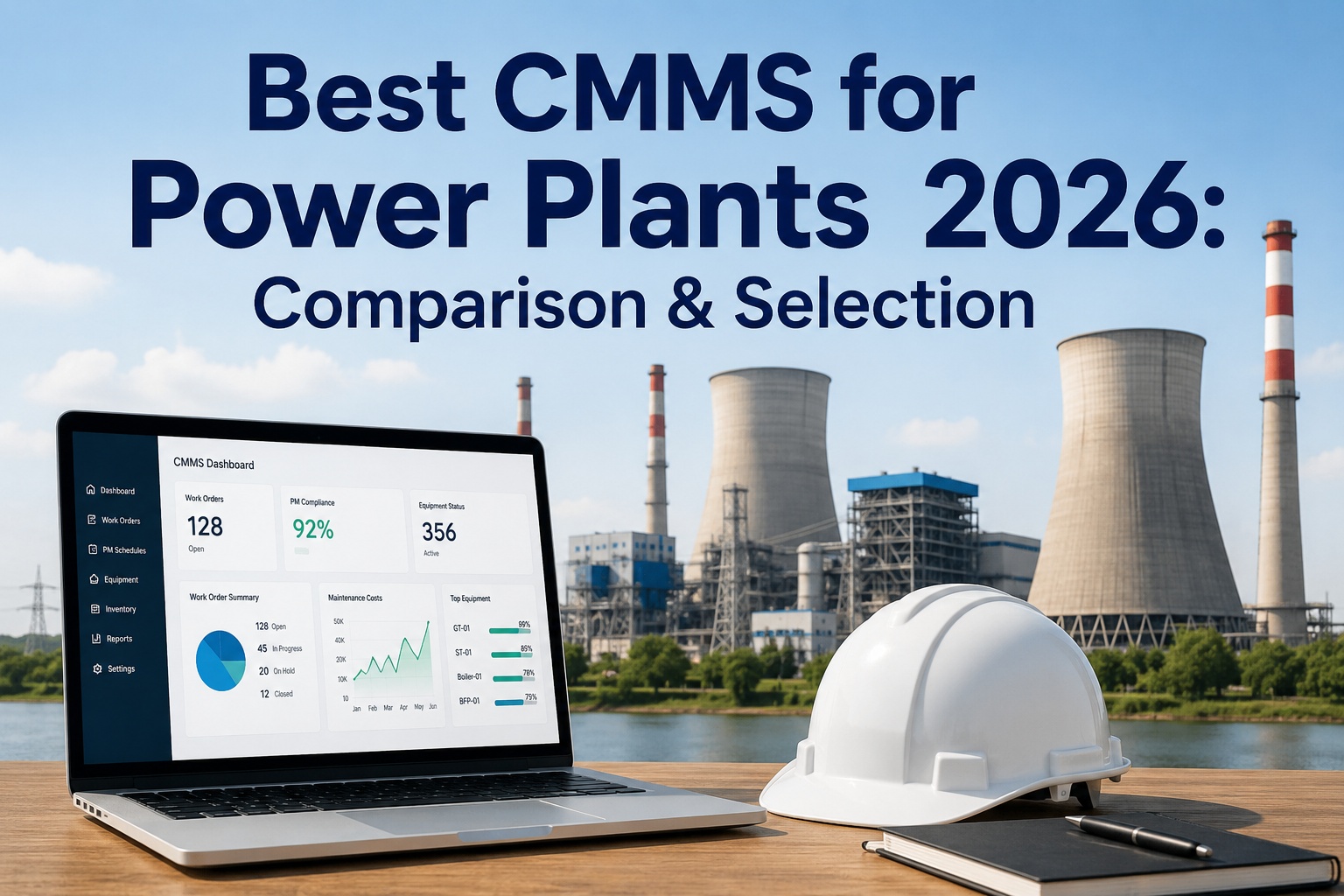
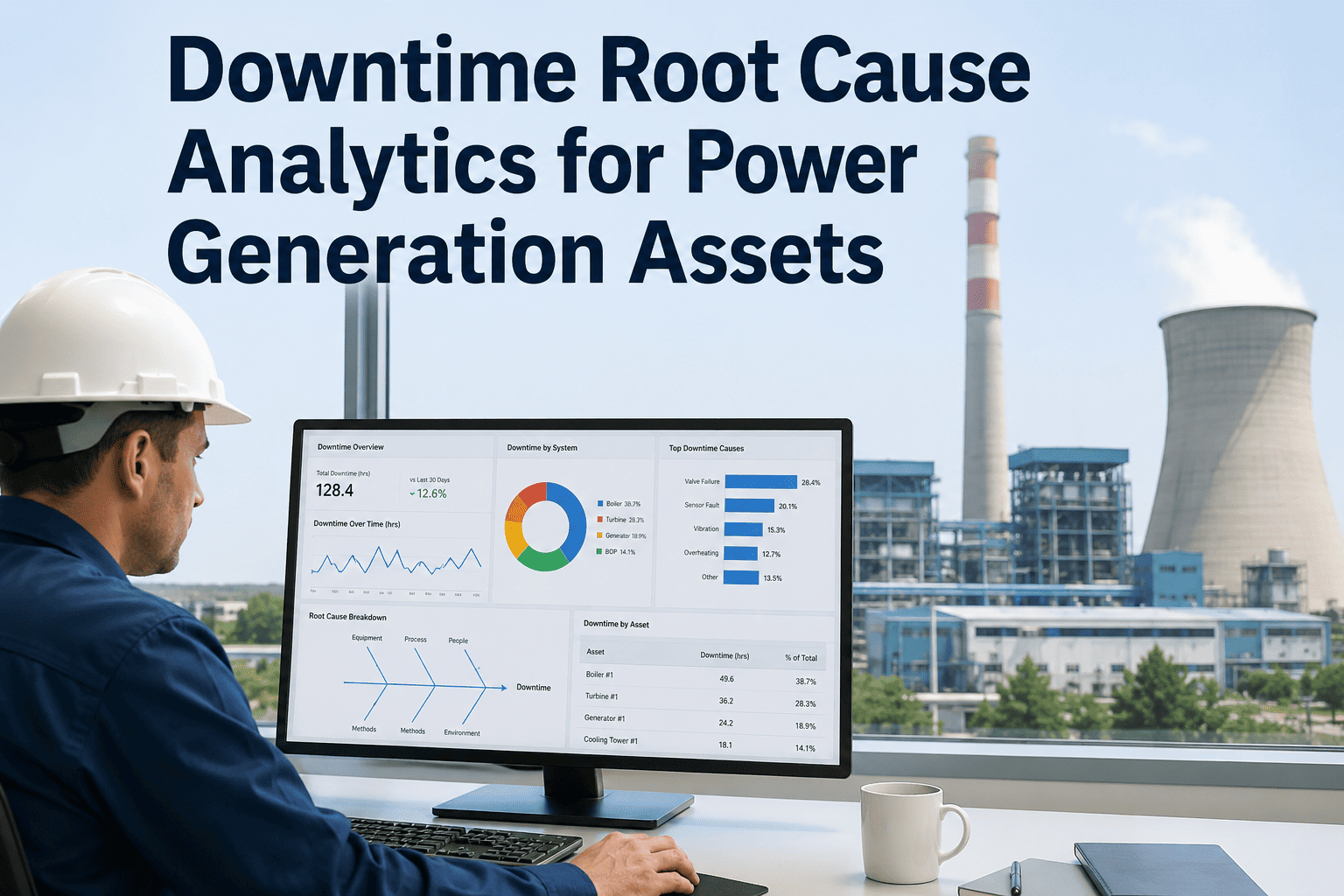
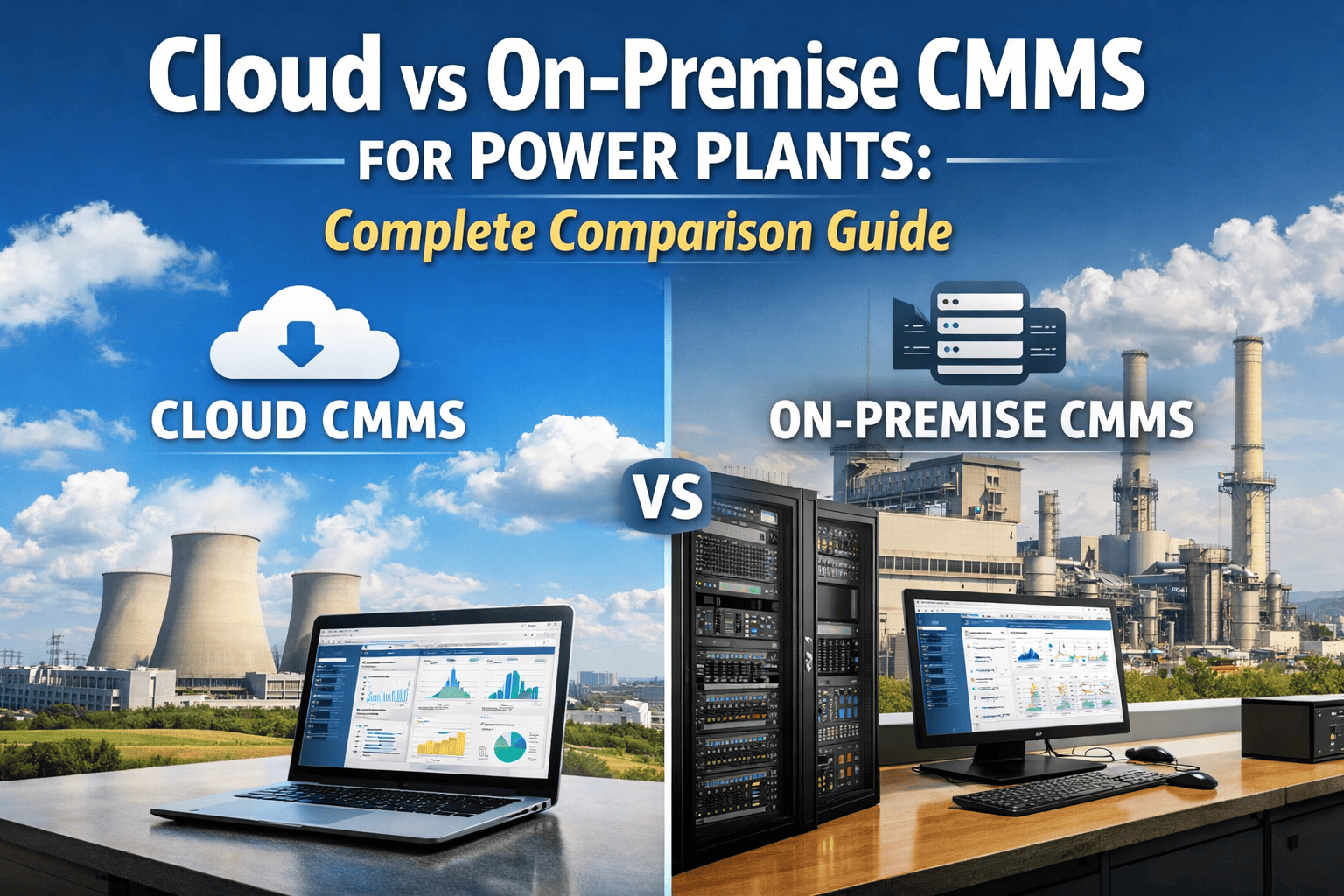
Choosing a CMMS for a power plant is not like buying maintenance software for a warehouse or a food facility. A single unplanned gas turbine trip during peak summer demand costs an estimated $1.2 million per day in lost generation revenue and replacement power purchases — before accounting for NERC CIP compliance violations triggered when emergency maintenance documentation falls through the cracks. The platform you select must handle fired-hour counters, correlate DCS alarm patterns with maintenance history, produce NERC CIP audit evidence on demand, and give technicians a field-ready mobile experience — all while integrating cleanly with your existing SAP or Oracle ERP. This guide gives plant managers 18 scored criteria to evaluate any CMMS candidate rigorously, with a free RFP-ready scoring template for your shortlist. If you want to see how Oxmaint performs across all 18, book a 30-minute demo with your specific plant context.
Power Plant CMMS Buyer's Guide — 2026
18 Criteria for Evaluating a Power Plant CMMS — A Plant Manager's Shortlist Framework
Turbine and boiler-specific workflows, NERC CIP compliance, ERP integration, mobile parity, and predictive maintenance — the full evaluation checklist before you sign a contract.
$1.2M
Per-day cost of an unplanned gas turbine trip at peak demand
60%
Of new NERC-regulated CMMS deployments in 2025 were cloud-based
6–18 mo
Typical IBM Maximo or SAP PM implementation — vs weeks for modern CMMS
38%
Average maintenance cost reduction within 18 months — AI-native CMMS adopters, 2024
Why Generic CMMS Platforms Fail Power Plants
No Fired-Hour Tracking
Gas turbine PM intervals are governed by fired hours and starts — not calendar days. A CMMS that only handles time-based schedules misses the fundamental maintenance trigger for your most critical rotating equipment.
No NERC CIP Workflow
NERC CIP-002 through CIP-013 require specific evidence trails — asset inventories, access control records, patch management logs, and inspection documentation. Generic CMMS platforms have no concept of these standard structures.
No DCS / Historian Connectivity
Without OPC-UA, OSIsoft PI, or SCADA connectivity, sensor data never reaches the CMMS. Condition-based maintenance is impossible. Alarm-to-work-order automation doesn't exist. Technicians work from fixed schedules regardless of actual asset condition.
No Outage Planning Tools
Planned major overhauls involve thousands of work packages, contractor crafts, and OEM inspection requirements coordinated across a defined shutdown window. A CMMS without outage planning functionality forces this coordination into spreadsheets.
The 18 Criteria — Scored Evaluation Framework
Score each criterion 1–5. A CMMS with a total score below 60 should not advance to a full RFP. A score of 75+ indicates a fit worth pursuing. Use the priority weights below to calculate a weighted score for your specific plant context.
Category A
Power Generation-Specific Functionality (Weight: 30%)
01
Fired-Hour and Starts-Based PM Scheduling
Can the platform trigger PM work orders based on equipment operating hours, starts/stops, and OEM inspection intervals — not just calendar-based schedules? This is non-negotiable for gas turbines, HRSGs, and steam turbines.
Ask the vendor: Show me a gas turbine combustion inspection triggered at 8,000 fired hours with automatic reschedule on next planned window.
02
Turbine and Boiler-Specific Equipment Hierarchies
Does the platform support functional location hierarchies that match power plant asset structures — unit, system, equipment, component — with OEM-aligned equipment classes for gas turbines, steam turbines, HRSGs, boilers, and generators?
Ask the vendor: Can we import a 500-asset gas turbine HRSG hierarchy with OEM part numbers in a single upload?
03
Outage and Shutdown Planning Module
Does the platform include a dedicated major overhaul planning tool that manages work package sequences, contractor craft assignments, critical path visualization, and OEM inspection milestones — within a defined outage window?
Ask the vendor: Show me a 14-day HRSG major inspection outage plan with 200 work packages and resource leveling.
04
Condition-Based Maintenance Triggers
Can work orders be automatically generated when sensor readings cross defined thresholds — vibration amplitude, temperature, pressure, current draw — fed from DCS, OSIsoft PI, or SCADA historian connections?
Ask the vendor: Walk me through the configuration from a PI tag threshold breach to a dispatched technician work order.
05
Predictive Maintenance and Remaining Useful Life Modeling
Does the platform provide ML-based failure prediction with remaining useful life (RUL) estimates for major rotating equipment — enabling scheduled replacement within a maintenance window rather than reactive breakdown response?
Ask the vendor: How does your RUL model handle a bearing where the vibration trend is non-linear due to intermittent load cycling?
Category B
Regulatory Compliance and Audit Readiness (Weight: 25%)
06
NERC CIP Evidence Management
Does the platform support structured evidence collection for NERC CIP-002 (BES Cyber System identification), CIP-007 (system security management), and CIP-010 (configuration management) — with timestamped records exportable for auditor review?
Ask the vendor: Generate a CIP-007 R3 patch management evidence package for the last 12 months — how long does that take?
07
ISO 55001 Asset Management Alignment
Does the platform support ISO 55001 asset management requirements — documented asset policy, FMEA records, risk-based maintenance prioritization, and measurable performance objectives per asset class?
Ask the vendor: Show me how your FMEA module links failure modes to PM task lists and risk priority numbers.
08
Permit-to-Work and LOTO Integration
Does the work order workflow include integrated permit-to-work authorization, lockout/tagout procedure attachment, and isolation point verification — preventing technicians from beginning work without confirmed safe system state?
Ask the vendor: Can a work order be blocked from dispatch until the LOTO permit is digitally acknowledged by the issuing authority?
09
Inspection Record Traceability
Are all inspection findings — borescope results, weld inspection reports, thickness measurements, insulation resistance values — attached to the specific work order, asset, and date of inspection with technician digital signature and timestamps?
Ask the vendor: How do I retrieve all boiler inspection records for Unit 3 from the last 5 years in a single export?
Category C
Integration and Data Architecture (Weight: 25%)
10
SAP PM / Oracle EAM Bidirectional Integration
Does the platform offer a pre-built, configurable connector to SAP PM (AFKO, EQUNR, FI/CO) or Oracle EAM — synchronizing work orders, asset records, labor hours, and parts consumption without custom development?
Ask the vendor: When a work order is closed in your CMMS, how long before the labor hours appear in SAP FI? Is it real-time or batch?
11
DCS and OSIsoft PI / Historian Connectivity
Can the platform connect to OSIsoft PI, AVEVA PI, Honeywell PHD, or DCS OPC-UA servers to receive real-time sensor data — without modifying DCS control logic or requiring OT team involvement beyond read-access provisioning?
Ask the vendor: Which PI Web API version does your integration use, and what is the minimum polling interval for condition-based triggers?
12
MRO Inventory and Procurement Integration
Does the platform manage spare parts inventory with automatic reorder triggers, purchase requisition generation to SAP MM or Oracle Purchasing, and real-time stock reservation against open work orders?
Ask the vendor: When a work order is created for a bearing replacement, does the system check stock, reserve the part, and flag a low-stock alert — automatically?
13
API Openness and Data Portability
Does the platform offer a documented REST API for custom integrations, data export in standard formats (JSON, CSV, XML), and no vendor lock-in restrictions on accessing your own maintenance history?
Ask the vendor: If we decide to migrate away from your platform in 3 years, how do we extract our full work order history, asset records, and PM history?
Category D
Field Usability and Mobile Parity (Weight: 10%)
14
Offline Mobile Operation
Can technicians access work orders, complete checklists, capture readings, and close work orders without network connectivity — with automatic sync on reconnection? Essential for switchyard, substation, and rooftop equipment environments.
Ask the vendor: If a technician loses signal at the top of a cooling tower, what exactly can and cannot be done in the app?
15
QR Code and Asset Tag Integration
Can technicians scan a QR code or NFC tag on a piece of equipment to instantly pull up the asset record, open work orders, maintenance history, and safety documents — without navigating a hierarchy in the field?
Ask the vendor: Demonstrate scanning an asset tag to a complete work order dispatch — from scan to technician assignment — in under 60 seconds.
Category E
Implementation, Support, and TCO (Weight: 10%)
16
Go-Live Timeline
What is the realistic time from contract signature to technicians using the platform for daily work order management? Platforms requiring 12–18 months of implementation (Maximo, SAP PM standalone) delay ROI by a full generation cycle. Target: live in 4–8 weeks for initial scope.
Ask the vendor: What is your documented median go-live time for a single-site power plant with 300 assets and 2 DCS integrations?
17
Total Cost of Ownership at Year 3
License fee alone is a misleading metric. Calculate implementation consulting costs, custom development fees, annual support costs, per-user charges at projected headcount, and upgrade/migration costs over a 3-year horizon. Enterprise EAM total 3-year TCO regularly exceeds $500K before any operational value is delivered.
Ask the vendor: Provide a fully itemized 3-year cost projection for our 200-user, 3-site deployment including all implementation, support, and upgrade costs.
18
Power Industry Customer References
Can the vendor provide three reference customers in power generation — not general manufacturing — who have been live for more than 12 months and are willing to discuss results, integration complexity, and support responsiveness?
Ask the vendor: Connect us with a combined-cycle plant reference that has been live for 18+ months and has completed at least one major outage with your platform.
See All 18 Criteria in Action
Oxmaint Scores Strong Across Every Category — See It for Your Plant
From fired-hour PM scheduling and NERC CIP evidence management to SAP integration, OSIsoft PI connectivity, and mobile offline operation — Oxmaint is built for power generation environments. Book a demo with your plant context and walk through the 18-criteria evaluation live.
Scoring Summary: How to Use the 18-Criteria Framework
| Category |
Criteria Count |
Weight |
Max Raw Score |
Threshold to Advance |
| A — Power Generation Workflows |
5 criteria |
30% |
25 points |
18+ (Score ≥ 3.6 avg) |
| B — Regulatory Compliance |
4 criteria |
25% |
20 points |
15+ (Score ≥ 3.75 avg) |
| C — Integration & Data |
4 criteria |
25% |
20 points |
14+ (Score ≥ 3.5 avg) |
| D — Mobile & Field Usability |
2 criteria |
10% |
10 points |
7+ (Score ≥ 3.5 avg) |
| E — Implementation & TCO |
3 criteria |
10% |
15 points |
10+ (Score ≥ 3.3 avg) |
| Total |
18 criteria |
100% |
90 points |
64+ = Advance to RFP · 75+ = Strong Fit |
Frequently Asked Questions
Should we replace SAP PM with a dedicated CMMS, or integrate them?
The recommended approach for most power plants is integration, not replacement. Keep SAP PM or Oracle EAM as the financial system of record for cost postings and asset valuation. Use a dedicated CMMS as the field execution layer for work orders, mobile maintenance, and condition-based scheduling. The two systems stay synchronized through standard APIs.
Book a demo to review the architecture for your specific SAP landscape.
Is cloud-based CMMS acceptable under NERC CIP requirements?
Yes — when the platform separates OT data flows from cloud analytics in compliance with CIP-005 and CIP-007. Over 60% of new NERC-regulated CMMS deployments in 2025 were cloud-based. Look for FIPS 140-2 data encryption, role-based access with full audit logging, and an option for on-premise deployment for facilities with strict data residency requirements.
How many vendors should we include on the initial CMMS shortlist?
Apply the 18-criteria scoring framework to 5–8 candidates based on vendor demos and published documentation. Advance the top 3 scorers (64+ points) to a formal RFP with site-specific requirements. Require a live proof-of-concept on your asset data from the final 2 before contract signature.
What is the biggest mistake power plant managers make in CMMS selection?
Evaluating only license cost and feature list — not implementation timeline and Year-3 total cost of ownership. Enterprise EAM platforms (Maximo, SAP PM standalone) carry $200K–$500K in implementation consulting fees before go-live. A modern cloud CMMS that goes live in 4–8 weeks at a fraction of the cost delivers ROI in the same quarter, not 18 months later.
Start a free trial and compare results directly.
Do we need a CMMS before we can implement predictive maintenance?
Yes. Predictive maintenance ML models are trained on historical failure data — work orders, parts used, failure codes, repair times — stored in the CMMS. Without structured maintenance history, predictive models have no training data and produce unreliable outputs. A CMMS with at least 12 months of clean asset records is the prerequisite for meaningful predictive maintenance deployment.
Power Plant CMMS — Oxmaint
18 Criteria. One Platform That Checks Them All.
Fired-hour PM scheduling, NERC CIP evidence management, SAP PM and Oracle EAM integration, OSIsoft PI connectivity, offline mobile operation, and a 4–8 week go-live timeline. Oxmaint is built for power generation — and you can start for free today.
4–8 wks
Typical power plant go-live
18
Evaluation criteria covered
Zero
Custom dev for standard integrations
Free
Trial — no credit card required