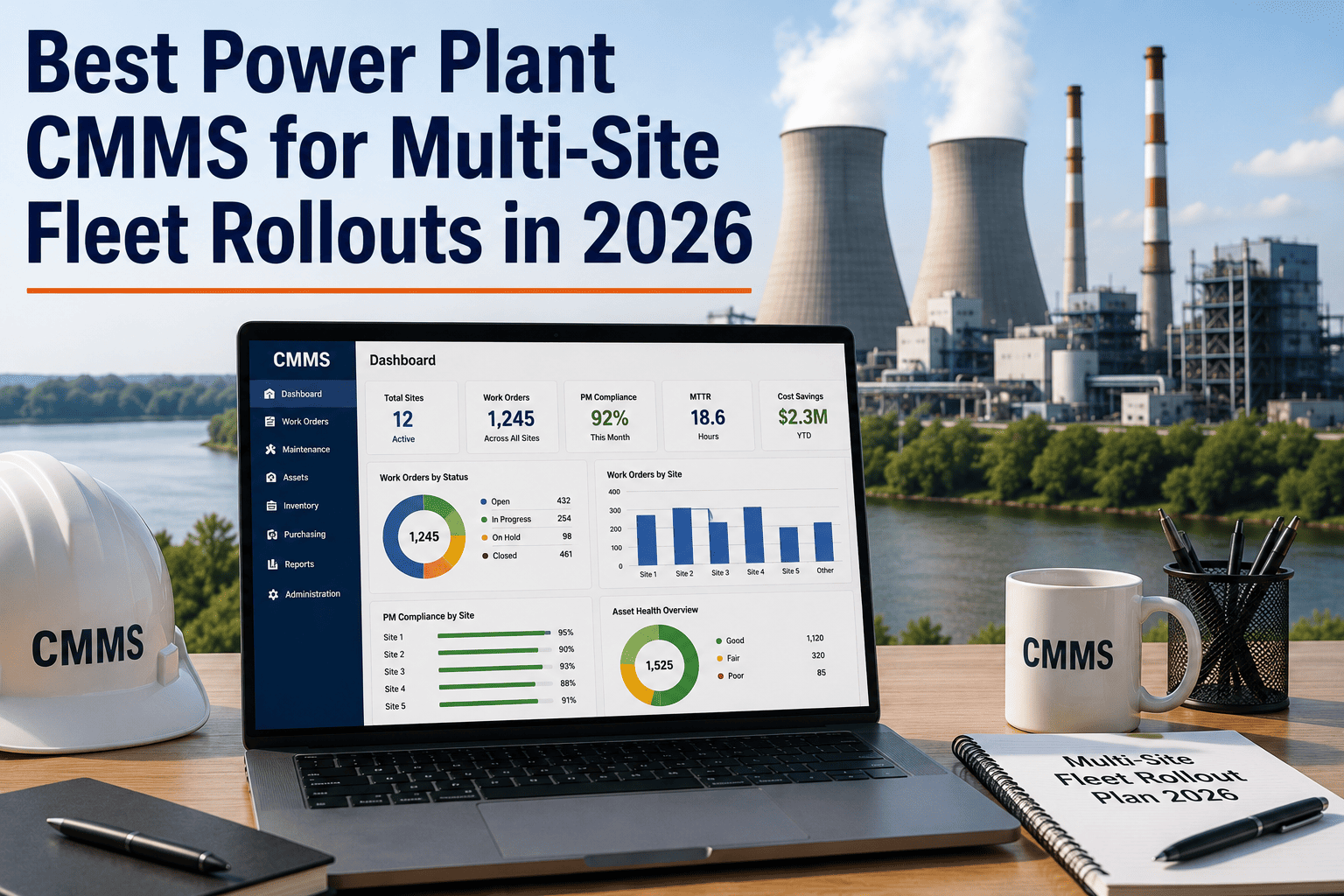
Running a power generation fleet across 14 plants means 14 maintenance teams, 14 sets of PM schedules, 14 different ways of naming the same asset — and zero ability to compare performance across any of them. When corporate asks why Plant 7 has twice the forced outage rate of Plant 3, nobody can answer, because the data doesn't speak the same language. For one regional power fleet operator managing gas, combined-cycle, and peaker assets across three states, this fragmentation had become a strategic liability. Procurement couldn't leverage cross-fleet spend. Reliability engineers couldn't benchmark sister plants. Corporate reporting meant chasing spreadsheets from 14 maintenance managers every month. In 28 weeks, they standardized the entire fleet on Oxmaint — central reporting, plant-level autonomy, shared PM templates, and a corporate dashboard that made fleet performance visible for the first time. Sign up free to explore the platform, or book a demo to see how a fleet rollout maps to your portfolio.
CASE STUDY · POWER GENERATION FLEET · MULTI-SITE CMMS
14 Plants. 1 Platform. 28 Weeks.
How a regional power fleet eliminated fragmented maintenance data, standardized PM procedures across gas and combined-cycle assets, and gave corporate leadership real-time visibility for the first time — without disrupting plant-level operations.
14
Plants on a Single Platform
28 wks
Full Fleet Deployment
100%
Corporate Reporting Automated
34%
Reduction in Cross-Fleet Spare Parts Spend
THE FLEET PROFILE
What 14 Plants Looked Like Before Standardization
The fleet comprised 14 generating facilities — six combined-cycle plants, five simple-cycle gas peakers, and three legacy steam units — across three states. Each plant had been acquired or commissioned independently over a 12-year period, resulting in a patchwork of maintenance practices that had never been rationalized at the enterprise level.
Asset Naming
14 different conventions
The same frame 7 turbine had different asset IDs at every plant. Cross-fleet failure analysis was impossible.
PM Templates
47 incompatible versions
Identical equipment on different PM intervals because local engineers had set schedules independently years earlier.
Corporate Reporting
12–18 days to compile
Monthly performance reports required 14 site managers to submit individual spreadsheets, then manual consolidation by corporate staff.
Spare Parts Visibility
Zero cross-fleet view
Plants were emergency-ordering parts that sat in another plant's storeroom 90 miles away. No shared inventory visibility.
Performance Benchmarking
Not possible
Without a shared KPI framework, leadership couldn't identify which plants were underperforming or why. Every plant reported different metrics.
Maintenance Software
6 different systems
Four plants on legacy CMMS, three on spreadsheets, two on paper-based systems, five on nothing at all.
THE BUSINESS CASE
Why Fragmentation Was Costing Real Money
Before the Oxmaint rollout, the VP of Asset Management commissioned a fragmentation cost analysis. The findings made the business case for standardization self-funding.
$2.1M in Duplicate Spare Parts Inventory
Cross-fleet inventory audit revealed $2.1M in duplicate stocking — plants carrying safety stock of identical parts because they had no visibility into sister-plant inventory. Consolidation eliminated most of it in the first year post-deployment.
$380K/Year in Corporate Reporting Labor
Compiling monthly performance data from 14 plants required the equivalent of two full-time corporate staff positions annually. Automated dashboard reporting eliminated this overhead entirely.
Unquantified Forced Outage Risk From PM Gaps
Without standardized PM intervals on common equipment, some plants were over-maintaining while others had critical PMs running 40% past their recommended cycle. The risk asymmetry was invisible without a fleet-level view.
OXMAINT · FLEET CMMS · MULTI-PLANT STANDARDIZATION
Managing Multiple Power Plants Without a Unified Platform?
Oxmaint gives power fleet operators central dashboards, shared PM templates, cross-fleet inventory visibility, and plant-level autonomy — deployed in weeks, not years.
THE ROLLOUT STRATEGY
How 14 Plants Were Deployed in 28 Weeks
The deployment was designed around a phased wave model — three pilot plants first, then waves of three to four plants per month, with corporate templates and shared taxonomies locked in after Wave 1 to ensure data consistency across the fleet.
Pilot & Template Development
Three flagship combined-cycle plants deployed. Asset taxonomy, PM template library, and KPI framework defined. Corporate dashboard configured. All subsequent waves inherit these standards — no re-work.
Outcome: Fleet-wide naming convention, 112 shared PM templates, corporate dashboard live
Simple-Cycle & Peaker Rollout
Four gas peaker plants onboarded using Wave 1 templates with peaker-specific PM additions. Cross-fleet inventory module activated — shared parts visibility across 7 plants by end of week 14.
Outcome: First cross-plant inventory transfers, 7 plants reporting to central dashboard
Legacy Steam & Remaining Gas Units
Four plants including three legacy steam units. Steam-specific asset hierarchies added to template library. Historical maintenance data migrated from two legacy CMMS systems. 11 plants on unified platform.
Outcome: Steam PM templates added to library, legacy CMMS data migrated, 11 plants live
Final Plants + Fleet Optimization
Final three plants onboarded. Fleet-wide KPI benchmarking activated. Corporate reporting automation configured to replace monthly spreadsheet submissions. All 14 plants contributing to unified dashboard.
Outcome: Full 14-plant fleet on platform, monthly reporting automated, benchmarking live
THE RESULTS
What the Fleet Looked Like at Week 28
34%
Reduction in Cross-Fleet Spare Parts Spend
Shared inventory visibility eliminated duplicate stocking. Parts transferred between plants instead of being emergency-ordered. $710K saved in Year 1 on parts procurement alone.
Zero
Monthly Spreadsheet Submissions Required
Corporate performance reporting fully automated from Oxmaint dashboard. The two-week monthly aggregation process eliminated. Leadership sees fleet KPIs updated in real time.
112
Shared PM templates deployed across the fleet — replacing 47 incompatible local versions
19%
Improvement in fleet-wide PM completion rate in first 6 months post-deployment
4 plants
Identified as significant underperformers via benchmarking — invisible before standardization
$1.4M
Estimated Year 1 ROI from parts consolidation, reporting labor, and PM compliance gains
"Before Oxmaint, I genuinely could not tell you which of our 14 plants had the best maintenance performance. They all reported differently. Six months after deployment, I can benchmark every plant on the same KPIs and tell you exactly where we need to focus. That visibility is worth more than any individual efficiency gain."
— VP of Asset Management, Regional Power Generation Fleet
HOW IT WORKS
Oxmaint's Multi-Plant Fleet Architecture
Oxmaint's fleet model is built around a two-tier permission and data structure — corporate visibility with plant-level autonomy. No plant has to operate identically. Every plant contributes to the same corporate reporting layer.
CORPORATE LAYER
Fleet-wide KPI dashboard — MTTR, MTBF, PM compliance, downtime by plant
Shared PM template library — push updates to all plants or specific sites
Cross-fleet spare parts inventory — see stock at every plant, initiate transfers
Asset taxonomy governance — enforce naming standards across all sites
Automated corporate reporting — no monthly spreadsheet submissions
PLANT LAYER
Plant-level work order management with local technician assignments
Site-specific PM additions to corporate templates where conditions differ
Local inventory management with corporate-level visibility
Mobile technician access — field work orders, asset records, manuals
Plant manager dashboard — local KPIs and work order backlog
FREQUENTLY ASKED
Fleet Deployment Questions
How does Oxmaint handle plants that are at very different stages of maintenance maturity?
The wave deployment model is designed for exactly this. Plants with existing CMMS data migrate history in; plants starting from scratch use the shared template library to stand up quickly. Corporate templates set the floor — each plant can add local procedures on top. See the platform at
app.oxmaint.ai.
Can plant managers restrict what corporate can see about their site?
Oxmaint's permission model gives corporate read access to fleet KPIs and asset records while preserving plant-level operational control. Plant managers manage their own work orders and schedules without corporate interference. Role-based access controls are fully configurable per your org structure.
How long does a 14-plant fleet deployment realistically take?
This fleet completed in 28 weeks using a 4-wave model. Smaller fleets of 5–7 plants typically complete in 12–16 weeks. The critical path is the Wave 1 template and taxonomy build — once that's done, each subsequent plant takes 2–3 weeks.
Book a demo for a timeline built around your portfolio.
Does Oxmaint support different asset types across a mixed-technology fleet?
Yes. Oxmaint supports gas turbines, combined-cycle systems, steam units, HRSGs, peakers, and renewable assets within a single fleet account. Each plant type has its own template library, and shared templates are pushed to applicable sites only.
What does Oxmaint cost for a multi-plant fleet?
Fleet pricing is structured per site with volume discounts for portfolios of 5+ plants. The cost is a fraction of legacy enterprise CMMS or EAM platforms — with deployment in weeks rather than years.
Sign up free for a single plant first, or
book a demo for a fleet pricing discussion.
OXMAINT · FLEET CMMS · POWER GENERATION
Stop Managing 14 Plants Like 14 Different Companies
Oxmaint gives power fleet operators a unified maintenance platform — shared PM templates, cross-fleet inventory visibility, automated corporate reporting, and plant-level performance benchmarking — deployed in weeks without disrupting site operations.