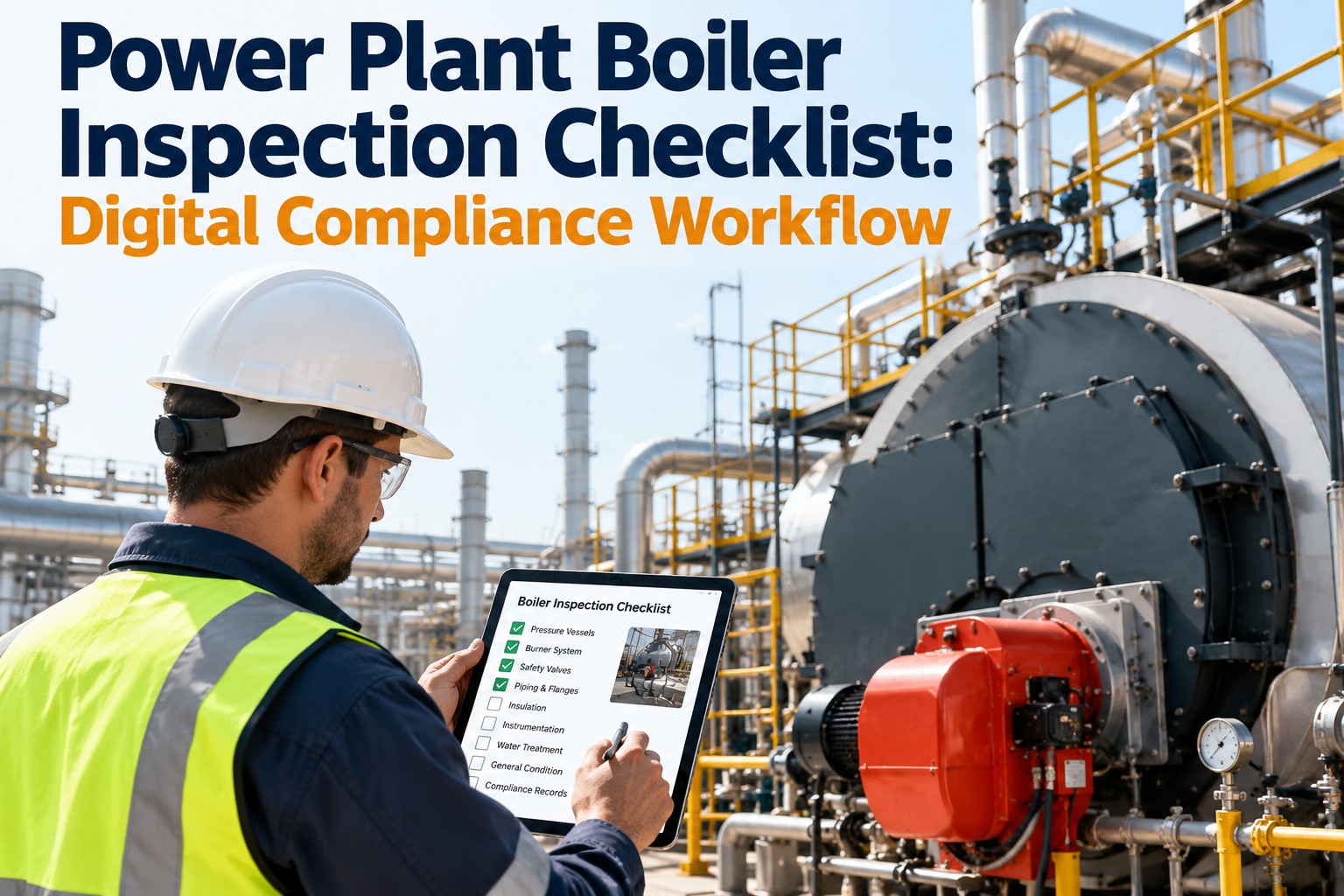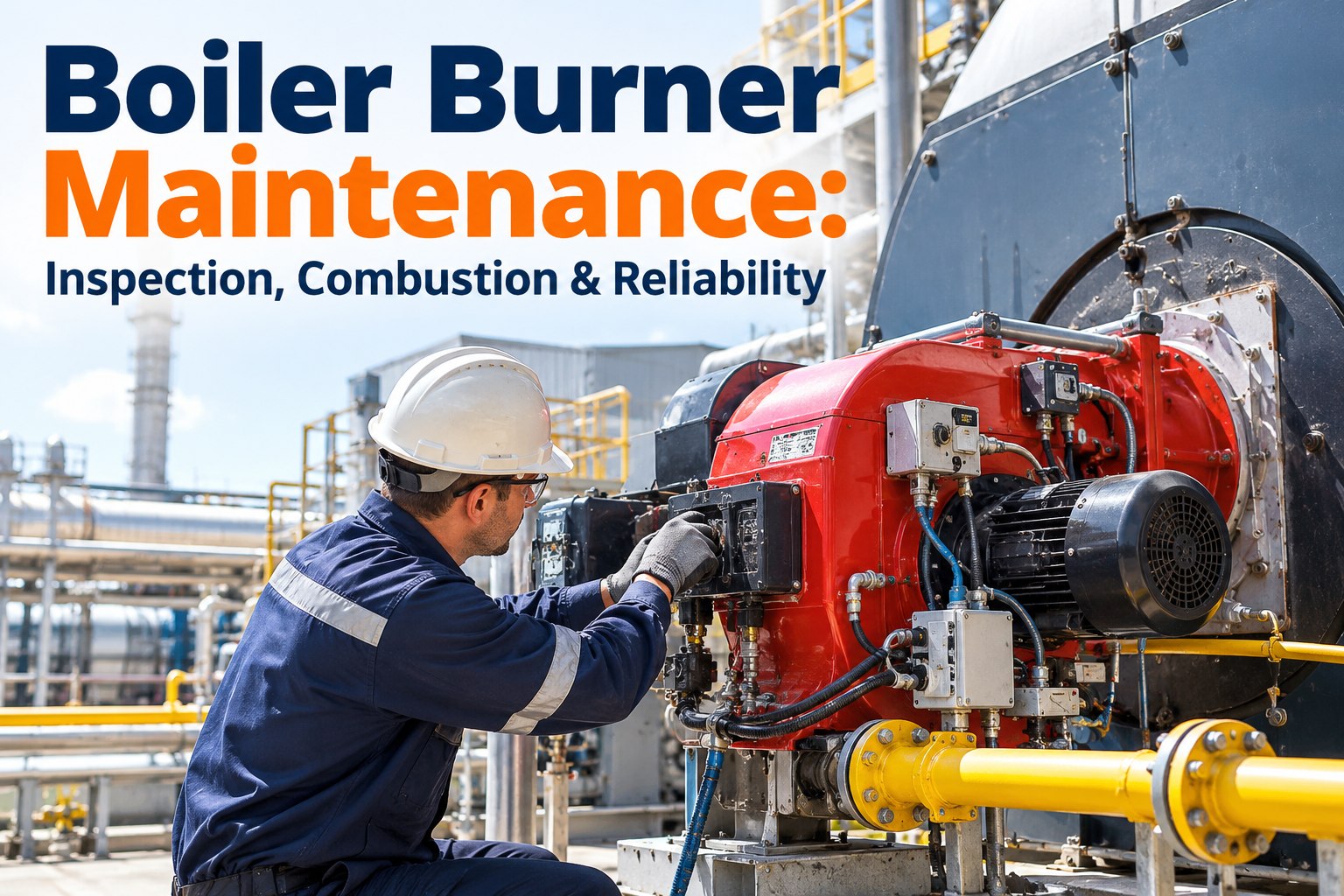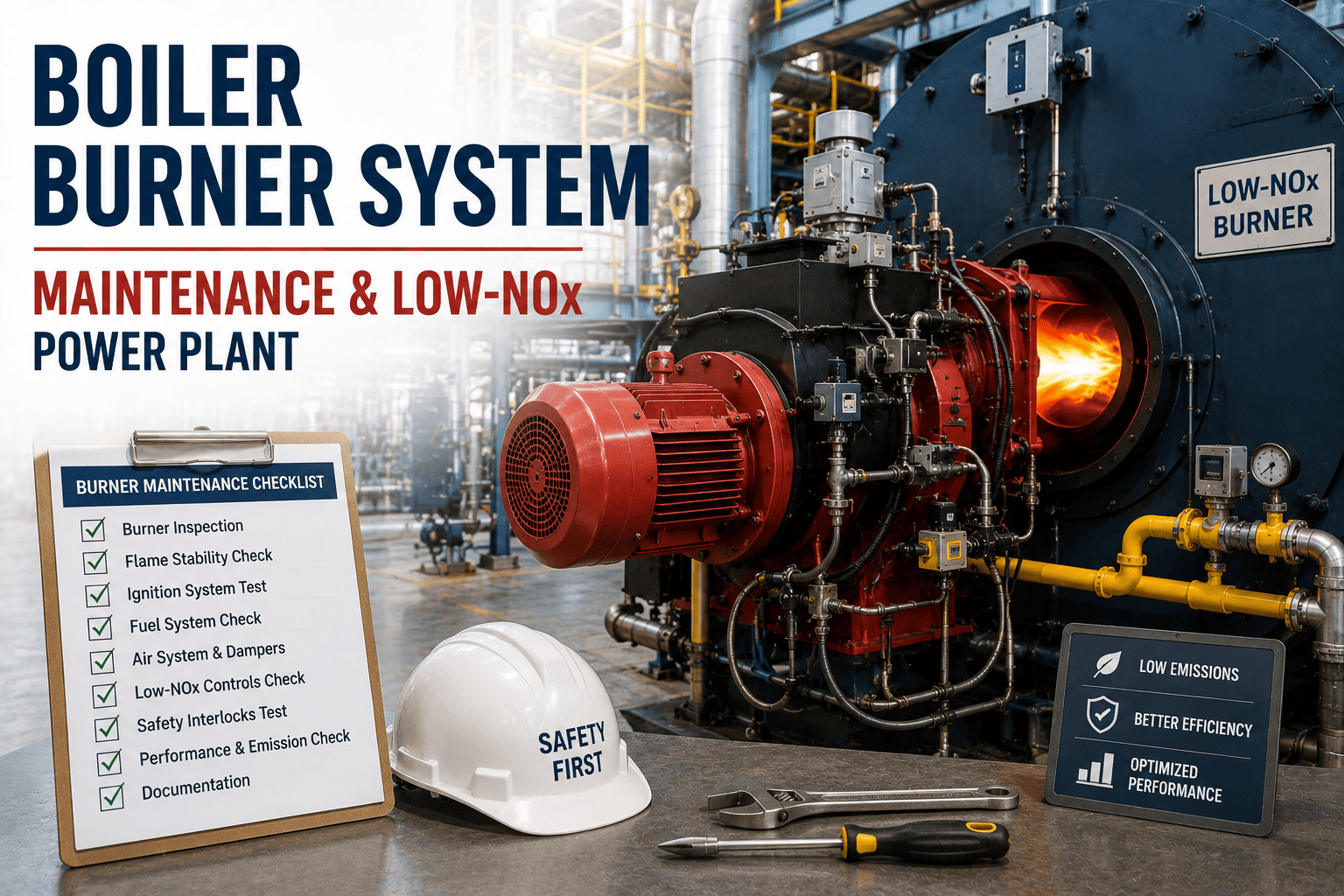
Boiler burner system maintenance in a power plant environment demands rigorous preventive scheduling, precise combustion tuning, and disciplined spare-parts management — a single misaligned fuel nozzle or fouled flame scanner can push NOx emissions past permit limits, derate output by 5–12%, and trigger six-figure compliance penalties. This burner maintenance guide covers low-NOx burner PM, fuel nozzle inspection intervals, scanner maintenance, and boiler combustion tuning as a structured program that reliability teams can operationalize inside a CMMS. If your plant is still tracking burner PM on spreadsheets or paper work orders, you can Start Free Trial of OxMaint to digitize the entire workflow in under a week.
Is a single burner failure costing your plant $18,000 per day in derated output?
Low-NOx burner systems operate within a narrow combustion window. Without disciplined PM, fuel nozzle inspection, and scanner calibration, efficiency drops, emissions rise, and unplanned outages eat into your annual availability factor. The right maintenance strategy — backed by a CMMS — keeps every burner component in spec and every audit-ready record at your fingertips.
Burner PM power plant teams should run every combustion season
A structured burner PM program reduces forced gas-turbine and boiler outages by up to 28% and keeps NOx below permitted limits. Below is the preventive maintenance checklist that every shift should execute on a defined cadence — daily, monthly, and annual outage — to protect availability and compliance.
- Inspect flame scanners for signal strength above 60% threshold
- Log burner diffuser pressure and compare to baseline curve
- Verify pilot gas regulator pressure within ±2% of setpoint
- Check atomizing steam / air pressure on oil-fired burners
- Record O2 at economizer outlet — target 2–4% excess oxygen
- Clean flame scanner lens and verify UV/IR response time < 2 sec
- Calibrate combustion analyzer (CO, O2, NOx) to reference gas
- Inspect fuel nozzle tips for carbon buildup or erosion > 0.5 mm
- Lubricate burner management system (BMS) linkages and dampers
- Trend NOx readings vs. load curve — flag deviations > 5%
- Remove and bench-test all fuel nozzles — replace if flow deviates > 3%
- Borescope burner throat refractory for spalling or slagging
- Replace scanner quartz lenses and UV sensor tubes on PM cycle
- Perform low-NOx burner air staging damper travel verification
- Re-tune combustion matrix across 30–100% MCR load range
Boiler fuel nozzle, scanner, and low-NOx component maintenance intervals
Use this interval matrix to schedule work orders in your boiler burner CMMS. Each row maps a component to its inspection frequency, failure warning signs, and the risk of deferring — so your planning team can prioritize with confidence.
| Component | Inspection Interval | Key Failure Signal | Risk If Deferred |
|---|---|---|---|
| Fuel nozzle tips | Monthly visual / Annual bench test | Flow deviation > 3%, carbon buildup | Uneven flame, NOx spike, tube overheating |
| Flame scanner (UV/IR) | Weekly clean / Monthly calibrate | Signal strength < 60%, slow response | Spurious boiler trip, loss of availability |
| Low-NOx air staging dampers | Quarterly travel check | Sticking, > 5% position error | NOx exceedance, RATA failure |
| Burner diffuser / register | Annual outage | Refractory spalling, warping > 3 mm | Flame impingement, waterwall tube leak |
| Pilot gas regulator | Monthly | Pressure drift > ±2% | Ignition failure, delayed light-off |
| Atomizing steam / air header | Monthly | Pressure drop, moisture carryover | Poor atomization, smoking, CO rise |
How to execute low-NOx boiler combustion tuning in 6 steps
Combustion tuning is the single highest-ROI activity in burner system maintenance — a properly tuned low-NOx burner can cut NOx by 20–40% and improve boiler efficiency by 1–3 percentage points. Follow this six-step tuning protocol during commissioning, after major repairs, or whenever fuel quality changes significantly.
Baseline data collection
Log current O2, CO, NOx, flue-gas temperature, and burner load across 30–100% MCR. Record fuel composition (hydrogen/carbon ratio, sulfur, moisture). This baseline becomes the reference curve for every future combustion-tuning event.
Excess oxygen optimization
Reduce excess O2 in 0.25% increments while monitoring CO. Target the lowest O2 that keeps CO below 100 ppm — typically 2–4% at economizer outlet. Every 1% reduction in excess air raises boiler efficiency by roughly 0.5%.
Low-NOx burner air staging adjustment
Tune over-fire air (OFA) and secondary air damper positions to create fuel-rich primary zones and air-rich secondary zones. This staged combustion lowers peak flame temperature — the primary thermal-NOx formation driver — by 150–300°F.
Fuel nozzle balancing
Verify equal fuel distribution to all burners using individual flow meters or pressure-drop correlation. A 5% imbalance between burners can raise NOx by 10–15% and cause localized tube overheating. Replace nozzles outside 3% flow tolerance.
Flame scanner mapping
With burners firing at design load, map each scanner's signal strength. Reposition or clean any scanner reading below 60%. A false "flame-out" trip on a single scanner can cost $18K–$50K per event in lost generation and restart fuel.
Document & load to CMMS
Store the final tuning curve, damper positions, nozzle flows, and scanner readings as a digital baseline in your CMMS. Set automated alerts when live operating data deviates from the baseline — so the next tuning event is predictive, not reactive.
What poor burner maintenance really costs a 500-MW plant
Consider a 500-MW coal- and gas-fired plant running at 85% capacity factor with a net margin of $35/MWh. Even a 1% efficiency loss from poor combustion tuning costs $1.3 million per year. Here is the math — and why it compounds when PM is deferred.
A single deferred fuel-nozzle replacement can cascade into a flame-impingement tube leak, a 72-hour forced outage, and a $500K+ repair bill. The burner maintenance cost is trivial by comparison — a full set of nozzles and a day of tuning runs $15K–$25K. The ROI is not a projection; it is the avoidance of a near-certain failure mode.
Book a 30-minute demo and see OxMaint on your burner assets
See how a CMMS purpose-built for power-plant maintenance turns your burner PM checklists, combustion-tuning baselines, and scanner calibration records into automated, audit-ready work orders — in days, not months.
Burner system CMMS: how OxMaint digitizes boiler burner maintenance
OxMaint is an AI-powered CMMS and EAM platform that turns your boiler burner maintenance program from a paper-and-spreadsheet operation into a predictive, audit-ready system of record. Here is how four core capabilities map directly to the burner PM challenges above — and the measurable outcomes reliability teams achieve.
Automated PM scheduling for every burner component
Build recurring work orders for fuel nozzle inspections, scanner calibrations, and low-NOx damper travel checks on any cadence — daily, monthly, or outage-based. OxMaint auto-assigns to the right technician with checklists, safety permits, and spare-part kits attached.
Combustion-tuning baselines with predictive alerts
Store each tuning curve — O2, NOx, damper positions, nozzle flows — as a digital asset baseline. OxMaint's AI engine monitors live operating data and alerts your team the moment a parameter drifts beyond tolerance, before NOx climbs or efficiency drops.
Spare-parts inventory for nozzles, scanners & seals
Track min/max stock levels for every burner critical spare — fuel nozzle tips, UV scanner tubes, diffuser refractory, pilot regulators. OxMaint auto-generates purchase requisitions when stock hits reorder point, so the part is on the shelf before the work order opens.
Audit-ready maintenance records for compliance
Every burner work order — PM, inspection, repair, tuning — is timestamped, geo-tagged, and signed digitally. Pull a full maintenance history for any burner, scanner, or nozzle by asset ID in seconds. OxMaint exports reports in the format auditors and environmental regulators expect.
A 600-MW combined-cycle plant in the Midwest tracked 42 burners and 84 flame scanners across two HRSGs on paper logs and a shared spreadsheet. After implementing OxMaint, they digitized all PM checklists, set predictive alerts on O2 and NOx baselines, and linked spare-parts kits to every work order. In the first 12 months, the plant cut forced burner-related outages by 31%, eliminated two near-miss RATA failures, and reduced time-to-resolve on scanner faults from 4 hours to under 45 minutes — saving an estimated $390K in avoided derate and repair costs.
Boiler burner maintenance: what reliability teams ask most
How often should boiler fuel nozzles be inspected in a power plant?
Fuel nozzle tips should be visually inspected monthly during operation and bench-tested during the annual outage. If flow deviation exceeds 3% from the manufacturer's reference curve, or if carbon buildup or tip erosion exceeds 0.5 mm, the nozzle should be replaced immediately. High-cycling units or plants firing heavy oil may require inspection as frequently as every two weeks. Scheduling these inspections in a CMMS like OxMaint ensures no interval is missed.
What is the ideal O2 level for low-NOx boiler combustion tuning?
Most low-NOx burner systems operate best at 2–4% excess oxygen at the economizer outlet, though the exact target depends on fuel type and boiler design. The goal is the lowest O2 that keeps CO below 100 ppm — this minimizes thermal NOx formation while avoiding incomplete combustion. Reduce O2 in 0.25% increments and map the full 30–100% load range to build a reliable tuning curve.
Why do flame scanners fail and how should they be maintained?
Flame scanners fail most often due to dirty or fogged quartz lenses, degraded UV/IR sensor tubes, and misalignment after burner repair. Clean the scanner lens weekly, verify signal strength above 60% on every shift walkdown, and calibrate response time monthly — it should be under 2 seconds. Replace UV sensor tubes on the annual outage PM cycle, and always re-map scanner positioning after any nozzle or diffuser change.
Can a CMMS improve low-NOx burner maintenance compliance?
Yes — a CMMS is the most effective tool for maintaining low-NOx compliance because it automates PM scheduling, stores tuning baselines, and generates a timestamped audit trail for every inspection and repair. When O2 and NOx data are integrated, the system can alert teams to combustion drift before a RATA test fails. Book a demo of OxMaint to see how automated work orders and predictive alerts keep your plant within permit limits.
What are the signs a low-NOx burner system needs immediate maintenance?
The top warning signs are a NOx reading trending more than 5% above the baseline curve, CO spikes above 100 ppm, uneven flame patterns or flame impingement visible through inspection ports, individual burner diffuser pressure deviations, and flame scanner signal drops below 60%. Any of these indicates the burner is operating outside its tuned envelope and should trigger a work order within 24 hours to prevent efficiency loss, tube overheating, or a compliance violation.
Stop managing burner maintenance on spreadsheets
OxMaint digitizes your boiler burner PM, combustion-tuning baselines, scanner calibration records, and spare-parts inventory into one AI-powered platform — built for power-plant reliability teams. Start your free trial today, or book a 30-minute demo and we will show you the system configured for your assets.
Free 14-day trial · No credit card