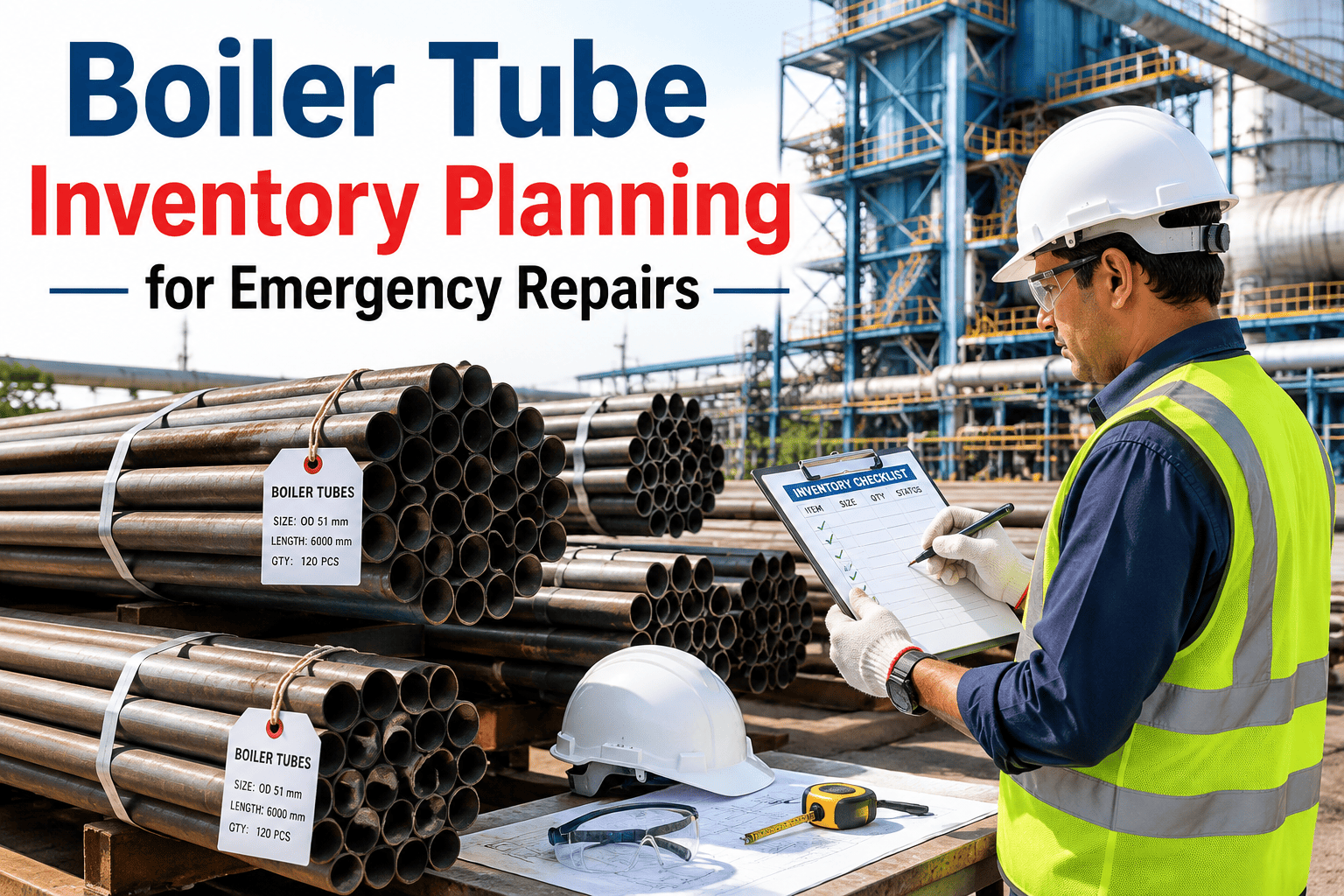
A waterwall tube let go at 3 a.m., and the unit tripped before the control room finished reading the alarm. Ninety-six hours later it was still offline — roughly $2.4 million in lost generation — not because the repair was hard, but because the right tube was not in the warehouse and qualified welders were being chased down by phone. Boiler tube failures are the single largest cause of forced outages in thermal plants, behind well over half of all unplanned shutdowns, and the length of every one of them is decided long before the leak by what sits on the shelf. The grade, diameter, and wall thickness you stocked last quarter is the difference between a two-day repair and a two-week scramble. You can plan tube holdings by section, grade, and failure history and pre-kit your emergency repairs by booking a 30-minute demo or starting a free trial on your own boiler data.
Where Tubes Fail
One Boiler, Four Sections, Four Different Tubes
A utility boiler is not one tube. A 500 MW unit carries more than 50,000 linear feet of tube across four sections, each running at a different temperature, made from a different grade, and failing in a different way. Stocking for it means accepting that the economizer and the superheater have almost nothing in common except the word "tube."
Economizer
Coolest · feedwater heating
MaterialCarbon steel — SA-178 / SA-210
Dominant failureFlyash erosion on leading edges, oxygen pitting
Stock signalHigh-turnover carbon tube, common sizes
Waterwall
Radiant furnace heat
MaterialCarbon steel — SA-210 panel and membrane
Dominant failureHydrogen damage and caustic gouging from waterside deposits; overheat from flow restriction
Stock signalPanel tube held to failure history
Superheater
Hottest gas path
MaterialLow-alloy to 9-chrome — SA-213 T11 / T22 / T91
Dominant failureLong-term creep from overheating, steamside oxidation, ash corrosion
Stock signalAlloy grades by exact spec — long lead, stock deliberately
Reheater
High temperature · cycling duty
MaterialChrome-moly alloy — SA-213 T22 / T91
Dominant failureThermal fatigue at bends and weld zones from load cycling
Stock signalAlloy tube plus pre-formed bends for cyclers
Why Tubes Fail
The Mechanisms Behind Most Tube Failures
Across decades of failure investigations, the same handful of mechanisms account for most boiler tube failures — and they cluster in predictable sections. Knowing which ones dominate your unit tells you which grades and sizes deserve the deepest shelf.
Creep — long-term overheat
Fatigue — thermal and corrosion
Ash and fireside corrosion
The remaining failures — erosion, oxygen pitting, caustic attack, and stress-corrosion cracking — make up the balance, and each points back to a specific section and grade you can stock against.
The Emergency-Repair Clock
Where the Outage Hours Actually Go
When a tube lets go, the clock starts — and most of the stages are fixed no matter how prepared you are. Cooldown, access, cut-out, weld, and hydro test take what they take. The one stage that swings from hours to weeks is sourcing the replacement tube. That single variable separates a controlled repair from an open-ended outage.
Correct tube on the shelf
≈ 2–3 days online
Trip and cooldown8–12 h
Access and locate4–8 h
Cut out and prep4–8 h
Weld and inspect8–16 h
Hydro test and restart8–12 h
Wrong grade or size, none on hand
≈ 7–14+ days online
Trip and cooldown8–12 h
Access and locate4–8 h
Source tube: confirm grade, expedite or order from mill3–12+ days
Cut, weld, inspect1 day
Hydro test and restart8–12 h
Turn Your Next Tube Outage Into a Two-Day Repair
Book a 30-minute walkthrough and we will map your boiler's tube population by section and grade, weight stock to your real failure history, and show pre-kitted emergency repairs staged inside OxMaint Parts & Inventory before a leak ever happens.
The Planning Method
A Five-Step Tube Inventory Plan
Tube inventory planning is not about stocking one of everything — that bankrupts the storeroom and still misses the size you need. It is a five-step method that holds the right grades and sizes against your unit's real failure history, and stages them so a repair crew is never waiting on procurement.
1
Map your tube population by spec
Catalogue every section's grade, outside diameter, and wall thickness so the storeroom mirrors the boiler instead of a generic parts list.
In OxMaint: each tube SKU tied to its boiler section asset
2
Rank by failure history and criticality
Weight holdings toward the sections and specs that actually fail on your unit, using past leak locations and wall-loss trends.
In OxMaint: failure history recorded per tube location
3
Set holdings by lead time
Stock deep where the grade is alloy and the mill lead time runs weeks; run lean where common carbon tube ships the same week.
In OxMaint: lead time and min/max set per part
4
Pre-kit emergency repair packages
Bundle the tube, matched weld consumables, and fittings for the most likely failures so a kit is pulled whole, not assembled mid-outage.
In OxMaint: kitted parts staged to a repair work order
5
Track usage and replenish automatically
Every repair decrements stock and fires a reorder, so the shelf is rebuilt before the next leak instead of after it.
In OxMaint: automatic reorder at the threshold
What To Stock
A Tube Stocking Matrix by Boiler Section
The clearest way to turn this method into a storeroom is a matrix that pairs each section with the grade it needs, the sizes it consumes, the failure that drives demand, and how deep to hold it. Sizes below are typical ranges; your own drawings set the exact specs.
| Section |
Typical Grade |
Common Sizes |
Failure Driver |
Holding Strategy |
| Economizer |
Carbon — SA-178 / SA-210 |
1.5–2.5 in OD, thin wall |
Flyash erosion, pitting |
Deep stock, common carbon sizes |
| Waterwall |
Carbon — SA-210 |
2.5–3 in OD panel |
Hydrogen damage, overheat |
Held to failure history |
| Superheater |
Alloy — T11 / T22 / T91 |
1.75–2.5 in OD, heavy wall |
Creep, ash corrosion |
Stock by exact grade, long lead |
| Reheater |
Alloy — T22 / T91 |
2–2.5 in OD plus bends |
Thermal fatigue at bends |
Tube plus pre-formed bends |
| All sections |
Weld consumables and fittings |
Matched filler metal |
Weld-zone failures |
Kitted with the tube |
The Economics
The Numbers That Justify Planning Tube Stock
60–80%
Share of unplanned boiler shutdowns driven by tube failures — the leading forced-outage cause
$2.4M
Lost generation from a single 96-hour waterwall-rupture outage
50,000+ ft
Tube circuit in a 500 MW boiler, spanning four grades and dozens of sizes
23%
Largest single failure mechanism — long-term-overheat creep in superheater alloy
3–12+ days
Sourcing time added to an outage when the correct tube grade is not on hand
0.5–2.0 mm/yr
Fireside corrosion rate that turns a stocked spec into predictable, plannable demand
From The Field
What 18 Years of Outage Planning Teaches About Tubes
The painful outages I have seen were almost never about the welding — the crews are good and the repair is routine. They were about a warehouse that had three of the wrong tube and none of the right one. People stock what is cheap and common, then a superheater pendant lets go and the T91 in that exact diameter is two weeks out from a mill. Planning tube inventory means looking at where your boiler actually fails, holding those specific grades and sizes, and kitting them with the weld metal — so when the unit trips at three in the morning, the repair is the only thing anyone has to think about.
FAQs
Frequently Asked Questions
Why can't we just keep a general stock of boiler tube and cut it to fit?
Because a boiler runs four sections at four temperatures, and each demands a specific grade — carbon steel in the economizer and waterwall, low-alloy to 9-chrome material like T22 or T91 in the superheater and reheater. Substituting a lower grade where an alloy is required risks another failure, and over-specifying everywhere wastes capital on expensive tube you rarely use. Stocking has to mirror your boiler section by section, not treat tube as one commodity.
Book a demo to map your tube population by section and grade.
How does OxMaint decide which tube grades and sizes to hold?
It weights your holdings toward the sections and specifications that actually fail on your unit, using recorded leak locations and wall-loss trends rather than a generic parts list. Long-lead alloy grades are stocked deeper because a mill order can run weeks, while common carbon sizes that ship same-week are held lean. Every tube SKU is tied to the boiler section it belongs to, so the storeroom reflects the asset rather than a guess.
Start a free trial to set holdings against your own failure history.
What does it mean to pre-kit an emergency boiler tube repair?
A repair kit bundles the replacement tube with its matched weld consumables, fittings, and any pre-formed bends for the most likely failures, so the crew pulls one package instead of hunting parts during the outage. When a known failure mode hits — a reheater bend cracking from thermal fatigue, a superheater pendant failing from creep — the kit is staged straight to the work order. That removes the mid-outage scramble that turns a two-day repair into a week.
Book a demo to see kitted repairs staged in OxMaint.
How far ahead can boiler tube demand actually be predicted?
Further than most teams expect. Fireside corrosion advances at a measurable 0.5 to 2.0 millimetres per year, and long-term-overheat creep builds over months of running above design temperature, so wall-loss and overheat trends point to which specs will be needed before they fail. Tracking that history turns emergency tube buys into planned replenishment that arrives on a schedule you control.
Start a free trial to trend wall loss against your stock levels.
Can OxMaint manage tube stock across more than one boiler or site?
Yes. Tube SKUs, their boiler-section mapping, and failure history are held in one place across every unit and site, so a grade and size sitting idle at one plant can cover a leak at another instead of triggering an emergency mill order. This matters most for expensive, long-lead alloy tube that you only need a few lengths of across the whole fleet. Reorder and criticality rules stay enforced wherever the tube is physically stored.
Book a demo to set up cross-site tube visibility.
Decide Your Next Tube Outage Before the Leak
OxMaint's Parts & Inventory maps every boiler tube to its section and grade, weights stock to your unit's real failure history, and kits each emergency repair with its weld metal — so when a tube lets go, the only variable left is the welding, not the warehouse.