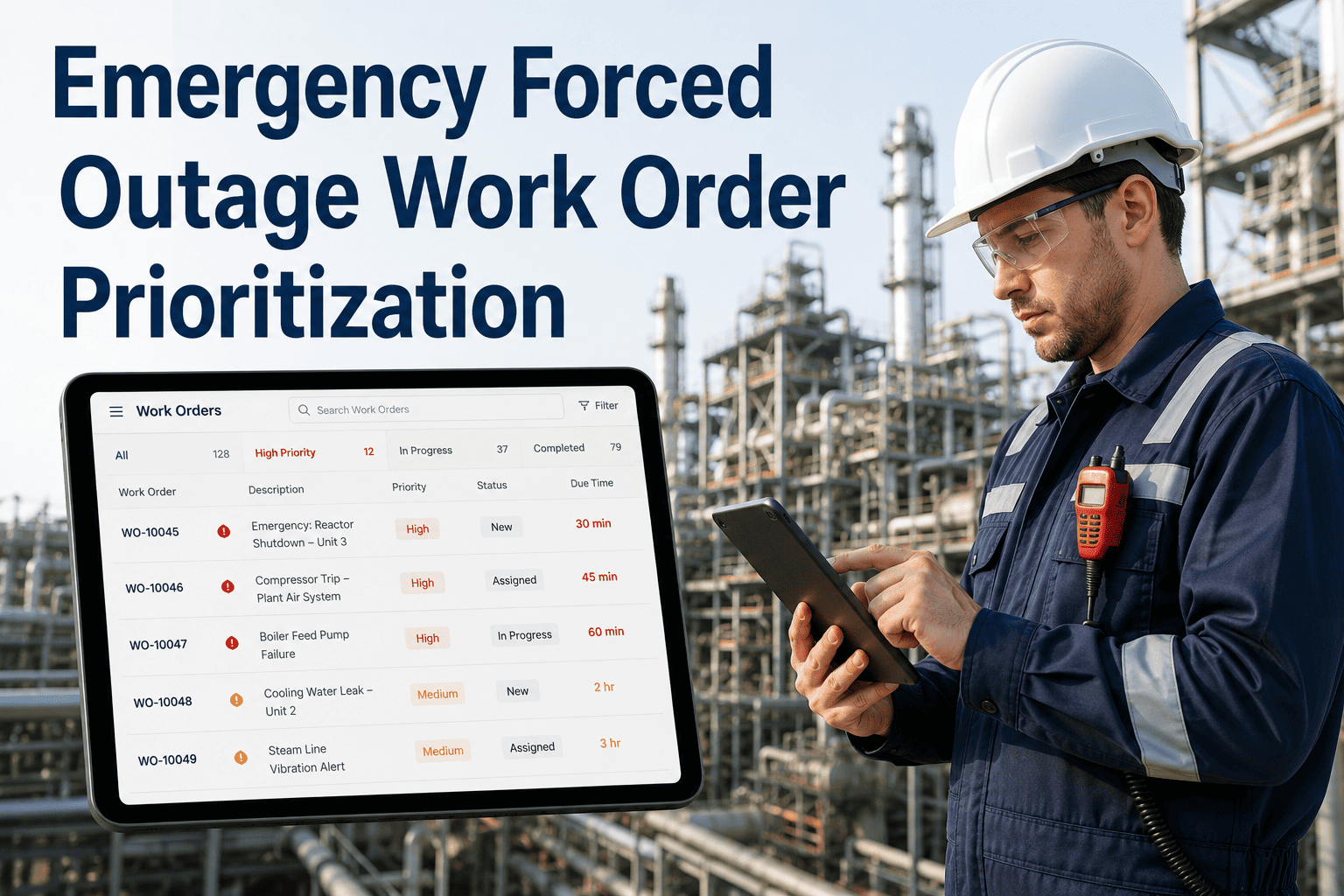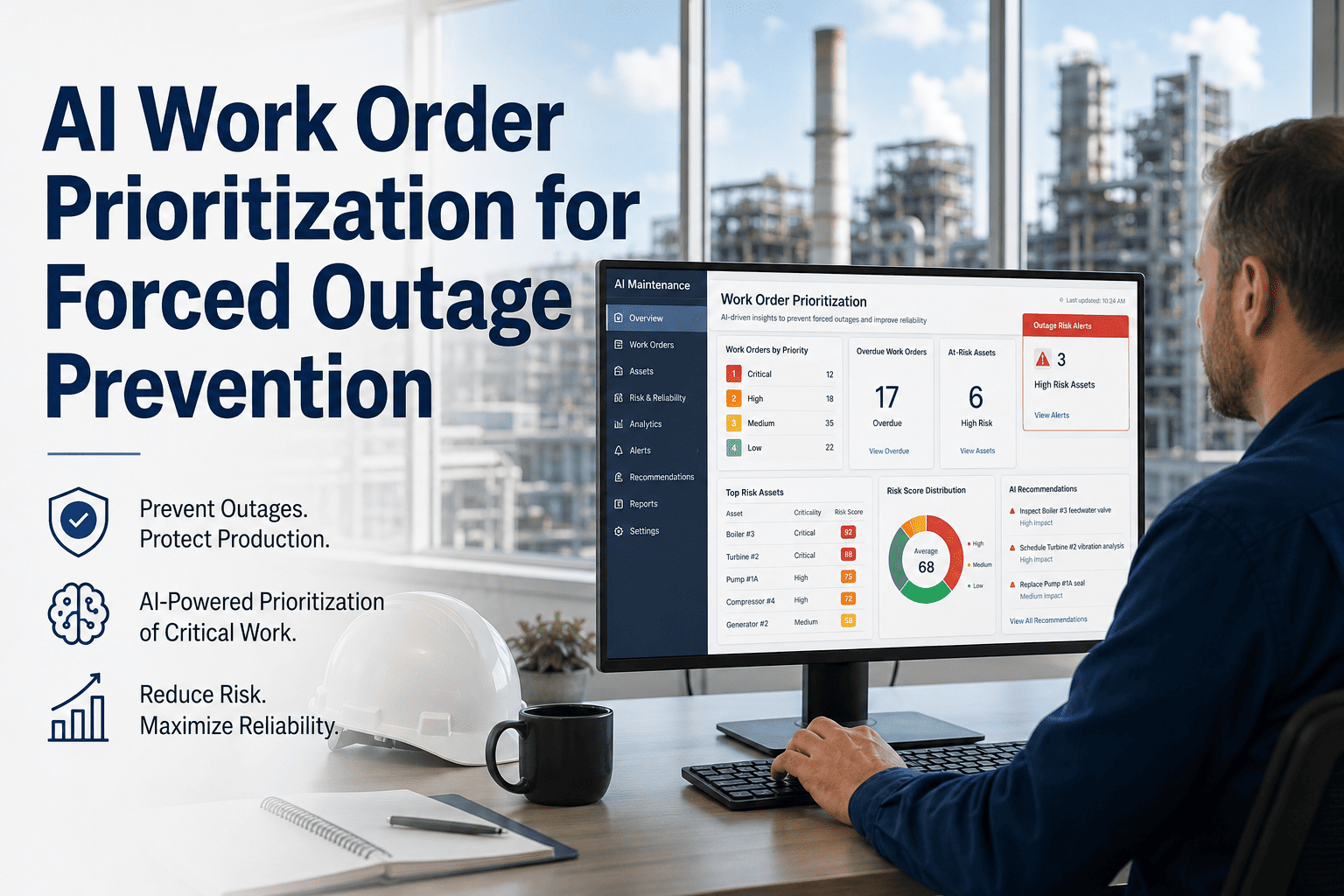
At 2 a.m., three things fail at once: a feedwater pump trips, a breaker throws a fault, and a cooling fan starts vibrating. Every one feels urgent, and the crew on shift can only take one first. Get that order wrong and you either risk a safety event or drop load you didn't have to. Emergency prioritization isn't about working faster — it's about working the right ticket first, every time, with a rule instead of a gut call. This guide lays out a six-factor scoring model for ranking emergency work orders, and shows how OXMAINT AI, the AI-powered CMMS, applies that model automatically so the top of the queue is always the ticket that matters most.
Emergency Power Plant Maintenance Work Order Prioritization
When several failures hit at once, "whoever shouts loudest" is not a prioritization strategy — it's how a safety-critical ticket ends up behind a cosmetic one. OXMAINT AI scores every emergency work order against the factors that actually decide urgency — safety, generation impact, criticality, failure probability, repair time, and spare availability — so the queue ranks itself and the crew always knows what to touch first.
Why "Loudest Voice" Prioritization Fails
In a forced-outage scramble, tickets get worked in the order they're shouted, not the order they matter. The pump nearest the control room gets attention while a safety interlock waits. Without a shared rule, every shift prioritizes differently, and no one can explain afterward why one job went first. A scoring model fixes that — it makes the ranking explicit, repeatable, and defensible. Start free and give every shift the same rule.
- Tickets worked by who asks loudest, not by real urgency
- Safety-critical items queued behind quick, visible wins
- Each shift ranks differently — no consistency across the day
- Repair time and spare availability ignored until work stalls
- No record of why one job went ahead of another
- Every ticket ranked on the same six weighted factors
- Safety and generation impact always weighted highest
- One consistent queue every shift inherits and trusts
- Repair time and spares factored in before work starts
- The reasoning logged on the asset for the outage review
The Six Prioritization Factors
Each emergency ticket gets scored on six questions. Safety and generation impact carry the most weight; the rest sharpen the ranking and keep the crew from starting a job they can't finish. Book a demo to weight these for your plant.
How the Score Becomes a Ranking
Score the two heavy factors first, layer in criticality and failure probability, then let repair time and spares break the ties. The result is a single ordered queue — not six separate opinions. Start free and let the queue rank itself.
| Priority | What lands here | Response |
|---|---|---|
| P1 — Critical | Safety/environmental risk, or a tripped unit with no redundancy | Work immediately — pull crew off lower tickets if needed |
| P2 — High | Derate risk or a critical asset degrading toward failure | Next in line; stage spares and crew now |
| P3 — Standard | Real fault, but redundancy holds and generation is stable | Scheduled into the queue once P1/P2 clear |
| P4 — Deferred | Low impact, no safety or generation consequence | Rolled into planned work or the next window |
A Priority Rule Only Works If It's Applied Every Time.
A scoring model on a whiteboard gets abandoned the moment the alarms start. OXMAINT AI applies the factors to every incoming ticket automatically, so the queue is already ranked when the crew looks — no debate, no delay, no safety item buried.
What OXMAINT AI Does in the Scramble
The model decides the order. OXMAINT AI applies it in real time and keeps the record — so the crew acts on a ranked queue, and the outage review has the reasoning already captured. Start free and put triage on one system.
Three Failures, One Ranked Queue
Here's how that 2 a.m. scenario resolves when the factors do the ranking instead of the loudest radio. Book a demo to see this on your plant's tickets.
Gut-Call Triage vs. Scored Prioritization
| What matters | Gut-call triage | Scored in OXMAINT AI |
|---|---|---|
| Safety-critical work | Can end up behind quick wins | Always weighted to the top |
| Consistency across shifts | Every shift ranks its own way | One rule everyone inherits |
| Spare-parts check | Found missing mid-job | Visible before the job ranks |
| Generation impact | Judged case by case | Scored on every ticket |
| Speed of triage | Debated at the radio | Queue pre-ranked on arrival |
| Outage review | Rebuilt from memory | Reasoning already logged |
Frequently Asked Questions
Let the Right Ticket Rise to the Top on Its Own.
Score every emergency work order on safety, generation impact, criticality, failure probability, repair time, and spares — automatically — so the crew always works the ticket that matters most, and the review has the reasoning already logged.