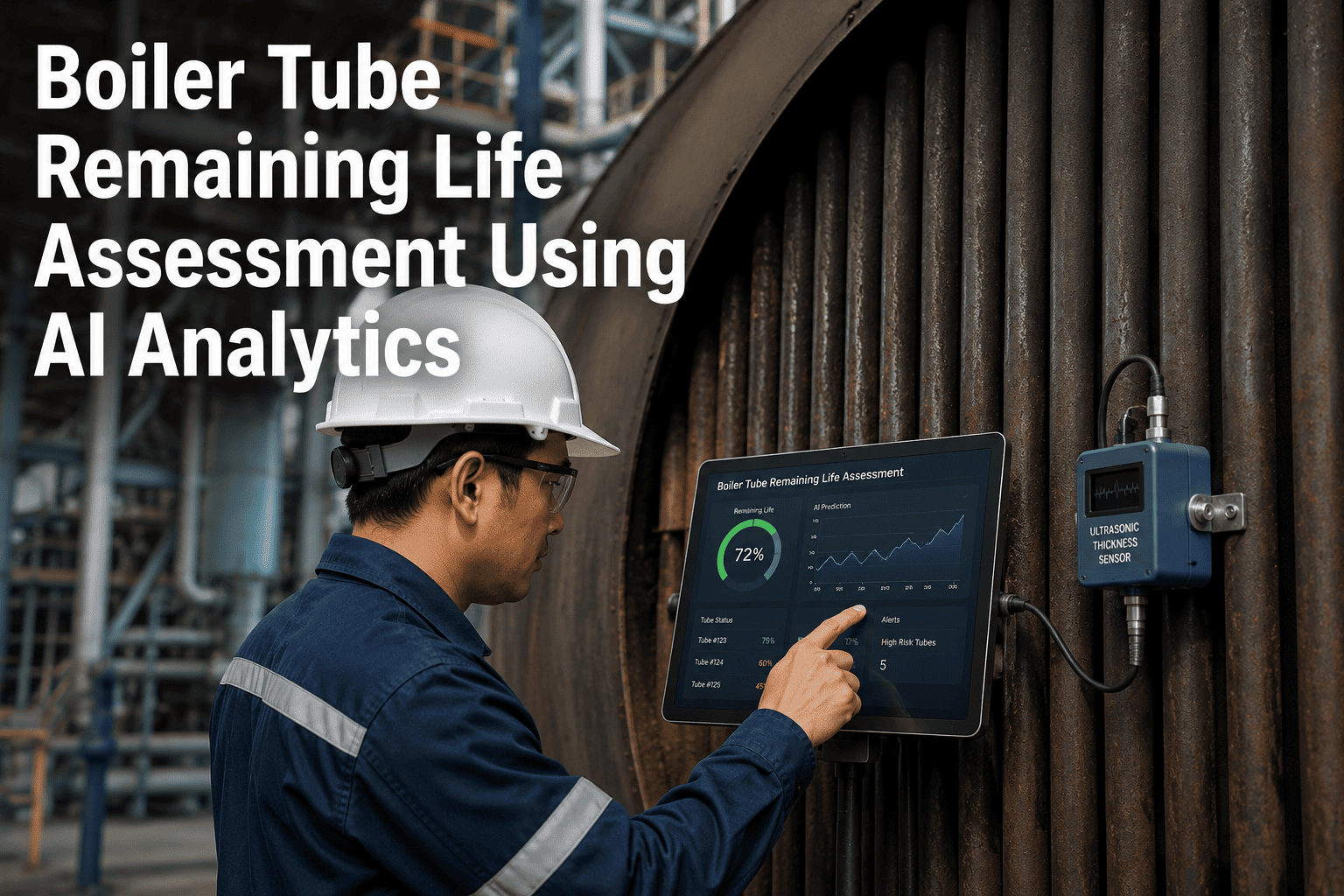
Boiler tube failures are the single largest cause of forced outages at coal-fired thermal power plants in India — accounting for over 40% of unplanned generation loss across state and central GENCOs, according to CEA annual reports. Each failure that reaches the rupture stage costs ₹1.5–4 crore in tube replacement, scaffold erection, and lost generation revenue at current CERC tariff rates, and damages downstream superheater, reheater, and economizer sections through steam impingement erosion. Yet the tubes that fail have almost always been signalling their trajectory for months through wall thickness reduction, oxide scale buildup, and creep deformation visible in NDT inspection records — records that currently sit in Excel files, inspection binders, or contractor reports with no structured trending capability. OxMaint's AI analytics module transforms scattered inspection data into a living remaining useful life (RUL) model for each tube circuit, alerting engineering teams to accelerating degradation before the failure threshold is reached. OxMaint integrates inspection inputs, thickness history, and operating hour accumulation into predictive maintenance decisions tied to your planned outage calendar. Book a demo to see boiler tube RUL tracking in action.
Boiler Tube Remaining Life Assessment Using AI Analytics
Convert inspection thickness records, NDT findings, and operating history into structured RUL estimates for every boiler tube circuit — and connect degradation alerts to predictive maintenance work orders in OxMaint before forced outages consume your generation schedule.
The Four Failure Pathways That RUL Assessment Must Track
Boiler tube degradation is not a single mechanism — it is a combination of thermal fatigue, corrosion, erosion, and creep acting on different tube circuits at different rates. Effective RUL assessment requires each mechanism to be tracked separately, with inspection inputs and operating data mapped to the appropriate degradation model for each circuit.
Sustained operation above design metal temperature causes time-dependent plastic deformation in the tube wall. Creep life consumption is calculated from the Larson-Miller parameter using measured operating temperature and hours accumulated. OxMaint logs operating hour accumulation by circuit and integrates with temperature historian data to calculate cumulative creep damage fraction (CDF) over the asset life.
Coal ash erosion and high-temperature sulphidation attack the external tube surface, reducing wall thickness progressively. Erosion rate is highest in high-velocity gas paths near burner zones and soot blower impingement areas. OxMaint tracks external wall thickness by measurement location and calculates the erosion rate (mm/1000 hours) from sequential UT readings to project remaining life against the minimum allowable thickness per ASME PTC 4.3.
Steam-side magnetite scale accumulates on the inner tube wall, reducing heat transfer and elevating metal temperature above design — accelerating creep even when steam temperature is within limits. Oxide thickness is estimated from tube samples during major overhauls or predicted from steam temperature history and service hours. OxMaint links oxide scale assessment records to the tube section's cumulative creep damage calculation.
Poor water chemistry allows under-deposit corrosion and hydrogen damage in waterwall tubes — the fastest-acting failure mechanism in the boiler. Internal pitting and hydrogen embrittlement do not show a gradual wall reduction pattern; they create sudden failures with minimal warning. OxMaint links boiler water chemistry monitoring records to tube inspection history, flagging circuits with documented chemistry exceedances for priority inspection targeting.
How OxMaint AI Calculates and Trends Boiler Tube RUL
UT thickness readings, visual inspection findings, metallurgical sample results, operating hour logs, and water chemistry records are entered into OxMaint against specific tube circuits and measurement points. Legacy inspection data from Excel and PDF reports can be imported to establish the historical baseline for trending.
For each measurement location, OxMaint AI calculates the degradation rate from sequential inspection readings — external wall reduction rate (mm/year for erosion), creep damage fraction rate (per 1000 operating hours), and oxide scale growth rate (microns/year). Statistical regression across multiple measurement points identifies the worst-affected tube sections per circuit.
OxMaint projects the degradation trajectory forward in time, calculating the estimated date at which the tube circuit reaches the minimum allowable wall thickness per ASME B31.1 / IBR Schedule VI or the creep life limit per ASTM/BS materials standards. The projected RUL date is displayed on the asset record and compared against the next planned outage window.
AI models flag the statistical confidence of each RUL estimate based on data density (number of measurement points, inspection frequency, data consistency). Circuits with sparse inspection data show wider confidence intervals, driving priority inspection scheduling in OxMaint to narrow the uncertainty before the next major overhaul decision point.
When projected RUL falls within a configurable horizon (e.g., within 18 months or within two planned outage cycles), OxMaint generates a predictive maintenance alert and creates a work order for priority inspection during the next outage. For circuits where RUL projection indicates replacement within the current capital planning cycle, OxMaint flags the asset for CapEx budget inclusion.
NDT Methods and Inspection Inputs Required for RUL Assessment
| NDT Method | Applicable Circuits | What It Measures | Frequency for RUL Trending | OxMaint Record Type |
|---|---|---|---|---|
| Ultrasonic Thickness (UT) | All circuits | Remaining wall thickness from external or internal surface | Every planned outage — same measurement points | Thickness reading per location; rate calculated automatically |
| Radiographic Testing (RT) | Welds, bends, fittings | Internal defects, weld quality, crack detection | Post-repair and targeted inspection at risk welds | RT report attached to weld joint asset record |
| Magnetic Particle / Dye Penetrant | Welds, tube surface | Surface and near-surface cracks | Annual on high-temperature circuits | Finding record with severity grade and location |
| Tube Sample Metallurgy | Superheater, Reheater | Oxide scale thickness, microstructure, creep void density | Major overhaul (every 4–6 years) | Lab report linked to circuit record; feeds CDF calculation |
| Borescope / Visual | Waterwall, Economizer | Internal pitting, deposit thickness, surface condition | Every major outage, targeted at chemistry-exceedance locations | Photo evidence with location tag; pitting severity grade |
| Eddy Current Testing | Economizer, Air Heater | Wall thinning, pitting, crack detection without physical contact | Every 2–3 years or targeted | ECT scan results attached to tube section record |
What Engineers See on the OxMaint Boiler Tube Health Dashboard
What Boiler Engineers Say About AI-Driven RUL Assessment
We have a 210 MW unit with 30-year-old superheater elements that have had four tube failures in the last two years. Each time, the failure was in a circuit where the previous inspection thickness reading was already trending below the ASME limit — but the data was sitting in a spreadsheet and nobody had plotted the rate. OxMaint's AI trended the same data in minutes and showed us which three circuits would reach the retirement limit before the next annual overhaul. We replaced them proactively. No failures since.
Chief Boiler Engineer · State GENCO · 4x210 MW Thermal Plant · Northern IndiaIBR requires thickness records for every boiler circuit, but the standard does not mandate that you trend them systematically. Our Chief Inspector now specifically asks for degradation trend analysis when he sees repeated thickness readings from the same circuit. OxMaint produces exactly this — and it has become the document that convinces inspection authorities we are managing tube life proactively rather than reactively.
O&M Director · Central GENCO · Supercritical FleetFrequently Asked Questions
Can OxMaint import historical boiler tube thickness data from existing Excel inspection records?
Yes — OxMaint supports CSV and Excel import for historical thickness inspection data. Legacy records from multiple inspection cycles can be imported against specific tube circuit measurement points, allowing the AI analytics engine to calculate historical degradation rates immediately without requiring new inspection campaigns. Start free to configure your boiler tube data import template and establish baseline trending from existing records.
How does OxMaint handle Indian Boiler Regulations (IBR) compliance documentation for tube inspections?
OxMaint maintains inspection records for each boiler circuit in alignment with IBR Schedule VI minimum wall thickness requirements and periodic inspection intervals. Records include UT thickness readings, inspection dates, technician credentials, and approval workflow for Chief Inspector of Boilers submissions. Inspection status dashboards show which circuits are within IBR compliance intervals and which are approaching renewal — with export formats suitable for official IBR inspection submissions. Book a demo to see IBR compliance record management in OxMaint.
What happens when RUL projections indicate a tube circuit will fail before the next planned outage?
OxMaint generates a P1 priority predictive maintenance alert and creates a work order flagging the circuit for immediate engineering review. The alert includes the projected failure date, the rate-of-degradation calculation, the specific measurement points driving the projection, and a comparison of the projected failure date against the scheduled outage window. Engineers then make an informed decision on whether to de-rate the unit, schedule an early inspection window, or proceed with enhanced monitoring — all documented within the same work order record in OxMaint for regulatory and management accountability.
Can OxMaint handle RUL tracking for supercritical boilers with different material specifications than subcritical units?
Yes — OxMaint's RUL framework is material-agnostic and can be configured with the specific design parameters, material creep properties, and minimum allowable thicknesses for each tube circuit regardless of whether the unit is subcritical (SA-210 waterwall), high-temperature subcritical (SA-213 T22 superheater), or supercritical (SA-213 T91, T92 superheater). Each circuit carries its own material specification, design temperature, and limit references in OxMaint — ensuring RUL projections are calculated against the correct material standard for each circuit. Start free to configure your boiler tube circuit database.
How does OxMaint connect boiler tube RUL data to CapEx budget planning?
OxMaint's CapEx flag feature automatically identifies tube circuits where the projected RUL date falls within the current annual or multi-year capital budget cycle and marks them for CapEx planning. The flag includes the estimated replacement cost based on tube quantity and material, the projected failure date, and the RUL confidence interval — providing the engineering and finance teams with data-backed justification for budget submissions. This replaces the current practice of requesting tube replacement budgets based on age alone, which often fails to convince management without quantified risk data.
Your Boiler Tubes Are Telling You When They Will Fail. OxMaint Helps You Listen.
Stop discovering boiler tube failures at the rupture stage. OxMaint AI analytics converts your inspection thickness records into RUL projections, predictive work orders, and CapEx flags — giving engineering teams the advance warning to act in planned outage windows, not emergency shutdowns.