Carbon Emissions Tracking & ESG Reporting for Power Generation
By Johnson on March 10, 2026
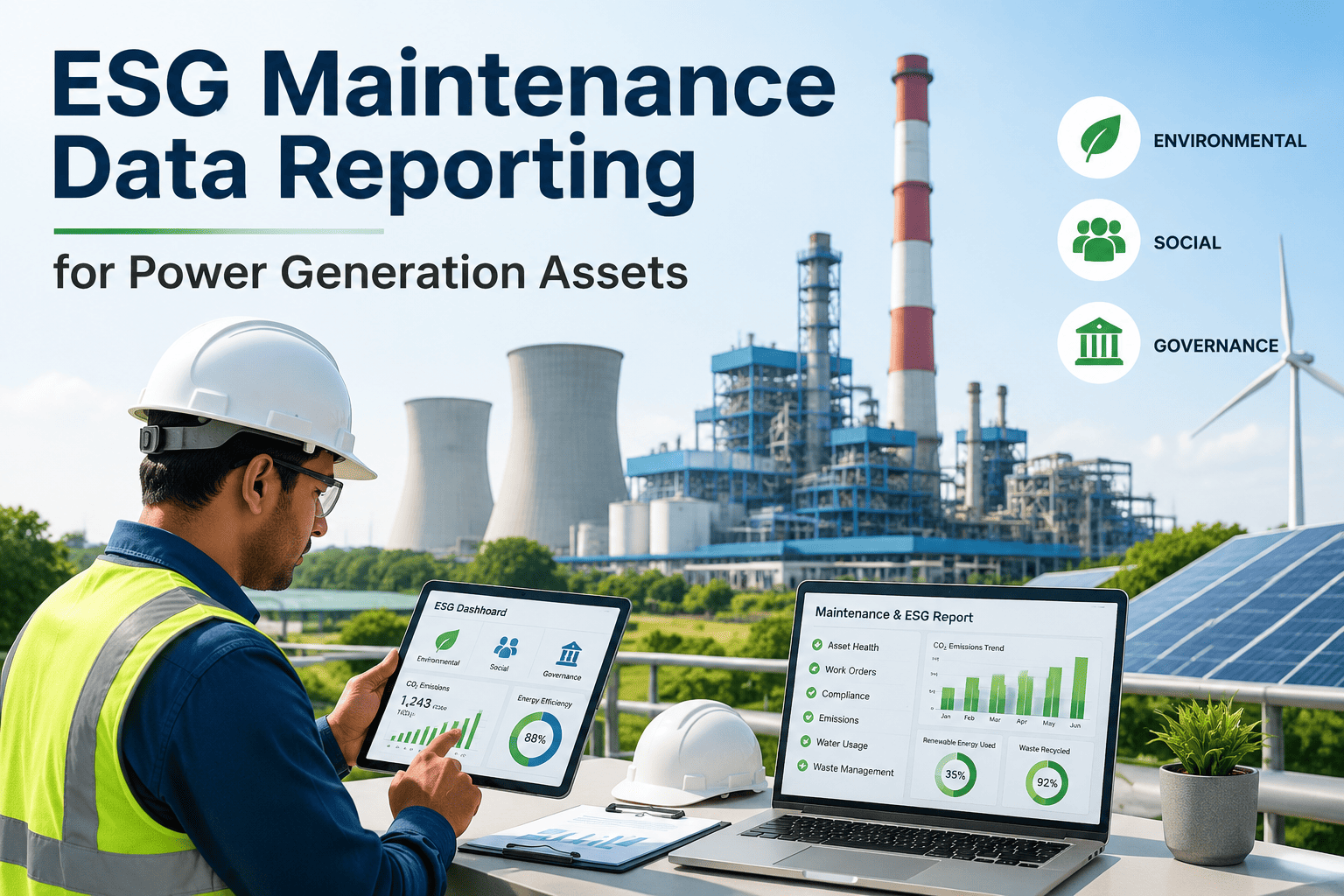
Power generation facilities are now at the center of global carbon accountability. With CSRD mandates covering nearly 50,000 companies, California's SB 253 requiring Scope 1 and 2 disclosures by August 2026, and investor pressure reaching an all-time high, the question is no longer whether your plant needs emissions tracking — it is whether your current approach can withstand regulatory and financial scrutiny. Manual spreadsheets, siloed CEMS data, and quarterly PDF reports were never built for this environment. OxMaint's Emissions Tracking module gives power generation teams a single, automated intelligence layer that captures Scope 1 greenhouse gas data at source, translates it into audit-ready ESG reports, and surfaces AI-driven reduction pathways — all without adding headcount. Sign up for OxMaint to start your free deployment, or book a demo to see a live emissions dashboard built from your plant's operational data.
OxMaint Emissions Tracking · Power Generation
Your Carbon Data. Automated.
Your ESG Reports. Audit-Ready.
From real-time Scope 1 monitoring to one-click CSRD-aligned reports — built for power plants, not spreadsheets.
The Carbon Compliance Gap: Why Power Plants Are Exposed Right Now
Electricity generation accounts for roughly 25% of total US greenhouse gas emissions, making power plants the single most scrutinized sector under every major climate disclosure framework. Yet the majority of facilities still track emissions through disconnected CEMS exports, manual entry, and annual consultant-assembled reports — a process that is simultaneously too slow for regulatory timelines, too inaccurate for third-party verification, and too opaque for investor due diligence. The gap between what regulators and asset managers require and what most plant operations teams can actually produce is widening. Sign up for OxMaint to close that gap with automated tracking from day one.
Without OxMaint
✕ Manual CEMS data exports — monthly or quarterly
✕ Spreadsheet calculations with no audit trail
✕ Scope 1 and Scope 2 tracked in separate systems
✕ ESG reports take 6–10 weeks to compile
✕ No real-time alerts for emissions threshold breaches
✕ Compliance frameworks mapped manually per report
✕ Zero visibility into reduction opportunity pathways
With OxMaint
✓ Real-time emissions ingestion from plant data sources
✓ Automated CO₂e calculations with full audit log
✓ Scope 1 + 2 + 3 unified in one dashboard
✓ One-click ESG report generation in minutes
✓ Instant alerts when emissions exceed set thresholds
✓ GHG Protocol, CSRD, and TCFD auto-aligned
✓ AI-identified reduction pathways ranked by impact
Scope 1, 2 & 3 Emissions: What Power Plants Are Required to Track
The GHG Protocol's three-scope framework is the foundation of every major compliance requirement — from California's SB 253 to the EU's CSRD. For power generation facilities, each scope carries specific measurement obligations and carries different regulatory deadlines. Understanding which scope creates your highest exposure is the first step to building a defensible emissions programme.
Scope 1
Direct Emissions
Combustion from boilers, turbines, generators, and on-site fuel use. For power plants, this is typically the largest and most measurable emissions source.
Natural Gas Combustion
Coal Firing
Fuel Oil
On-site Fleet
Refrigerant Leaks
Reporting deadline: Active now under most frameworks
Scope 2
Indirect Energy
Purchased electricity, steam, heat, or cooling consumed by plant operations — including auxiliary loads and grid support systems.
Grid Power Draw
Purchased Steam
Auxiliary Systems
Control Buildings
Reporting deadline: Active now · California SB 253 Aug 2026
Scope 3
Value Chain Emissions
Upstream supply chain, fuel extraction, transmission losses, capital goods manufacturing, and downstream grid distribution. The most complex and fastest-growing reporting obligation.
Fuel Supply Chain
Capital Equipment
Transmission Loss
Waste Disposal
Business Travel
Reporting deadline: CSRD 2025 · California SB 253 2027
OxMaint tracks all three scopes from a single platform. Book a demo to see how your facility's emissions map across all scopes before your next reporting window.
OxMaint Emissions Dashboard: What You See, What You Know, What You Act On
The OxMaint emissions dashboard is not a static report — it is a live operational intelligence layer that transforms raw plant data into decision-ready insights. Every metric below is produced automatically from your existing CEMS integration and operational data. No manual entry. No data prep. No consultant engagement.
OxMaint · Emissions Intelligence Dashboard · Live View
↓ 12.4%
Scope 1 vs Prior Year
847 tCO₂e
MTD Emissions Total
94.2%
Target Compliance Rate
3 Reports
Ready for Export
Monthly CO₂e Trend — Scopes 1 + 2 (tCO₂e)
Jan
Feb
Mar
Apr
May
Jun
Now
Scope 1 DirectScope 2 IndirectReduction Target
Live Alerts
Unit 3 — Emissions within threshold
Unit 1 — Approaching Q3 CO₂ limit (88%)
ESG Q2 report — Ready for download
Compliance Frameworks: What OxMaint Automates for Power Generation
Every compliance framework has a different data structure, calculation methodology, and disclosure format. Manually mapping your plant's emissions data to each framework is a process that costs 6–10 weeks of engineering and consulting time per reporting cycle. OxMaint maintains native alignment to all major frameworks, so report generation is a single action — not a project.
GHG Protocol
Corporate Standard
The foundational global standard covering Scope 1, 2, and 3 calculations. OxMaint applies the correct emission factors automatically per fuel type and region.
Fully Supported
CSRD / ESRS
EU Sustainability Reporting
Mandatory for ~49,000 EU-linked companies. OxMaint auto-structures disclosures to ESRS E1 environmental standards with audit-ready documentation.
Fully Supported
TCFD
Climate Risk Disclosure
Task Force on Climate-related Financial Disclosures — required by major asset managers and institutional investors. OxMaint maps climate risk metrics directly to TCFD reporting pillars.
Fully Supported
ISO 14064
GHG Verification Standard
International standard for third-party GHG emissions verification. OxMaint maintains the data integrity and audit trail required for ISO 14064 third-party sign-off.
Fully Supported
EPA CEMS
US Regulatory Reporting
Continuous Emissions Monitoring System integration with EPA reporting. OxMaint ingests CEMS data directly and formats it for EPA regulatory submissions.
Fully Supported
CDP
Carbon Disclosure Project
Used by over 18,000 companies for voluntary environmental disclosure. OxMaint formats CDP questionnaire responses from your live emissions data automatically.
Fully Supported
All frameworks maintained and updated automatically. California SB 253 and SB 261 templates in active development for August 2026 deadline. Book a demo to confirm which frameworks apply to your reporting obligations.
Facilities using AI-driven monitoring reduce emissions by up to 10% while cutting reporting time by over 80%.
OxMaint gives your team both — from the same platform, in three weeks or less.
AI-Powered Reduction Pathways: From Tracking to Action
Tracking emissions is compliance. Reducing them is strategy. OxMaint's AI analytics layer continuously analyses your plant's operational data against emissions output to identify the specific maintenance actions, equipment settings, and operational changes that will produce the largest measurable reductions — ranked by CO₂e impact and implementation cost. This is where compliance investment converts into operational efficiency gain.
01
Continuous Baseline Mapping
OxMaint builds a rolling emissions baseline from your CEMS and operational data, calculating CO₂e per unit of output for each generation asset. This baseline becomes the reference point against which every reduction initiative is measured — and every anomaly is flagged.
Typical finding: 8–15% of Scope 1 emissions linked to equipment running outside optimal efficiency band
02
Predictive Maintenance-Emissions Correlation
Degraded combustion efficiency in a boiler or turbine increases both fuel consumption and direct CO₂ output. OxMaint correlates maintenance state with emissions intensity in real time — issuing work orders for emissions-causing degradation before it escalates. Maintenance and emissions reduction become the same workflow.
Typical finding: Scheduled burner tune-ups triggered by OxMaint reduce Scope 1 intensity by 4–9% per unit
03
Load Optimisation Signals
OxMaint's AI identifies operating windows where partial-load running produces disproportionately high emissions per MWh of output. These signals are delivered to control room operators as actionable schedule recommendations — not raw data — reducing carbon intensity without sacrificing generation capacity.
Typical finding: Load scheduling adjustments reduce carbon intensity index by 6–12% in mixed-fleet facilities
04
Reduction Target Tracking and Scenario Modelling
Set your net-zero or interim carbon reduction targets inside OxMaint. The platform models your current trajectory against the target, shows the gap, and ranks the available operational interventions by their projected impact. Ownership committees and ESG investors see a credible, data-backed decarbonisation roadmap — not a pledge without a plan.
Typical output: A 3-year reduction roadmap with quantified savings per initiative, ready for board presentation
Frequently Asked Questions
How does OxMaint connect to our existing CEMS infrastructure?
OxMaint integrates with continuous emissions monitoring systems via standard API and data export protocols. The platform supports direct CEMS data ingestion as well as manual import from existing plant historian systems, PI systems, and SCADA exports. Most power generation facilities are fully connected within the first week of deployment without any modifications to existing monitoring hardware. Sign up for OxMaint to begin your integration assessment.
Which emission factors does OxMaint use, and how are they kept current?
OxMaint maintains a continuously updated library of emission factors aligned to the GHG Protocol, EPA eGRID, IEA regional grid factors, and IPCC AR6 values. Emission factors are applied automatically based on fuel type, location, and reporting period — and are updated when authoritative sources publish revisions. Your historical calculations are recalculated against updated factors with full version tracking, so your audit trail always reflects the most current methodology.
Can OxMaint produce reports that pass third-party ESG verification?
Yes. OxMaint's reporting outputs are structured to meet ISO 14064 third-party verification requirements, including full data lineage, calculation transparency, and boundary documentation. The platform produces a verification package that includes source data, applied emission factors, calculation methodology, and confidence intervals — the exact documentation structure that third-party verifiers require. Properties using OxMaint for ESG reporting have achieved third-party assurance without additional data preparation. Book a demo to review a sample verification package.
How does OxMaint handle multi-unit or multi-site power generation portfolios?
OxMaint's portfolio view aggregates emissions data across multiple generating units within a single facility and across multiple facilities in a portfolio. Emissions are tracked at asset level, unit level, site level, and portfolio level simultaneously. ESG reports can be produced at any aggregation level — site-specific for regulatory submissions, portfolio-consolidated for investor reporting. Cross-site benchmarking identifies which units or facilities have the highest reduction opportunity, prioritising decarbonisation capital allocation.
Does OxMaint cover only Scope 1 for power plants, or also Scope 2 and Scope 3?
OxMaint tracks all three scopes. Scope 1 covers direct combustion emissions from all fuel-burning plant assets. Scope 2 covers purchased electricity and energy consumed in auxiliary plant operations. Scope 3 covers upstream fuel extraction and transportation, capital goods manufacturing, and transmission and distribution losses — the categories most frequently required by CSRD and increasingly by institutional investors. The platform tracks each scope independently and produces consolidated reports across all three. Sign up for OxMaint to begin full-scope emissions tracking today.
Your Next ESG Report Could Write Itself.
OxMaint connects to your plant's emissions data, applies the right framework, and generates audit-ready reports — automatically. Most facilities are live and reporting within three weeks.