Every ESG report a power producer files rests on numbers — tonnes of CO2e, leak rates, injury frequencies, efficiency gains. What is rarely said is where those numbers come from: most of them originate on the plant floor, inside maintenance logs, leak inspections, and equipment readings. When that operational data is captured on paper and in scattered spreadsheets, it reaches the sustainability team late, incomplete, and impossible to audit — exactly the weakness that fails assurance and invites greenwashing scrutiny. Oxmaint turns day-to-day maintenance into clean, traceable ESG source data — start free on Oxmaint or book a 15-minute demo to see how the plant floor connects to the report.
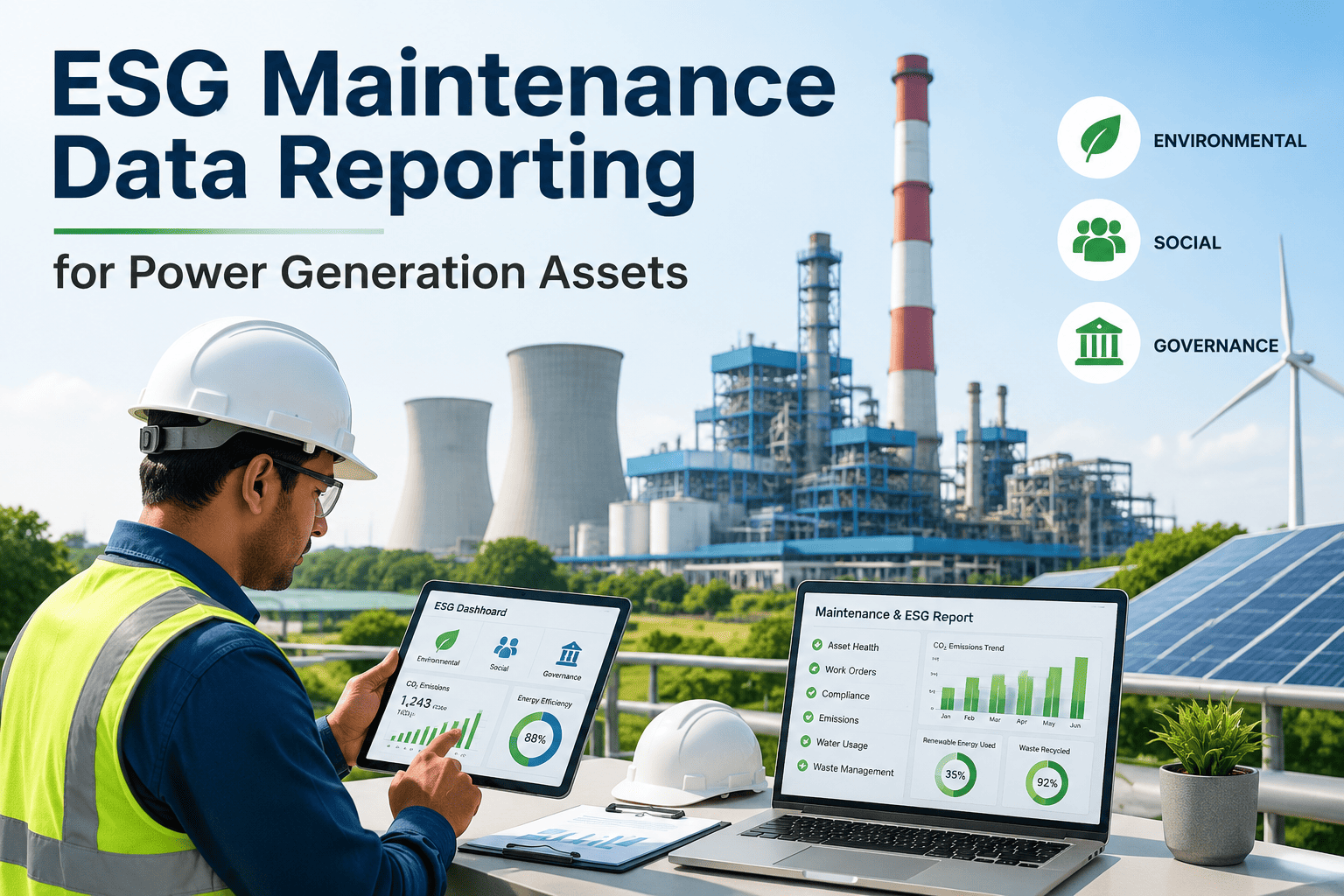
ESG Maintenance Data Reporting for Power Generation Assets
Investors, regulators, and auditors no longer accept ESG numbers on faith — they want a traceable line from each disclosure back to the work that produced it. Oxmaint captures emissions readings, efficiency data, and safety records at the asset, so your sustainability report is backed by evidence instead of estimates.
Where Your ESG Numbers Actually Come From
An ESG disclosure is the last link in a chain that starts with a technician and a wrench. The credibility of the number at the end depends entirely on how the data was captured at the beginning. This is the path every reliable emissions or safety figure travels.
A technician inspects a gas-insulated breaker, records a leak reading, and replaces a worn seal during a scheduled task.
Timestamped, location-tagged readings, parts consumed, labor, and photos are logged against the specific asset.
Measured gas loss converts to tonnes of CO2e — a Scope 1 fugitive-emission figure, not a rough estimate.
The figure rolls up into your GHG inventory, ISSB climate metrics, and CSRD pollution disclosure.
Break the chain at step one — paper logs, missed readings, no asset link — and every number downstream becomes an assumption an auditor can challenge.
The Maintenance Data Behind E, S, and G
ESG is not three separate data-collection projects. The same maintenance work that keeps a plant running already generates the evidence for all three pillars — if it is captured in a structured, reportable form rather than a binder.
See how Oxmaint captures emissions, efficiency, and safety data at the source and hands your sustainability team numbers that survive an audit. Book a 15-minute walkthrough with your own assets as the example.
SF6 and Fugitive Emissions — One Task, One Data Point
No example shows the maintenance-to-disclosure link more clearly than SF6, the insulating gas in high-voltage switchgear and circuit breakers. It is among the most potent greenhouse gases on Earth, and it leaks from the joints and seals of aging equipment. Every inspection a technician performs is, in effect, an emissions measurement.
Inspect the breaker joints and density monitors, measure any leak with a calibrated detector, log the timestamped and location-tagged reading, repair the seal, verify the post-fix reading, and report the result into the annual emissions filing. Captured digitally, that one task becomes a defensible data point. On paper, it becomes a gap.
Measured beats default: actual leak data lowers reported emissions versus conservative nameplate estimates — meaning fewer allowance obligations and reduced enforcement exposure.
From Work Order to Audit-Ready Disclosure
Closing the gap between the plant floor and the report takes four things: capture at the source, automatic conversion, a defensible trail, and reporting on demand. Oxmaint builds all four into the work your team already performs.
Every inspection, leak reading, and part issued is logged on mobile against the asset — online or offline, with timestamp and location preserved at the moment of entry. No re-keying, no end-of-month reconstruction.
Readings and consumption map to emission factors and ESG KPIs, so a seal replacement becomes a tonnes-CO2e line and an efficiency log becomes an intensity figure — without a spreadsheet in between.
Records are timestamped, attributed to the technician, and versioned. Assurance providers get a traceable path from any disclosed number straight back to the work order that created it.
Dashboards and exports align to the metrics your frameworks ask for, ready the moment a filing deadline, investor request, or auditor arrives — not weeks of manual assembly later.
Mapped to the Standards You Report Against
The same captured data point serves multiple frameworks at once. This is how maintenance-sourced data lines up against the disclosure standards a power generator faces — so you collect once and report everywhere.
| ESG Data Point | Maintenance Source | Pillar | Framework / Reference |
|---|---|---|---|
| Fugitive SF6 emissions | Gas-insulated breaker leak inspections | E | EPA GHGRP · ISSB IFRS S2 · ESRS E1 |
| GHG emissions intensity | Turbine & boiler efficiency and runtime logs | E | SASB Electric Utilities · ISSB S2 · GRI 305 |
| Air quality (NOx, SOx, PM) | Emission-control equipment upkeep | E | SASB IF-EU · ESRS E2 · GRI 305 |
| Water management | Cooling-system and discharge maintenance | E | SASB IF-EU · ESRS E3 · GRI 303 |
| Waste & coal-ash | Ash-handling and disposal records | E | SASB IF-EU · ESRS E5 · GRI 306 |
| Worker health & safety | Permit-to-work, isolation, incident logs | S | SASB IF-EU · ESRS S1 · GRI 403 |
| Asset & grid reliability | Condition data and PM completion rates | S | SASB IF-EU · ISSB S2 |
| Data integrity & assurance | Timestamped, versioned work records | G | ESRS assurance · ISSB S1 · GRI 2 |
Scroll horizontally to see every column on smaller screens
Oxmaint maps maintenance-sourced data to ISSB, CSRD/ESRS, GRI, SASB, and your GHG inventory from a single record. Start free and connect your first assets, or book a demo to see the framework mapping live.
Why Operational ESG Data Is Now a Board-Level Risk
ESG reporting has crossed from voluntary goodwill into regulated, assured disclosure. When the underlying data cannot be traced, the consequences land on the balance sheet and the reputation — not just the sustainability team.
Frequently Asked Questions
Oxmaint turns routine maintenance into clean, timestamped, audit-ready ESG source data for power generation — so your disclosures hold up to investors, regulators, and assurance providers alike.