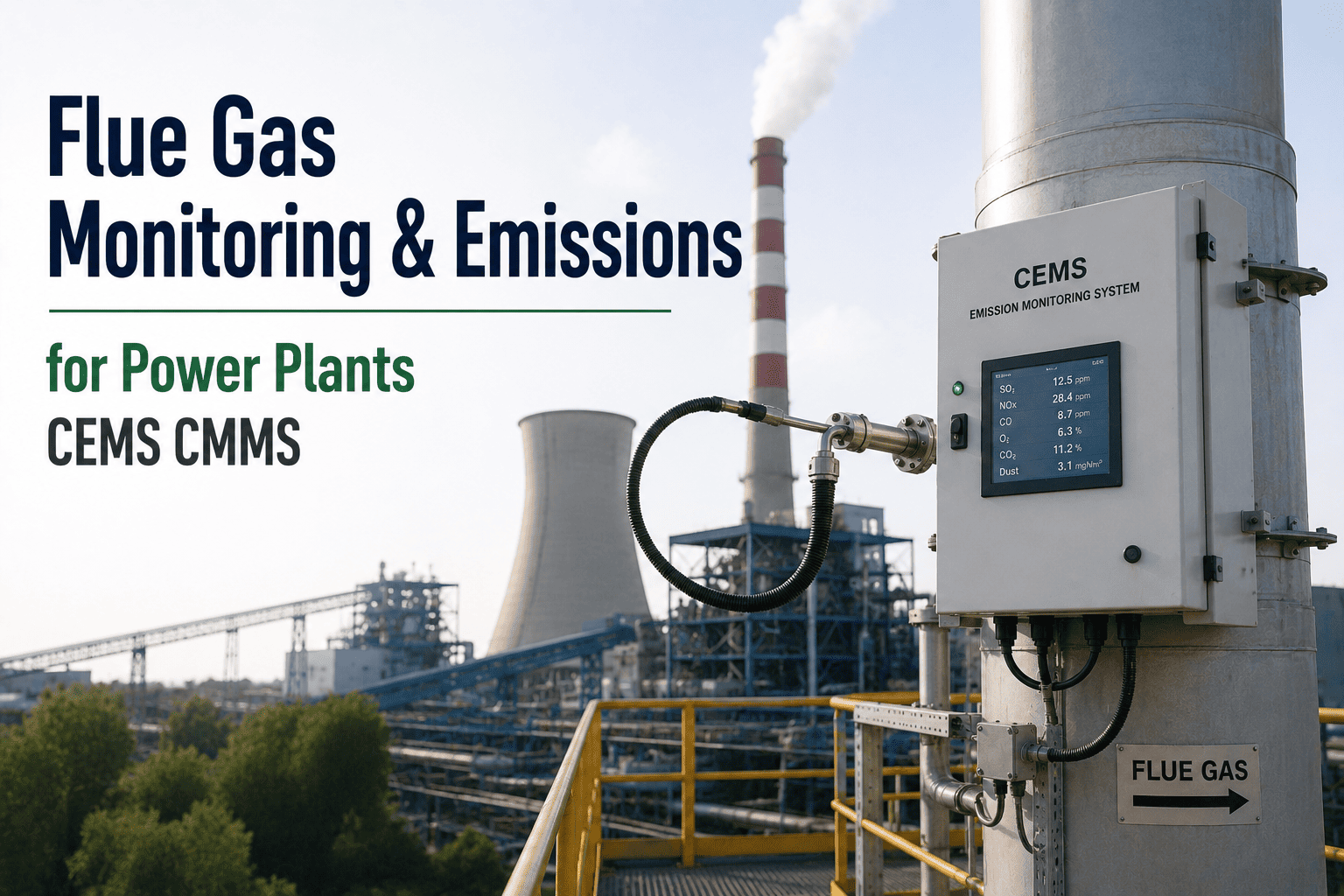
Every power plant that burns fuel faces a non-negotiable reality: emissions equipment must stay operational, calibrated, and documented — or regulators show up with violation notices before your maintenance team shows up with work orders. A single failed CEMS analyzer during a high-load period, an ESP field inspection that slips past its 90-day window, or an FGD absorber pH log that disappears into a binder can trigger a Notice of Violation, a $37,500-per-day penalty, or both. OxMaint turns your emissions control assets — CEMS, ESP, FGD, SCR, stack monitoring — into structured, audit-ready maintenance programs that survive every inspector visit. Start your free trial and build your first emissions compliance workflow today.
EPA COMPLIANCE CMMS
Stop Managing Emissions Compliance on Paper. Start Passing Every Audit.
OxMaint tracks every CEMS calibration, ESP inspection, FGD log, and SCR test — so your emissions records are always audit-ready, never reconstructed from memory.
$37,500
Per-day CAA penalty per violation
60 Days
EPA data substitution clock for CEMS downtime
95%
Required CEMS data availability under 40 CFR Part 75
4x / yr
Minimum RATA tests for major source boilers
Your Emissions Control Stack — Every Asset, Every Failure Risk
Emissions compliance is not a single system — it is a chain of assets, each with its own inspection interval, calibration requirement, and documentation burden. Missing one link in that chain puts your operating permit at risk.
CEMS
Continuous Emissions Monitoring System
SO₂
NOₓ
CO₂
Opacity
Flow
Daily calibration drift checks, quarterly RATA tests, 95% uptime required under Part 75. Missing records trigger data substitution and potential violations.
PM Interval: Daily QA + Quarterly RATA
ESP
Electrostatic Precipitator
Rapping cycle
Field voltage
Current
Opacity
Failed rapper motors and high-voltage transformer faults are the top causes of opacity exceedances. Each hop above permit limit is a recordable deviation.
PM Interval: Weekly field inspection + Annual overhaul
FGD
Flue Gas Desulfurization (Scrubber)
pH
L/G ratio
Slurry density
SO₂ outlet
pH drift below 5.5 immediately degrades SO₂ removal. Pump wear and mist eliminator fouling reduce removal efficiency without any visible alarm.
PM Interval: Daily chemistry + Monthly mechanical
SCR
Selective Catalytic Reduction
NH₃ slip
NOₓ outlet
Catalyst DP
Reagent flow
Catalyst poisoning, ammonia overdose causing slip above 2 ppm, and plugged nozzles are the leading SCR failure paths — all invisible until NOₓ readings spike.
PM Interval: Shift checks + Catalyst inspection annually
Stack
Stack Monitoring & Sampling Ports
Method 5 particulate
Method 9 opacity
Port integrity
Sampling port corrosion, blocked access, and unscheduled Method 9 tests during high-load events create compliance gaps exactly when regulators are watching.
PM Interval: Semiannual port inspection + Test scheduling
DAHS
Data Acquisition & Handling System
Data completeness
Substitution flags
QA logs
DAHS failures are invisible until the quarterly report is assembled. Missing hourly records require substitution methodology that always overstates actual emissions.
PM Interval: Weekly backup verification + Quarterly data audit
Every one of these assets needs a PM schedule, an inspection log, and an audit trail. OxMaint builds all three from a single work order — so your compliance records are never scrambled together the night before an inspection.
The Compliance Gap: What Regulators Look For vs. What Plants Actually Document
EPA auditors arrive with a checklist built around 40 CFR Part 60, Part 63, Part 75, and your facility's Title V permit. Most plants have performed the work. The problem is the records either don't exist, can't be found, or contain gaps that look like violations even when the equipment was functioning correctly.
| Regulation / Requirement |
What Auditors Check |
Common Documentation Gap |
OxMaint Fix |
| 40 CFR Part 75 — CEMS |
Daily calibration drift logs, RATA test records, data substitution justification |
Calibration logs in paper binders; RATA certificates in email attachments |
Every calibration event tied to CEMS asset ID with timestamp and technician sign-off |
| 40 CFR Part 60 — NSPS |
Opacity logs, startup/shutdown/malfunction records, monitoring plan compliance |
SSM events not logged in real time; opacity readings from separate system |
SSM work orders auto-created on deviation with linked monitoring data |
| 40 CFR Part 63 — MATS |
Mercury, HCl, and PM initial performance tests; ongoing compliance demonstrations |
Test reports stored by contractor; not linked to facility maintenance records |
Test results uploaded against stack asset; next test date auto-scheduled |
| Title V Permit Conditions |
All permit-specific monitoring frequencies, recordkeeping, and deviation reports |
Permit conditions tracked in a separate spreadsheet disconnected from work orders |
Permit conditions mapped to recurring tasks; deviation reports generated from work order data |
| ESP / FGD / SCR O&M Plans |
Manufacturer-required inspections, as-found / as-left condition records |
O&M plans exist in PDF; actual inspections recorded inconsistently |
O&M plan tasks imported into PM schedule; as-found conditions captured via mobile form |
CEMS Uptime: The Number That Defines Your Compliance Score
Under 40 CFR Part 75, your CEMS must achieve at least 95% valid data availability on a quarterly and annual basis. Below that threshold, you enter data substitution territory — which means the EPA assumes the worst-case emission values for every missing hour. A well-managed CEMS PM program is not about keeping equipment running. It is about protecting your emissions record from regulatory overstatement.
CEMS Data Availability — What Each Band Means for Your Plant
≥ 95%
Full Compliance
Valid data used for all emissions calculations. No substitution required. Audit-ready.
90–94%
Substitution Zone
Missing hours filled with 90th-percentile emission values from reference period. Reported emissions overstate actual performance.
75–89%
Extended Substitution
Worst-case substitution applies. Quarterly emissions totals significantly inflated. Audit scrutiny increases.
< 75%
Deviation / NOV Territory
Exceedance of Part 75 availability requirement. Subject to Notice of Violation and civil penalty proceedings.
OxMaint tracks CEMS uptime hours against each monitor ID and auto-schedules corrective maintenance when availability trends toward the 95% boundary — before the quarterly report reveals the gap.
Seven Emissions Compliance Workflows OxMaint Runs Automatically
Emissions compliance maintenance is not one task — it is dozens of recurring tasks across multiple assets, each tied to a specific regulation, frequency, and documentation requirement. These are the seven workflows OxMaint automates from day one of deployment.
01
Daily CEMS Calibration Drift Check
Logs zero and span drift against 40 CFR Part 75 limits for every CEMS analyzer. Flags any drift exceeding 2.5% of span and auto-generates a corrective work order before the out-of-control criteria are met.
Frequency: Every operating day
02
Quarterly RATA Scheduling and Documentation
Tracks RATA due dates per monitor and unit. Creates the pre-RATA inspection checklist, contractor coordination work order, and post-RATA certificate upload — all linked to the affected CEMS asset.
Frequency: Quarterly per 40 CFR Part 75
03
ESP Field Inspection and Rapper PM
Schedules rapper motor checks, high-voltage power supply inspection, and hopper level verification. Captures as-found field readings and flags any opacity trend deviation from the prior 30-day baseline.
Frequency: Weekly field + Annual full inspection
04
FGD Chemistry and Mechanical PM
Logs pH, L/G ratio, slurry density, and SO₂ outlet readings every shift. Triggers reagent adjustment work orders when pH drifts below setpoint. Schedules pump, agitator, and mist eliminator inspections on rolling intervals.
Frequency: Per shift chemistry + Monthly mechanical
05
SCR Reagent System and Catalyst Health Check
Tracks ammonia slip readings, reagent injection flow rates, and catalyst differential pressure. Auto-schedules catalyst inspection when DP trend exceeds the 20% rise threshold. Logs every NH₃ delivery and consumption event.
Frequency: Shift readings + Annual catalyst inspection
06
Startup, Shutdown, and Malfunction (SSM) Event Logging
Creates timestamped SSM work orders at the moment a deviation begins — capturing the cause, duration, corrective action taken, and pollutant affected. Exports directly into the format required for quarterly deviation reports and annual compliance certifications.
Frequency: Event-triggered, every occurrence
07
Annual Compliance Report Assembly
Compiles all CEMS data completeness records, inspection logs, SSM events, RATA certificates, and deviation reports into a single exportable compliance package — reducing report preparation from weeks to hours.
Frequency: Quarterly and Annual
What Audit Readiness Actually Looks Like
The difference between a clean audit and a Notice of Violation is almost never whether the maintenance was done. It is almost always whether the records prove the maintenance was done — with timestamps, asset IDs, technician names, and parameter readings attached to every action.
Without OxMaint
CEMS calibration logs scattered across paper binders and shift logs
RATA certificates in email threads, not linked to the monitoring system
ESP inspection history in a technician's notebook
FGD chemistry readings in an unlabeled spreadsheet
SSM events reconstructed from memory after the fact
Compliance report assembled manually over 2–3 weeks
With OxMaint
Every calibration event timestamped to the CEMS asset, searchable in seconds
RATA certificates uploaded and linked to asset and test date automatically
ESP inspection history trended by field, with as-found/as-left readings
FGD chemistry readings logged against shift, unit, and date
SSM events logged at occurrence with duration and corrective action
Compliance report exported on demand from structured work order data
Frequently Asked Questions
How does OxMaint help power plants meet 40 CFR Part 75 CEMS requirements?
OxMaint schedules and logs every daily calibration drift check, quarterly RATA, and cylinder gas audit against each CEMS monitor ID. When data availability trends below 95%, the system flags the affected unit and auto-schedules corrective maintenance before the quarterly availability threshold is missed. All records are timestamped and exportable for EPA reporting.
Start free to track your first CEMS asset.
Can OxMaint generate EPA deviation reports from maintenance records?
Yes. OxMaint captures SSM events as structured work orders with cause, duration, pollutant affected, and corrective action taken. These records are directly exportable into the format required for quarterly deviation reports and annual Title V compliance certifications — without manual reconstruction.
Book a demo to see the deviation report workflow.
Does OxMaint track ESP, FGD, and SCR maintenance on a single platform?
Yes. Every emissions control asset — ESP, FGD absorber, SCR reactor, stack sampling ports, and DAHS — is managed as a separate asset with its own PM schedule, inspection checklist, and parameter log. Work orders, inspection results, and chemistry readings are all linked to the asset and searchable by date, unit, or parameter.
How quickly can a plant set up emissions compliance tracking in OxMaint?
Most plants complete initial asset setup and PM schedule configuration within the first two weeks. CEMS calibration logs and inspection records begin accumulating from the first work order completed — so your audit trail starts building immediately.
Start free and configure your first asset today.
What compliance reports does OxMaint produce for Title V and MATS?
OxMaint generates CEMS data completeness summaries, SSM event logs, RATA and performance test tracking reports, and equipment inspection histories — all drawn from the same operational records used to manage day-to-day maintenance. Reports carry full asset traceability and technician sign-off for auditor review.
Your Emissions Records Are Either Audit-Ready or They Are a Liability.
OxMaint gives power generation teams a single platform for CEMS calibration tracking, ESP and FGD inspection logs, SCR catalyst health, SSM event documentation, and every compliance report your Title V permit demands — so the next EPA audit is a scheduled event, not an emergency.