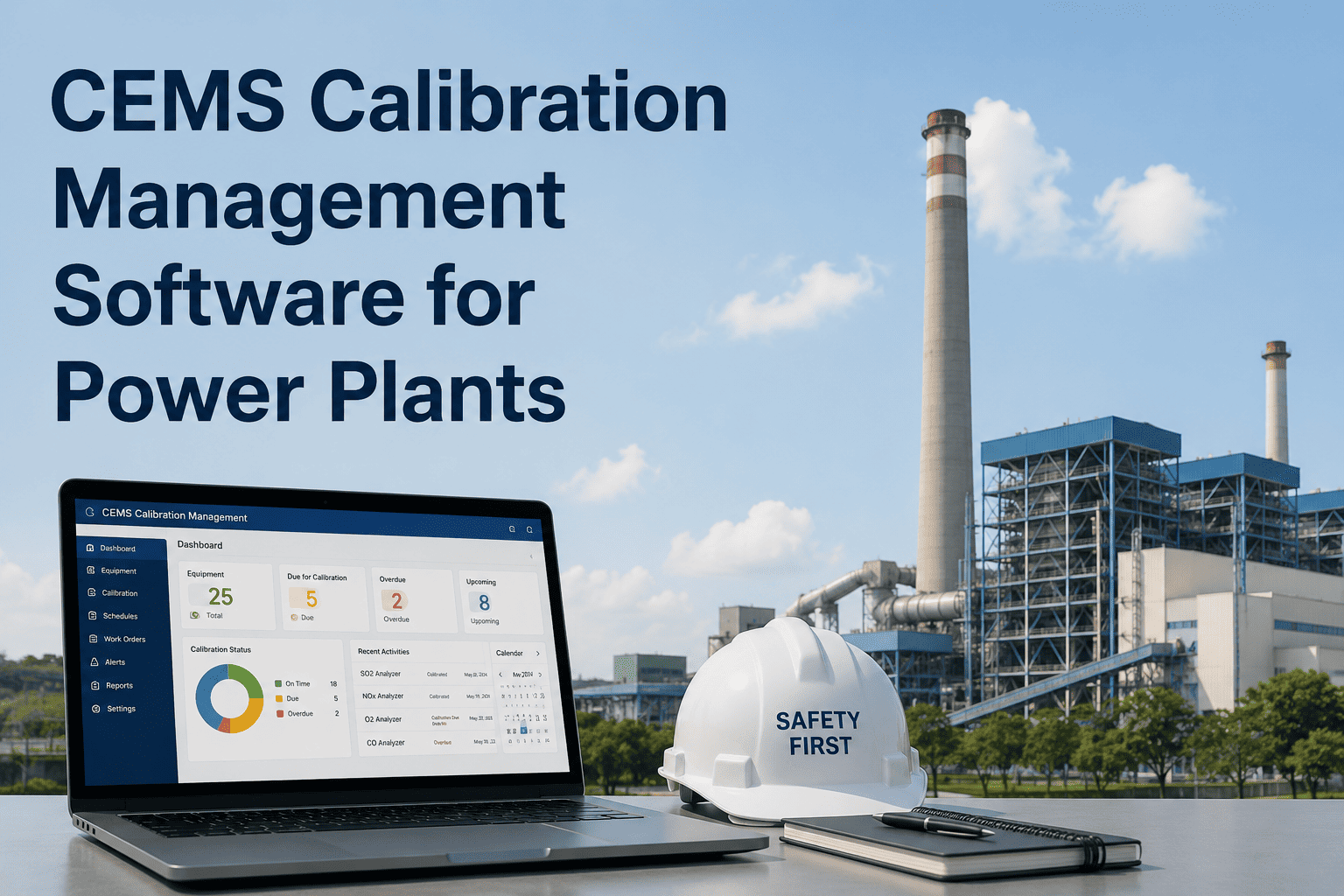
Continuous Emissions Monitoring Systems exist to prove a plant is operating within its permitted limits, but the monitors themselves are only as trustworthy as their calibration record. A missed daily zero/span check, a quarterly cylinder gas audit completed three days late, or an annual RATA scheduled around the wrong production window can quietly turn a compliant plant into one with a reportable deviation — discovered only when a regulator asks for the calibration log. Environmental teams that track CEMS calibration on spreadsheets often find out about a missed window after the fact, when the only options left are disclosure and explanation. Sign Up Free to start managing CEMS calibration schedules as part of your plant's regular maintenance system.
Environmental Compliance · Calibration Management · 2026
CEMS Calibration Management Software for Power Plant Compliance
Daily zero/span checks, quarterly audits, and annual RATAs — scheduled, tracked, and documented in one place so no calibration window gets missed.
365Daily zero/span checks required per CEMS analyzer every year
4Quarterly cylinder gas audits that must each fall within a defined window
−68%Reduction in missed calibration windows after moving to scheduled tracking
1Missed RATA window is enough to trigger a reportable deviation
The CEMS Calibration Cycle — Four Recurring Requirements
CEMS calibration isn't a single task — it's four overlapping cycles running on different clocks, each with its own deadline structure and documentation requirements. Missing any one of them creates a compliance gap, regardless of how well the other three are managed. Sign Up Free to put all four cycles on a single schedule linked to your analyzer records.
Daily
Zero & Span Drift Check
Automated or manual check confirming each analyzer reads within tolerance at zero and span gas concentrations. Drift beyond tolerance triggers a corrective action requirement.
Quarterly
Cylinder Gas Audit (CGA)
Independent gas standards are introduced to verify analyzer accuracy. Must fall within a defined calendar window each quarter — early or late audits can be flagged as non-compliant.
Annual
Relative Accuracy Test Audit (RATA)
Reference method testing against the CEMS during normal operating conditions. Requires production scheduling coordination and produces the core annual compliance record.
Periodic
Linearity & Interference Checks
Verifies analyzer response across its measurement range and checks for interference from other gas components — typically required quarterly or semi-annually depending on parameter.
Spreadsheet Tracking vs. Scheduled Calibration Management
Most environmental teams know the calibration requirements by heart — the gap is usually in tracking four overlapping schedules across multiple analyzers without a window being missed during a busy outage season. Book a Demo to see how OxMaint keeps all four cycles visible per analyzer.
Never Discover a Missed Calibration Window During an Audit Again.
OxMaint schedules daily, quarterly, and annual CEMS calibration requirements per analyzer and keeps the documentation in one place.
How OxMaint Manages CEMS Calibration Compliance
OxMaint treats each CEMS analyzer as an asset with its own calibration schedule — daily checks, quarterly audits, and annual tests are all linked to that record, so the next due date and the full history are always visible together.
Per-Analyzer Schedule
All four calibration cycles tracked against each analyzer
Daily, quarterly, and annual requirements appear together on each analyzer's record, with next-due dates visible at a glance.
Window Alerts
Advance notice before a calibration window opens or closes
Quarterly CGA and annual RATA windows generate advance alerts so scheduling conflicts with outages can be resolved early.
Drift Logging
Daily zero/span results recorded with timestamps
Drift values outside tolerance can trigger a corrective action work order automatically, keeping the response documented alongside the reading.
Audit-Ready Records
Calibration history available per analyzer on demand
When a regulator requests calibration history, the complete record is available without reconstructing it from multiple sources.
We found out our Q3 cylinder gas audit was three days outside the window during an internal review, after it had already happened. It wasn't a big deal that time, but it could have been. We moved all four CEMS calibration cycles into OxMaint so the schedule sits next to our regular maintenance work orders — the environmental team and maintenance team are finally looking at the same calendar.
Environmental Compliance Lead — 600 MW Coal Plant, Indonesia
Frequently Asked Questions
What CEMS calibration requirements can OxMaint track?
Daily zero/span checks, quarterly cylinder gas audits, annual RATAs, and periodic linearity checks can all be scheduled per analyzer.
Sign Up Free to set up your first analyzer schedule.
How does OxMaint help avoid missed CGA windows?
Quarterly window dates are calculated per analyzer, with advance alerts before the window opens so the audit can be scheduled around plant operations rather than missed entirely.
Can daily drift check results trigger a corrective action automatically?
Yes — when a logged zero/span result falls outside tolerance, a corrective action work order can be generated and linked to that reading for documentation.
How is RATA scheduling coordinated with plant operations?
RATA due dates are visible months in advance, giving environmental and operations teams time to align the test with planned outages or production schedules.
What happens when a regulator requests calibration records?
Each analyzer's calibration history is stored in one record, so it can be retrieved without assembling files from multiple sources.
Book a Demo to see the record format.
Put All Four CEMS Calibration Cycles on One Schedule.
OxMaint tracks daily, quarterly, and annual CEMS calibration requirements per analyzer — with alerts before windows close and a complete record when regulators ask.